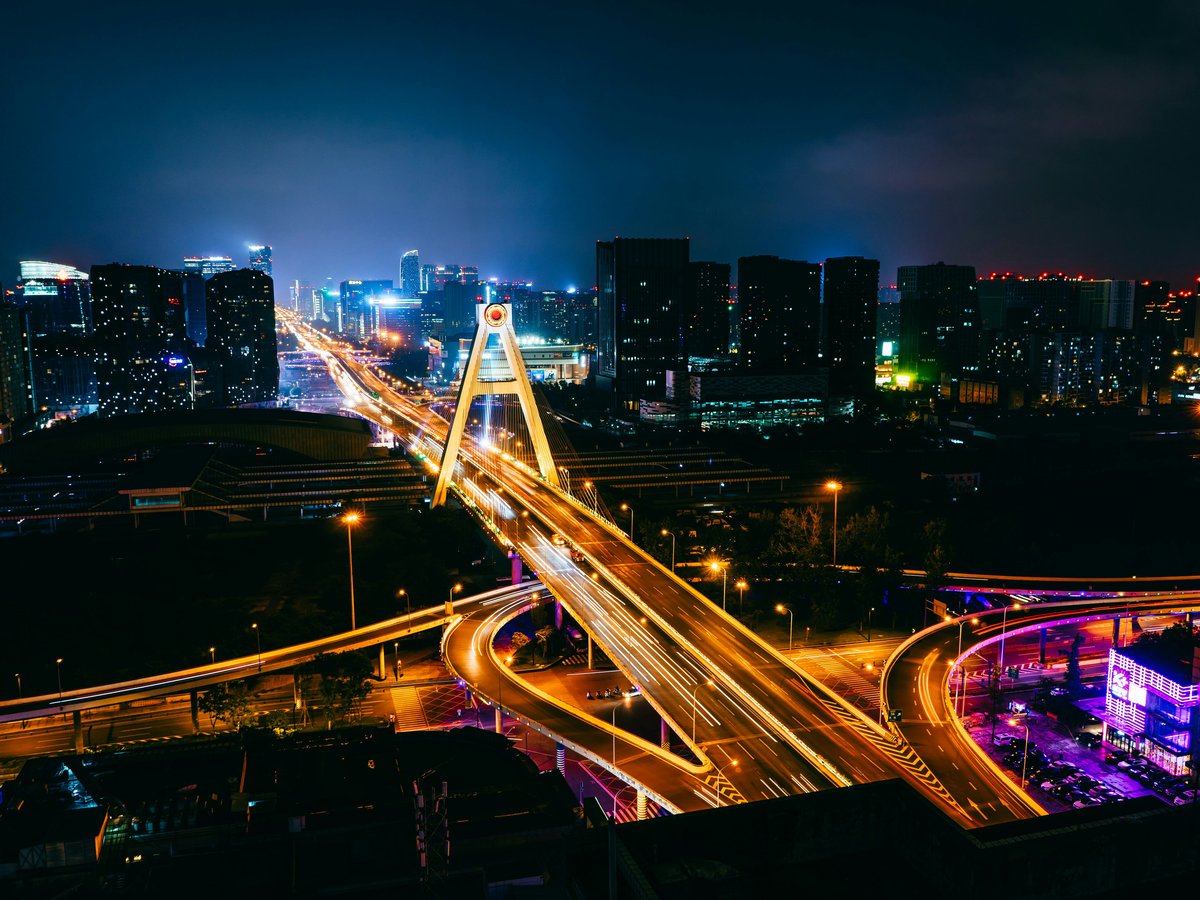
Chengdu radiates outward from Tianfu Square in concentric ring roads, numbered First through Third, with the Jin River and Fu River cutting through the city's western half. The 1968 Mao Zedong Statue still marks the geographic center at Tianfu Square, and most visitor-relevant neighborhoods sit inside the Second Ring. The metro network reaches nearly every district within 30 to 40 minutes. Mid-September temperatures settle around 23°C with 78% humidity, and the overcast skies Chengdu is known for filter the light into a soft gray wash over everything. The pace here runs slower than Shanghai or Beijing. Locals along the Jin River set out bamboo chairs on sidewalks by mid-morning, card games spill onto the pavement outside corner shops, and the Sichuan habit of sitting in a teahouse for half a day carries the weight of civic tradition. Most first-time visitors stay inside the First Ring or along the Second Ring's southern arc, where food, temples, and walkable streets are most concentrated. The western corridor between Qingyang Palace and the Jinsha archaeological site is quieter and more residential, while the commercial axis around Chunxi Road moves at a noticeably faster pace.
Neighborhoods
-
Chunxi Road & Taikoo Li
Chengdu's commercial center sits east of Tianfu Square, anchored by the pedestrian-only Chunxi Road and the open-air Sino-Ocean Taikoo Li complex. Taikoo Li's low-rise, courtyard-style buildings feel unusual for a luxury shopping district. Even the Apple Store here wraps around a traditional gray-brick structure. The IFS tower on the north side has a giant panda sculpture climbing its facade at the 60-meter mark, and it has become the single most photographed spot in the city. Foot traffic on Chunxi Road stays heavy until midnight on weekends. The noise is persistent, and the smell of grilled skewers from street vendors fills the air after dark.
- Best for
- First-time visitors who want a central, metro-connected base with late-night food options within walking distance
- Key streets
- Chunxi Road (pedestrian), Dongda Jie, Hongxing Road (runs parallel, less crowded), Shamao Jie for smaller boutiques
-
Kuanzhai Xiangzi (Wide and Narrow Alleys)
Three parallel east-west lanes of restored Qing-dynasty courtyard houses make up this pedestrian district northwest of Tianfu Square. Kuan Xiangzi (Wide Alley) is the broadest and most commercial, with teahouses and souvenir shops behind gray-brick walls. Zhai Xiangzi (Narrow Alley) is tighter, with more food stalls packed into the lane. Jing Xiangzi (Well Alley) tends to be the least visited of the three. Some of the brickwork is genuine Qing-era structure, though the distinction from reconstruction is hard to spot without close inspection. On weekend afternoons the foot traffic in Kuan Xiangzi gets uncomfortably dense, shoulder to shoulder for 400 meters.
- Best for
- Heritage-minded travelers, photographers looking for courtyard composition, and visitors with only 2 to 3 days in Chengdu
- Key streets
- Kuan Xiangzi, Zhai Xiangzi, Jing Xiangzi, and Tongren Road on the eastern edge for local Sichuan restaurants at neighborhood prices
-
Wuhou & Jinli
The Temple of Marquis Wu, a shrine compound honoring Zhuge Liang and Liu Bei from the Three Kingdoms period, anchors this southern neighborhood. Jinli pedestrian street runs along the temple's eastern wall, a 550-meter strip of Qing-style shopfronts. The area smells of chili oil and sweet potato starch noodles by late afternoon. Jinli gets loud after 6pm, with red lanterns switching on above the lane and amplified folk music from the teahouses. Beyond the pedestrian strip, Wuhouci Dajie is a calmer, tree-lined avenue with mid-range hotels and local hotpot restaurants.
- Best for
- History-focused visitors, families with older children, and anyone who wants a hotel within walking distance of two or three major sites
- Key streets
- Wuhouci Dajie (main avenue), Jinli pedestrian street, and the smaller lanes south of the temple toward Gaosheng Bridge for cheaper street food
-
Qingyang & Huanhuaxi
Chengdu's western cultural corridor stretches from Qingyang Palace, one of China's oldest Taoist temples, south to the Du Fu Thatched Cottage park and museum. The Huanhua River runs through here, and the paths along it stay shaded under dense camphor trees. Du Fu Thatched Cottage is a rebuilt memorial to the Tang-dynasty poet who lived on this spot from 759 to 765 CE, and the grounds cover about 20 hectares of bamboo groves and thatched-roof pavilions. The residential streets between these two sites are lined with 6-story apartment blocks from the 1990s. The morning wet market on Qinghua Road has bins of fresh Sichuan peppercorns whose numbing fragrance carries across the street.
- Best for
- Culture-focused travelers, older visitors who prefer a quieter base, and anyone who wants proximity to green space along the Huanhua River
- Key streets
- Qinghua Road, Caotang Road (leads to Du Fu's cottage), the riverside path from Baihuatan Park to Huanhuaxi Park, and Yongling Road where the Tomb of Wang Jian sits underground
-
Yulin
A low-rise residential neighborhood south of the First Ring, built primarily in the 1980s and 1990s, Yulin is where Chengdu locals go to eat. The apartment blocks run 5 to 7 stories, no elevators, with ground-floor restaurant fronts that open directly onto the sidewalk. Neon signs in red and yellow stack vertically above the storefronts on Yulin Xi Lu, and the smoke from charcoal-grilled chuanchuan (skewers) pools at street level around dinner time. Yulin has no tourist infrastructure, no English menus, no hostel signs, no souvenir shops. The streets feel residential and unhurried until about 5pm, when the evening food crowd fills the pavement.
- Best for
- Food-focused travelers who can handle a Chinese-only environment, and visitors who want to see how the city eats without performing for tourists
- Key streets
- Yulin Xi Lu (West Road), Yulin Zhong Lu (Middle Road), and the small lanes branching south toward Yulin Dong Lu for late-night barbecue spots
-
Tongzilin & South Kehua
Several diplomatic missions, including the US Consulate, anchor this neighborhood south of the First Ring. Western-style coffee shops, yoga studios, and imported-goods grocery stores sit between Sichuan University's West Campus and the consulate row. The tree-lined streets are quieter than most of central Chengdu, and you'll hear more English spoken here than anywhere else in the city. Chengdu scores 5.2 out of 10 for digital-nomad suitability (sourced from TTDI's editorial rubric), and Tongzilin is where most of that infrastructure sits. Kehua Zhong Lu to the east has a denser mix of bookshops, craft beer bars, and student-priced Sichuan restaurants that feed off the university crowd.
- Best for
- Long-stay visitors, digital nomads, and travelers who want English-language amenities without leaving the city center
- Key streets
- Tongzilin Lu, Kehua Zhong Lu, and the smaller lanes between Sichuan University's West Gate and the river for student cafes
-
Jiuyanqiao
Chengdu's nightlife district lines both banks of the Jinjiang River near Nine Eyes Bridge. The bridge itself is modern, but the name dates to a Qing-era crossing. After dark, the riverside bars light up in neon and project colors onto the water surface. The noise rises sharply after 10pm, a mix of bass from the clubs and the persistent sound of bar staff calling out drink specials from doorways. Daytime Jiuyanqiao is unremarkable, mostly office towers and apartment blocks. The 2-kilometer riverside walk between Hejiang Pavilion and Jiuyanqiao Bridge is pleasant in the late afternoon when the light softens.
- Best for
- Nightlife seekers, younger travelers, and anyone who wants riverside bars within walking distance of a metro station
- Key streets
- Jiuyanqiao riverside strip, Lantai Road for cocktail bars, and the Hejiang Pavilion riverside path heading west toward Anshun Bridge
-
Wenshu Monastery Area
North of the city center, Wenshu Monastery draws Buddhist pilgrims and curious visitors into a neighborhood that still feels like older Chengdu. The monastery grounds smell of sandalwood incense, and the vegetarian restaurant inside serves 15 CNY lunch sets that fill the courtyard tables by noon. The surrounding streets, particularly Wenshu Yuan Jie, are narrow and lined with tea shops, calligraphy supply stores, and small Buddhist artifact dealers. A few blocks east, the Immaculate Conception Cathedral has stood since 1897. Its Gothic Revival facade looks conspicuously European among the low-rise Chinese shopfronts on the same street.
- Best for
- Budget travelers near Chengdu Railway Station, temple visitors, and anyone who wants an older, slower neighborhood within 2 metro stops of Chunxi Road
- Key streets
- Wenshu Yuan Jie (monastery street), Renmin Zhong Lu heading south toward Tianfu Square, and the alley market behind the monastery for cheap street breakfasts
FAQ
Is Chengdu safe for solo travelers?
Chengdu scores 7.2 out of 10 for solo-traveler safety (see the TTDI Solo-Safety Index). Petty theft is the main concern, concentrated around crowded tourist areas like Jinli and Chunxi Road. The metro runs until about 11pm on most lines, and ride-hailing apps like Didi work reliably for late-night trips. Neighborhoods like Yulin and Tongzilin feel safe at all hours, with foot traffic from residents and diners well past midnight.
Which neighborhood is best for families visiting Chengdu?
Chengdu scores 7.2 out of 10 for family friendliness (see the TTDI Family-Friendliness Index). Families with younger children tend to do well in the Qingyang and Huanhuaxi area, where the parks offer open green space and the riverside paths are flat and stroller-friendly. The Chengdu Research Base of Giant Panda Breeding, founded in 1987 in the northern suburbs, is the single most popular family destination. Plan to arrive before 8:30am, as the pandas are most active in the early morning and crowds grow much larger by 10am.
Where should I stay if I care most about eating well?
Yulin is the food neighborhood. The density of family-run Sichuan restaurants between Yulin Xi Lu and Yulin Zhong Lu is higher than anywhere else in the city, and the price-to-quality ratio favors the places with the least decoration. That said, Tongzilin and South Kehua offer a wider range of cuisines if the Sichuan heat gets overwhelming after a few days. For the specific dishes Chengdu is known for, look for Dan Dan Mian (noodles in chili-sesame sauce) and Zhong Shui Jiao (sweet-spicy wontons) at specialist shops rather than general restaurants.
How LGBTQ-friendly is Chengdu compared to other Chinese cities?
Chengdu scores 3.5 out of 10 for LGBTQ+ friendliness (sourced from TTDI's editorial rubric). The city has a reputation as one of the more accepting places in mainland China, with a small but visible scene concentrated around the Tongzilin and south Second Ring areas. Same-sex couples are unlikely to face confrontation, but public displays of affection tend to draw stares outside expat-oriented venues. Legal protections for LGBTQ+ individuals in China remain limited at the national level.
How do I get to the Panda Base from central Chengdu?
The panda breeding base sits about 13 kilometers north of the city center. Metro Line 3 reaches Panda Avenue station, and a shuttle bus covers the remaining 2 kilometers to the gate. A Didi ride from the Chunxi Road area takes around 30 to 45 minutes depending on traffic and costs approximately 40 to 55 CNY. The base opens at 7:30am year-round. Mornings before 9am are much less crowded, and the animals tend to be feeding rather than sleeping in the heat.
What about the newer landmarks outside the historic center?
The West Pearl Tower, completed in 2006, is Chengdu's 339-meter television and observation tower visible from most of the city's southern neighborhoods. The Chengdu Sports Centre near Renmin South Road hosts concerts and sporting events in the central area. Further east, the Longquanyi Football Stadium opened in 2004, about 20 kilometers from the center in a largely residential suburban district. These spots draw locals more than tourists, but the West Pearl Tower's observation deck offers clear sightlines across the basin on the rare days when the haze lifts.
Last verified by automated review (v1.7.2) on . What is automated review?