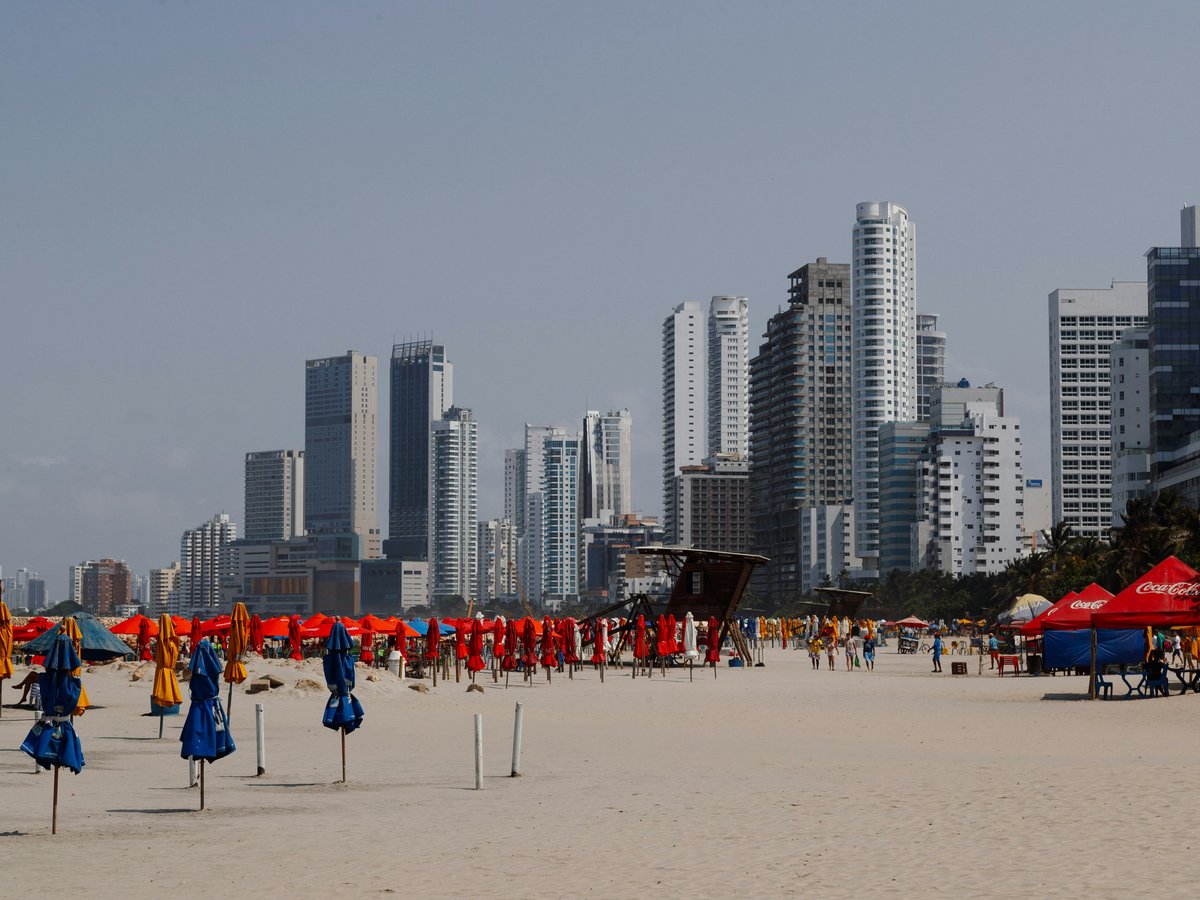
Stay in Cartagena in April
80 hotels in the Trip.com pool for Cartagena, from US$11 a night.
Opens Trip.com on Fri 2 Apr to Sun 4 Apr 2027; change the dates there.
April in Cartagena marks the turn. The dry season that held since December is ending, and the first serious rains of the year arrive. Rainfall reaches about 79mm across 17 days, roughly four times March's 22mm. Most of it falls in short, heavy afternoon bursts that clear within 30 to 45 minutes. Mornings tend to stay bright and dry. Temperatures hold steady at 32°C (89°F) during the day and 25°C (77°F) at night, with 78% humidity that makes the heat sit heavier than the thermometer suggests.
When Semana Santa falls in April, and it does roughly half the time depending on the liturgical calendar, Cartagena transforms. Solemn Catholic processions wind through the colonial streets of Centro Histórico, with candlelit floats carried by cofradías moving along Calle de la Iglesia and around the Plaza de San Pedro Claver. Hotel prices spike for that week, sometimes 50% above the April average, and the Walled City fills with Colombian families on holiday. Outside of Holy Week, April is notably calmer than the December-to-March peak. You'll find shorter lines at the Castillo San Felipe de Barajas and open tables at restaurants in San Diego that were fully booked in January.
To be fair, April isn't Cartagena at its absolute best. The sky loses some of that razor-sharp dry-season blue, and the humidity can feel relentless by early afternoon. But the trade-off is real. Fewer cruise ship crowds in the old town, lower hotel rates, and a Caribbean Sea still warm and calm enough for day trips to the Islas del Rosario. For travelers who tolerate afternoon showers and pack accordingly, April is a solid month before the heavy rains of May through November set in.
Why visit in April
- Shoulder season pricing. Hotel rates in Bocagrande and the Walled City typically drop 20-30% from the December-February peak, with further discounts at boutique hotels in Getsemaní that rely on international travelers.
- Thinner crowds at major sites. The Castillo San Felipe de Barajas, Palacio de la Inquisición, and Convento de la Popa are noticeably less packed than in January or February, when charter flights and Caribbean cruise ships peak.
- Caribbean Sea conditions remain calm. Water visibility around the Islas del Rosario still sits at 8-12 meters, and wave heights stay low enough for comfortable boat crossings from the Muelle de la Bodeguita.
- Afternoon showers bring evening relief. After a 30-minute downpour, temperatures often drop 3-4°C, and the streets of the old city smell like wet stone and frangipani. The post-rain golden-hour light over the rooftops is worth the brief wait.
Worth knowing
- Humidity sits at 78% and combines with 32°C heat to produce a feels-like temperature closer to 37-38°C (99-100°F) by midday. Walking the walls of the Ciudad Amurallada between noon and 3pm is genuinely uncomfortable.
- Rainfall is four times March's total. While showers are typically brief, they can derail an afternoon beach plan at Playa Blanca or an open-air dinner on Plaza de Santo Domingo if the timing is unlucky.
- If Semana Santa falls in April, expect a temporary price surge of 40-60% on accommodation and fully booked restaurants in Centro Histórico for that entire week. Rooftop bars in Getsemaní may require reservations 3-4 weeks out.
Best for
Think twice if
April delivers consistent Caribbean heat with the first serious rains of the year. Expect 31.8°C (89°F) highs and 25°C (77°F) lows, with 78% humidity that makes midday feel closer to 37°C (99°F). Rainfall reaches 79mm spread across about 17 days, mostly in short afternoon downpours that clear within half an hour. Mornings are typically sunny and hot, with clouds building after noon. Sea temperature sits around 28-29°C (82-84°F), still comfortable for swimming. Wind drops compared to the breezy January-March period, which unfortunately means less natural relief from the heat.
Seasonal caution
- UV index reaches 11-12 on clear mornings. Cartagena sits at 10.4°N latitude, nearly on the equator, and April's thinner cloud cover in the morning hours means intense direct sun exposure. Sunburn can happen in under 20 minutes without protection.
- Heat index regularly exceeds 37°C (99°F) between noon and 3pm when the 78% humidity combines with 32°C air temperature. Heat exhaustion is a real risk during midday walking tours of the Walled City. Carry water and plan indoor stops at museums or cafés.
Year-round climate
Averages from the last 5 years.
| Month | Avg high (°C) | Avg low (°C) | Rainfall (mm) |
|---|---|---|---|
| Jan | 32 | 24 | 17 |
| Feb | 32 | 24 | 14 |
| Mar | 33 | 25 | 22 |
| Apr | 32 | 25 | 79 |
| May | 31 | 25 | 159 |
| Jun | 30 | 25 | 202 |
| Jul | 31 | 25 | 142 |
| Aug | 30 | 25 | 171 |
| Sep | 30 | 25 | 150 |
| Oct | 29 | 25 | 207 |
| Nov | 29 | 25 | 191 |
| Dec | 31 | 25 | 35 |
Headline events
Semana Santa (Holy Week)
Late March to mid-April, depending on the liturgical calendar. Core days are Palm Sunday through Easter Sunday.
When Easter falls in April, Cartagena's Holy Week processions rank among the most atmospheric in Latin America. Candlelit floats carried by cofradías wind through Centro Histórico's narrow streets. The route passes the Catedral de Santa Catalina de Alejandría, the Plaza de San Pedro Claver, and the Iglesia de Santo Domingo. The Good Friday procession draws tens of thousands. The Walled City becomes pedestrian-priority for most of the week. Note that dates shift each year, and in some years the entire week falls in March.
Best things to do in April
Day trip to Islas del Rosario
outdoorThe archipelago of 27 coral islands sits about 45 minutes by speedboat from the Muelle de la Bodeguita. Snorkeling, beach time, and a seafood lunch at one of the island restaurants make up the typical itinerary. The Oceanario on Isla de San Martín de Pajarales has a small aquarium worth a stop.
Sea conditions in April are still calm enough for comfortable crossings, but the dry-season crowds have thinned. In December-February, boats leave packed to capacity. By April, expect 20-30% fewer passengers, and beach space on Isla Grande feels noticeably less cramped.Booking tipBook with a reputable operator from the Muelle de la Bodeguita at least a day ahead. Avoid the aggressive dock touts who quote low prices and add fuel surcharges later.
Early morning walk along the Murallas
sightseeingThe 11km of colonial fortification walls surrounding Centro Histórico offer elevated views over the Caribbean, Bocagrande's skyline, and the terracotta rooftops of the old city. The Baluarte de Santo Domingo and Baluarte de San Francisco Javier sections are the most photogenic stretches.
April mornings before 9am are the sweet spot. The temperature sits near 26-27°C before the midday heat builds, and the lower tourist numbers mean you can photograph the wall cannons and watchtowers without crowds. By May, morning cloud cover increases and the light becomes less reliable.Booking tipNo booking needed. The walls are free and open. Start at the Torre del Reloj by 6:30am to catch the sunrise light.
Explore Mercado de Bazurto
culturalCartagena's largest public market is raw, chaotic, and authentic. Hundreds of stalls sell fish hauled in that morning, tropical fruits by the crate, medicinal herbs, and household goods. The food stalls inside serve some of the cheapest and most honest local cooking in the city, including cazuela de mariscos for about 12,000-15,000 COP.
April's peak fruit season fills the market with mango varieties, corozo berries, níspero, zapote, and maracuyá at their ripest. The fish section receives steady catches from calmer April seas. The market is also less hectic than during the December holiday rush when Colombian families stock up.Booking tipGo before 10am when the produce is freshest and the heat is tolerable. Leave valuables at your hotel. A local guide familiar with the layout is worth the cost for a first visit.
Sunset drinks at Café del Mar
nightlifeThis bar sits on top of the Baluarte de Santo Domingo section of the city walls, overlooking the Caribbean. The sunset view across the water toward Tierra Bomba island is one of the most photographed in Cartagena. Cocktails run 35,000-50,000 COP, and a DJ typically plays from late afternoon.
April's increasing cloud activity improves the sunsets. Dry-season sunsets in January-March can be clear but flat. April's scattered clouds catch the light and produce more dramatic color. The bar is also less likely to hit full capacity than during peak months.Booking tipArrive by 5pm to secure a wall-side seat. No reservations for walk-ins, but the line moves faster in April than in December or January.
Walking tour of Getsemaní street art
culturalGetsemaní, immediately south of the Walled City across the Plaza de la Trinidad, has become one of Latin America's most concentrated street art districts. Murals cover nearly every block, with works by Colombian and international artists addressing Afro-Colombian heritage, displacement, and Caribbean identity. Callejón Angosto and Calle de la Sierpe have the densest concentration.
April's lower tourist density makes Getsemaní's narrow streets easier to navigate and photograph. Several murals are repainted or replaced seasonally, and April often sees fresh work go up after the high-season foot traffic fades. The post-rain light in late afternoon is particularly good for the saturated colors.Booking tipFree to walk independently. Guided street art tours run about 60,000-80,000 COP per person and cover the history behind individual murals.
Visit Castillo San Felipe de Barajas
sightseeingThe largest Spanish colonial fortress in the Americas sits on the Cerro de San Lázaro, built between 1536 and 1657. The tunnel system, cannon placements, and strategic sightlines cover a complex that takes 1.5-2 hours to explore properly. Admission is around 33,000 COP for foreign visitors.
April's reduced tour-group presence means you can explore the interior tunnels and ramparts without large guided groups clogging the narrow passages. The fortress is largely exposed to the sun, so the slightly increased cloud cover in April provides intermittent shade that the December-March dry season does not.Booking tipGo at opening time, 8am, or after 3:30pm. Midday visits in April's heat are punishing on the exposed stone ramps. Bring at least 1 liter of water per person.
Boat trip to Playa Blanca on Isla Barú
beachPlaya Blanca is a 700-meter stretch of white sand on Isla Barú, about 45 minutes southwest of Cartagena by boat or 1.5 hours by road through the village of Santa Ana. The water is shallow and clear for roughly 30 meters out. Beach chairs and a seafood lunch run about 40,000-60,000 COP combined.
The beach is noticeably less packed in April than in December-February. Water clarity remains good before the heavier May-June rains start stirring sediment. The calmer April seas also mean fewer cancelled boat departures compared to later wet-season months.Booking tipThe overland route avoids seasickness risk and is cheaper. Day tours typically depart from the Torre del Reloj area by 8am. Stay past 2pm when the day-trippers leave for a quieter experience.
Evening at Plaza de la Trinidad
nightlifeThis plaza is the social heart of Getsemaní and comes alive after 7pm. Local families, backpackers, street performers, and food vendors share the space. Beer and empanadas from the surrounding stalls cost 3,000-5,000 COP each. Champeta music often plays from portable speakers near the plaza steps.
April evenings after a rain shower are some of the most comfortable nights in Cartagena's year. Temperatures drop to 26-27°C, and the post-rain air feels noticeably cleaner. The plaza draws a more local crowd in April than during the tourist-heavy January-March period.Booking tipNo booking needed. Street food vendors set up from around 6pm. Bring small bills, as change can be difficult to get.
Canoe tour through La Boquilla mangroves
outdoorLocal fishermen in the village of La Boquilla, north of Bocagrande, paddle visitors through the mangrove channels of the Ciénaga de la Virgen in traditional wooden canoes. The tour takes about 1-1.5 hours and costs 30,000-40,000 COP per person. Herons, iguanas, and fiddler crabs are common sightings.
April's early rains start raising water levels in the ciénaga, which opens up narrower mangrove channels that are too shallow in the dry months. Bird activity tends to increase as migratory species pass through. Lower tourist volume means quieter, less disturbed wildlife.Booking tipArrange directly with the fishermen's cooperative at La Boquilla rather than through a hotel, which typically marks up 50-100%. Go in the early morning for the best bird sightings.
What to eat in April
In season: fruit
Mango
April marks peak mango season on Colombia's Caribbean coast. Street vendors along Avenida Venezuela and outside Mercado de Bazurto sell mango de azúcar, mango tommy, and mango hilaza by the bag for 5,000-8,000 COP. Mango biche (green mango) with salt and lime appears on nearly every corner in Getsemaní.
On menus now
Ceviche de camarón cartagenero
Cartagena's shrimp ceviche differs from the Peruvian style. It typically uses a pink ketchup-based sauce with lime, red onion, and the local suero costeño. April's calmer seas mean fresher daily catches at La Boquilla fishing village, and ceviche carts multiply around Plaza de la Trinidad in the evenings.
Street food peaks
Raspao
Shaved ice drenched in fruit syrup and condensed milk. By April the heat makes these cart-sold treats practically essential. Vendors concentrate around the Torre del Reloj and along the Camellón de los Mártires. Tamarind and corozo (a tart Caribbean palm berry) are the traditional flavors to try.
Arepa de huevo
Deep-fried corn dough stuffed with a whole egg, sometimes with ground beef. A Caribbean coast breakfast staple year-round, but April's Semana Santa and school holidays bring more vendors to the old city streets. The stalls near Portal de los Dulces tend to start frying by 6:30am.
Cocada
Coconut candy in brown and white varieties, sold from wooden trays by palenqueras. April's fruit abundance means more coconut-and-fruit-blend varieties appear, including a tamarind cocada that is sharper and less sweet than the standard. A small bag costs about 2,000-3,000 COP.
What to drink
Jugo de corozo
A tart, deep-red juice pressed from the corozo palm berry that grows along Colombia's Caribbean coast. The corozo harvest peaks between March and May, so April is prime season. It is served cold from large plastic jugs at Mercado de Bazurto for about 2,000 COP, a fraction of what tourist restaurants charge.
Regular events in April
FICCI (Festival Internacional de Cine de Cartagena de Indias)
Latin America's oldest film festival, founded in 1960. Screenings take place at venues across the Walled City, including open-air projections. The festival has shifted dates over the years and sometimes extends into early April when it starts in late March. Worth checking the current year's schedule.
Late March to early April (dates vary annually)Día del IdiomaFree
Colombia celebrates Language Day on April 23, honoring Miguel de Cervantes. Libraries and cultural centers in Cartagena, including the Biblioteca Bartolomé Calvo in the Walled City, host readings, poetry events, and literary talks throughout the day.
April 23Día de los Niños y la RecreaciónFree
Colombia's Children's Day falls on the last Saturday of April. Parks and plazas across Cartagena host free activities for kids, including Parque del Centenario and the waterfront along Bocagrande. Street performers and candy vendors come out in force, and the city takes on a festive, family-oriented energy.
Last Saturday of AprilBest places this April
Mercado de Bazurto
marketCartagena's largest and most authentic market, well outside the tourist corridor. April's fruit season fills the stalls with mango, corozo, zapote, and maracuyá at peak ripeness. The prepared food section serves cazuela de mariscos and fried fish lunches for 12,000-15,000 COP. Go before 10am when the produce is freshest.
BazurtoPlaza de la Trinidad
plazaThe social center of Getsemaní and the best free evening entertainment in Cartagena. After April's afternoon showers, the plaza fills with street performers, local families, and food vendors. The Iglesia de la Santísima Trinidad anchors one end of the square.
GetsemaníConvento de la Popa
viewpointCartagena's highest point at 150 meters above sea level. The 17th-century Augustinian convent offers 360-degree views over the city, the bay, and the open Caribbean. April's dramatic cloud formations, building before the afternoon rains, make the panorama more photogenic than the flat blue skies of January. Visit before 10am.
La PopaIglesia de San Pedro Claver
churchA 17th-century Jesuit church and monastery named for the Spanish priest who ministered to enslaved Africans arriving at Cartagena's port. The courtyard and cloister provide a cool retreat from April's midday heat. If Semana Santa falls in April, the church hosts some of the most solemn processions in the city.
Centro HistóricoLa Boquilla
villageA fishing village on a narrow sand spit north of Cartagena's hotel zone. Local fishermen offer canoe tours through the mangrove channels of the Ciénaga de la Virgen for about 30,000-40,000 COP per person. April's calmer waters and lower tour-group presence make the mangrove experience quieter and more wildlife-rich than the peak months.
La BoquillaPalacio de la Inquisición
museumA colonial-era palace housing a museum that documents the Spanish Inquisition's activities in Cartagena from 1610 to 1821. The shaded interior courtyard and thick stone walls provide genuine relief from April's heat. Admission is around 26,000 COP for foreign visitors.
Centro HistóricoParque del Centenario
parkA tree-shaded park on the edge of the Walled City that locals use, unlike the more tourist-oriented plazas inside the walls. Iguanas, sloths, and parakeets inhabit the large trees. In late April, the Día de los Niños celebrations fill the park with family activities and street vendors.
Centro
Your packing checklist
Tick items off as you pack. Your progress saves in this browser.
All packed — have a great trip.
Insider tips
The palenqueras (fruit vendors in traditional dress) near the Torre del Reloj and in Plaza de Santo Domingo will charge 10,000-20,000 COP for a photo. This is their livelihood, not a scam. Agree on the price before shooting. The palenqueras in Getsemaní tend to ask less than those inside the Walled City.
Mercado de Bazurto prices are 40-60% lower than the identical fruit sold at tourist-facing stalls in Centro Histórico. A bag of 6-8 mangos costs about 5,000 COP at Bazurto versus 15,000 COP from a cart near the Catedral. Worth the 15-minute taxi ride.
Afternoons between 2pm and 4pm are dead time in April. The rain often hits, the heat peaks, and locals retreat indoors. Schedule your siesta here and use the 4:30-7pm window for the old city. The light is better, the temperature drops 3-4°C, and the streets refill with energy.
If you're visiting during Semana Santa, the procession routes through Centro Histórico are published by the Arquidiócesis de Cartagena about 2 weeks before Easter. The best viewing spots fill up 1-2 hours early. The corner near the Plaza de San Pedro Claver tends to be less packed than the Catedral frontage.
Avoid the money changers near the Torre del Reloj. Their rates run 5-8% worse than the ATMs inside Centro Comercial Caribe Plaza on Carrera 3. Most restaurants and shops in the tourist zone accept cards, but Mercado de Bazurto and street food vendors are cash-only.
Avoid these mistakes
- Scheduling outdoor walking tours between noon and 3pm. The 32°C air temperature with 78% humidity produces a heat index near 38-39°C (100-102°F) in direct sun. Heat exhaustion is a genuine medical risk, not a comfort issue. Book morning or late-afternoon tours instead.
- Booking a beach day at Playa Blanca without checking the forecast. April showers can turn a beach trip into a wet, uncomfortable experience with no indoor shelter on the island. Check the morning forecast and pick a day when rain is predicted for late afternoon rather than midday.
- Assuming Semana Santa dates without checking the specific year. Easter moves by up to 35 days year to year. Arriving in Cartagena expecting Holy Week processions only to find they happened in March is a real possibility. Verify the current year's calendar before booking.
- Packing only for heat and forgetting the rain. April's 79mm of rainfall catches unprepared travelers in white linen with no rain layer. The downpours are warm but heavy enough to soak you through in 2 minutes flat.
Practical tips for April
Book accommodation at least 3-4 weeks ahead if your trip overlaps with Semana Santa. Outside Holy Week, 1-2 weeks is generally sufficient for the Walled City and Getsemaní. April sometimes includes Colombian public holiday long weekends (puentes) that cause domestic tourism spikes, so check the holiday calendar for your specific year. Taxis in Cartagena do not use meters. Agree on the fare before getting in. A ride from the airport (Rafael Núñez, CTG) to the Walled City costs about 15,000-20,000 COP, and drivers may quote double to tourists. The InDriver and Uber apps work in Cartagena and offer more transparent pricing, though some drivers cancel if the pickup is in a congested part of Centro Histórico. Dress codes are relaxed everywhere except a few upscale restaurants in the Walled City and Bocagrande where covered shoulders are expected for dinner. Most museums close on Mondays. The Castillo San Felipe de Barajas and the Palacio de la Inquisición are open daily, but the Museo Naval del Caribe on Calle San Juan de Dios closes Mondays. Currency is the Colombian peso (COP). ATMs are widely available in Bocagrande and the Walled City. Notify your bank before traveling, as some ATMs limit single withdrawals to 300,000-600,000 COP.
FAQ
Is April a good time to visit Cartagena?
April is a good, though not ideal, time. It sits in the shoulder season between the dry months (December through March) and the heavy rains (May through November). You'll get lower prices and fewer crowds than peak season, but 79mm of rainfall across 17 days means afternoon showers are likely on more days than not. The heat and humidity are high at 32°C and 78%. If Semana Santa falls in April, the Holy Week processions through Centro Histórico are a genuine highlight, though accommodation prices spike for that week. For the best mix of dry weather and reasonable prices, January or March tends to edge out April.
What is the weather like in Cartagena in April?
Hot and increasingly humid. Daily highs average 31.8°C (89°F) with lows near 25°C (77°F) and 78% humidity that makes midday feel closer to 37-38°C (99-100°F). Rainfall averages 79mm across about 17 days, a significant jump from March's 22mm. Most rain falls in short, heavy afternoon bursts lasting 20-45 minutes, and mornings are typically sunny. The Caribbean Sea temperature is a warm 28-29°C (82-84°F). Pack light, breathable clothing, sun protection, and a compact rain layer.
Is Cartagena crowded in April?
Medium crowds overall. April is noticeably quieter than the December-February peak, when charter flights and Caribbean cruise ships fill the Walled City daily. You'll find shorter lines at the Castillo San Felipe de Barajas and easier restaurant reservations in San Diego and Getsemaní. The exception is Semana Santa week, when it falls in April. Colombian families flood the city for the holiday, and Centro Histórico can feel as packed as New Year's. Outside that specific week, April is one of the calmer months.
Does it rain a lot in Cartagena in April?
More than the dry season, but far less than the wet-season peak. April averages 79mm across 17 days, compared to 14-22mm in February-March and 150-207mm in the September-November wet peak. The rain typically arrives as short, intense afternoon showers rather than all-day drizzle. Most mornings stay dry and sunny, and it rarely rains for more than an hour straight. Plan outdoor activities for the morning and you'll likely avoid the worst of it.
What should I wear in Cartagena in April?
Light, breathable natural fabrics in light colors. Linen and cotton perform better than synthetics in 78% humidity. Shorts, light dresses, and sandals are standard daytime wear across the city. Bring a compact umbrella or rain jacket for the afternoon showers. For upscale restaurants in the Walled City, light trousers and covered shoulders are appropriate. A wide-brimmed hat and SPF 50+ sunscreen are critical at Cartagena's near-equatorial latitude, where the UV index reaches 11-12 in April. Comfortable shoes that handle wet cobblestones are worth packing for the old city.
Things to Do in Cartagena in April
 Free cancellation
 Cartagena 5 Island Hop Tour: Lunch, Snorkel, Beach Clubs, & More
Day trip: 7 hours, free cancellation.
via Viator Free cancellation
 Tour De Palenque, Road to Emancipation.
Day trip: free cancellation.
via Viator Free cancellation
 Private Walking Tour in Cartagena Walled City & Getsemaní
Day trip: free cancellation.
via Viator Free cancellation
 Cartagena's Rosario Islands 5-Site Boat Tour with Lunch & Snorkel
Day trip: 7 hours, free cancellation.
via Viator Free cancellation
 Cartagena ATV Tour
Outdoor experience: 2.5 hours, free cancellation.
via Viator Free cancellation
 Full Day Tour of 5 Must-See Places in the Rosario Islands
Outdoor experience: 7.5 hours, free cancellation.
via ViatorFind a flight to Cartagena
Live fares to Cartagena appear here once cookies are accepted.
Last verified by automated review (v1.7.2) on . What is automated review?