Cartagena sits on Colombia's Caribbean coast, and its layout still follows the logic of a 16th-century colonial port. The old walled city, Ciudad Amurallada, occupies a peninsula jutting into the Bahía de Cartagena. South of the walls, Getsemaní was historically the artisan quarter. Farther south, the Bocagrande strip runs along a narrow spit toward the sea, lined with high-rise hotels built from the 1970s onward. To the east, Manga island connects by bridge and feels like a different city entirely. North of the walls, Crespo stretches toward Rafael Núñez International Airport. And past Crespo, the fishing village of La Boquilla sits where the Ciénaga de la Virgen meets the Caribbean. Most visitors stick to a roughly 4-kilometer corridor between Getsemaní and Bocagrande, but the neighborhoods beyond that strip tend to reward the curious. The walled city itself divides informally into two halves. Centro, the southern portion, holds the major plazas and churches. San Diego, the northern section inside the walls, runs quieter and more residential. You can walk from one end of the walled city to the other in about 20 minutes, though the heat might convince you otherwise.
Neighborhoods
-
Centro Histórico (Ciudad Amurallada)
Stone-paved streets barely wide enough for a single car. Wooden balconies sag under the weight of bougainvillea, and the plaster on colonial facades peels in thick Caribbean humidity. Plaza de Santo Domingo fills with tables by 6 PM. The architecture dates mostly to the 17th and 18th centuries, with fortress walls completed around 1796 after nearly 200 years of construction. It smells like fried empanadas and diesel from the occasional taxi that squeezes through. Noise levels shift block by block. Plaza de los Coches gets loud with street vendors by mid-morning, while a side street off Calle de la Mantilla might have nothing but the hum of air conditioning units.
- Best for
- First-time visitors, history-focused travelers, couples looking for walkable restaurants and colonial architecture within the UNESCO World Heritage zone designated in 1984.
- Key streets
- Calle de las Damas runs along the northern wall and stays cooler in the afternoon shade. Calle del Arzobispado connects Plaza de Bolívar to the cathedral. Plaza de la Aduana, the largest square in the old city, still has the old customs house on its western edge. Calle Santos de Piedra is where many of the boutique hotels cluster, particularly between Calles 35 and 36.
-
San Diego
Still inside the walls, but the energy shifts noticeably once you cross north of Calle de la Universidad. San Diego was the quarter where the colonial middle class lived, and the houses are slightly smaller than Centro's mansions. The streets narrow further. You'll hear more birdsong than traffic here, which sounds unlikely until you walk it. Plaza de San Diego has a single large ceiba tree and a handful of restaurant tables. The Hotel Santa Clara, a converted 17th-century convent, anchors the western edge. Cats seem to own the alleys. The pace is slower than Centro by a noticeable margin, and by 10 PM most of the foot traffic has moved south toward Getsemaní.
- Best for
- Travelers who want the walled-city location without the Plaza de Santo Domingo crowds. Particularly good for longer stays of 4 or more nights, since the quieter streets wear better over time.
- Key streets
- Calle del Curato leads to the Convento de la Popa viewpoint road. Calle de las Bóvedas runs along the top of the wall near Las Bóvedas, the 23 arched chambers built in the late 1700s that now sell crafts. Plaza Fernández de Madrid sits shaded and usually empty on weekday mornings.
-
Getsemaní
Getsemaní sat neglected for decades while the walled city got the restoration money. That changed around 2010, when artists and hostel operators moved in. The neighborhood still feels like it is mid-transition. On Calle de la Sierpe, a freshly painted mural might sit next to a house with boarded windows. Plaza de la Trinidad fills every evening with locals drinking beer on the church steps, kids kicking soccer balls, and vendors selling arepas de huevo for 3,000 to 5,000 COP. The smell of frying corn dough carries two blocks. Music leaks from bars along Callejón Angosto most nights past 9 PM. The architecture is lower-slung than Centro, mostly 2-story houses with less ornate facades but more color. It's louder and scrappier. Some find the graffiti overly curated at this point. To be fair, the murals on Calle de la Sierpe and Callejón Angosto were coordinated by local collectives, not random taggers.
- Best for
- Budget travelers, solo backpackers, and anyone who wants nightlife within walking distance. Hostels here run 40,000 to 80,000 COP per night for a dorm bed. Mid-range boutique hotels have appeared on nearly every block since 2018.
- Key streets
- Plaza de la Trinidad is the social center. Calle de la Media Luna has the densest concentration of bars and small restaurants. Calle del Porvenir connects Getsemaní to the walled city through the Puerta del Reloj clock tower. Callejón Angosto holds most of the mural art.
-
Bocagrande
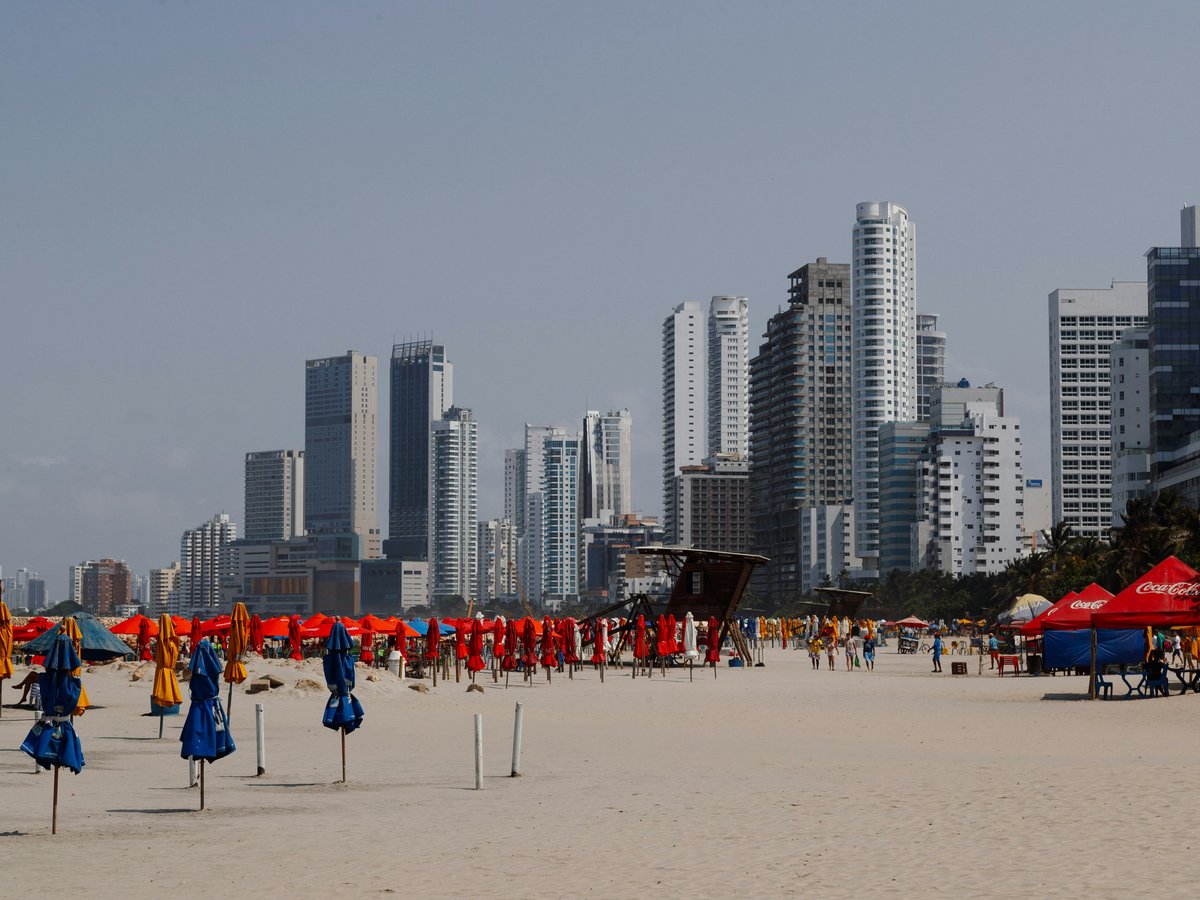
A Miami Beach comparison gets thrown around, and it's not entirely wrong. Bocagrande occupies a narrow peninsula south of the old city, lined with high-rise condos and chain hotels built mostly between 1975 and 2000. Avenida San Martín, the main commercial street, has pharmacies, casinos, leather goods shops, and fast food. The beach runs along the western side for roughly 3 kilometers, though the sand is grayish-brown and vendors approach every 90 seconds with massages, sunglasses, and fruit. The water is warm, around 28°C year-round, but murky compared to the Islas del Rosario 45 minutes offshore. At night, Bocagrande gets quiet except around the casino hotels. The neighborhood lacks the colonial architecture of the walled city. What it has instead is reliable air conditioning, elevators, and Rappi delivery to your door.
- Best for
- Families with young children who want a beach and pool. Colombian domestic tourists, who make up a large share of Bocagrande's hotel occupancy. Anyone who prioritizes modern amenities over architectural character.
- Key streets
- Avenida San Martín for commerce and restaurants. Carrera 2 runs parallel to the beach and has slightly quieter hotels. The Hilton Cartagena sits at the southern tip near El Laguito, where the peninsula narrows to a single block wide.
-
Manga
Manga is an island connected to the mainland by the Puente Román bridge, and most tourists never cross it. That's part of its appeal. The neighborhood was Cartagena's wealthy residential district in the early 1900s, and the Republican-era mansions along Avenida del Pedregal still show that money. Wrought-iron gates, tiled porches, mango trees dropping fruit onto the sidewalk. The pace is suburban. Dogs sleep in doorways. There is almost no nightlife. A few upscale restaurants have opened along the waterfront in recent years, including the well-known El Boliche del Mono on Calle Real. The Club de Pesca, Cartagena's old yacht club on the island's western tip, remains one of the city's better seafood restaurants, sitting on a wooden deck over the water with views across the bay to the walled city.
- Best for
- Repeat visitors who already know the walled city. Travelers who prefer quiet evenings and a short taxi ride over walking-distance nightlife. The neighborhood has fewer than 10 hotels, so options are limited.
- Key streets
- Avenida del Pedregal has the best-preserved Republican mansions. Calle Real holds most of Manga's restaurants. The waterfront path along the bay's edge gives unobstructed sunset views back toward the old city, and you'll likely share it with joggers and fishermen, not tourists.
-
Crespo
Crespo stretches along the coast between the walled city and Rafael Núñez Airport, which means planes pass low overhead every 15 to 20 minutes during the day. The neighborhood is mostly residential, with mid-rise apartment buildings from the 1980s and 1990s. It lacks the historical pull of Centro or the beach access of Bocagrande, but it has become a practical base for travelers who want lower hotel prices and easy airport access. A taxi from Crespo to the walled city runs about 10,000 to 15,000 COP, or roughly a 10-minute ride. The seafood along the Crespo waterfront tends to be cheaper than inside the walls. The salt air is stronger here, and the coast is rocky rather than sandy.
- Best for
- Business travelers, anyone with an early morning flight, or budget-conscious visitors willing to taxi into the old city. Hotels here run 30 to 50 percent less than equivalent options inside the walls.
- Key streets
- Calle 70 connects to the main road toward the airport. The waterfront Avenida Santander, which runs from Bocagrande through Crespo, has a few cevicherías and fried-fish stands clustered near Calle 64.
-
La Boquilla
La Boquilla is a fishing village about 15 minutes north of the walled city by taxi, sitting on a sand spit between the Caribbean and the Ciénaga de la Virgen lagoon. It has changed significantly since 2015, when new condo towers started going up on the beachfront road, but the village core remains a grid of concrete houses where fishing nets still dry on front porches. The beach here is wider and less crowded than Bocagrande, with rougher surf. On weekends, Colombian families drive up from the city and the palapa restaurants fill by noon. The smell of fried fish and wood smoke hangs over the waterfront. Mangrove tours through the ciénaga leave from the lagoon side in wooden canoes, typically running 40,000 to 60,000 COP per person for about 90 minutes. Bird life in the mangroves includes herons, cormorants, and occasionally roseate spoonbills.
- Best for
- Travelers who want a beach day outside the tourist corridor. Birdwatchers heading into the Ciénaga de la Virgen. Anyone who prefers fresh-caught seafood eaten at a plastic table on the sand over a white-tablecloth dinner.
- Key streets
- The main beachfront road has the palapa restaurants lined up one after another. The village core sits inland from the beach by 2 blocks. The canoe launch for mangrove tours is on the lagoon side, accessible from the road that runs behind the village.
-
Castillogrande and El Laguito
These two neighborhoods occupy the southern tip of the Bocagrande peninsula, where the land narrows to a sliver between the bay and the open Caribbean. El Laguito is essentially one curving street, Carrera 1, lined with high-rise condos from the 1990s. Castillogrande has slightly older construction, more trees, and a small, less-visited beach. The area feels more residential than Bocagrande proper. Colombian retirees and seasonal residents make up much of the population. Foot traffic is light. The Naval Base sits at the very tip, so the peninsula dead-ends at a military checkpoint. At sunset, the bay side of El Laguito catches the light across the water, and the fortress walls of the old city glow orange about 4 kilometers to the north.
- Best for
- Extended-stay visitors renting apartments by the month. Travelers who want Bocagrande's amenities with fewer crowds and a more residential feel. Monthly apartment rentals here start around 3,500,000 COP for a furnished 2-bedroom.
- Key streets
- Carrera 1 loops around El Laguito's tip. The small Castillogrande beach sits off Calle 5. Avenida del Malecón on the bay side has a walking path with views of Manga and the old city.
FAQ
Which Cartagena neighborhood is best for a first-time visitor staying 3 to 5 nights?
Centro Histórico or San Diego, both inside the walled city. You can walk to restaurants, plazas, and the main historical sites without needing taxis. Centro puts you closer to the activity around Plaza de Santo Domingo and Plaza de los Coches. San Diego is quieter, especially at night. Getsemaní is the budget alternative, about a 5-minute walk from the walled city through the Puerta del Reloj. If you want a beach and a pool and don't mind taxiing 10 minutes to the old city, Bocagrande works, but you'll likely spend most of your daytime hours inside the walls anyway.
Is Bocagrande worth staying in, or should I stay inside the walled city?
It depends on what bothers you more. Bocagrande has reliable air conditioning, modern hotel infrastructure, and a beach, but the neighborhood itself has little architectural interest, and you'll spend 10,000 to 15,000 COP on taxis every time you want to visit the old city. The walled city has the atmosphere but the colonial buildings can mean smaller rooms, inconsistent plumbing, and more street noise. Families with small children and anyone who wants a pool tend to be happier in Bocagrande. Solo travelers and couples usually prefer being inside the walls.
How walkable is Cartagena between neighborhoods?
The walled city, San Diego, and Getsemaní are all walkable from each other in 10 to 20 minutes. Bocagrande is technically walkable from Getsemaní, about 25 to 35 minutes along Avenida Santander, but the heat makes it unpleasant past mid-morning. Manga requires crossing the Puente Román bridge, roughly a 15-minute walk from Getsemaní. La Boquilla and Crespo require a taxi or bus. Cartagena's midday heat, which regularly hits 32 to 34°C with high humidity, is the main limit on walking. Most locals avoid extended outdoor walks between 11 AM and 3 PM.
Where should I eat in Cartagena for the best local food, not tourist-priced restaurants?
Getsemaní has the best concentration of affordable food. The arepas de huevo sold around Plaza de la Trinidad cost 3,000 to 5,000 COP and are a Cartagena staple. Bazurto Market, the city's main public market south of Getsemaní, has the cheapest meals in the city, with full plates of rice, fish, and plantain for under 12,000 COP. Mind you, Bazurto is loud, hot, crowded, and not sanitized for tourism. The comida corriente restaurants in Bocagrande's back streets, especially along Carreras 4 and 5, serve solid lunch sets for 15,000 to 20,000 COP. For seafood, the palapa restaurants in La Boquilla give better value than anything inside the walls.
Is Getsemaní safe for tourists at night?
Getsemaní has improved significantly since the early 2010s. Plaza de la Trinidad and Calle de la Media Luna stay busy and well-lit until midnight or later most nights. The streets closer to Avenida del Pedregal and the edges of the neighborhood get darker and quieter. Standard city precautions apply. Keep your phone in a front pocket, don't flash expensive jewelry, and stick to streets with other pedestrians after 11 PM. Petty theft happens, as it does in any tourist area. Violent crime against tourists in Getsemaní is uncommon. The neighborhood currently has a visible police presence on weekends around the main plazas.
When is the best time of year to visit Cartagena?
December through March is the dry season, with lower humidity and almost no rain. Hotel prices during this period run 30 to 50 percent higher than the wet season, and the walled city fills noticeably during Colombian holiday weeks in late December and Semana Santa. January averages about 1 rainy day. The wet season peaks in October and November, with afternoon downpours most days, but mornings tend to stay clear. September through November offers the lowest hotel prices. The Fiestas de la Independencia on November 11 fills the city regardless of weather. Water temperature stays around 27 to 29°C year-round, so swimming is comfortable in any month.
Last verified by automated review (v1.7.2) on . What is automated review?