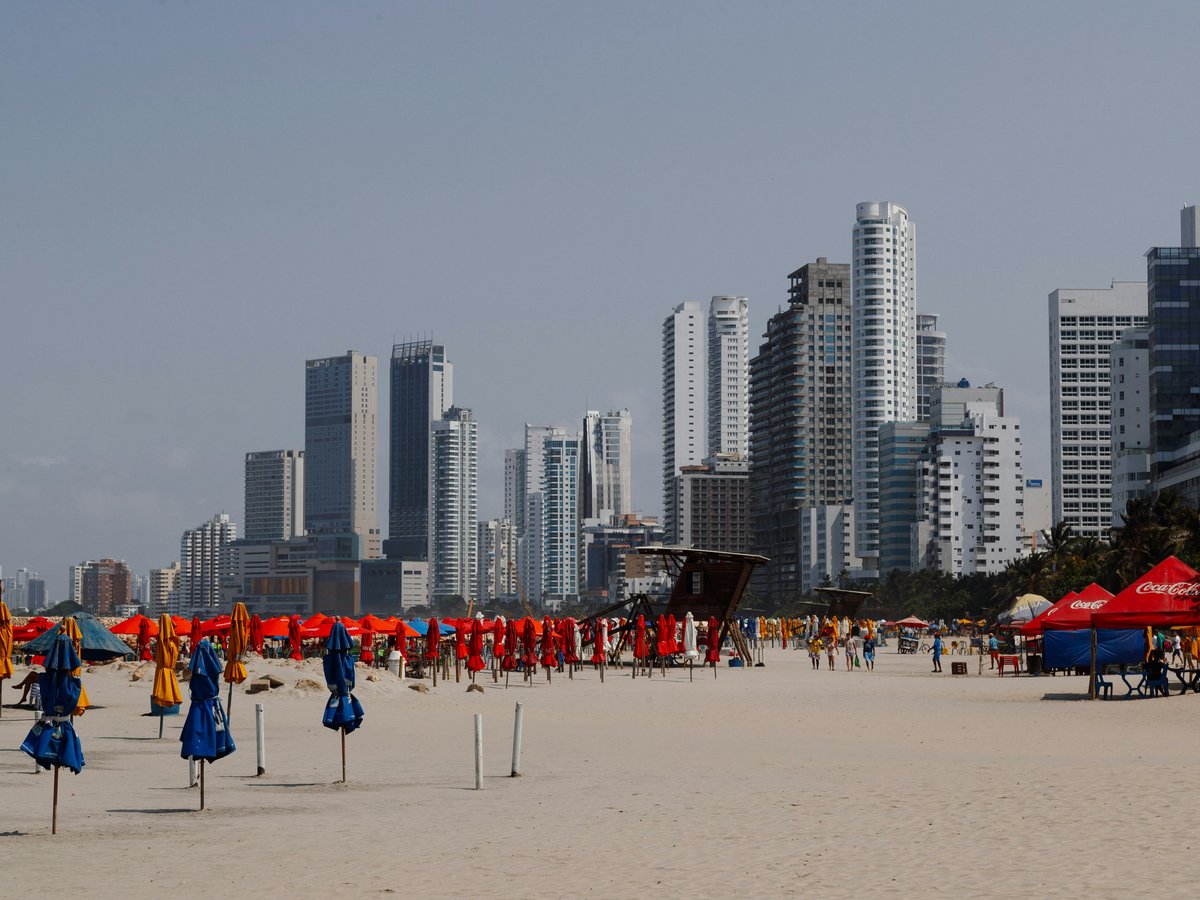
Cartagena's centro histórico sits behind 11 kilometers of stone walls that took nearly two centuries to complete, with final sections finished in the late 1700s. Walking every stretch costs nothing. The Museo del Oro Zenú on Plaza de Bolívar, operated by Banco de la República, has never charged admission. Public beaches line the Bocagrande peninsula for about 3 kilometers. Getsemaní, the barrio south of the walled center, has become a rotating open-air gallery of street murals that shifts every few months as new artists arrive from across Latin America. Hotels and restaurants in the tourist core do run high by Colombian standards. A sit-down dinner in the Plaza de Santo Domingo area can easily reach 80,000 to 120,000 COP per person. But the walls, plazas, Caribbean shoreline, and nightly street life at Plaza de la Trinidad remain accessible at zero cost. That gap between accommodation prices inside the old city and the cost of experiencing Cartagena is wider here than in Bogotá or Medellín.
Free attractions
-
Murallas de Cartagena
The colonial walls stretch roughly 11 kilometers around the old city, with the main walkable sections connecting Baluarte de Santo Domingo to Baluarte de San Francisco Javier. Most of the current structure dates to rebuilds after the 1741 British siege led by Admiral Vernon. The stretch between the Café del Mar section and the Torre del Reloj offers Caribbean views at sunset, with the Bocagrande skyline on one side and the terracotta rooftops of San Diego barrio on the other. No ticket, no hours, no gates. The Murallas are accessible 24 hours.
Centro HistóricoLandmark -
Museo del Oro Zenú
This Banco de la República museum on Plaza de Bolívar holds pre-Columbian gold and ceramic pieces from the Zenú people who inhabited the Sinú river basin. The collection currently includes over 600 gold objects. The Zenú were particularly known for their filigree technique, and several display cases show the progression from raw material to finished nose ring or ear ornament. Two air-conditioned rooms, roughly 40 minutes to see everything. Always free, open Tuesday through Saturday from 10:00 to 17:00 and Sundays until 15:00.
Centro HistóricoMuseum -
Centro de Formación de la Cooperación Española
The Spanish cultural center occupies a restored colonial building on Calle de la Factoria in the old city. It hosts rotating exhibitions, typically 4 to 6 per year, covering contemporary art, photography, and Caribbean cultural history. The ground-floor gallery and courtyard shows are all free. Worth noting that the programming tends to be more serious than tourist-oriented. The CFCE monthly schedule is posted at the entrance on Calle de la Factoria and on their website.
Centro HistóricoMuseum / Gallery -
Catedral de Santa Catalina de Alejandría
Construction on Cartagena's cathedral started in 1577. Francis Drake's forces partially destroyed it during the 1586 attack. The rebuild was completed by 1612. The stone exterior is relatively plain by colonial standards, but the interior has a wooden ceiling and a gilded altar that catches the light from narrow side windows. Free to enter during open hours, typically 8:00 to 12:00 and 15:00 to 19:00. The parish requests no photography during Mass services, which generally run at 7:00 and 18:00.
Centro HistóricoLandmark / Church -
Las Bóvedas
Twenty-three arched storage vaults built into the city walls in the late 1700s, originally used as military storage and later as prison cells. The barrel-vaulted corridor runs about 200 meters along the wall near Baluarte de Santa Catalina. These days the spaces house artisan shops, and browsing the stalls costs nothing. The thick stone walls keep the interior noticeably cooler than the 32°C streets outside, which on a midday walk through Cartagena feels like a minor mercy.
San DiegoLandmark -
Torre del Reloj (Puerta del Reloj)
The main gate into the walled city faces Plaza de los Coches. The original entrance was a single archway in the 16th-century fortifications. The clock tower was added in the early 1800s, and the current clock mechanism dates to a 1937 replacement. The gate's three arched passages are always open. Walk through and you emerge into Plaza de los Coches, where the Portal de los Dulces lines the arcade with candy vendors who have been selling cocadas and bolas de tamarindo from these same stalls for decades.
Centro HistóricoLandmark -
Parque Centenario
The largest green space near the old city, Parque Centenario sits between the walled center and the Matuna commercial district. It was inaugurated in 1911 to mark the centennial of Cartagena's independence from Spain. The park is known for its resident iguana population. Dozens of green iguanas sun themselves on the pathways and low walls, seemingly unbothered by foot traffic. Mature shade trees keep the interior several degrees cooler than the surrounding streets of Avenida Venezuela.
Centro / MatunaPark -
Parque Fernández Madrid
A quieter square in the San Diego neighborhood, named after the independence-era political figure José Fernández Madrid. The plaza has a small fountain and mature tamarind trees. Several of the surrounding colonial houses have been restored with painted wooden balconies in the traditional style. It tends to be less crowded than Plaza de Bolívar, especially in the mornings. The Iglesia de Santo Toribio de Mogrovejo sits on the south side.
San DiegoPark -
Plaza de Bolívar
The main square of the old city, originally called Plaza de la Inquisición. A bronze statue of Simón Bolívar stands at the center, erected in 1896. The Palacio de la Inquisición, the Museo del Oro Zenú, and the Catedral all face the square. Large trees provide shade over most of the benches. In the evenings, the plaza fills with street vendors, families, and performers. The palenqueras, women in traditional dress from San Basilio de Palenque about 50 kilometers south, sell fresh fruit here during the day.
Centro HistóricoPark / Plaza -
Iglesia de Santo Domingo
The oldest church in Cartagena, with origins in the 1550s, though much of the current structure dates to later rebuilds. The bell tower has a visible lean, reportedly from a construction error that was never corrected. Inside, the nave is relatively unadorned compared to the Catedral, which gives it a quieter atmosphere. Free entry during open hours. A Fernando Botero bronze sculpture, known locally as La Gorda, sits in the small plaza outside the church's main entrance.
Centro HistóricoLandmark / Church -
Plaza de la Trinidad
The social center of Getsemaní. This triangular plaza fronts the Iglesia de la Santísima Trinidad, which dates to the mid-1600s and is free to enter when open. By late afternoon the square starts filling with people. By 20:00 or so it becomes an informal gathering spot with street performers, cold-beer vendors, and live music on most nights. The surrounding blocks of Getsemaní hold the densest concentration of street art in Cartagena.
GetsemaníPark / Plaza -
Baluarte de Santo Domingo
One of the best-preserved bastions along the Murallas. This section of wall juts out over the Caribbean and gives an unobstructed view north toward Tierrabomba island. The flat stone platform at the top still has several colonial-era cannons in position, their iron barrels warm to the touch by mid-afternoon. In the early evening, this stretch fills with locals and visitors watching the sunset. No charge, no barrier, no closing time.
Centro HistóricoViewpoint
Free activities
-
Getsemaní street art walk
The blocks between Calle de la Sierpe, Calle del Pozo, and Callejón Angosto hold what is probably the densest concentration of large-format murals in Colombia outside Bogotá's La Candelaria. The artists range from local Cartageneros to international painters who have worked here over the past decade. Themes lean toward Afro-Colombian identity, Caribbean mythology, and political commentary. New pieces appear every few months. Start at Plaza de la Trinidad and work outward through the side streets. Early morning or late afternoon light works best for photographs, and you can cover the main route in about 90 minutes.
GetsemaníWalking route -
Sunset walk along the Murallas
The wall-top path from Baluarte de Santo Domingo south toward the Café del Mar stretch and around to La Tenaza runs roughly 2 kilometers. You'll pass 4 or 5 spots where vendors sell cold Club Colombia beer for around 5,000 COP, but the walk itself is free. The last 30 minutes before sunset, when the stone is still warm underfoot and the Caribbean turns orange-pink, tends to be when most people make the walk. The view from the Baluarte de Santa Catalina section looks directly at the Bocagrande high-rises across the bay.
Centro HistóricoWalking route -
Playa de Bocagrande
The main urban beach runs about 3 kilometers along the Bocagrande peninsula. The sand is gray-brown, not white, and the water is warm at around 28°C but tends to be murky compared to the Islas del Rosario. Beach-chair rental typically runs 20,000 to 30,000 COP, but setting up your own towel costs nothing. Bocagrande vendors are persistent. They walk the sand selling arepa de huevo, ceviche in plastic cups, and sliced mango with lime from roughly 8:00 until the light fades.
BocagrandeBeach -
Mercado de Bazurto
Cartagena's main public market is loud, humid, and about as far from the polished old city as you can get while still being in Cartagena. It sprawls across several blocks in the southeast part of the city. The fish section fills the air with salt and brine. Produce stalls stack towers of zapote, maracuyá, and guanábana, and the prepared-food stands sell corrientazo lunches for 8,000 to 12,000 COP. Mind you, browsing is free, and this is where Cartageneros shop. Best before noon when the selection peaks and the heat hasn't fully settled in.
BazurtoMarket -
Self-guided Centro Histórico church circuit
Four major churches sit within a 1-square-kilometer area, and you can visit all of them on foot in under 2 hours. Start at the Catedral de Santa Catalina de Alejandría on Plaza de Bolívar, continue to Iglesia de Santo Domingo on Calle Santo Domingo, then to Iglesia de San Pedro Claver on Plaza de San Pedro Claver (the church itself is free, the attached museum charges about 30,000 COP), and finish at Iglesia de la Santísima Trinidad in Getsemaní. All 4 churches are free to enter. The buildings span construction dates from the 1550s to the 1650s.
Centro Histórico / GetsemaníWalking route -
Playa de Castillogrande
A quieter alternative to Bocagrande's main beach, Castillogrande sits at the far southern tip of the peninsula. The beach is smaller, roughly 400 meters of sand, and draws fewer vendors. The water is similar to Bocagrande in quality and temperature. The Club Naval de Oficiales occupies the point, but the public beach section is free and accessible from the street. It tends to be less crowded on weekday mornings, when you might have a 50-meter stretch largely to yourself.
CastillograndeBeach -
Browsing Portal de los Dulces
Under the arches of Plaza de los Coches, directly through the Torre del Reloj gate, a row of candy vendors has operated for decades. The stalls sell cocadas (coconut sweets), bolas de tamarindo, alegrías (sesame-and-honey bars), and other traditional Bolívar department sweets. The warm smell of coconut and melted panela hangs in the arcade. Most individual pieces cost 1,000 to 3,000 COP if you decide to buy, but walking through and watching the vendors shape the candy by hand is its own experience.
Centro HistóricoMarket / Cultural
Free events
-
Nightly live music at Plaza de la Trinidad
Nightly, strongest Thursday through SundayMost evenings, particularly Thursday through Sunday, Plaza de la Trinidad in Getsemaní hosts informal live music. Performers range from champeta DJs with portable speaker stacks to acoustic vallenato trios to hip-hop crews. The crowd spills from the plaza into surrounding streets. This isn't an organized festival. It happens organically and has been a feature of Getsemaní nightlife for over a decade. The sound typically picks up after 20:00 and the warm night air carries the bass a few blocks in every direction.
Plaza de la Trinidad, Getsemaní -
Fiestas de la Independencia de Cartagena
Around November 11 each year (multi-day)Cartagena celebrates its independence from Spain on November 11, but the festivities run for several days before and after. Street parades, beauty pageants, open-air concerts, and neighborhood block parties take over much of the city. The Desfile de Bando is the main parade and draws thousands along its route through Centro Histórico. Most public events are free. The streets stay full well past midnight for the duration. Cartagena declared independence on November 11, 1811, making it the first city in the former New Granada to do so.
Various locations, primarily Centro Histórico and Getsemaní -
Festival Internacional de Música de Cartagena
January (8 to 10 days, annual)This classical and contemporary music festival takes place each January, typically running 8 to 10 days. The headline concerts in venues like the Teatro Adolfo Mejía are ticketed, but the festival stages several free outdoor performances in plazas throughout the old city. Past editions have included free concerts at Plaza de la Aduana and Plaza de San Pedro Claver. Programming changes each year, so check the festival calendar when it publishes, usually by November.
Various plazas in Centro Histórico -
Hay Festival Cartagena
Late January to early February (annual)The Latin American edition of the Welsh literary festival takes place in late January or early February. Many events are ticketed, but the festival consistently offers a slate of free talks, readings, and panel discussions, typically held in the courtyards of colonial buildings or open-air stages. Recent editions have included free events at the Centro de Convenciones and Plaza de la Aduana. Programming tends to be announced 4 to 6 weeks before the festival opens.
Various venues in Centro Histórico -
Sunday Ciclovía along Avenida Santander
Sundays and public holidays, morning hoursOn Sundays and public holidays, Cartagena closes sections of road to motor traffic for cyclists, runners, and pedestrians. The main route follows Avenida Santander along the waterfront, connecting Bocagrande to the Crespo neighborhood, roughly 6 kilometers of coastal road. The program follows the national Colombian Ciclovía model that started in Bogotá in the 1970s. Morning hours, typically wrapping up by midday.
Avenida Santander (Bocagrande to Crespo)
The free beach situation in Cartagena
All beaches in Colombia are legally public, which means no hotel or business can block access to the sand or water. That said, the practical experience at Cartagena's urban beaches varies. Playa de Bocagrande and Playa del Laguito are the most accessible from the old city, about a 15-minute walk south from the Torre del Reloj. The sand is packed gray-brown, the water warm year-round at around 28°C, and the waves generally mild. If you don't want to rent a chair at 20,000 to 30,000 COP, bring a towel and claim a spot closer to the waterline. Playa Blanca on Isla Barú, about 45 minutes south, has whiter sand and clearer water. The colectivo bus from the Mercado de Bazurto area to Playa Blanca currently costs roughly 15,000 COP each way, though the beach itself is free once you arrive. The Islas del Rosario require a boat, and the cheapest group tours start around 60,000 COP. For a genuinely free beach day without leaving the city, Bocagrande or Castillogrande are the options.
What used to seem free (but is not)
The Castillo San Felipe de Barajas, Cartagena's most famous fortress, currently charges around 33,000 COP for foreign adults and 20,000 COP for Colombian residents. The Palacio de la Inquisición, now called the Museo Histórico de Cartagena de Indias, sits on Plaza de Bolívar and charges approximately 26,000 COP. The San Pedro Claver museum and cloister, attached to the free church of the same name, runs about 30,000 COP. The Convento de la Popa, on the hill overlooking the city, charges approximately 15,000 COP and also requires a taxi or mototaxi to reach. To be fair, the Castillo San Felipe is probably worth the money if you have it. The tunnel system alone takes 30 to 40 minutes to explore. But none of these qualify for a zero-budget day.
Free Cartagena by time of day
Mornings before 9:00 are the coolest part of the day, with temperatures around 26°C before the tropical heat builds. This is the best window for the Murallas walk and the Centro Histórico church circuit. The light on the colonial facades of Calle de la Iglesia and Calle del Colegio has a softer quality at this hour than the harsh midday glare. By noon, shade becomes essential. Parque Centenario's tree canopy and the interior of Las Bóvedas offer relief. The Museo del Oro Zenú is air-conditioned and comfortable at any hour. Afternoons are for the beach, or for the covered wall sections near Baluarte de San Francisco Javier. From about 17:00, the heat eases and Cartagena's street life picks up speed. Sunset from the Murallas typically falls between 17:45 and 18:15 depending on the month. After dark, Getsemaní's Plaza de la Trinidad fills up. The palenqueras leave, the beer vendors arrive, and the music starts. By 21:00 the plaza is at full volume, the warm night air heavy with the smell of fried empanadas from the corner stalls.
FAQ
Can you walk the full length of Cartagena's city walls?
Not quite the full 11 kilometers as a continuous path. Several sections are open and connected, particularly the stretch from Baluarte de Santo Domingo around to Las Bóvedas in San Diego. Other sections are interrupted by modern streets or buildings. The most popular walkable stretch runs about 2 kilometers along the Caribbean-facing side. There is no ticket or gate at any access point. You can reach the wall-top path from multiple stairways spaced throughout the old city.
Is Getsemaní safe to walk around at night?
The core blocks around Plaza de la Trinidad and the streets heading toward the Murallas are well-trafficked and generally considered safe through the evening hours. This area has changed substantially over the past 10 to 15 years as tourism and gentrification reshaped the neighborhood. Like anywhere in Cartagena, keep your phone and valuables close and be aware of your surroundings. The streets farther east toward Mercado de Bazurto are less traveled after dark and worth approaching with more caution.
Are Cartagena's urban beaches worth visiting on a free day?
They're fine for a free swim, but set expectations accordingly. Playa de Bocagrande has gray-brown sand and the water tends toward murky. It's a functional city beach, not a postcard scene. The vendor attention can wear on you if you're not used to it. That said, the water sits at about 28°C year-round, the waves are gentle enough for casual swimming, and it costs nothing to spread a towel on the sand. For clearer water and whiter sand, Playa Blanca on Isla Barú is about 45 minutes south by public colectivo for roughly 15,000 COP each way.
When is the best time of year to visit Cartagena for free events?
November gives you the Fiestas de la Independencia around November 11, the biggest free street celebration of the year with parades and open-air concerts. January brings both the Festival Internacional de Música and the Hay Festival, which between them offer several free concerts and talks across the old city's plazas. The rest of the year is quieter on the formal event calendar, but Getsemaní's nightly informal scene at Plaza de la Trinidad runs year-round regardless of season. Weather-wise, December through March is the dry season and the most comfortable for walking.
Is the Museo del Oro Zenú really always free?
Yes. All Banco de la República museums across Colombia are free, including the larger Museo del Oro in Bogotá. The Cartagena branch on Plaza de Bolívar has been free since it opened. There is no catch, no suggested donation box, no special-day requirement. It is currently open Tuesday through Saturday from 10:00 to 17:00 and Sundays until 15:00. Closed on Mondays. The collection takes about 40 minutes if you read the display descriptions.
Do free walking tours in Cartagena cost nothing?
Several companies in Cartagena offer walking tours advertised as free, but they operate on a tips-expected model. The guides depend on gratuities, and the going rate tends to be 30,000 to 50,000 COP per person. They can be worthwhile if you want a guided narrative through the old city, but they are not truly zero-cost. For a genuinely free experience, self-guided walking with an offline map app like Maps.me or OsmAnd works well. Most of the sites in Centro Histórico sit within a 1-square-kilometer area, so navigating on your own is straightforward.
Last verified by automated review (v1.7.2) on . What is automated review?