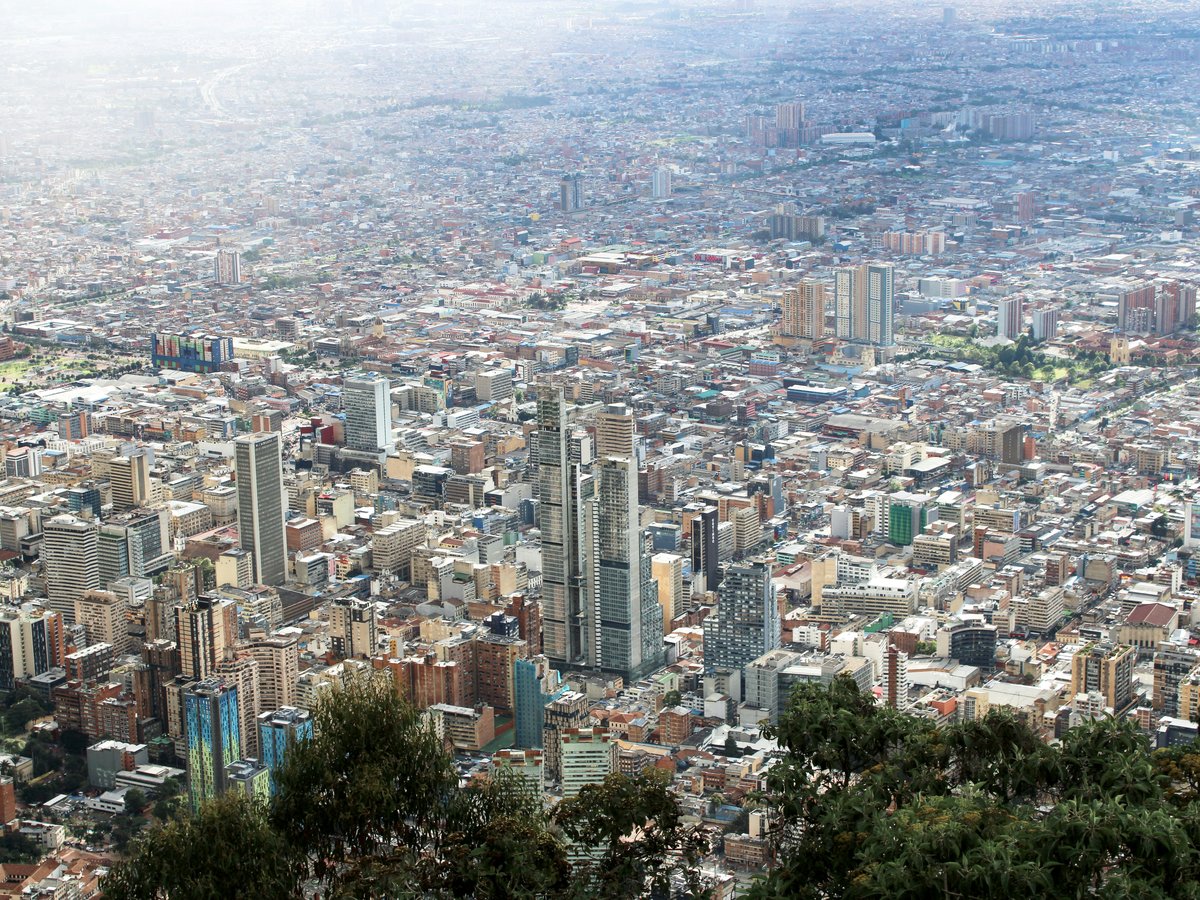
Bogota sits on a high Andean plateau at roughly 2,640 meters above sea level, backed by the Cerros Orientales on its eastern edge. The city reads north to south. La Candelaria, the old colonial core, anchors the southern end near the base of Monserrate. Carrera Séptima runs northward from there through Chapinero, past Zona Rosa, and into Usaquén, and each step north tends to track the estrato system, Bogota's 1-to-6 socioeconomic scale that shapes utility rates and restaurant prices alike. TransMilenio, the bus rapid transit network, connects most districts along major trunk corridors, though rush-hour traffic can stretch a 4-kilometer trip to 45 minutes. Year-round temperatures hover between 13 and 18°C at this altitude, and overcast September skies with humidity around 83% are entirely normal. Bogota's thin air catches most sea-level arrivals off guard by late afternoon. The city scores 7.8/10 for digital-nomad suitability (sourced from TTDI's editorial rubric), supported by reliable fiber internet in the northern neighborhoods and a cost of living where a filling almuerzo ejecutivo still costs about 18,000 COP. For reference, the Colombian peso currently sits at roughly 3,092 COP per dollar.
Neighborhoods
-
La Candelaria
Steep cobblestone streets run below Monserrate, lined with 16th-to-18th-century Spanish colonial buildings. Thick whitewashed walls, wooden balconies, and red clay tile roofs define the blocks between Calle 7 and Calle 13. The smell of corn dough from arepa vendors mixes with exhaust from passing buses on Carrera 7. Plaza de Bolívar sits at the center, with the Primary Cathedral of Bogota (completed 1807) on its east side and the Capitolio Nacional to the south. The Gold Museum opened in 1968 near Parque Santander and holds more than 55,000 pre-Columbian gold pieces across 3 floors. A few blocks east, Fernando Botero's donated collection of 208 works has been on display at the Botero Museum since 2000. The neighborhood gets loud during weekday afternoons when students from Universidad de los Andes and Universidad del Rosario flood the plazas. After about 8 PM, side streets south of Calle 9 thin out quickly.
- Best for
- Budget travelers, history-focused visitors, and students willing to trade polish for proximity to Bogota's densest cluster of museums
- Key streets
- Calle 10 between Carreras 5 and 6 passes Teatro Colón (operating since 1892) and several well-preserved colonial facades. Calle 11 connects west to Chorro de Quevedo, the plaza where Bogota was traditionally founded in 1538. Calle 7 runs past the gates of Casa de Nariño, the presidential residence completed in 1906, though public access is restricted.
-
La Macarena
A quiet residential pocket east of Carrera 5, between roughly Calles 26 and 30. Low-rise 3-to-4-story apartment buildings and converted houses from the 1960s line the hilly side streets. The restaurant strip along Carrera 4A between Calles 26 and 29 has become one of Bogota's most interesting dining corridors over the past decade. You'll find Colombian-Japanese fusion next door to a family-run tamale shop, with most mains falling between 25,000 and 45,000 COP. The Colombian National Museum, founded in 1823 and housed in a former panopticon prison on Carrera 7 at Calle 28, marks the neighborhood's western boundary. A few blocks south, the Bogota Museum of Modern Art (MAMBO), founded in 1955, sits on Carrera 6. The clatter of plates and conversation spills out of open-doored restaurants along the strip on weekend evenings. Most restaurants close by 10 PM on weeknights.
- Best for
- Food-focused travelers and couples who want walkable dining without Chapinero's noise level
- Key streets
- Carrera 4A between Calles 26 and 29 is the main restaurant corridor. Carrera 5 connects south toward the Parque de la Independencia and the Torres del Parque residential complex designed by Rogelio Salmona.
-
Chapinero
Chapinero sprawls from around Calle 45 to Calle 72, split between a grittier lower half called Chapinero Central and a polished upper section toward the Zona G restaurant district near Calle 69. The lower blocks around Calle 53 and Carrera 13 have a raw commercial energy, with shoe repair shops and cheap lunch counters next to newly opened specialty coffee roasters. The upper reaches around Calle 69, between Carreras 4 and 9, hold some of Bogota's most ambitious restaurants, where tasting menus run 180,000 to 350,000 COP. Bogota scores 7.5/10 for LGBTQ+ friendliness (sourced from TTDI's editorial rubric). Chapinero is where most of that visibility concentrates. The Theatron nightclub on Calle 58 occupies a converted movie theater and draws thousands on weekend nights. Panaderías along Carrera 13 fill the morning air with the warm, yeasty smell of fresh bread. The sound of reggaeton from open shop doors mixes with honking buses on Carrera 13 during weekday rush hour.
- Best for
- LGBTQ+ travelers, food enthusiasts willing to explore both ends of the price spectrum, and digital nomads looking for coworking options near Carrera 7
- Key streets
- Carrera 13 between Calles 53 and 60 for street food and daily commerce. Zona G around Calle 69 between Carreras 4 and 9 for upscale dining. Calle 58 between Carreras 9 and 13 for nightlife.
-
Zona Rosa and Parque 93
The commercial triangle around Carrera 15 and Calles 79 to 85, known as Zona T, and the tree-lined Parque de la 93 a few blocks north form Bogota's most conventionally polished district. The Zona T pedestrian area has the highest concentration of international brand stores in the city. Parque de la 93 is quieter, ringed by upscale restaurants and cafes with sidewalk seating where afternoon sun breaks through when Bogota's cloud cover lifts. The area feels safe at most hours, with private security guards posted at building entrances along Carrera 11A. Weekend evenings along the Zona T draw large crowds, and noise levels rise sharply after 10 PM. The architecture is mostly 1980s and 1990s commercial high-rises, functional rather than beautiful.
- Best for
- First-time visitors who prioritize a familiar urban feel and walkable safety, and business travelers needing proximity to Bogota's corporate offices along Calle 100
- Key streets
- The pedestrian Zona T between Carreras 12 and 15. Parque de la 93 on Calle 93A between Carreras 11A and 13. Carrera 15 south toward Calle 72 for mid-price dining.
-
Usaquén
Usaquén sits in the far north of the city, around Calles 116 to 122 and Carreras 5 to 7. The old town center around Calle 119 retains a handful of colonial-era buildings, now converted into restaurants and boutiques. Narrow streets branch off from Parque de Usaquén, where the Sunday flea market draws vendors and browsers from across the city. The surrounding blocks have a quieter residential feel compared to Chapinero or Zona Rosa, with lower-rise construction and more tree cover. Restaurant quality is solid, with many spots in the 35,000 to 70,000 COP range for mains. The area has a steady expat presence, particularly among European and North American residents. Several coworking spaces have opened along Carrera 7 between Calles 116 and 119 over the past 2 years.
- Best for
- Longer-stay visitors and remote workers who want a calmer base with dining options within walking distance
- Key streets
- Carrera 6 between Calles 116 and 120 for restaurants and bars. Parque de Usaquén for the Sunday market, which runs from roughly 9 AM to 5 PM. Calle 119 east toward the hills for quieter residential streets with breakfast spots.
-
Teusaquillo
A middle-class residential neighborhood west of Chapinero, centered roughly around Calles 34 to 45 and Carreras 17 to 24. The architecture here is striking, if overlooked. Dozens of 1930s and 1940s Art Deco and Tudor Revival houses line streets like Calle 34 and the blocks around Parque Simón Bolívar. Bogota's Botanical Garden, founded in 1955, sprawls across 19.5 hectares along Calle 63 at the neighborhood's northwestern edge. Estadio El Campín, the roughly 36,000-seat home of Millonarios and Santa Fe football clubs, sits on Carrera 30. The eucalyptus trees planted along Carrera 22 give off a sharp, wet scent on rainy mornings. Hotel options are limited to a handful of places on Calle 45, and guests tend to be Colombian domestic travelers rather than international visitors.
- Best for
- Architecture enthusiasts, football fans on match days, and budget travelers comfortable staying outside the tourist corridor
- Key streets
- Calle 34 between Carreras 17 and 22 for Art Deco residences. The Parque Simón Bolívar loop for running or weekend family outings. Carrera 30 for El Campín on match nights.
FAQ
How safe is Bogota for solo travelers?
Bogota currently scores 4.2/10 for solo-traveler safety (see the TTDI Solo-Safety Index). The northern neighborhoods from Chapinero to Usaquén tend to feel considerably safer than the historic center after dark. In La Candelaria, avoid side streets south of Calle 7 at night. Use ride-hailing apps rather than flagging taxis on the street, and keep phones tucked away on crowded TransMilenio routes. For more detailed safety guidance, see https://en.wikivoyage.org/wiki/Bogota#Stay_safe.
What is the best way to get around Bogota?
TransMilenio is the cheapest option, with single rides at roughly 2,950 COP. The Calle 26 trunk line connects El Dorado airport to the city center. Ride-hailing apps typically cost between 8,000 and 15,000 COP for trips within the central-to-north corridor. On Sundays, Ciclovía shuts down over 120 kilometers of roads from 7 AM to 2 PM, which makes bikes the fastest way to move that day. For route planning details, see https://en.wikivoyage.org/wiki/Bogota#Get_around.
Which Bogota neighborhoods work best for families?
Bogota scores 6/10 for family friendliness (see the TTDI Family-Friendliness Index). Usaquén and the Parque 93 area offer the calmest street environments, with sidewalks wide enough for strollers and restaurants that welcome children. Teusaquillo's Parque Simón Bolívar has playgrounds and open green space, though it sits farther from most hotels. Zona Rosa's commercial infrastructure makes logistics easier for families with young children.
Where are the best food neighborhoods in Bogota?
La Macarena's Carrera 4A corridor offers the best concentration of quality mid-range restaurants in a walkable stretch. Chapinero's Zona G district has the high-end dining scene, including several restaurants recognized by Latin America's 50 Best. For street food, Paloquemao market near Calle 19 and Carrera 25 has the widest selection of fresh fruit, arepas, and empanadas under one roof. The market operates daily but is busiest before noon on weekdays. For a broader overview, see https://en.wikivoyage.org/wiki/Bogota#Eat.
Which neighborhoods should I prioritize for museums and cultural sites?
The blocks south of Calle 13 in La Candelaria hold Bogota's densest museum cluster, all walkable in a single afternoon. Northwest of that area, the stretch around Calle 28 adds the national museum and the modern art collection. North of Calle 60, cultural institutions thin out considerably, and the northern neighborhoods lean more toward dining and commerce. For a complete inventory of sights across the city, see https://en.wikivoyage.org/wiki/Bogota#See.
Last verified by automated review (v1.7.2) on . What is automated review?