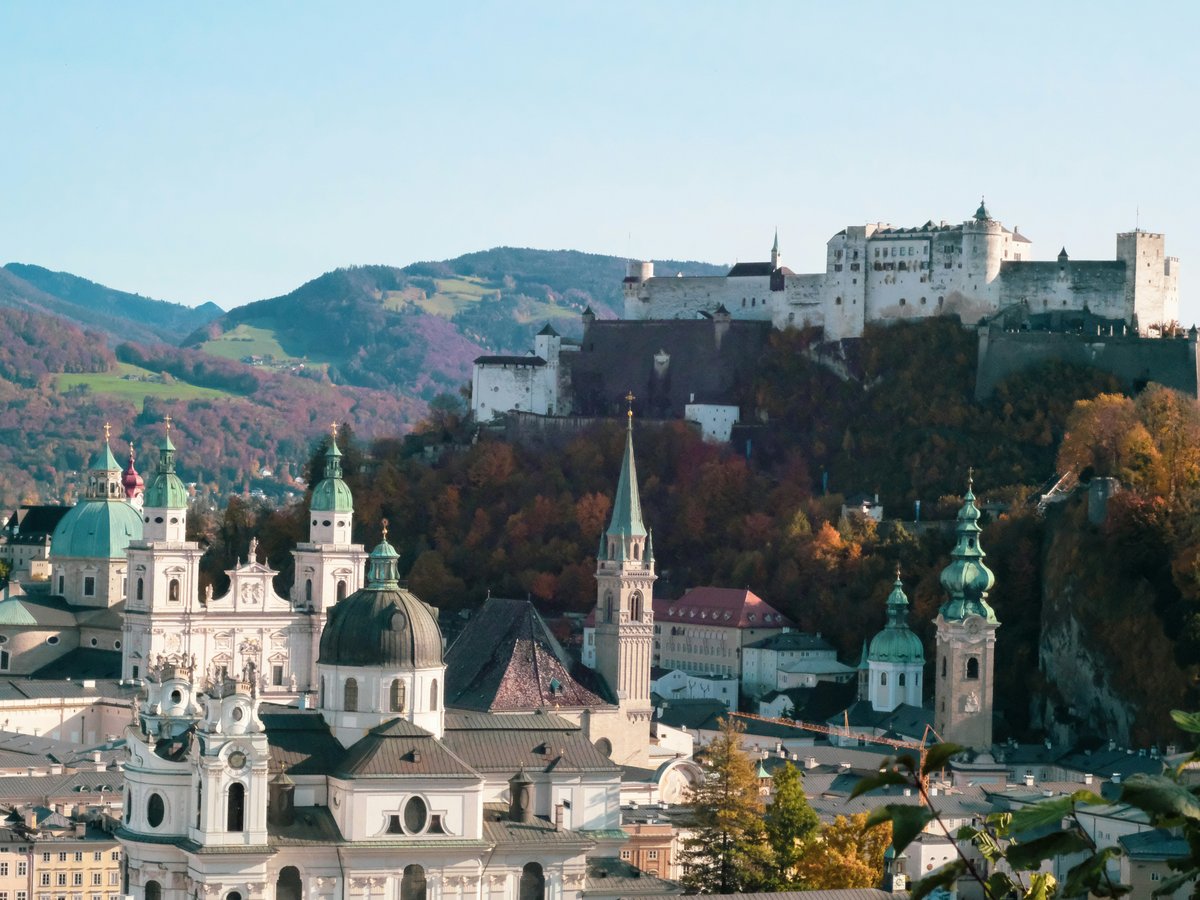
Salzburg With Kids: What Works
Salzburg earns an 8.2 for families, but the score papers over a meltdown trap on Getreidegasse and buries an under-rated winner 6 km south at Hellbrunn. This is the itinerary shape that survives children under 8.
Published
1 Salzburg Scores 8.2 for Families, but the Number Hides One Expensive Mistake
The smell of roasted almonds hits you before you cross Staatsbrücke into the Altstadt. Your 4-year-old will notice it too, then notice the crowds on Getreidegasse, then notice that walking is boring. You have about 40 minutes before the day pivots from charming to hostile. That window defines everything about Salzburg with small children.
The city's family-friendliness score sits at 8.2 out of 10. That number is earned. The UNESCO-listed Altstadt is compact, roughly 800 metres end to end. The Festung Hohensalzburg, founded in 1077, has a funicular that eliminates the steep climb. Mirabell Gardens cost nothing to enter. Haus der Natur, the science museum at Museumsplatz 5, has hands-on exhibits that hold attention for 2 to 3 hours. And 6 km south, Hellbrunn Palace's trick fountains have been soaking visitors for over 400 years.
But the 8.2 also contains Mozart's Birthplace at Getreidegasse 9, and this is where the score misleads. Mozart is the marquee name. Every guided walk leads there. The building is narrow, the rooms are small, the crowd pressure is real, and the content is pitched at adults who care about 18th-century musical manuscripts. For children under 8, it is a cramped, hot corridor that ends in a tantrum. The score does not distinguish between "exists and is culturally significant" and "will work for your 5-year-old at 2 PM."
This guide does. Salzburg's 8.2 is accurate if you sequence the day correctly, skip one famous stop, and redirect to a less obvious one. The itinerary that works starts early at the Festung Hohensalzburg, burns energy at Mirabell Gardens before lunch, and saves Hellbrunn for the afternoon. Mozart's Birthplace gets replaced by the Mozart Residence on Makartplatz 8, which has more space and fewer bodies. Haus der Natur is the rain card you keep in your back pocket. The Salzach River runs through the city center and serves as your orientation line when everything else fails.
The score does not distinguish between "exists and is culturally significant" and "will work for your 5-year-old at 2 PM."
2 Hellbrunn's Trick Fountains Are the Under-Rated Winner for Anyone Under 10
The first jet catches you from a stone seat at the garden table. Your child screams. It is a good scream. Within 30 seconds, water shoots from a carved deer's antlers, from the path beneath your feet, from a crown on a stone figure's head. Hellbrunn Palace, built between 1613 and 1619 by Prince-Archbishop Markus Sittikus, was designed to prank dinner guests. Four centuries later, it remains the single best family attraction in Salzburg, and most first-time visitors schedule it as an afterthought.
The Wasserspiele, the trick fountain tour, runs roughly 40 minutes. A guide leads your group through the garden's mechanical waterworks and triggers hidden jets at each station. Children do not need to understand Baroque power theatre to love getting drenched. Bring a change of clothes. The mechanical theatre, a roughly 200-figure water-powered automaton built around 1750, moves through an entire miniature village scene. Blacksmiths hammer. Painters paint. A procession files through a town square. It runs on water pressure alone, no electricity, and children under 5 tend to watch it twice.
Hellbrunn sits about 6 km south of the Altstadt. Bus 25 runs from Salzburg Hauptbahnhof to the Hellbrunn stop. The palace grounds also contain Tiergarten Hellbrunn, Salzburg's zoo, which holds around 140 species across a hillside enclosure built into the Hellbrunn mountain. You could do both in a single afternoon, but with children under 6, pick one. The trick fountains win. The zoo involves uphill gravel paths that tire small legs fast.
Worth noting, Hellbrunn's gardens are free to walk year-round. The Wasserspiele tour is the paid element, running from roughly April through October. If you visit in winter, the grounds still offer open green space, but the fountains stay off. Compare this to 2 hours spent at Mozart's Birthplace on Getreidegasse 9. Same half-day, entirely different result. Hellbrunn leaves your child talking about the surprise water jets at dinner. Mozart's Birthplace leaves them asking why you made them stand in a hot room. The Hellbrunn grounds alone cover more area than the entire Getreidegasse pedestrian zone.
Children do not need to understand Baroque power theatre to love getting drenched.
3 Mozart's Birthplace on Getreidegasse Is the Meltdown Trap Most Families Walk Into
You hear the crowd before you see it. Getreidegasse is roughly 5 metres wide at its narrowest point, and in high season the foot traffic moves at supermarket-checkout pace. Your stroller hits ankles. Your toddler can see belt buckles and shopping bags. Mozart's Birthplace sits at Getreidegasse 9, behind the wrought-iron guild signs that appear on every Salzburg postcard. Inside, the rooms feel smaller than they are because 50 other visitors are already there.
Wolfgang Amadeus Mozart was born in this building on January 27, 1756. The museum occupies 3 floors. The exhibits include his childhood violin, family portraits, and period instruments behind glass. For an adult with genuine interest in classical music history, it is absorbing. For a 5-year-old, it is a series of "don't touch" moments in rooms where the temperature rises with the crowd density. The museum is not designed wrong. It is designed for a different audience.
The alternative is 10 minutes away on foot. The Mozart Residence, known as the Wohnhaus, sits at Makartplatz 8. This was the family's later home, rebuilt after bomb damage in 1944 and reopened in 1996. The rooms are larger. The crowds are thinner. A family of 4 can move through the Wohnhaus without the elbow-to-elbow compression that defines the Getreidegasse experience. The Wohnhaus also has a larger audio-visual component, which tends to hold younger attention better than static display cases.
If your children are over 10 and have encountered Mozart in school, the Birthplace at Getreidegasse 9 has genuine pull. Below that age, skip it. Mind you, Getreidegasse itself has value as a 3-minute walk-through. The wrought-iron guild signs, some from the 17th century, hang overhead in iron. Point them out, keep moving, and do not enter number 9. The Wohnhaus on Makartplatz 8 delivers the same Mozart content in a building that does not punish you for bringing children.
The museum is not designed wrong. It is designed for a different audience.
4 The Festung Hohensalzburg Funicular Makes the Fortress Work Before Naptime
The Festungsbahn lurches upward at a steep angle, and every child under 7 presses their face against the window for the full ride. Below, the Altstadt shrinks to postcard scale. The Salzach River bends south. The whole trip takes about 1 minute and replaces a 20-minute uphill walk that would end your morning before it started.
Festung Hohensalzburg, founded in 1077 by Archbishop Gebhard, sits on the Festungsberg at roughly 506 metres above sea level. The fortress stretches about 250 metres in length and ranks as one of the largest fully preserved medieval fortresses in Central Europe. The views from the terrace reach the Untersberg to the south and the Salzburg Alps beyond. For families, the fortress works if you arrive early. By 10 AM in summer, the funicular queue thickens. By 11 AM, the courtyards fill. By noon, you compete with tour groups for shade.
The fortress interior includes medieval state rooms, a fortress museum, and a marionette collection with historical puppets. Children tend to lose interest in the state rooms within 15 minutes but stay engaged with the marionettes and the fortress walls, where they can peer through archer slits. Allow 60 to 90 minutes total. The Festungsbahn's lower station sits on Festungsgasse, a short walk from Kapitelplatz, where a large outdoor chess board sometimes holds a child's attention for an extra 10 minutes.
That said, Festung Hohensalzburg is not the only hilltop option. The Kapuzinerberg, across the Salzach on the city's eastern side, offers a quieter walk through forest with viewpoints over the rooftops. It has no funicular, no entrance fee, and no crowds. For older children who can handle a 30-minute uphill trail, the Kapuzinerberg gives a better ratio of effort to calm. For the under-6 set, the Festungsbahn and the fortress win. The lower station sits about 300 metres from Mozartplatz.
5 Haus der Natur Beats Every Rainy-Day Option in the City
The shark passes above your child's head in the walk-through tunnel on the ground floor. They crane their neck, press both palms against the acrylic, and do not move for 4 minutes. This is minute 12 of your visit to Haus der Natur. You have roughly 2 hours of engagement left, it is raining outside, and nobody is crying.
Haus der Natur sits at Museumsplatz 5, a 5-minute walk from Mozartplatz in the Altstadt. The museum was founded in 1924 and occupies more than 7,000 square metres of exhibition space across multiple floors. The ground floor houses the aquarium, with around 40 display tanks of freshwater and marine species. Upper floors cover geology, dinosaur reconstructions, wildlife dioramas, and a section on the human body. The Science Centre on the upper level offers hands-on physics experiments where children can generate electricity, build small bridges, and test optical illusions. That floor alone is worth 45 minutes.
For families, Haus der Natur is Salzburg's most reliable indoor half-day. It works from about age 3 up. The exhibits are physical and tactile, not text-heavy. The building is large enough that crowd density stays manageable even during summer peaks. And it sits inside the Altstadt, so you can combine it with a walk to Mirabell Gardens afterward or a stop at Cafe Tomaselli on Alter Markt for a Melange.
The nearest competitor for indoor family time is the Spielzeugmuseum, the toy museum at Bürgerspitalgasse 2. It is smaller, targets a younger age range of roughly 2 to 7, and closes earlier. If you have a toddler who is too young for the Science Centre at Haus der Natur, the Spielzeugmuseum might hold 60 to 90 minutes. For any child over 5, Haus der Natur is the stronger pick. At 7,000 square metres, you run out of afternoon before you run out of rooms.
6 Mirabell Gardens Cost Nothing, and by Day Three That Matters
The gravel crunches underfoot as your child runs toward the Pegasus fountain, arms wide. You let them go because there is no road, no glass case, no exhibit to shatter. Mirabell Gardens, on the right bank of the Salzach north of the Altstadt, are free to enter, open year-round, and large enough that a 4-year-old can burn 45 minutes of energy without you redirecting every 90 seconds.
The gardens were laid out around Mirabell Palace, originally built in 1606 by Prince-Archbishop Wolf Dietrich for his companion Salome Alt. The palace was rebuilt after a city fire in 1818 and now houses municipal offices. The Baroque garden layout, with geometric hedges and marble statuary, has survived largely intact. The Do-Re-Mi steps from the 1965 film The Sound of Music sit on the western side, facing Festung Hohensalzburg across the river. They draw visitors for photos but do not create the Getreidegasse bottleneck, because Mirabell Gardens spread across roughly 4 hectares of open ground.
The Zwerglgarten, the dwarf garden in the southern corner, has a collection of marble dwarf statues carved around 1715. Children will examine every one. These are not cute garden gnomes. They are Baroque grotesques, deliberately strange, and children find them fascinating in a way that clean modern playgrounds cannot match. Allow 10 to 15 minutes here. More if your child decides to name them all.
To be fair, Mirabell Gardens have no playground equipment, no cafe within the garden walls, and limited shade in midsummer. Bring water and a hat. The nearest alternative for free outdoor time is the Salzach riverbank promenade between Staatsbrücke and Mozartsteg, about a 7-minute walk south, where benches line the water and the flat path works for strollers. But Mirabell Gardens remain the better option for contained energy release. The nearest coffee is at a kiosk on Mirabellplatz, about 2 minutes from the main garden entrance.
7 The Itinerary Shape That Survives Small Children in Salzburg
By 8:30 AM, the Altstadt smells like fresh bread from the bakeries on Brodgasse. The Festungsbahn has no queue. Your child is fed, rested, and still believes today will be fun. This is the only hour of the day where all three conditions hold, and the family that uses it well will have a different Salzburg than the one that starts at 10 AM on Getreidegasse.
The shape that works is front-loaded. Festung Hohensalzburg first, arriving by 9 AM, out by 10:30. Walk downhill through Festungsgasse to Kapitelplatz. Cross the Altstadt on foot to Mirabell Gardens, roughly a 12-minute walk across the Staatsbrücke. Let children run in the gardens until 11:30. Lunch on the right bank near Linzer Gasse, where the restaurants are less tourist-priced than on Getreidegasse. By 12:30, you are either heading to your hotel for a nap or boarding Bus 25 from Salzburg Hauptbahnhof toward Hellbrunn.
Hellbrunn's Wasserspiele fits the 2 PM to 4 PM window. Children are rested if they napped, or at least reset by the bus ride south. The trick fountain tour runs about 40 minutes. Add 30 minutes for the Hellbrunn grounds afterward. By 4:30, the day has included a fortress founded in 1077, open Baroque gardens, and 400-year-old trick fountains, with zero minutes of museum-quiet pressure.
The rain variant replaces Mirabell Gardens with Haus der Natur at Museumsplatz 5. Enter at 10 AM, spend 2 hours in the aquarium and Science Centre, and the morning is covered. Hellbrunn still works in light rain because you are getting wet from the Wasserspiele anyway.
Skip Mozart's Birthplace at Getreidegasse 9. Visit the Wohnhaus on Makartplatz 8 instead, or skip Mozart entirely if your children are under 7. Salzburg's family-friendliness score of 8.2 assumes you make these substitutions. The number measures what is available in the city, not what happens when you follow the default tourist route.
The number measures what is available in the city, not what happens when you follow the default tourist route.
Last verified by automated review (v1.7.0_2026-07-30-flagship-7-salzburg-family) on . What is automated review?