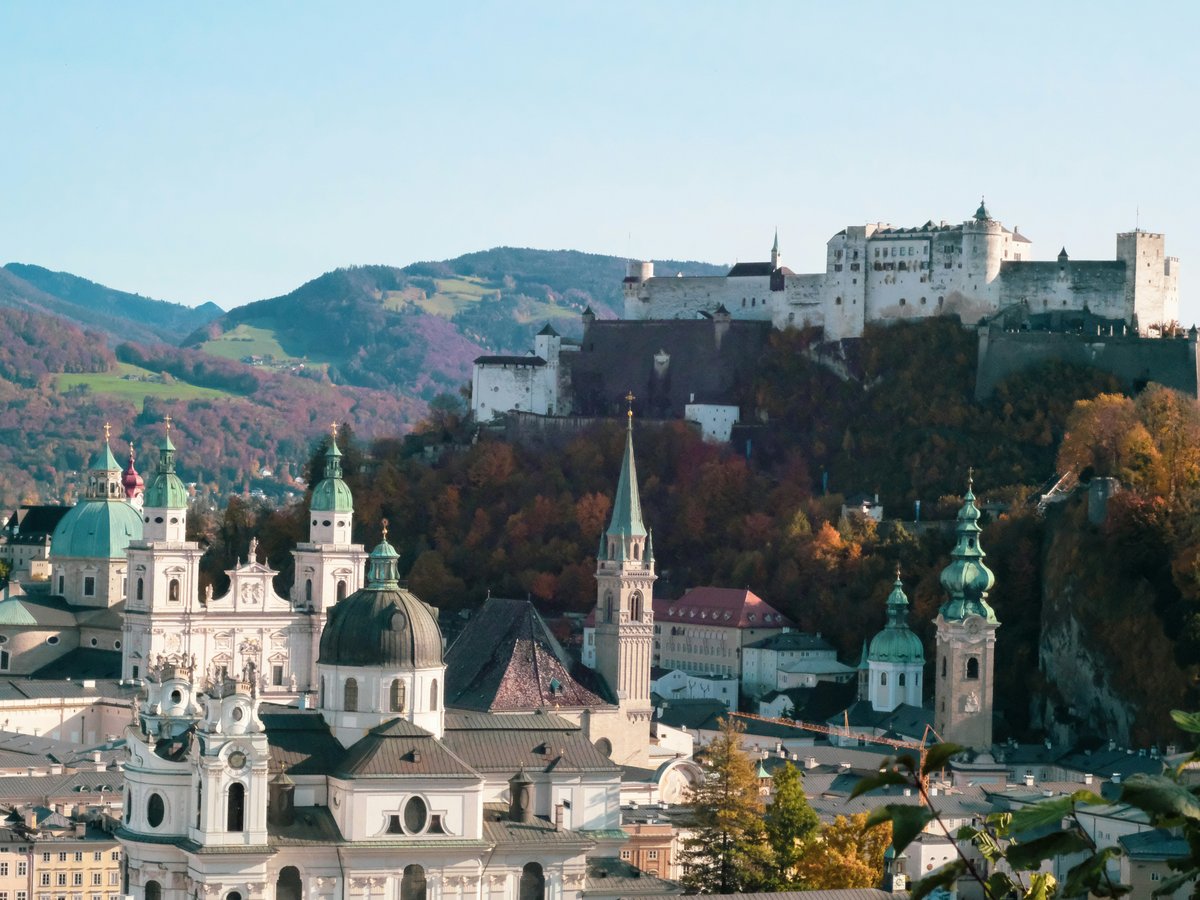
Best Time to Visit Salzburg, by Season
Salzburg's temperature range runs from January's -2.7°C lows to July's 24.7°C highs, a 27.4-degree spread that creates five distinct travel windows. This month-by-month verdict names the single best window for each kind of traveller, built from 5-year daily-observation averages.
Published
1 July's 24.7°C Average Hides Salzburg's Most Punishing Trade-Off
The heat sits on the Getreidegasse cobblestones in late July, trapped between iron guild signs and baroque facades barely 4 meters apart. You smell warm stone and melting Mozartkugel chocolate from the shop doorways. Salzburg's average high in July reaches 24.7°C with lows of 14.9°C, making it the warmest month on the calendar. June runs close at 24.5°C highs and 13.6°C lows. August settles to 24.3°C highs and 14.7°C lows. The three months form a flat plateau, spread across 0.4°C at peak.
That 0.4°C thermal consistency is the trap. The Salzburg Festival runs from late July through August, and the entire Altstadt shifts into premium mode. Mirabell Gardens fills with tour groups by 9 AM. Hohensalzburg Fortress queues stretch past the funicular entrance. Residenzplatz becomes a staging ground for organized buses rather than the quiet baroque square it is in May.
Worth noting, the Salzburg Festival programming concentrates in a 6-week window that has anchored the city's cultural identity since 1920. If the Festival is why you're coming, there is no alternative month. July's 24.7°C highs and August's 24.3°C highs are genuinely pleasant for evening performances at the Felsenreitschule. Nights in July drop to 14.9°C, which means a light jacket for the walk back along the Salzach River, not a winter coat.
But if you want Salzburg's summer weather without the Festival-season congestion, look at June. The average high of 24.5°C is functionally identical to July's 24.7°C, a difference your skin cannot detect. June's low of 13.6°C runs 1.3°C cooler than July's 14.9°C. You get the same warm evenings on the Makartsteg footbridge with fewer people on the railings. September at 20.5°C highs and 11.0°C lows drops 4.2°C from July while shedding the Festival crowds entirely.
June's 24.5°C average high is functionally identical to July's 24.7°C, a difference your skin cannot detect.
2 September Drops to 20.5°C and the Altstadt Finally Breathes
The morning air along the Salzach River in early September carries a clean edge that July never has. You notice it when you cross the Makartsteg footbridge around 8 AM, when the temperature still sits near the month's 11.0°C low. Dew clings to the Mirabell Gardens grass in the early light. By midday, September's average high of 20.5°C feels like a different city from July's 24.7°C peak.
That 4.2°C drop from July's 24.7°C to September's 20.5°C is the most productive temperature decline on Salzburg's calendar. You lose heat you didn't need and gain walkability. The Kapuzinerberg trail, punishing at July's 24.7°C, becomes a comfortable 45-minute climb at September's 20.5°C. Mirabell Gardens recovers its proportions when you can stand still long enough to appreciate the Zwergerlgarten sculptures without sweat forming at your collar.
September's low of 11.0°C means evenings require a proper layer, not a light jacket. Compare that to August's 14.7°C low. The 3.7°C difference hits the moment the sun drops behind the Mönchsberg cliff around 7 PM. The trade-off at September's 11.0°C tends to be worth it. Kapitelplatz has room to sit on the grass by mid-September. The Stiftsbäckerei near the Stift St. Peter likely still draws a line, but September's 20.5°C keeps the wait manageable.
To be fair, September is no longer unknown. Weekends still bring tour-bus traffic through the Altstadt. But compare September's 20.5°C high and 11.0°C low to June's 24.5°C and 13.6°C range. The question becomes whether you prefer warmth or breathing room. October at 17.1°C high and 7.4°C low offers even more quiet, but drops below comfortable t-shirt weather for most visitors. September threads between summer comfort and autumn emptiness at the Residenzplatz.
That 4.2°C drop from July to September is the most productive temperature decline on Salzburg's calendar.
3 October and November: A 7.6-Degree Cliff Splits Autumn in Two
October's light on the Hohensalzburg Fortress walls has a quality you don't find in summer. It's lower, warmer in hue, and the 17.1°C average high means you can stand on the fortress ramparts without squinting through heat shimmer. The Salzach below catches copper light off the Altstadt roofs. November's 9.5°C average high is a different proposition entirely.
The 7.6°C gap between October's 17.1°C and November's 9.5°C highs is the steepest month-to-month drop on Salzburg's calendar. No other consecutive pair comes close. June to July moves 0.2°C. August to September drops 3.8°C. But October to November falls off a cliff, and the lows confirm the story. October's overnight average of 7.4°C is brisk but manageable for an evening walk along the Salzach. November's 1.3°C sits close enough to freezing that frost forms on the Residenzplatz cobblestones by morning.
October is the contrarian's pick. The Kapuzinerberg trail at 17.1°C is arguably more pleasant than at September's 20.5°C if you run warm. Mirabell Gardens in mid-October has the foliage peak, and the 7.4°C low means you need a proper coat for the walk back from Stiftskeller St. Peter, nothing heavier. The Altstadt tends to feel like it belongs to residents again.
November is Salzburg's dead zone. The 9.5°C high and 1.3°C low sit in an uncomfortable middle. Too cold for extended outdoor sightseeing at the Residenzplatz, too early for Christkindlmarkt stalls on the Domplatz, which typically open in the last week of November. The narrow Getreidegasse funnels wind off the Salzach at these temperatures. Mind you, if you want to see the Salzburg Museum or DomQuartier without another visitor in sight, November's 9.5°C keeps everyone else away. You pay for that solitude with 1.3°C nights along the Salzach.
4 December's 6.3°C Highs and -1.5°C Lows Are What the Christkindlmarkt Needs
The first thing that hits you at the Christkindlmarkt on the Residenzplatz is not the lights. It's the smell of Punsch, sweet and alcoholic. The steam rises visibly from paper cups into the dark above the wooden stalls. December's average high of 6.3°C keeps that steam curling. The -1.5°C average low means by 7 PM, your fingers understand exactly why Salzburg vendors sell so many wool gloves.
December is the one month where cold is an asset, not a drawback. The 6.3°C high and -1.5°C low create the conditions that make outdoor Christmas markets feel right. The Domplatz and Residenzplatz stalls hit differently at 6°C than they would at October's 17.1°C. You want your breath visible against the Hohensalzburg Fortress lights. You want the excuse to stand closer to the roasted-chestnut cart near the Kapitelplatz.
January continues the cold at 5.6°C highs and -2.7°C lows, but the Christkindlmarkt closes after early January. That makes December the cold-weather month with cultural infrastructure to match its temperature. The Salzburg Advent concerts at the Festspielhaus run through December, and Hohensalzburg Fortress is illuminated against the early 4:15 PM darkness.
Compare December's -1.5°C low to November's 1.3°C low, a gap of only 2.8°C. The temperatures sit close, but November has none of the Christkindlmarkt atmosphere on the Residenzplatz. Compare December to January's -2.7°C low, a further 1.2°C drop into Salzburg's coldest sustained period. December threads between November's emptiness and January's deep freeze. If you dislike cold, skip December through February. March at 12.2°C highs and 1.1°C lows is the first month where outdoor Salzburg becomes comfortable again. But if the Christkindlmarkt on the Residenzplatz is the reason you're booking, December's 6.3°C delivers the atmosphere without January's -2.7°C bite.
December's 6.3°C and -1.5°C create the conditions that make outdoor Christmas markets on the Residenzplatz feel right.
5 January Averages -2.7°C at Night and 5.6°C by Day, Salzburg's Cold Floor
The Getreidegasse at 8 AM in January is almost silent. The wrought-iron guild signs creak overhead in cold air. Your boots sound loud on the flagstones. Salzburg's average high in January reaches 5.6°C with lows of -2.7°C, making it the coldest month on the calendar. February, often assumed to be the deeper freeze, runs warmer at 9.2°C highs and -0.5°C lows.
That 3.6°C gap between January's 5.6°C high and February's 9.2°C high is the largest upward month-to-month jump until the March-to-May spring sequence. February can feel like early thaw on a sunny afternoon in Salzburg, which catches visitors off guard. January offers no such reprieve. The 5.6°C high and -2.7°C low hold steady through the month.
January's case for visiting rests on proximity to alpine terrain. The Untersberg cable car runs from Salzburg's southern edge, and January's -2.7°C valley floor temperature correlates with reliable snow above 1,500 meters. The city sits closer to proper skiing than most people expect. The Salzach Valley funnels cold air through the Altstadt, which makes the 5.6°C daytime average feel sharper than the number suggests, especially on the exposed Mozartsteg bridge.
Mind you, January has its quiet rewards at street level. Hohensalzburg Fortress with fresh snow on its ramparts, seen from the Makartsteg footbridge, is the image the Salzburg tourism office prints on every winter brochure. Mozart's Geburtshaus at Getreidegasse 9 has no queue. The DomQuartier galleries are heated and empty. February's 9.2°C high and -0.5°C low mark the turn toward spring. If deep winter silence is what you want, January's -2.7°C delivers it more reliably than any other month in Salzburg. February at 9.2°C and the Kapuzinerberg's bare trails are 4 weeks away.
6 March Through May Climbs From 12.2°C to 18.3°C, and May Is the Month to Book
The Mirabell Gardens in late March smell like wet earth and the first cut grass of the year. The hedgerows are still brown-edged. Salzburg's average high of 12.2°C and low of 1.1°C make March the transition month, the first time since November that the city's high breaks double digits. The Kapuzinerberg trail dries out enough for comfortable hiking by mid-March, though the 1.1°C overnight average still puts frost on exposed ground above the Altstadt.
April steps to 14.0°C highs and 3.4°C lows. April's gain over March is only 1.8°C at the highs, the smallest month-to-month improvement in the entire spring sequence. April in Salzburg can feel stalled. The Untersberg still carries snow on its peak. The Salzach River runs high and grey-green with snowmelt below the Staatsbrücke. Easter tourism, when it falls in April, briefly fills the Altstadt, but the 14.0°C high doesn't draw the same volume as June's 24.5°C.
May changes the equation. The average high reaches 18.3°C with lows of 8.5°C, a 4.3°C jump from April's 14.0°C that you feel the moment you step onto the Mozartsteg. The 8.5°C low means evenings along the Salzach need only a light layer. May in Salzburg is what September promises with better daylight hours. Compare May's 18.3°C high to September's 20.5°C. That gap is 2.2°C. Compare May's 8.5°C low to September's 11.0°C low. That gap is 2.5°C.
The difference is crowd density. May sits before the Salzburg Festival machinery engages. The Felsenreitschule is quiet. Hohensalzburg Fortress at May's 18.3°C, with longer days and thinner crowds, might be the single best fortress experience of the year. April at 14.0°C is the weak link in the spring chain. March at 12.2°C and 1.1°C lows is for Salzburg residents.
Compare May's 18.3°C to September's 20.5°C. That gap is 2.2°C.
7 The Verdict: September for Most Visitors, May for the Contrarian, December for the Romantic
Read the numbers front to back and one pattern emerges. Salzburg's temperature range spans 27.4 degrees between January's -2.7°C low and July's 24.7°C high. That range creates five distinct windows, each suited to a different kind of trip.
The general visitor should book September. The 20.5°C average high and 11.0°C low give full days of comfortable walking between Hohensalzburg Fortress, the Altstadt, and Mirabell Gardens. The Salzburg Festival is over, the Kapuzinerberg trail is dry, and the 4.2°C drop from July's 24.7°C thins the crowds without sacrificing comfort. October at 17.1°C is the runner-up if September dates don't work.
The budget-conscious traveller should target May. The 18.3°C high and 8.5°C low are functionally close to September's range, but May falls before the summer pricing wave. The 2.2°C gap between May's 18.3°C and September's 20.5°C is imperceptible on the Getreidegasse.
The Salzburg Festival devotee has no scheduling freedom. July and August, with highs of 24.7°C and 24.3°C, are the Festival months and have been since 1920. June at 24.5°C is the warmup month when smaller Salzburg venues program their own seasons alongside rehearsal traffic at the Felsenreitschule.
The winter-atmosphere traveller should book early December. The 6.3°C high and -1.5°C low power the Christkindlmarkt on the Residenzplatz. Late November at 9.5°C catches the market opening with fewer visitors, but the 1.3°C lows test your commitment.
The skier books January. The 5.6°C valley high and -2.7°C low correlate with reliable snow on the Untersberg and in the nearby Berchtesgaden Alps. February at 9.2°C and -0.5°C is warmer but still productive.
The single worst month is November. At 9.5°C highs and 1.3°C lows, it sits between seasons. Too cold for comfortable walking on the Kapuzinerberg, too early for Christkindlmarkt, too far from reliable ski conditions on the Untersberg. April at 14.0°C and 3.4°C lows is the second-weakest, stalled between spring and the summer plateau. September at 20.5°C highs, 11.0°C lows, and post-Festival quiet has the fewest trade-offs of any month on the calendar.
The 2.2°C gap between May's 18.3°C and September's 20.5°C is imperceptible on the Getreidegasse.
Last verified by automated review (v1.7.0_2026-07-30-flagship-7-salzburg-best-time) on . What is automated review?