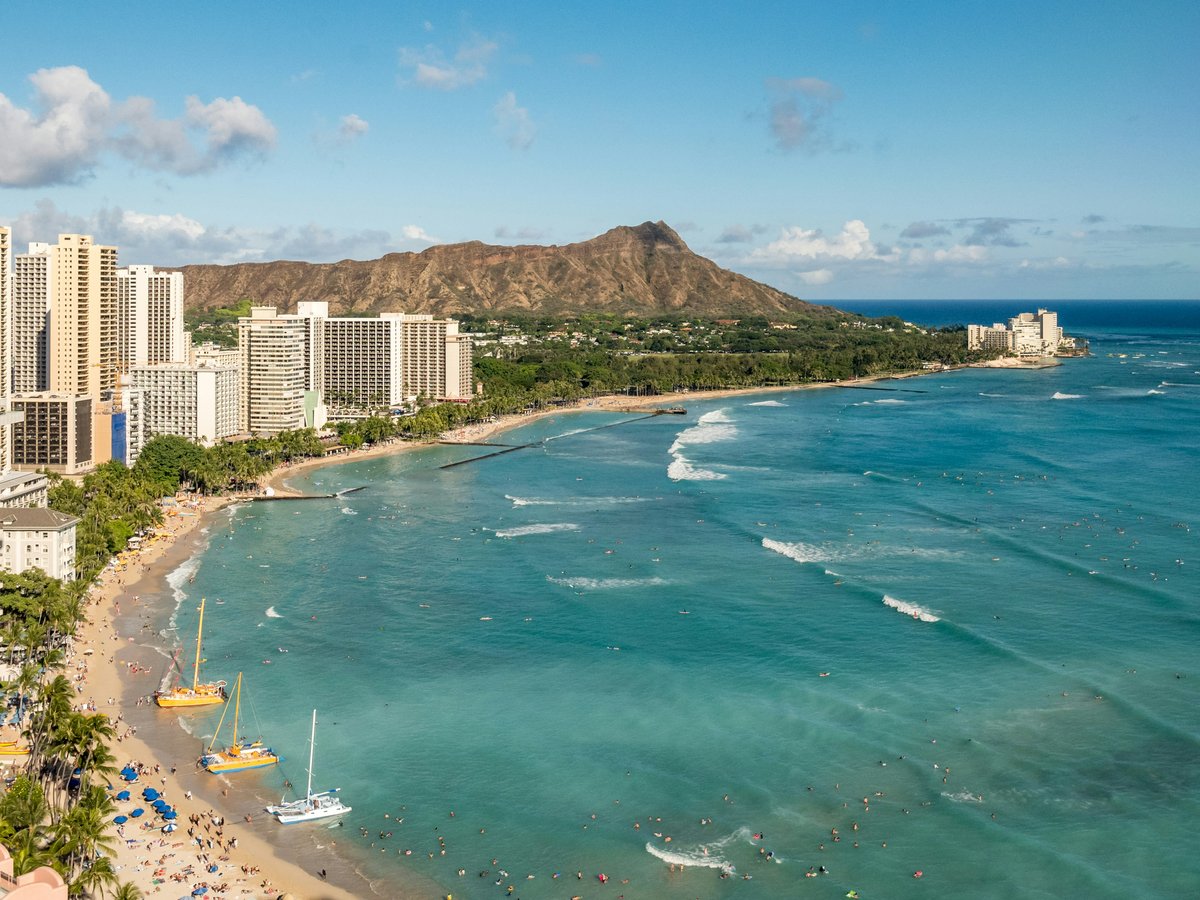
Best Time to Visit Honolulu, by Season
Honolulu's annual temperature range spans 4.1 degrees. That narrow window, from February's 25.3°C to August's 29.4°C, determines everything from hotel pricing to beach density. A month-by-month projection from 5 years of daily observations, with the single best window named for every kind of traveler.
Published · Updated
1 Honolulu's 4-Degree Window: Why 25.3°C to 29.4°C Is the Only Number That Matters
Stand on the sand at Ala Moana Beach Park in February and the afternoon air reads 25.3°C. The trade wind pushes through the ironwood trees and there is a lightness to it, almost spring-like. Return in August to the same stretch and the thermometer shows 29.4°C. The air sits heavier. The wind does not cut the same way. Four degrees. That is the entire annual range of Honolulu's average daily highs.
January's average high reaches 25.5°C. February dips to 25.3°C, the coolest month on the calendar. From there the climb is steady. March hits 25.7°C, April 26.1°C, May 27.0°C. The jump from May to June is the steepest single-month increase of the year, a full 1.3 degrees to 28.3°C. July reaches 28.7°C. August and September share the summit at 29.4°C. Then the slow descent. October falls to 28.7°C, November to 27.4°C, December to 26.0°C.
The overnight lows follow the same arc but tell a different story. February's 19.7°C nights mean the air cools after sunset. You might want a light layer walking the Waikiki beachfront at 10 PM. By August, the low is 23.3°C, and the pavement holds stored heat well past midnight. September's low of 23.2°C is nearly identical. The nights never fully reset.
That difference shapes everything. It determines whether you sleep with the lanai door cracked or the air conditioning sealed. It shifts what you want to eat, how far you want to hike, and how much of the day you spend in the water versus in the shade. The range from February's 25.3°C floor to August and September's shared 29.4°C ceiling is where every booking decision sits.
Four degrees. That is the entire annual range of Honolulu's average daily highs.
2 December Through February Holds at 25.3-25.5°C and Draws Every Visitor on the Mainland
The lobby of any Waikiki hotel in late December smells like sunscreen and airport coffee. The temperature outside reads a comfortable 26.0°C. Inside, the check-in line wraps around the corner. This is peak season in Honolulu, and the weather is, by the numbers, the mildest the island offers all year.
December's average high of 26.0°C pairs with a 20.6°C low. January settles at 25.5°C highs and 19.8°C lows. February bottoms out at 25.3°C and 19.7°C, the coolest month on the calendar by both measures. The total swing across these three months is 0.7 degrees on the highs and 0.9 degrees on the lows. You would struggle to feel the difference day to day.
What you will feel is the compression. Mainland visitors escaping sub-zero winters converge on O'ahu between Thanksgiving and Presidents' Day. The beaches at Waikiki tighten. Restaurant waits grow. The walk from the Royal Hawaiian to the Duke Kahanamoku statue, maybe 15 minutes on a quiet October afternoon, becomes a slow shuffle.
Worth noting, though. These temperatures are genuinely comfortable for anything active. A hike up Diamond Head at 25.5°C in January means you are not fighting heat the way you would in August at 29.4°C, when the same trail turns into a sweat-soaked grind. January's 19.8°C lows mean evening walks along the Ala Wai Canal carry a pleasant cool that fades by April's 20.8°C.
February at 25.3°C tends to be the sharpest play within this window. The holiday crowds have thinned, the weather sits within 0.7 degrees of December's 26.0°C and 0.2 degrees of January's 25.5°C, and the 19.7°C nights are within 0.1 degrees of January's 19.8°C. February's 25.3°C highs and 19.7°C lows deliver functionally identical weather to the rest of winter at a lower demand point on the calendar.
3 March Through May Climbs from 25.7°C to 27.0°C While Nobody Is Watching
The plumeria along the Kapi'olani Park fence line blooms heavier in March. The air has warmed only 0.4 degrees from February, from 25.3°C to 25.7°C, but the mornings feel different. March's 20.3°C lows lack the faint bite of February's 19.7°C.
April rises to 26.1°C highs and 20.8°C lows. May reaches 27.0°C and 21.6°C. That is a 1.3-degree climb across three months on the highs, with a matching 1.3-degree rise on the lows. The symmetry is worth noting. Unlike mainland cities where daytime tends to warm faster than nighttime in spring, Honolulu's gap between high and low stays steady through this stretch, holding at around 5.4 degrees in both April and May.
This is Honolulu's quiet quarter. A 2-week spring-break spike in late March aside, the island sits in a lull between the winter peak and the summer family wave. May at 27.0°C occupies a comfortable middle ground. Warm enough for full beach days without the thick humidity that arrives with June's 28.3°C. Cool enough at 21.6°C lows for sleeping without air conditioning.
The transition from April's 26.1°C to May's 27.0°C is where you cross a threshold locals seem to notice. Below 27°C, the trade winds keep most afternoons pleasant on the trails above the city. Above it, shade starts to matter. May is the last month where a midday hike up Manoa Falls feels comfortable rather than punishing.
For the visitor watching costs, this quarter likely offers the strongest weather-to-value ratio on the calendar. April at 26.1°C and May at 27.0°C deliver temperatures 0.8 to 1.7 degrees warmer than February's 25.3°C peak-season floor, while hotel demand runs measurably lower. May at 27.0°C marks the last month before the steepest temperature jump on the calendar, the 1.3-degree leap to June's 28.3°C.
4 June Through August Peaks at 29.4°C, but the Heat Is Not the Real Problem
The asphalt on Kalakaua Avenue in August holds heat you can feel through your sandals. The afternoon air has reached 29.4°C, the year's warmest reading. Step onto the sand and the relief is immediate. Step into the ocean and you understand why summer remains the most popular family-travel season on O'ahu.
June opens the quarter at 28.3°C highs and 22.5°C lows. That 1.3-degree jump from May's 27.0°C is the single largest month-to-month increase of the year. July climbs to 28.7°C and 22.9°C. August tops out at 29.4°C with 23.3°C lows, the warmest overnight reading on the calendar.
The daytime heat is manageable. Honolulu at 29.4°C is milder than most tropical destinations in their own summer months. The question is what 23.3°C nights mean for comfort. In December, the 5.4-degree spread between the 26.0°C high and 20.6°C low creates a noticeable cooling arc through the evening. In August, both endpoints sit higher. The air never fully resets. By 6 AM the temperature has barely dipped below 24°C, and the walls of your hotel room still carry the previous afternoon's warmth.
Summer also brings O'ahu's calmest ocean conditions. The North Shore, which pounds with winter swells from November through February, settles to gentle rollers by July. Swimming and snorkeling conditions at Hanauma Bay tend to peak when July's 28.7°C air meets calm, flat water.
That said, June and July carry a quieter feel than August, which draws the final wave of mainland school-holiday families. June at 28.3°C is 1.1 degrees cooler than August's 29.4°C, and the overnight gap matters more than it appears on paper. June's 22.5°C lows versus August's 23.3°C lows, a difference of 0.8 degrees, can separate a comfortable night with the lanai door open from a night where the air conditioning runs until dawn.
5 September Matches August's 29.4°C Peak, but the Crowds Have Already Left
Late-afternoon light on Waikiki in September falls at a lower angle than the June solstice. It casts longer shadows across the sand. The thermometer, though, reads 29.4°C, identical to August's peak. Same average high. The low sits at 23.2°C, within 0.1 degrees of August's 23.3°C. By the numbers, September is August.
By the experience, September is a different month entirely. Mainland schools have resumed. The families that packed every hotel pool in late July and August have thinned. Flight prices from LAX and SFO tend to ease after Labor Day. You get August's warmth at something closer to spring's availability.
October begins the descent. The high drops to 28.7°C, a 0.7-degree fall from September's 29.4°C, with lows at 22.6°C. That puts October at the same average high as July (both 28.7°C), though October's air tends to hold slightly more moisture as winter weather patterns begin to organize over the Pacific.
This two-month window is where savvy repeat visitors focus. September at 29.4°C and October at 28.7°C sit near the top of Honolulu's annual range. The water is at its warmest. The trade winds still blow, though less reliably than in June or July. October's 28.7°C highs are 3.2 degrees warmer than January's 25.5°C, which is peak-season pricing territory, typically at a fraction of the winter room rate.
The caveat is hurricane season. Hawai'i rarely takes direct hits, but September and October fall within the central Pacific storm window. Statistical risk remains low. Your cancellation flexibility should be higher.
For the heat-tolerant traveler who wants Honolulu at its warmest without the crowds, September at 29.4°C and 23.2°C lows is the clearest value position on the calendar. The readings match August's 29.4°C and 23.3°C within a tenth of a degree on both measures.
By the numbers, September is August. By the experience, September is a different month entirely.
6 November at 27.4°C Splits Everything Down the Middle and Wins for Most Travelers
Rain on the Ko'olau Mountains is visible from Waikiki in November. You can see the gray curtain hanging over the ridgeline while the beach below sits dry under a 27.4°C afternoon. That is November in Honolulu. The rain is real, and it is mostly somewhere else.
November's average high of 27.4°C sits near the midpoint of the annual range. February, the coolest month, averages 25.3°C. August, the warmest, reaches 29.4°C. November's 27.4°C lands within half a degree of the mathematical center. The overnight lows follow suit. November's 21.9°C falls neatly between February's 19.7°C floor and August's 23.3°C ceiling.
This is the Goldilocks month. The temperature is warm enough for comfortable beach days, cool enough at night for easy sleep without sealed windows and air conditioning. The 5.5-degree spread between November's 27.4°C high and 21.9°C low gives the evening a genuine cooling arc, one that August's higher-sitting 29.4°C-to-23.3°C range does not deliver despite a similar numerical spread.
The calendar position matters as much as the thermometer. November sits in the gap between summer's family crowds and December's holiday invasion. Thanksgiving week concentrates demand for about 5 days, but the first three weeks of November tend to be among the quietest periods on O'ahu.
October at 28.7°C is 1.3 degrees warmer and still carries residual summer heat. December at 26.0°C is 1.4 degrees cooler and marks the start of peak pricing. November at 27.4°C occupies the space between, with rates that have not yet climbed to holiday levels and temperatures that have dropped from the summer ceiling without falling to winter lows.
For the couple traveling without school-calendar constraints, or the remote worker who can choose any 2-week window, November's 27.4°C highs and 21.9°C lows at shoulder-season pricing represent the strongest booking on Honolulu's calendar. The first two weeks of November, before Thanksgiving demand arrives, are where the value peaks.
November's 27.4°C lands within half a degree of the mathematical center of Honolulu's annual range.
7 The Final Verdict: Your Best Month Comes Down to One Question
The morning air in your Waikiki hotel hallway feels different depending on the month. In February, you step outside into 19.7°C and the walk to breakfast carries a freshness that surprises first-time visitors. In August, the 23.3°C dawn wraps around you like a warm towel before you have crossed the street. Both are Honolulu. They are not the same trip.
The best month for the budget-focused traveler is September. The 29.4°C highs match August's peak. The 23.2°C lows sit within 0.1 degrees of August's 23.3°C. Post-Labor Day flight and hotel pricing tends to drop. You get the warmest Honolulu has to offer, without the summer surcharge.
The best month for couples is November, specifically the first two weeks before Thanksgiving. At 27.4°C highs and 21.9°C lows, the temperature works for both beach days and longer hikes up trails like Diamond Head or Manoa Falls. The crowds are thin. The evenings cool enough for comfortable outdoor dining.
The best month for families with school-age children is June. At 28.3°C highs and 22.5°C lows, it is 1.1 degrees cooler than August's 29.4°C peak and 0.8 degrees more comfortable overnight than August's 23.3°C. June also avoids the late-summer crunch when mainland families scramble for the last weeks before school.
The best month for hikers and active travelers is January. The 25.5°C highs and 19.8°C lows keep O'ahu's ridgeline trails in a tolerable range. February at 25.3°C and 19.7°C is marginally cooler but effectively identical.
The month offering the least advantage depends on what you are optimizing against. February at 25.3°C gives the coolest weather during peak pricing. August at 29.4°C brings the warmest weather during peak family demand. Neither is a bad month. Both are months where the weather-to-cost arithmetic works against you. The full spread, 4.1 degrees on the highs and 3.6 degrees on the lows, is every bit of leverage the calendar gives you.
Last verified by automated review (v1.7.0_onboard-honolulu-flagship-2026-06-06) on . What is automated review?