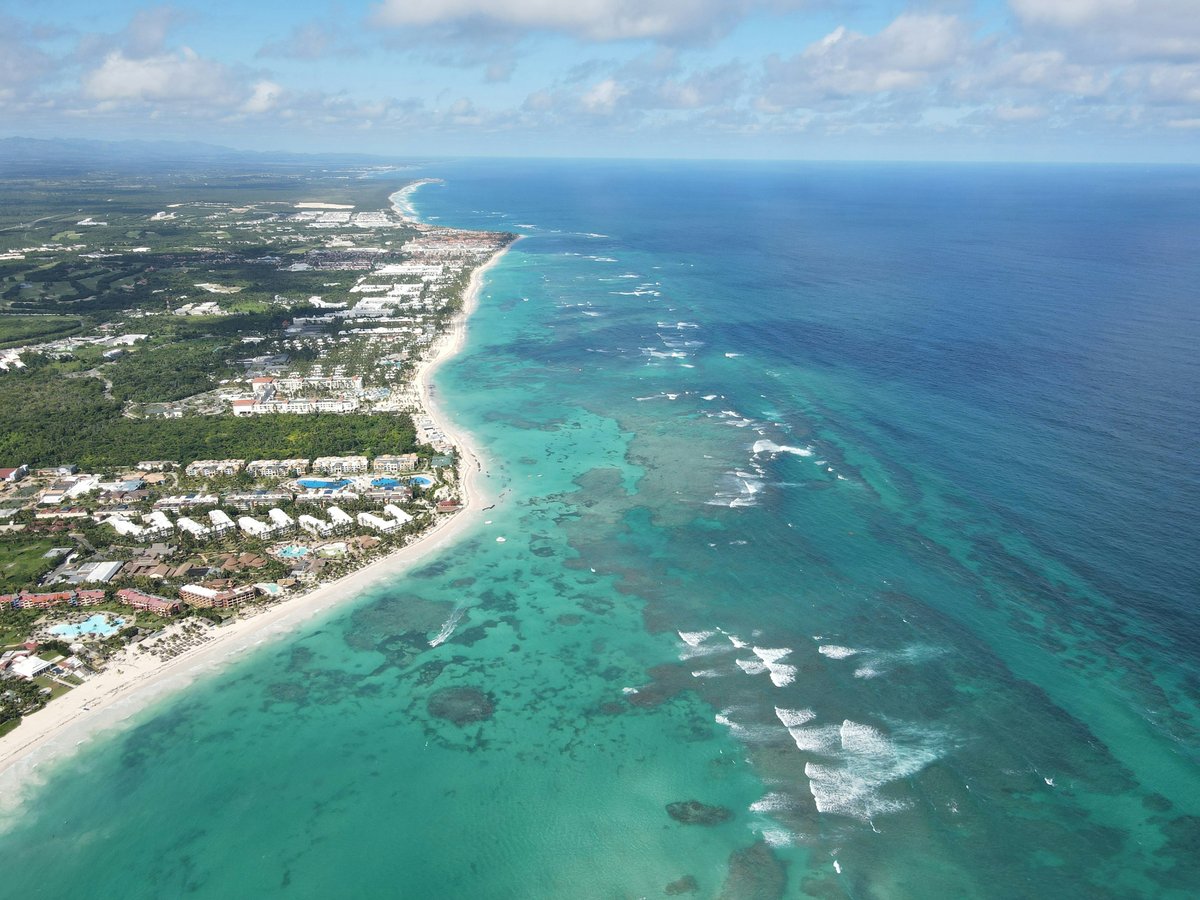
Punta Cana stretches along the Dominican Republic's eastern tip, where the Caribbean Sea meets the Atlantic near Cabo Engaño. Most travelers arrive through Punta Cana International Airport and head straight to all-inclusive resorts in Bávaro or Cap Cana, rarely leaving the property. What they miss is that Dominican environmental law makes every meter of coastline public. The roughly 30 kilometers of coast from Cap Cana north through Macao belong to everyone, resort gate or not. The turquoise water at Bávaro is famously shallow. You might wade 30 meters from shore before it reaches your waist. Beyond the beach, the provincial capital of Higüey sits about 45 minutes west by guagua (public minibus) and holds the Basílica Catedral Nuestra Señora de la Altagracia, one of the Caribbean's most visited pilgrimage churches. Iglesia San Dionisio and the Mercado Municipal sit in the old town center a short walk away. September air currently runs around 28.6°C with 76% humidity, and the felt temperature pushes closer to 32.5°C under overcast skies. The area scores 6.8 out of 10 for family friendliness (see the TTDI Family-Friendliness Index), partly because beaches, churches, and plazas charge nothing.
Free attractions
-
Basílica Catedral Nuestra Señora de la Altagracia
Higüey's basilica opened in 1971 on the site of an older church. Its parabolic concrete arch is visible from several blocks away. Inside, the original 16th-century painting of the Virgen de la Altagracia sits behind the main altar in a gold-and-silver frame. The image is smaller than most visitors expect, perhaps 30 centimeters across. It still draws over a million pilgrims each year. Side halls display religious artifacts and votive offerings left over the decades, and the permanent collection is likely the area's closest thing to a museum of Dominican sacred art. Entry is free every day. The nave smells of candle wax and incense, and whispered prayers carry across the vaulted ceiling. Outside, the grounds include shaded walkways and flowering trees where families rest.
Higüeypilgrimage church / religious art -
Iglesia San Dionisio
This stone church in central Higüey dates to the early 16th century. It ranks among the oldest surviving church structures on the island of Hispaniola. The facade is modest compared to the basilica. Rough-cut limestone walls and a compact bell tower reflect colonial-era construction methods. Inside, wooden ceiling beams are dark with age, and the altar retains original colonial woodwork. The church sits near the center of town, close to Parque Duarte. Free entry.
Higüeyhistoric church -
Playa Macao
Macao sits about 25 minutes north of Bávaro by car and remains one of the few beaches in the area without a resort in sight. The sand here runs gold-brown, coarser than Bávaro's fine white powder. Waves are stronger too. Local surf outfitters near the parking area sometimes rent boards for around 500 DOP per hour, but the beach itself costs nothing. The northern stretch is less developed, with coconut palms and low scrubland of sea grape and noni trees behind the sand. You can walk the dune trail behind the beach for free. ATV tour operators have set up near the main entrance in recent years, and the engine noise carries. Best visited before 10:00, when the tour groups have not yet arrived.
Macaobeach / natural area -
Playa Bávaro
The main tourist beach stretches several kilometers between Arena Gorda in the north and El Cortecito in the south. Calm, shallow water and white sand make it the default swimming spot for the resort corridor. Resort staff set up loungers and umbrellas every morning, but the sand is legally public. Walk past the resort zones and lay a towel anywhere. Early mornings before 8:30 are quieter, with pelicans working the shallows and the light hitting the water at a lower angle. The palm grove behind the beach runs for roughly 2 kilometers between the sand and the hotel properties, and it offers free shade.
Bávarobeach -
Playa Juanillo
At the southern end of the tourist corridor, Playa Juanillo sits within the Cap Cana development. You pass through the Cap Cana entrance to reach it, which is straightforward. The sand here is finer and whiter than at Macao, and the water stays calm and knee-deep for a good distance out. A handful of restaurants line the shore, but the beach itself costs nothing. Fewer crowds on weekday mornings make Juanillo one of the quieter stretches in the area.
Cap Canabeach -
El Cortecito
El Cortecito was a fishing village before the resorts arrived, and remnants of that life still show in the wooden boats pulled up on the sand. The beachfront path connects south to Los Corales, where most of the area's independent restaurants and bars cluster. The full walk from El Cortecito to Arena Gorda takes about 40 minutes along the sand. Fishermen still haul in the catch early each morning, and you can watch them sort the day's take around 6:30. The smell of frying pescado frito and tostones drifts from the small comedores behind the beach.
El Cortecito, Bávarohistoric fishing village / beachfront -
Parque Duarte
Higüey's central square sits between Iglesia San Dionisio and the commercial streets of the town center. A bust of Juan Pablo Duarte, one of the Dominican Republic's three founding fathers, stands at the center. Dominican families gather on concrete benches in the evenings, and mobile food vendors sell empanadas de yuca and batidas around the perimeter. The park is shaded by mature flamboyán trees, and in summer months the red blossoms carpet the ground. Free and open at all hours.
Higüeypublic park / plaza -
Casa de la Cultura de Higüey
Higüey's provincial cultural center hosts rotating exhibitions of local art and occasional literary readings. The space is managed by the Ministry of Culture and is free to enter during business hours, typically Monday through Friday from 9:00 to 17:00. The exhibitions tend to feature painters and sculptors from the La Altagracia province. On weekdays, you may have the gallery to yourself. To be fair, the scope is modest next to what Santo Domingo's museums offer, but the Ministry of Culture keeps the space open at no charge.
Higüeycultural center / gallery
Free activities
-
Bávaro beachfront walk from El Cortecito to Arena Gorda
A roughly 4-kilometer walk along the sand from El Cortecito north to Arena Gorda, through the resort zone. The route passes hotel beach sections and stretches of open shoreline. No fee, no guide needed. Bring water. Starting before 8:00 lets you beat the resort crowds and catch pelicans diving for breakfast.
Bávarowalking route -
Browsing the Mercado Municipal de Higüey
Higüey's main market fills a covered building in the town center with stalls selling tropical fruit, fresh fish, root vegetables, Dominican coffee, and household goods. The vendors are accustomed to some tourist interest, but this is primarily a local market. A kilo of plantains might run 30 to 50 DOP. Browsing costs nothing, and the aromas of roasting coffee beans and fresh cilantro permeate the building.
Higüeymarket -
Sunrise at Playa Cabeza de Toro
Punta Cana faces east, which means sunrise comes directly off the water. Playa Cabeza de Toro, at the southern end of the resort strip, offers one of the less crowded vantage points. Mind you, the walk from most Bávaro resorts takes roughly 20 minutes, so set the alarm before 6:00. In September, sunrise occurs around 6:20. The sky shifts from deep orange to pale blue in about 15 minutes.
Cabeza de Toroviewpoint / natural spectacle -
Higüey town walk
A 2-hour walking loop through the provincial capital connects the basilica, Iglesia San Dionisio, Parque Duarte, and the Mercado Municipal. The route covers roughly 3 kilometers on flat, paved streets. Guaguas from Bávaro drop you at the main terminal near the western edge of town.
Higüeywalking route -
Walking the Faro Cabo Engaño coastline
The lighthouse at Cabo Engaño marks the Dominican Republic's easternmost point. The coastline here is rougher than the resort beaches, with rocky outcrops and stronger surf. The lighthouse itself is a modest white tower. The surrounding ground is free to walk, though the access road can be unpaved for the final stretch. Views run for several kilometers along the coast on clear mornings.
Cabo Engañocoastal walk / viewpoint
Free events
-
Día de la Altagracia
January 21 (vigil begins evening of January 20)The Dominican Republic's most important religious holiday centers on Higüey's basilica. Free street celebrations include live merengue and bachata, religious processions, and food vendors selling traditional sweets and fried snacks. The evening vigil on January 20 draws the largest crowds, with thousands of pilgrims filling the surrounding streets. The basilica stays open through the night.
Basílica Catedral Nuestra Señora de la Altagracia and surrounding streets, Higüey -
Carnaval de Higüey
Sundays in FebruaryHigüey's Carnaval brings diablo cojuelo characters to the streets in elaborate papier-mâché masks. Each mask is handmade and can weigh several kilograms. The characters dance and chase spectators with vejigas (inflated bladders), a tradition across Dominican towns. Merengue trucks blast music from mobile speakers. The largest parade falls on or near February 27, Dominican Independence Day. Free to watch from anywhere along the route.
Central Higüey -
Semana Santa processions
Good Friday through Easter Sunday (March or April, dates shift annually)Holy Week in Higüey brings free religious processions through the streets, typically on Good Friday and Easter Sunday. Participants carry wooden statues of saints and religious scenes between Iglesia San Dionisio and the basilica. The crowds are smaller than at Día de la Altagracia but the atmosphere is more solemn.
Higüey -
Sunday evening gathering at Parque Duarte
Sunday eveningsOn Sunday evenings, Higüey families fill the central square. Local musicians sometimes set up with accordion, güira, and tambora for informal merengue típico. Vendors sell dulce de coco and fresh chinola juice around the perimeter. The gatherings tend to run from around 17:00 until 21:00.
Parque Duarte, Higüey
How to access resort-fronted beaches as a non-guest
The public-access law covers every beach, but the practical experience in Bávaro and Cap Cana can feel different from an open public beach like Macao. Resorts mark their zones with roped-off lounger areas, and security staff may ask where you are staying. The sand from the high-tide line to the water remains open, and no resort employee can legally remove you from that strip. For practical access, approach from El Cortecito or Arena Gorda, where the beach meets public roads. At Cap Cana's gatehouse for Playa Juanillo, mentioning that you are headed to the beach is sufficient. Bring a towel and water, no more. Umbrellas and coolers tend to draw more attention from resort staff. A general rule for the whole coast: stay below the high-tide line, keep your volume down, and you will not have trouble.
A walking route through Higüey
From the guagua terminal, the basilica stands roughly 15 minutes east on foot. Turn south to reach Iglesia San Dionisio, then continue to Parque Duarte, spaced about 3 blocks apart. The Mercado Municipal sits on the loop back toward the terminal. Colmados on every block sell cold Presidente for around 100 DOP. That said, motoconchos charge around 25 to 50 DOP for short hops if you tire of walking. Higüey sits on a low plain, so the streets are flat and paved through the center. The shade between buildings drops the temperature a few degrees, and bachata from shop radios follows you down every block. Wikivoyage lists additional sights at https://en.wikivoyage.org/wiki/Punta_Cana#See.
FAQ
Are all Punta Cana beaches free to use?
Dominican law guarantees it. At Bávaro resorts, the sand from the high-tide line to the water remains open to everyone. Staff cannot legally remove you from that strip. Even gated developments like Cap Cana must allow beach access. Playa Macao has no gate and no resort presence at all.
How do I get from the Bávaro resort area to Higüey?
Guaguas, the Dominican public minibuses, run between the Bávaro strip and Higüey's main terminal throughout the day. The fare tends to run around 100 to 150 DOP per person. At the current rate of roughly 59.19 DOP per dollar, that comes to about 2 USD. Guaguas leave when full rather than on a fixed schedule, and they are not air-conditioned. The ride follows the main highway west. Taxis cost 10 to 15 times more. For a broader area overview, see https://en.wikivoyage.org/wiki/Punta_Cana#Get_around.
Is Punta Cana safe for solo travelers?
Punta Cana scores 6.2 out of 10 for solo-traveler safety (see the TTDI Solo-Safety Index). The resort strip in Bávaro is well-patrolled by tourist police (Politur), and the beaches feel safe during daylight. After dark, stick to lit commercial areas like Los Corales. Higüey is a working Dominican town, not a tourist zone, so apply standard city awareness there. Keep valuables out of sight and avoid unlit side streets. For more detail, see https://en.wikivoyage.org/wiki/Punta_Cana#Stay_safe.
What is the cheapest way to eat near the beaches?
Comedores (local restaurants) in Verón, the commercial hub behind the resort strip, serve platos del día for 200 to 350 DOP. That typically covers rice, beans, meat, and salad. Street vendors near El Cortecito sell pica pollo and fresh fruit cups for 100 to 200 DOP. The resort strip restaurants charge 3 to 5 times more for similar plates. For grocery basics, colmados stock bread, fruit, and water at local prices. Wikivoyage covers more food options at https://en.wikivoyage.org/wiki/Punta_Cana#Eat.
Is Punta Cana a good base for digital nomads?
The area scores 3.5 out of 10 for digital-nomad suitability (sourced from TTDI's editorial rubric). WiFi in the resort zone tends to be limited to hotel networks, and coworking spaces are scarce. Internet speeds outside the resorts can be inconsistent. The towns of Verón and Higüey have some cafes with WiFi, but the infrastructure is built for tourism, not remote work. Santo Domingo, roughly 3 hours west by bus, has a stronger setup for extended laptop work.
How welcoming is Punta Cana for LGBTQ+ travelers?
Punta Cana scores 3 out of 10 for LGBTQ+ friendliness (sourced from TTDI's editorial rubric). The Dominican Republic does not currently recognize same-sex marriage or civil unions, and public attitudes outside Santo Domingo tend to be conservative. Most resort staff are professional and courteous, but public displays of affection between same-sex couples may draw stares or comments outside the tourist bubble. For general practical guidance, see https://en.wikivoyage.org/wiki/Punta_Cana#Cope.
Last verified by automated review (v1.7.2) on . What is automated review?