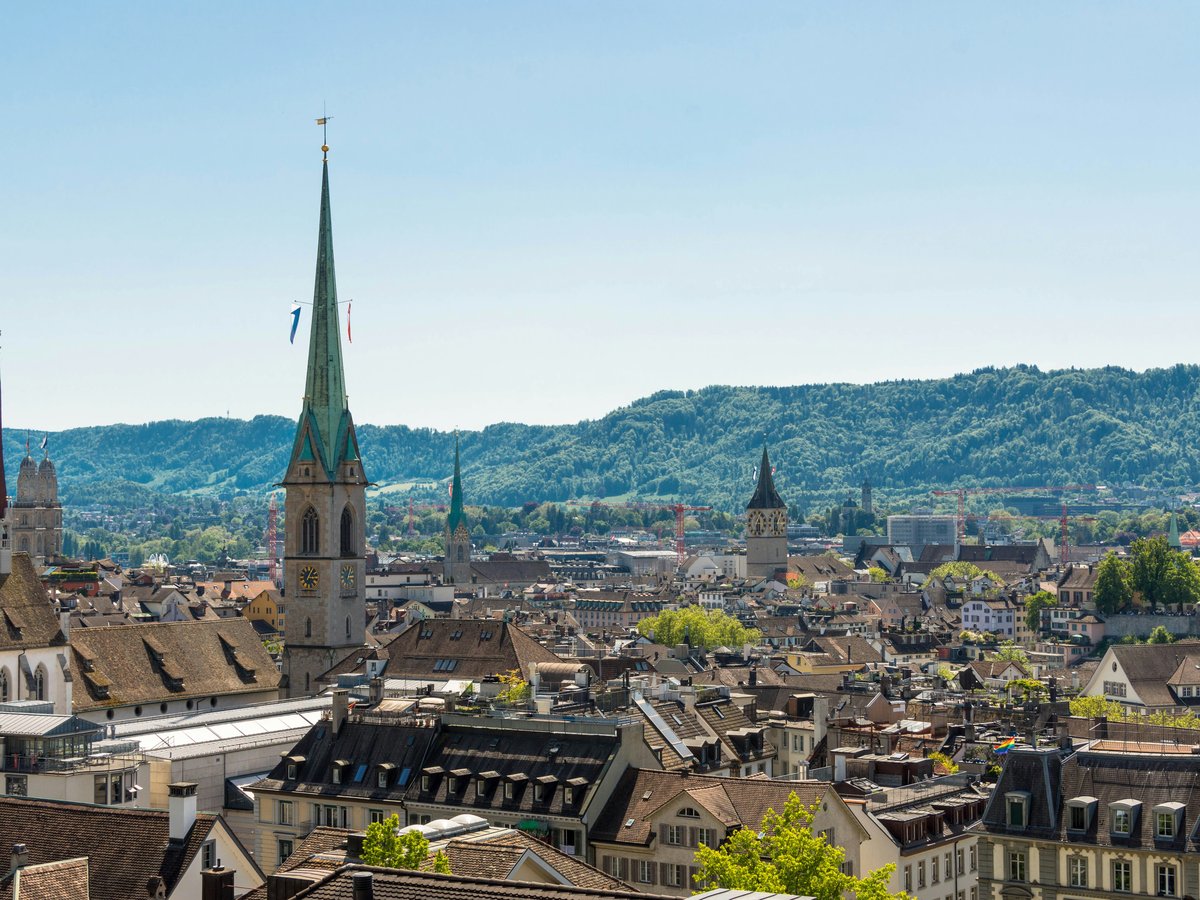
Zurich sits where the Limmat River flows north out of Lake Zurich, and the city's layout follows that water. Kreis 1, the old town, straddles both banks of the Limmat near the lake's northern tip. West of the river, the terrain climbs through Kreis 4's Langstrasse strip into the converted warehouses of Kreis 5. East of the Limmat, Seefeld (Kreis 8) stretches along the lakeshore. South along the western bank, Enge (Kreis 2) reaches toward the residential hills above Wollishofen. The city uses a 12-Kreis numbering system, but most locals say the neighborhood name rather than the number. Walking covers the center in about 25 minutes, and the tram network fills every gap beyond that. Late August brings evenings like tonight's 19.6 degrees and light rain at 88% humidity, when the wet cobblestones in the old town catch the glow from restaurant windows and the air smells of damp stone. The city scores 8.8 out of 10 for solo-traveler safety (see the TTDI Solo-Safety Index), so wandering after dark is not a concern in any district covered here. Worth noting, the feel shifts considerably between Kreise. The banking corridors off Bahnhofstrasse and the gritty Langstrasse strip might as well be in different cities. For general orientation on transit options and walking distances, the Wikivoyage guide is a reliable starting point (https://en.wikivoyage.org/wiki/Zurich#Get_around).
Neighborhoods
-
Altstadt West Bank (Kreis 1, Lindenhof)
The west bank of Kreis 1 is the quieter half of Zurich's old town. Side streets off Bahnhofstrasse hold 19th-century stone facades, and the smell of fresh-ground coffee drifts from espresso bars wedged into ground-floor storefronts. Fraumünster, founded in 853, still anchors the southern end with Marc Chagall's stained-glass windows from 1970. The pace here is slower than the east bank across the river. You'll hear church bells and tram chimes more than foot traffic on a weekday afternoon. Bahnhofstrasse itself runs 1.4 km from Hauptbahnhof to Bürkliplatz at the lake, lined with watch shops and bank headquarters that give way to smaller boutiques on the cross streets.
- Best for
- First-time visitors and anyone who wants to walk to everything. Most of the international hotels sit on or near Bahnhofstrasse, and the central position means no tram is strictly necessary for the old town.
- Key streets
- Bahnhofstrasse (the main shopping corridor, Hauptbahnhof to the lake), Augustinergasse (one of Zurich's oldest lanes with painted facades), Rennweg (local boutiques rather than chains), and Lindenhof, the hilltop square with a direct view across the Limmat toward the twin towers of the east bank.
-
Niederdorf (Kreis 1, East Bank)
Niederdorf is the east bank of the old town, and it runs louder and livelier than its western neighbor. Pedestrianized streets are packed with restaurants, and the smell of bratwurst and warm bread fills the alleys by midday. Grossmünster, completed around 1201, stands at the southern end with its Romanesque twin towers. The buildings here are medieval in bones but painted in yellows, blues, and ochres. At night the bars spill out onto the cobblestones and the noise carries uphill. During the day it still functions as a real neighborhood, with small grocers and a Saturday market on Rosenhof.
- Best for
- Travelers who want to eat and drink within walking distance of their hotel. Niederdorf has the densest concentration of restaurants in the city, from Swiss to Turkish, Thai, and Italian within 2 blocks. The Wikivoyage food guide covers specific options (https://en.wikivoyage.org/wiki/Zurich#Eat).
- Key streets
- Niederdorfstrasse (the main pedestrian spine), Münstergasse (quieter, runs parallel along the cathedral side), Hirschenplatz (a small square that fills with tables in summer), and Spiegelgasse, where Lenin lived at number 14 before departing for Russia in April 1917.
-
Langstrasse (Kreis 4)
Langstrasse is Zurich's most restless district, running about 1 km west of the Sihl River. The street itself is loud, gritty in patches, and lined with kebab shops, dim sum spots, Sri Lankan grocery stores, and late-night bars. The side streets, particularly south toward Stauffacher, quiet down into residential blocks with Art Nouveau facades. This is where Zurich's immigrant communities have lived for decades, and the food reflects it. You'll find some of the city's best Turkish pide, Vietnamese pho, and East African injera within a few minutes of each other. The city scores 8.5 out of 10 for LGBTQ+ friendliness (sourced from TTDI's editorial rubric), and Langstrasse is where much of that community concentrates, with several queer-friendly bars along Brauerstrasse and the main strip.
- Best for
- Budget-conscious travelers and anyone who wants nightlife, diverse food, and a neighborhood that does not feel polished. Hotels in Kreis 4 tend to run 30 to 50 CHF per night cheaper than Kreis 1.
- Key streets
- Langstrasse itself (tram stops Helvetiaplatz to Limmatplatz), Militärstrasse (a quieter residential parallel), Stauffacherstrasse (banks and errands), and Helvetiaplatz, a neighborhood square that hosts a small farmers' market on Fridays.
-
Zürich-West (Kreis 5)
Kreis 5 was an industrial zone until the early 2000s, and the conversion shows. Former machine factories and shipping halls now house restaurants, galleries, and co-working spaces, but the bones remain visible. Steel beams, corrugated walls, loading docks repurposed as terraces. The Viadukt, a 19th-century railway viaduct with 36 stone arches, was converted into a market hall and boutique strip that opened in 2010. The neighborhood smells different from the old town. Less coffee and bread, more concrete and the river. The Limmat runs along its eastern edge. Architecture near Hardbrücke station is tall, modern, and glassy, then drops to old warehouse scale further north toward Escher-Wyss-Platz.
- Best for
- Design-minded travelers, couples looking for interesting restaurants, and anyone who finds the old town too manicured. Mind you, the area north of Hardbrücke can feel empty on weeknights. Several converted-warehouse hotels opened here between 2015 and 2020, with rates comparable to Kreis 1.
- Key streets
- Hardstrasse (the main road through the district), Geroldstrasse (street-food containers and a rooftop bar), Turbinenstrasse (leads to Schiffbau, the theater complex in a former turbine hall), and the Im Viadukt arches along Limmatstrasse.
-
Seefeld (Kreis 8)
Seefeld follows the eastern shore of Lake Zurich south from Bellevue. It feels prosperous without being showy. Residential streets hold well-kept Jugendstil apartment buildings, and the lake promenade fills with runners and dog walkers by 07:00. The Zürich Opera House, which opened its current building in 1965, sits at the northern edge on Sechseläutenplatz, the city's largest open square. Kunsthaus Zürich, the city's main art museum since 1819, is a short walk uphill on Heimplatz, and its 2021 David Chipperfield extension now houses the Foundation E.G. Bührle Collection, established in 1960. The neighborhood's restaurants lean European and mid-to-upper in price. A main course in Seefeld tends to run 35 to 55 CHF.
- Best for
- Couples and art-focused travelers. The proximity to both the opera and Kunsthaus, plus the lake promenade for morning walks, makes Seefeld the obvious base for a culture-heavy visit. A broader list of museums and galleries appears in the Wikivoyage sights section (https://en.wikivoyage.org/wiki/Zurich#See).
- Key streets
- Seefeldstrasse (the main commercial street, lined with cafes and independent shops), Sechseläutenplatz (the opera square, also home to the spring Sechseläuten bonfire festival), Höschgasse (a quieter residential street with lake views), and Utoquai along the water.
-
Enge (Kreis 2)
Enge sits on the western shore of Lake Zurich, south of the old town. It is a residential district first, with wide tree-lined streets, solid early-20th-century apartment blocks, and a pace that feels nearly suburban even though Bürkliplatz is a 10-minute tram ride north. Museum Rietberg, established in 1952 in a neoclassical villa inside Rieterpark, holds one of Europe's significant non-European art collections. The park drops down a wooded slope toward the lake, and in summer the grass fills with families picnicking on the hillside. The city scores 9.2 out of 10 for family friendliness (see the TTDI Family-Friendliness Index), and Enge is likely where that score is most visible on the ground.
- Best for
- Families and travelers who want quiet evenings near the lake. A handful of mid-range hotels and Airbnbs sit along Mythenquai, and the lakeshore path is flat enough for strollers.
- Key streets
- Mythenquai (the lakeside road, with the Strandbad Mythenquai public bath), Tessinerplatz (the square outside Enge station, a direct S-Bahn connection to Hauptbahnhof in about 4 minutes), Bederstrasse (a leafy residential street with neighborhood bakeries), and the paths through Rieterpark.
-
Wiedikon (Kreis 3)
Wiedikon sprawls south and west of Stauffacher, gradually climbing toward the Uetliberg ridge. It has become noticeably more interesting over the past 5 to 10 years as younger residents priced out of Kreis 4 and 5 moved in. The restaurant scene along Birmensdorferstrasse now mixes Portuguese tascas, Middle Eastern bakeries, and small-plate wine bars. Letzigrund, the 26,000-seat stadium rebuilt in 2007, sits at the district's western edge and hosts FC Zürich home matches and the Weltklasse Zürich athletics meet each August. The architecture is mixed. Some blocks feel 1960s and functional. Others, particularly around Idaplatz, have kept their 19th-century facades.
- Best for
- Travelers who want a neighborhood feel with good food options and lower hotel rates than the center. Tram 9 connects Wiedikon to Bellevue in about 12 minutes.
- Key streets
- Birmensdorferstrasse (the main commercial artery, tram 9 runs its length), Idaplatz (a small neighborhood square with a weekend market and playground), Zweierstrasse (connects to Stauffacher and Kreis 4), and Uetlibergstrasse toward the forested ridge.
-
Oerlikon (Kreis 11)
Oerlikon sits 4 km north of Hauptbahnhof and still feels like a separate town that Zurich absorbed. The Hallenstadion, standing since 1939, hosts arena concerts and ZSC Lions ice hockey. Surrounding blocks mix postwar commercial buildings with recent glass-tower developments around the station. The MFO-Park, a steel-frame structure overgrown with climbing plants, is one of Zurich's more unusual green spaces. The food scene here is heavily shaped by the South Asian and East Asian communities living in the area. To be fair, you might find better biryani at a Marktgasse hole-in-the-wall here than anywhere in the old town.
- Best for
- Concert-goers, trade-fair visitors (Messe Zürich is adjacent to the Hallenstadion), and travelers looking for the city's most affordable hotel rates. S-Bahn trains reach Hauptbahnhof in 7 minutes.
- Key streets
- Schaffhauserstrasse (the main road connecting south toward the center), Binzmühlestrasse (leads to MFO-Park), Marktgasse (the old Oerlikon village street, now a strip of small restaurants), and the area around Oerlikon Bahnhof for chain hotels.
FAQ
How expensive is Zurich compared to other European cities?
Zurich is consistently one of Europe's priciest cities. At the current exchange rate, 1 USD buys about 0.799 CHF, so the dollar and franc sit close together. A restaurant main course in the old town runs 38 to 55 CHF. A draft beer costs 7 to 9 CHF. Budget travelers can eat for less in Kreis 4 or Kreis 11, where a kebab or rice plate runs 12 to 16 CHF. Grocery shopping at Migros or Coop helps considerably. Hotel rates in Kreis 1 start around 200 CHF per night for a double, dropping to 130 to 160 CHF in outer districts like Oerlikon or Wiedikon.
Which neighborhood is best for families with children?
Enge (Kreis 2) and Seefeld (Kreis 8) are the strongest choices. Both have flat lakeside promenades, public swimming baths, and low street noise after dark. Enge's Rieterpark has open grass for running around, and Seefeld's Blatterwiese meadow at the Zürichhorn is popular with local families on weekends. The family-friendliness score referenced in the Enge section above holds across both areas. Public transport in Zurich is stroller-accessible on all trams and S-Bahn trains.
Is Zurich walkable, or do I need public transit?
The core, from Hauptbahnhof through the old town to the lake, covers about 1.5 km and is flat. You can walk Kreis 1, Niederdorf, and northern Seefeld without touching a tram. Reaching Zürich-West, Langstrasse, or Wiedikon on foot adds 15 to 20 minutes from the station. Oerlikon requires the S-Bahn. A 24-hour Tageskarte for zone 110 costs 8.80 CHF and covers all trams, buses, and trains within the city.
Is Zurich safe for solo travelers walking around at night?
The solo-safety score referenced in the introduction reflects the reality on the ground. Zurich has low violent-crime rates and well-lit streets in nearly every district. Langstrasse can feel edgier after midnight on weekends, with some visible drug activity near Helvetiaplatz, but it tends to be more unsettling than dangerous. Women traveling alone report feeling comfortable on late-night trams and walking home through the old town. The Wikivoyage safety section covers specific advice for staying aware (https://en.wikivoyage.org/wiki/Zurich#Stay_safe).
What about Zurich for digital nomads and remote workers?
The city scores 4.8 out of 10 for digital-nomad suitability (sourced from TTDI's editorial rubric), and cost is the main reason. Coworking day passes run 40 to 60 CHF, a furnished studio on a monthly lease starts around 2,200 CHF, and food costs compound quickly. Wi-Fi speeds are excellent and the quality of life is high, but the math is difficult for anyone earning in a currency weaker than the franc. Kreis 5 has the densest concentration of coworking spaces, including Impact Hub on Viaduktstrasse.
Are there worthwhile day trips from Zurich?
Kyburg Castle, a medieval fortress about 20 km east of the city, is reachable by S-Bahn to Effretikon and then a bus. Uetliberg, the 871-meter ridge visible from most of the city, is a 20-minute S10 ride from Hauptbahnhof and offers a panorama from the Alps to the Jura range. Rapperswil, at the opposite end of Lake Zurich, takes about 40 minutes by S-Bahn and has a lakefront castle, a rose garden, and noticeably smaller crowds.
Last verified by automated review (v1.7.2) on . What is automated review?