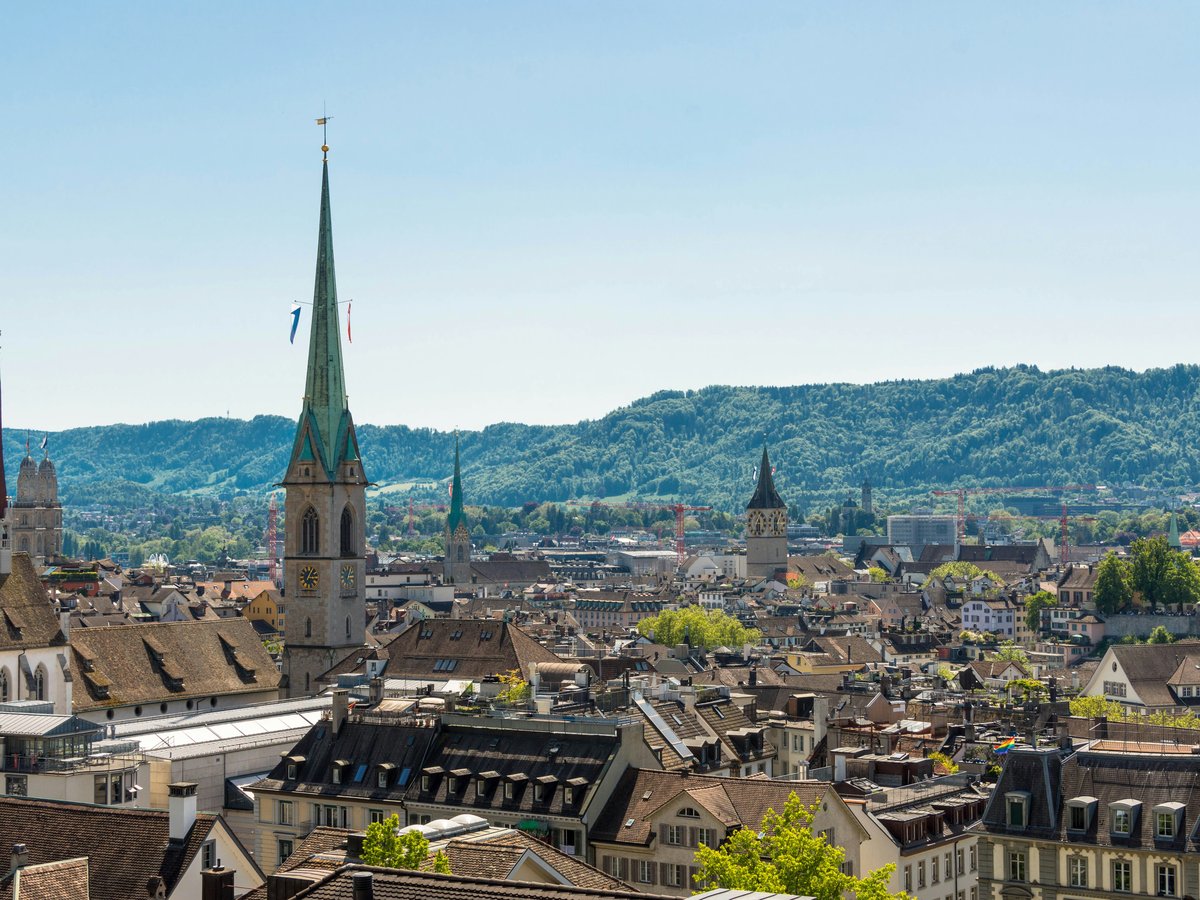
Stay in Zurich in January
78 hotels in the Trip.com pool for Zurich, from US$60 a night.
Opens Trip.com on Fri 1 Jan to Sun 3 Jan 2027; change the dates there.
January is Zurich's greyest month. The phenomenon locals call Hochnebel, a thick layer of high fog, tends to settle over the Swiss Plateau and can hang there for days without breaking. Daytime temperatures hover around 5°C (40°F), and nights regularly drop a couple of degrees below freezing. Sunrise comes late, around 8:10, and by 16:50 the light is gone. That works out to roughly 8 hours and 40 minutes of daylight, and much of it arrives filtered through a flat, uniform grey. The air on those mornings smells of wet stone and damp wool. The Christmas stalls at Sechseläutenplatz have been dismantled by early January, and the post-holiday quiet is real.
That said, this is still Zurich. The trams run on time. The lake, even under grey skies, holds a particular grey-green winter tone. Fondue restaurants in Niederdorf fill their tables by 19:00 on weekends, the warm cheese smell drifting out onto the cobblestones. The Kunsthaus Zürich, which has shown art since 1819, is far more pleasant to wander when galleries hold 20 visitors instead of 200. January also puts you within 90 minutes of serious Alpine skiing at resorts like Flumserberg and Hoch-Ybrig, and SBB trains make the connections straightforward.
The honest assessment. January is not a month that sells itself. You are paying Swiss prices for short days and limited outdoor appeal. But if you are combining the city with Alps skiing, or you genuinely prefer museums and warm restaurants over lakeside terraces, there is a stripped-down quality to winter Zurich that some travelers find worth the trip. The city scores 8.8 out of 10 for solo-traveler safety (see the TTDI Solo-Safety Index), and walking the Altstadt alone at 22:00 in midwinter feels entirely unremarkable.
Why visit in January
- Hotel rates drop 15 to 25% from December's holiday peak, and availability improves across most neighborhoods. January tends to be the cheapest month in a city where 'cheap' still means Swiss prices.
- Crowds at major attractions thin significantly. The Grossmünster, which has drawn visitors since 1201, and the Fraumünster (founded 853) can both be explored without tour-group congestion.
- Proximity to ski resorts with reliable January snow coverage. Flumserberg in St. Gallen canton and Hoch-Ybrig in Schwyz are both under 90 minutes by train from Hauptbahnhof.
- Peak fondue and raclette season. Restaurants across Niederdorf and Kreis 5 run dedicated winter cheese menus from November through March, and January is when the culture feels most alive.
Worth knowing
- Hochnebel can persist for 7 to 10 consecutive days, producing a relentless grey that genuinely affects mood. January averages only about 2 hours of direct sunshine per day.
- Short days. Under 9 hours of light, and much of it dimmed through fog or cloud cover. Outdoor photography becomes a gamble on rare clear mornings.
- Lakeside activities effectively shut down. Swimming areas close, boat tours run minimal winter schedules, and the terrace-bar culture along Zürichsee disappears until April.
- Icy cobblestones in the Altstadt and along the Limmat. The combination of wet conditions and centuries-old stone surfaces catches visitors off guard, especially near the Quaibrücke and Lindenhof steps.
Best for
Think twice if
Zurich in January typically sits under persistent Hochnebel, the high fog that blankets the Swiss Plateau from December through February. The fog layer hovers at 800 to 1,000 meters, and Zurich at 408 meters elevation lies well below it. Daily highs average 4.6°C (40°F) and nights drop to -1.4°C (29°F). Humidity stays around 84%, and you can expect rain or wet snow on about 13 of 31 days, with total precipitation near 99mm (3.9 inches). It is the damp kind of cold, the sort that settles into your fingers at tram stops and follows you into restaurants. When the fog does break, Alpine views from the lakefront appear sharper in dry winter air than at any other time of year. Mind you, those clear spells might total 5 or 6 days across the whole month.
Seasonal caution
- Temperatures regularly drop below 0°C (32°F) at night. Cold snaps can push overnight lows to -10°C (14°F) or lower, particularly during clear-sky windows between Hochnebel episodes.
- Icy conditions on cobblestone sidewalks and bridge surfaces, especially before 9:00 when city crews have not yet applied salt. The Altstadt and Lindenhof steps are particularly slippery after overnight frost.
- Persistent Hochnebel can reduce visibility and block direct sunshine for 7 to 10 consecutive days. While not a physical hazard in the city, it affects driving on foggy mountain roads outside Zurich and has a measurable impact on mood during extended grey stretches.
Year-round climate
Averages from the last 5 years.
| Month | Avg high (°C) | Avg low (°C) | Rainfall (mm) |
|---|---|---|---|
| Jan | 5 | -1 | 99 |
| Feb | 8 | 0 | 54 |
| Mar | 11 | 2 | 76 |
| Apr | 14 | 4 | 100 |
| May | 18 | 9 | 151 |
| Jun | 25 | 14 | 121 |
| Jul | 25 | 15 | 168 |
| Aug | 25 | 15 | 118 |
| Sep | 20 | 12 | 117 |
| Oct | 16 | 8 | 95 |
| Nov | 8 | 3 | 122 |
| Dec | 5 | 0 | 113 |
Holidays and festivals in January
Public holidays
- New Year's Day(Neujahr)1 January 2027
- St. Berchtold's Day(Berchtoldstag)2 January 2027
- Epiphany(Heilige Drei Könige)6 January 2027
Best things to do in January
Day skiing at Flumserberg or Hoch-Ybrig
outdoorZurich sits within 90 minutes of several ski areas by SBB train. Flumserberg is the largest resort in the eastern Swiss Mittelland with runs above 1,200 meters. Hoch-Ybrig in Schwyz Canton offers quieter slopes and shorter lift lines. Both have reliable January snow coverage.
January typically has the deepest snowpack of the season, and weekday slopes are noticeably emptier than the February Sportferien school-holiday period.Booking tipBuy the SBB Snow'n'Rail combo ticket for a bundled train-plus-lift-pass discount. Available at ticket machines or the SBB Mobile app.
Uetliberg fog escape
natureThe S10 train from Zürich Hauptbahnhof takes about 20 minutes to reach Uetliberg's summit station at 869 meters. On Hochnebel days, the peak sits above the fog layer. You step out of thick grey into hard sunshine, with views across a white cloud sea to the Bernese Alps and the Glarner range. The contrast is startling.
Hochnebel frequency peaks in January. The gap between grey city and sunlit summit is more dramatic this month than at any other time of year.Booking tipNo booking needed. The S10 runs every 30 minutes. A standard ZVV zone ticket covers the trip.
Kunsthaus Zürich winter visit
cultureThe 2021 extension by David Chipperfield doubled the exhibition space. January's low visitor numbers mean you can stand alone in front of the Giacometti collection or the Foundation E.G. Bührle paintings, established as a collection in 1960 and now housed in the new wing. The top-floor café looks out at the fog pressing against the glass.
Visitor numbers drop sharply after the holidays. Gallery space that feels crowded in August feels spacious and quiet in January.Booking tipFree admission on Wednesdays. The permanent collection alone takes 2 to 3 hours.
Fondue-Tram through the city streets
foodVBZ, the Zurich transit authority, operates a vintage tram fitted with tables where passengers eat cheese fondue while the tram loops through the city. The ride lasts about 2 hours and passes along Bahnhofstrasse, the lakefront, and parts of the Altstadt. Windows fog from the heat inside while January streets pass by in soft focus.
The Fondue-Tram runs November through March. January is deep fondue season, and the experience of eating melted cheese in a warm, rocking tram while grey evening streets slide past captures the month.Booking tipBook at least 3 weeks ahead for weekend departures. Weeknight availability is usually better.
ZSC Lions ice hockey at Hallenstadion
sportsThe Hallenstadion in Oerlikon, built in 1939, holds about 11,200 fans for Swiss National League hockey. ZSC Lions home games bring a loud, partisan crowd. The standing section behind the goal drums and chants through every period. Tickets start around CHF 30 for upper sections.
The National League regular season runs September through March. January games often carry playoff-positioning stakes, and the atmosphere in a cold-weather month tends to be more charged than early-season autumn fixtures.Booking tipTickets available through the ZSC Lions website. Weekend games sell faster, but Tuesday or Friday fixtures usually have seats available a few days out.
Thermalbad and Spa Zürich
wellnessThe spa occupies a renovated 19th-century brewery in the Hürlimann Areal in Enge. The rooftop thermal pool holds water at around 36°C (97°F) with views across the city skyline. On fog days you are soaking in warm water looking out at grey mist. On clear days the Alps line the southern horizon.
The contrast between sub-zero outdoor air and 36°C pool water is strongest in January. Stepping outside in the cold and lowering into thermal water is an experience specific to deep winter.Booking tipBook 1 to 2 weeks ahead for weekend evening sessions. Weekday mornings are rarely full.
Winter swimming in the Limmat
outdoorCold-water swimming has an active following in Zurich. The Frauenbadi on the Stadthausquai and Männerbadi at the Schanzengraben both keep their river-fed pools accessible through winter. Water temperature in January sits around 4 to 6°C (39 to 43°F). The shock is immediate. So is the clarity afterward.
January offers the coldest water of the year, which is the draw for cold-plunge regulars. The practice peaks in winter, and locals tend to be welcoming to first-timers who show up and ask how to start.Tonhalle-Orchester Zürich concerts
cultureThe Tonhalle, Zurich's premier classical music venue near Sechseläutenplatz, hosts the Tonhalle-Orchester throughout the winter season. January typically features 4 to 6 orchestral programs. The resonance of a full orchestra in a hall built for that sound is worth an evening, especially when the alternative is fog and darkness outside.
The classical season is in full swing. January programs often include major symphonic cycles, and tickets are easier to get than the sold-out December holiday performances.Booking tipCheck the Tonhalle website for specific programs. Weeknight concerts are generally easier to book than Saturday evening performances.
What to eat in January
On menus now
Fondue moitié-moitié
The defining Swiss winter dish peaks in January. Zurich restaurants serve fondue moitié-moitié, a 50/50 blend of Gruyère AOP and Vacherin Fribourgeois, in heavy ceramic caquelon pots over spirit burners. The bread cubes come from crusty pain de campagne. Two people splitting a pot typically pay CHF 35 to 50 at Altstadt restaurants.
Raclette
Half-wheel raclette peaks as a cold-weather fixture at restaurants across Kreis 5 and Niederdorf. The cheese melts under a table-side heater, gets scraped with a broad knife onto boiled potatoes, cornichons, and pickled pearl onions. The smell of browning cheese fills the room within seconds.
Alplermagronen
Macaroni baked with potatoes, cream, and alpine cheese, topped with crispy onions and served alongside applesauce. The dish originates from Alpine huts and appears on Zurich restaurant menus mainly from November through March. Starchy warmth and sharp cheese together, built for exactly this kind of cold.
Vermicelles
A chestnut-cream dessert pressed through a fine ricer to resemble pale noodles, topped with whipped cream and meringue. The season runs roughly October through February, so January is toward the end. Sprüngli at Paradeplatz serves a reliable version.
Bündnerfleisch
Air-dried beef from Graubünden, sliced paper-thin into deep-red, slightly gamey sheets. Typically served as a cold starter alongside gherkins, rye bread, and a glass of Pinot Noir from the same canton. The drying process takes several months, and the concentration of flavor is immediate.
Nüsslisalat
Switzerland's winter salad green, sometimes called lamb's lettuce or mâche. Available fresh from about November through March. Zurich restaurants typically dress it with a warm bacon vinaigrette that wilts the edges of the leaves, then top it with hard-boiled eggs and croutons. It appears on almost every lunch menu in January.
Regular events in January
BerchtoldstagFree
Public holiday in the canton of Zurich on January 2. Most shops and some restaurants close. Public transport runs on a Sunday schedule. The day catches visitors off guard when they find Bahnhofstrasse shuttered.
January 2Zürich Opera House winter season
The Zürich Opera House, which opened in its current form in 1965, typically runs new productions and repertoire revivals through January. Ballet and opera alternate evenings, with about 15 to 20 performances across the month.
Throughout JanuaryWinterschlussverkauf (winter end-of-season sales)Free
Post-holiday retail discounts across Bahnhofstrasse, Jelmoli department store, and shops in Niederdorf. Sales typically start the first working day after New Year and run through late January, with the deepest discounts appearing in the final 2 weeks.
Early to late JanuaryBest places this January
Lindenhof
viewpointThis elevated square in the Altstadt offers the most accessible viewpoint over the Limmat and Niederdorf rooftops. On rare clear January mornings, snow-covered peaks appear in the distance. On fog days, the bare linden trees and mist rolling off the river produce a mood that photographs well in black and white.
AltstadtNational Museum Zurich (Landesmuseum)
museumDirectly adjacent to Hauptbahnhof, the museum traces Swiss cultural history from the Middle Ages onward. The building, completed in 1898, resembles a Loire Valley château. January's low foot traffic means the medieval armory and period room collections feel almost private. The modern extension hosts rotating exhibitions.
AltstadtMuseum Rietberg
museumThe museum occupies the grounds of the Villa Wesendonck in Enge and has held non-European art since 1952. The Asian and African collections span material from the 6th century onward. Underground galleries lit by natural skylights have their own winter quality. The surrounding parkland is bare in January, but the walk from Enge station through the park is quiet and pleasant on dry days.
EngeBahnhofstrasse during January sales
shoppingZurich's main shopping street runs from Hauptbahnhof south to Bürkliplatz on the lake. The Winterschlussverkauf brings discounts of 30 to 50% at many retail stores in the first weeks of January. The street is less crowded than December, and Sprüngli at Paradeplatz still serves Luxemburgerli worth the brief queue.
City CenterSeefeld lakefront walk
walkThe eastern shore of Lake Zurich from Bellevue through Seefeld to Tiefenbrunnen stretches about 3 km along the water. In January the path is free of the cyclists and inline skaters that crowd it in summer. On fog mornings, the lake surface disappears into grey. On clear mornings, the Glarner Alps reflect in still water. The cafes along the route stay open year-round.
SeefeldGrossmünster towers
landmarkClimbing the tower at Grossmünster gives you an elevated view of the Altstadt and Limmat from the eastern bank. January's bare trees mean you can see more of the roofscape and the Fraumünster spire than in summer. Inside, the stained glass windows by Sigmar Polke, installed in 2009, are worth seeing regardless of weather. The Romanesque crypt below the choir is cool and quiet.
Altstadt
Your packing checklist
Tick items off as you pack. Your progress saves in this browser.
All packed — have a great trip.
Insider tips
When Hochnebel locks in, check the Uetliberg summit webcam (hosted on the Zürich Tourism site) before riding up. Most days the fog breaks at about 800 meters, but occasionally it extends higher and you emerge into more grey. The webcam saves a wasted 40-minute round trip.
Sprüngli at Paradeplatz draws a queue at the ground-floor counter. The lower level café serves the same Luxemburgerli and coffee with a shorter wait. Locals tend to head straight downstairs.
The ZürichCARD (available in 24-hour and 72-hour versions) covers all city-zone public transit plus free or discounted entry to most museums. In January, when you will likely visit 2 to 3 museums to fill grey days, the card pays for itself on the first day.
For cheaper fondue, skip the tourist-facing places on Münstergasse in the Altstadt. Cooperative-run restaurants in Kreis 4 and Kreis 5 typically charge CHF 25 to 30 per person for a moitié-moitié, roughly 40% less than the Altstadt equivalents.
Migros and Coop grocery stores close entirely on Sundays. The shops inside Hauptbahnhof stay open 7 days a week until 21:00 and include a good Migros and pharmacy. Stock up there if you arrive on a Sunday or on Berchtoldstag.
Avoid these mistakes
- Planning outdoor-heavy itineraries without indoor alternatives. Hochnebel can persist for a full week, and if your trip is built around lake cruises and park walks, you will face grey skies and limited daylight with no backup. Build museums, thermal baths, and restaurant reservations as primary activities, not fallbacks.
- Expecting shops to be open on January 2, which is Berchtoldstag. It is a cantonal holiday in Zurich, and most retail and some restaurants close. If your first full day falls on January 2, plan for museum visits or restaurant reservations instead of shopping.
- Underpacking for the cold. Zurich looks like a mild temperate city on a map, but January cold snaps push nights to -10°C (14°F) or lower, and wind off the lake adds to the chill. Autumn-weight layers are not enough. Bring proper winter insulation.
- Visiting lakefront viewpoints in thick fog and expecting a panorama. On Hochnebel days, you will see grey from Bürkliplatz and the Bellevue terrace. Instead, take the S10 to Uetliberg where you are likely to break above the fog layer into clear sky.
Practical tips for January
Most Zurich shops close by 18:30 on weekdays and 17:00 on Saturdays. Sunday retail closures are nearly universal except at Hauptbahnhof, where shops stay open until 21:00. January 1 (New Year's Day) and January 2 (Berchtoldstag) are both public holidays, and most retail remains closed for both. SBB trains to ski resorts run expanded weekend schedules in January. Check sbb.ch for the winter timetable, as departure times shift from the summer schedule. Restaurants in the Altstadt and Niederdorf tend to fill by 19:30 on Friday and Saturday evenings during fondue season, so reserve by early afternoon. The Swiss franc traded at roughly 0.80 CHF per 1 USD as of late 2026. Tipping is not expected but appreciated. Locals typically round up to the nearest franc or add 5 to 10% at sit-down restaurants. Credit cards work almost everywhere, though some smaller Altstadt shops still prefer cash or the Twint mobile payment app.
FAQ
Is January a good time to visit Zurich?
January is a fair month for Zurich. The city is cold, grey, and running on under 9 hours of daylight. Persistent Hochnebel fog is the defining weather feature, and it can last for a week or more without breaking. That said, tourist crowds are at their annual low, hotel prices dip, and the cultural calendar of opera, orchestral concerts, and museum exhibitions runs at full capacity. January works best as part of a ski trip or for travelers who prioritize indoor culture over outdoor scenery.
What is the weather like in Zurich in January?
Cold and grey. Daytime highs stay in low single digits Celsius, and nights consistently drop below freezing. The defining challenge is Hochnebel, the persistent fog layer that can block direct sunshine for days at a time. Humidity runs high, and you should expect rain or wet snow regularly throughout the month. Dress in proper winter layers with waterproof boots and an insulated jacket. Clear days do happen, and they reveal sharp Alpine views, but you cannot count on them.
Is Zurich crowded in January?
No. January is Zurich's quietest tourist month. The December Christmas market visitors have gone, and summer travelers are months away. Museums, restaurants, and public transport all feel noticeably less busy. You can walk into most restaurants without a reservation on weeknights, and museum galleries are often nearly empty on weekday mornings. The Kunsthaus and National Museum in particular feel spacious compared to their summer peak.
Can I ski near Zurich in January?
Yes, and it is one of the strongest reasons to visit in January. Flumserberg and Hoch-Ybrig, the closest resort options, both have reliable January snow coverage and sit under 90 minutes from Hauptbahnhof by SBB train. Engelberg and the Titlis glacier offer higher-altitude runs for those willing to travel a bit further. The SBB Snow'n'Rail ticket bundles the train and lift pass at a discount and can be purchased at any SBB ticket machine or on the mobile app.
What should I wear in Zurich in January?
Dress for real winter. Insulated waterproof boots are the single most important piece, because icy cobblestones in the old town are a genuine slip hazard. Layer with wool or synthetic base layers, add a down or insulated jacket that blocks wind, and bring a hat, gloves, and scarf. Carry an umbrella for the frequent rain. If you plan to visit the thermal baths or try the Limmat cold-plunge swimming, pack a swimsuit as well.
Things to Do in Zurich in January
 Free cancellation
 Mount Titlis and Lucerne Day Trip from Zurich
Day trip: 10 hours, free cancellation.
via Viator Free cancellation
 Jungfraujoch: Top of Europe Day Trip from Zurich
Day trip: 11.5 hours, free cancellation.
via Viator Free cancellation
 Jungfraujoch Day Trip from Zurich: Swiss Alps & Bernese Oberland
Day trip: 12 hours, free cancellation.
via Viator Free cancellation
 Zurich Old Town Walking Tour
City tour: 2 hours, free cancellation.
via Viator Free cancellation
 Zurich Grindelwald, Lauterbrunnen Lungern Interlaken Semi Private
Day trip: 10 hours, free cancellation.
via Viator Free cancellation
 Private, excellent guided tour of Zurich (from CHF 21/pers.)
City tour: free cancellation.
via ViatorFind a flight to Zurich
Live fares to Zurich appear here once cookies are accepted.
Last verified by automated review (v1.7.2) on . What is automated review?