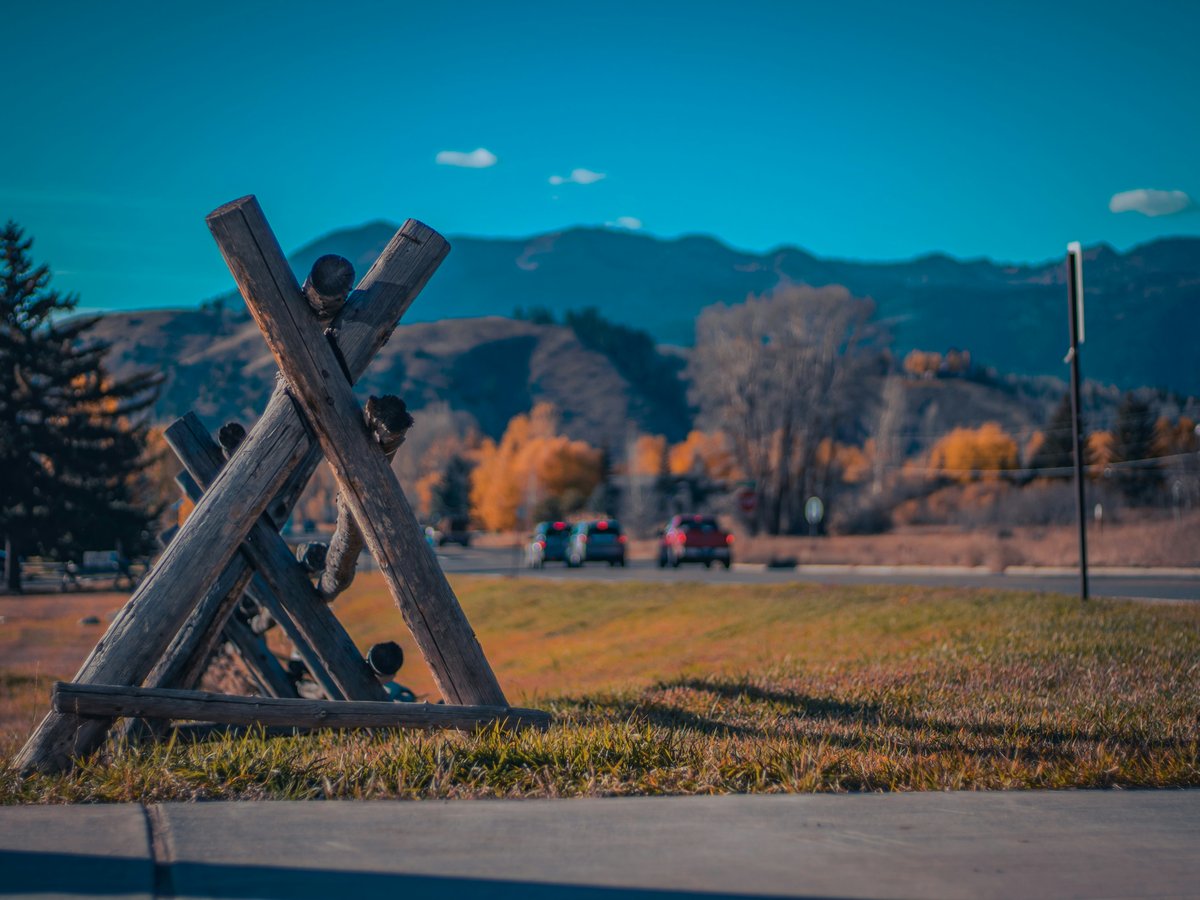
Jackson Hole sits in a narrow valley between the Teton Range to the west and the Gros Ventre Range to the east, at roughly 1,900 meters of elevation. The town of Jackson anchors the southern end of this valley, with Grand Teton National Park starting about 10 kilometers north and Yellowstone beyond that. It is a place built around proximity to big mountains, cold rivers, and public land. The Tetons rise nearly 2,100 meters above the valley floor without foothills, which gives the range that abrupt, wall-like quality you notice the moment you drive in from the south on US-191. Winters are long and serious here. Snow typically lingers into May at higher elevations, and overnight temperatures can drop below freezing well into June. Summer, from late June through September, is when the hiking and paddling seasons compress into a short, intense window. The town itself has about 10,500 permanent residents, though that number swells considerably during ski season and the July-August peak. Worth noting, Jackson Hole scores 8.3/10 for solo-traveler safety (see the TTDI Solo-Safety Index), which reflects the generally low crime rate and a well-maintained trail system with reliable signage across both the national park and the Bridger-Teton National Forest.
Outdoor activities
-
Mountain Biking in the Bridger-Teton National Forest
The Cache Creek trail system starts at the eastern edge of Jackson, roughly a 5-minute ride from the town square. You can piece together 30+ kilometers of singletrack through sagebrush meadows and aspen groves without needing a shuttle. The Putt-Putt trail offers a mellow warm-up loop, while Game Creek delivers steeper, more technical terrain with loose rock sections. Bikes are prohibited inside Grand Teton National Park, so the national forest land east and south of town absorbs most of the local riding. Teton Mountain Bike Tours on North Cache Street rents full-suspension rigs starting around $75/day.
- Difficulty
- Easy to Advanced depending on route choice
- Duration
- 2-5 hours
- Best season
- Late June through September, once snowmelt clears the upper trails
-
Rock Climbing in Death Canyon and Cascade Canyon
The Tetons draw climbers for the alpine granite, and the approaches are shorter than you might expect. Guides Canyon, at the southern end of the range near the Death Canyon Trailhead, has a selection of moderate single-pitch sport and trad routes accessible in a half-day from the valley. The bigger objectives, including the Grand Teton itself at 4,199 meters, typically require 2 days and a guide service. Exum Mountain Guides, operating in the park since 1931, runs the standard guided ascent for around $1,100-$1,200 per person. You will need a backcountry permit for any overnight climbing trip in the park.
- Difficulty
- Moderate to Expert
- Duration
- Half-day crag sessions to multi-day alpine routes
- Best season
- July through mid-September, when the high routes are snow-free
-
Paragliding from Rendezvous Mountain
The Jackson Hole Mountain Resort aerial tram lifts you to 3,185 meters at the top of Rendezvous Mountain. From there, tandem paragliding flights descend over the valley with views of the full Teton Range to the west. Jackson Hole Paragliding runs tandem flights that last 15-25 minutes and cost around $350-$400 per person. Wind conditions tend to be most favorable in the morning hours. No experience needed for the tandem option.
- Difficulty
- None for tandem passengers
- Duration
- 15-25 minutes in the air, plus tram ride
- Best season
- June through September
-
Cross-Country Skiing at Trail Creek
Winter turns the valley into Nordic terrain. The Trail Creek Nordic Center, operated by the Jackson Hole Nordic Alliance, maintains about 17 kilometers of groomed classic and skate lanes southeast of Wilson. A day pass runs around $20. The flat valley floor and consistent December-through-March snow coverage make this a reliable option when the Teton backcountry is locked down by avalanche risk. You might hear coyotes at dusk along the quieter loops near the Snake River corridor.
- Difficulty
- Easy to Moderate
- Duration
- 1-3 hours
- Best season
- December through March
-
Wildlife Safari by Vehicle in Grand Teton and Yellowstone
Dawn drives along the Moose-Wilson Road and Antelope Flats Road regularly produce moose, bison, pronghorn, and occasionally black bears. The stretch between Moose Junction and Moran Junction, roughly 30 kilometers of highway, passes through prime habitat where elk herds gather from September onward. Guided wildlife tours run early morning and evening departures, typically $200-$275 per person for a 4-hour circuit. Bring binoculars with at least 8x magnification, and keep 90 meters from bears and wolves per park regulations.
- Difficulty
- Easy
- Duration
- 3-5 hours for a full circuit
- Best season
- May through October for variety, September for elk rut
-
Backcountry Skiing in Teton Pass
Teton Pass, at 2,565 meters on Highway 22 between Jackson and Victor, Idaho, is the local backcountry skiing hub. The Glory Bowl and Mt. Glory access points sit right off the highway, with 600+ meters of vertical in steep, avalanche-prone terrain. This is expert-level touring that demands avalanche training, a beacon, probe, and shovel. The Bridger-Teton Avalanche Center posts daily advisories from November through April. A Level 1 avalanche course through the American Avalanche Institute in Jackson costs around $350.
- Difficulty
- Advanced to Expert
- Duration
- 3-6 hours per lap
- Best season
- December through April, conditions dependent
Day hikes
-
Cascade Canyon Trail
This is the signature Teton day hike. Take the Jenny Lake boat shuttle ($20 round trip) to cut 3 kilometers off each direction, then hike west into the canyon. The trail follows Cascade Creek through a narrow glacial valley with granite walls rising on both sides. At about 5.5 kilometers from the west boat dock, you reach the Cascade Canyon fork. The south fork leads toward Hurricane Pass, the north toward Lake Solitude. Turning around at the fork makes a manageable day. The trail is well-maintained, with moderate elevation gain of around 340 meters to the fork. Grizzly bears frequent this drainage, so carry bear spray and make noise on blind corners.
- Difficulty
- Moderate
- Duration
- 4-6 hours round trip with the boat shuttle
- Best season
- Late June through September
-
Delta Lake
A steep, unofficial climber's trail branches off the Lupine Meadows path and gains roughly 700 meters over about 4.5 kilometers to reach Delta Lake, a turquoise glacial tarn sitting in a cirque below the Grand Teton's east face. The route is not signed. It follows a rocky gully that requires some scrambling over boulders and can be hard to follow in early season when snow patches obscure the bootpath. The lake water hovers around 5-7°C even in August. Start early to avoid afternoon thunderstorms.
- Difficulty
- Strenuous
- Duration
- 5-7 hours round trip
- Best season
- July through September
-
Taggart Lake and Bradley Lake Loop
A gentler option that still delivers close Teton views. The trailhead sits along the Teton Park Road, and the loop connecting both lakes covers about 9 kilometers with roughly 200 meters of elevation gain. Taggart Lake fills a moraine-dammed basin, while Bradley Lake sits slightly higher and tends to be quieter. The trail passes through a 2010 burn zone where fireweed and young aspens have filled in. The mid-morning light on the Teton peaks reflected in Bradley Lake is the visual highlight. The parking lot fills by 9:00 a.m. in July and August.
- Difficulty
- Easy to Moderate
- Duration
- 3-4 hours
- Best season
- June through October
-
Surprise and Amphitheater Lakes
From the Lupine Meadows Trailhead, this route climbs roughly 900 meters over about 8 kilometers one way. It is relentless. The switchbacks feel endless through the Douglas fir, but the reward is two alpine lakes perched high above the valley floor with direct views across to the Gros Ventre Range. Amphitheater Lake, a few minutes past Surprise, sits at about 2,926 meters. Snow lingers on the upper trail well into July some years. Carry extra water, as there are no reliable sources after the first kilometer.
- Difficulty
- Strenuous
- Duration
- 6-8 hours round trip
- Best season
- Mid-July through September
-
Phelps Lake via Death Canyon Trailhead
The trail drops from the trailhead to the Phelps Lake overlook in about 1.5 kilometers, then continues down to the lakeshore. The loop option circles the lake and returns via the Valley Trail, covering roughly 12 kilometers with moderate elevation changes. Phelps Lake sits at the mouth of Death Canyon, and the water is clear enough to see the cobble bottom from the shore. The Laurance S. Rockefeller Preserve visitor center near the trailhead limits parking to about 50 vehicles, so arrive before 8:30 a.m. in peak season or walk in from the Granite Canyon Trailhead.
- Difficulty
- Moderate
- Duration
- 4-5 hours for the full loop
- Best season
- June through October
-
Snow King Summit Trail
The closest hike to downtown Jackson starts at the base of Snow King Mountain, about 6 blocks south of the town square. The trail gains approximately 460 meters over 2.5 kilometers, switchbacking up the steep west face. It is short but honest. The summit gives a full valley view with the Tetons lined up across the west. Locals use this as a before-work fitness climb. You can ride the scenic chairlift down for $20 if your knees protest the steep descent.
- Difficulty
- Moderate to Strenuous
- Duration
- 1.5-2.5 hours round trip
- Best season
- May through October
Water activities
-
Float Trip on the Snake River
The Snake River runs through the center of Jackson Hole valley, and the 8-kilometer scenic stretch between Deadman's Bar and Moose Landing is the classic float. Commercial outfitters run large rubber rafts that hold 10-15 passengers, typically $80-$95 per adult for a 3-hour trip. The current moves at a walking pace through braided channels lined with cottonwoods, and it is common to spot bald eagles, osprey, and moose along the banks. The water temperature stays around 10-13°C through summer. Mind you, this is not whitewater. It is a mellow drift.
- Difficulty
- Easy, suitable for children 6+
- Duration
- 3 hours on the water
- Best season
- Late May through September
-
Whitewater Rafting in Snake River Canyon
South of Jackson, the Snake River enters a canyon with Class III rapids like Big Kahuna and Lunch Counter. The 13-kilometer stretch between West Table and Sheep Gulch delivers consistent wave trains and a few legitimate drops during peak runoff in June. By August, the water level drops and the rapids mellow to Class II. Half-day trips through outfitters such as Dave Hansen Whitewater run $85-$110 per adult. Wetsuits or splash jackets are provided, which you will want. The canyon water runs colder than the scenic section upstream.
- Difficulty
- Moderate, Class II-III depending on water levels
- Duration
- 3-4 hours including shuttle
- Best season
- Late May through August, peak rapids in June
-
Kayaking and Canoeing on String Lake
String Lake, in Grand Teton National Park, is the warmest swimmable lake in the area. It is shallow enough that surface temperatures reach 18-20°C by late July. The lake is about 1.5 kilometers long, narrow, and sheltered from wind by the surrounding forest. You can rent kayaks and canoes at the String Lake launch area for around $25/hour through the park concessioner. Paddling the full length and back takes about 90 minutes at a relaxed pace. The Teton peaks fill the western skyline from the water. The parking lot at the String Lake trailhead is notoriously competitive. Arrive by 8:00 a.m. or try late afternoon after 4:00 p.m.
- Difficulty
- Easy
- Duration
- 1-3 hours
- Best season
- July through early September
-
Kayaking on Jackson Lake
Jackson Lake is the big water in the valley, covering about 10,400 hectares with a maximum depth of 134 meters. It is a serious lake, not a pond, and afternoon winds can build 0.5-meter waves with little warning. Paddle in the morning when conditions tend to be calmer. Colter Bay and Signal Mountain Lodge both rent kayaks, starting around $30/hour. The paddle from Colter Bay to the small islands offshore is a popular half-day route. Water temperature rarely exceeds 15°C, so a dry suit or proper layering matters for safety. Motorboats share the lake, so stay aware of wakes near the marinas.
- Difficulty
- Moderate, due to wind exposure and cold water
- Duration
- 2-5 hours depending on route
- Best season
- July through September
-
Fly Fishing on the Snake River and Flat Creek
The Snake River's fine-spotted cutthroat trout are a genetically distinct subspecies found only in this drainage. The river fishes well from July through October, with terrestrial patterns like hoppers and ants productive through August and September. A Wyoming fishing license costs $14/day for nonresidents. Flat Creek, running through the elk refuge north of town, has a restricted catch-and-release section open August 1 through October 31 with fly-only regulations. Half-day guided wade trips on the Snake run $350-$450 for 1-2 anglers through local shops like Westbank Anglers or Snake River Angler.
- Difficulty
- Moderate, wading in current requires some fitness
- Duration
- Half-day to full-day
- Best season
- July through October
Parks & gardens
-
George Washington Memorial Park
FreeThis small park sits in the center of Jackson, adjacent to the town square. It functions as the civic green, with mature cottonwood trees providing shade in summer and a flat lawn where locals stretch out during the Wednesday farmer's market. The four elk-antler arches at the corners of the adjacent square were built from naturally shed antlers collected by the Boy Scouts, and the park connects to the square's walking paths.
Highlights: Elk-antler arches framing the town square, shaded picnic areas, summer farmer's market proximity
-
Jackson National Fish Hatchery
FreeFounded in 1950, this federal facility sits about 2 kilometers north of downtown Jackson on Fish Hatchery Road. It raises native Snake River cutthroat trout, and the outdoor raceways where you can watch thousands of fish at various growth stages feel more like a nature walk than a government operation. The surrounding grounds include a short interpretive trail along Flat Creek, where wild trout hold in the current beside the hatchery outflow. Families with kids tend to spend about an hour here.
Highlights: Outdoor trout raceways, Flat Creek interpretive trail, free admission year-round
-
National Elk Refuge
FreeThe refuge covers roughly 10,000 hectares of valley floor immediately north and east of town. In winter, 5,000-7,000 elk gather on the flats, and the U.S. Fish and Wildlife Service runs horse-drawn sleigh rides through the herd from mid-December through early April, at around $30 per adult. In summer the elk disperse to higher elevations, but the refuge road still offers good birding, with trumpeter swans on the ponds and Brewer's blackbirds in the sagebrush. The Miller Butte trail on the refuge's east side gives a short, steep climb with a valley panorama.
Highlights: Winter sleigh rides among elk herds, Miller Butte trail, trumpeter swan nesting habitat along Flat Creek
-
National Museum of Wildlife Art Grounds
FreeThe museum, founded in 1987, sits on a hillside overlooking the elk refuge about 4 kilometers north of Jackson. Even if you skip the galleries, the outdoor sculpture trail winds through native sagebrush plantings with bronze wildlife pieces set against the Teton backdrop. The building itself, designed to echo the cliff dwellings of the American Southwest, blends into the hillside in a way that rewards a walk around the exterior. Museum admission runs about $16 for adults, but the sculpture trail and grounds are open without a ticket.
Highlights: Outdoor sculpture trail in native landscaping, elk refuge overlook, architect-designed integration with the hillside
Practical tips
- Altitude and Acclimatization
- Jackson sits at about 1,900 meters, and most Teton hikes top out between 2,400 and 3,000 meters. If you are coming from sea level, give yourself at least 1 full day in town before attempting a strenuous hike. Drink 3-4 liters of water per day even if you feel fine. Headaches and shortness of breath are common on the first day or two. The town has a medical clinic on West Broadway for altitude sickness that does not resolve with rest.
- Bear Safety Gear
- Carry bear spray in Grand Teton and the surrounding national forest. Grizzly bears are present throughout the valley, and encounters on trails happen every summer. A canister costs $45-$55 at outdoor shops in Jackson. Rent one for about $10/day if you prefer. Practice drawing and firing before you hit the trail. The spray needs to be accessible on your hip belt or chest strap, not buried in your pack. Make noise on blind corners and near streams where water sound masks your approach.
- Sun Protection at Elevation
- UV intensity increases roughly 10% per 1,000 meters of elevation. At 2,500 meters on a Teton trail, you are getting about 25% more UV than at sea level. Wear SPF 50+ and reapply every 2 hours. A wide-brim hat and UV-rated sunglasses are not optional. Sunburn comes faster than you expect, especially in July when the days stretch past 15 hours. The dry air compounds it since you do not feel the heat as much as you would in a humid climate.
- Trail Conditions and Timing
- Snow can block upper trails in Grand Teton National Park through late June or even mid-July in heavy snow years. Check the park's trail conditions page before planning a hike above 2,400 meters. Afternoon thunderstorms are common from July through August, usually building between 1:00 and 3:00 p.m. Start hikes by 7:00 a.m. to summit before the lightning risk increases. Trail surfaces range from packed dirt to loose talus. Trekking poles help significantly on the steeper descents like Surprise Lake and Snow King.
- Water and Filtration
- Carry at least 2 liters per person for any hike over 3 hours. Stream water in the Tetons looks clean but contains Giardia. Use a filter (Sawyer Squeeze or similar, available at Teton Mountaineering on North Cache Street for about $35) or chemical treatment. The park campgrounds at Jenny Lake and Colter Bay have potable water from late May through September. Fill up at the trailhead, since there are no reliable water sources on many of the exposed trails below the canyon floors.
- Layering for Temperature Swings
- A September morning in Jackson Hole can start near 0°C and reach 18°C by early afternoon. Currently, mid-morning temperatures sit around 10°C with overcast skies, and the real-feel is closer to 5°C with the wind. Pack a merino base layer, a fleece midlayer, and a wind-resistant shell even for summer hikes. Cotton is a liability if you get caught in rain above treeline. Evening temperatures drop fast after sunset, especially near lakes and in canyon bottoms where cold air pools.
FAQ
Do I need a permit for day hiking in Grand Teton National Park?
Day hikers do not need a separate backcountry permit. You do need a park entrance pass, which costs $35 per vehicle and is valid for 7 days. An annual America the Beautiful pass ($80) covers Grand Teton, Yellowstone, and all other national parks. If you plan an overnight backpacking trip, you need a free backcountry camping permit from the Craig Thomas Discovery and Visitor Center in Moose. Those permits are competitive in July and August, with a first-come, first-served system that opens at 8:00 a.m. the day before your trip.
Is Jackson Hole a good destination for families with children?
Jackson Hole scores 7.8/10 for family friendliness (see the TTDI Family-Friendliness Index). The fish hatchery on the north side of town is free and keeps young kids engaged for about an hour with outdoor raceways full of trout at different growth stages. The scenic Snake River float trips accept children age 6 and up. String Lake's shallow, relatively warm water works well for supervised swimming. That said, many of the premier hikes involve steep elevation gain and grizzly-country awareness, so families with very young children may find themselves sticking to the valley-floor trails and shorter walks like the Taggart Lake path.
When is the best time of year to visit Jackson Hole for outdoor activities?
The widest range of activities runs from early July through mid-September. By then, most high-country trails have melted out, the rivers have dropped to safe floating levels after spring runoff, and daytime temperatures sit between 20-28°C in the valley. June offers longer daylight and wildflower displays but snow still blocks some trails above 2,700 meters. September brings thinner crowds, golden aspens, and the start of the elk rut on the refuge, but nights turn cold and the first dustings of snow can appear on the peaks. Winter visitors (December through March) come for skiing at Jackson Hole Mountain Resort and backcountry touring on Teton Pass.
How serious is the grizzly bear risk on trails around Jackson Hole?
The Greater Yellowstone Ecosystem supports roughly 1,000 grizzly bears, and the Teton Range sits in the core of their range. Encounters happen every summer, though attacks on hikers are rare. The park service records 1-3 bear incidents per year on average in Grand Teton. Carry bear spray, hike in groups of 3 or more when possible, and make noise on the trail. Store all food in bear-proof containers or hang it at designated poles if camping. The park closes specific trails temporarily when bears are feeding nearby. Check closure notices at visitor centers or on the park website before heading out.
Can I visit the Chapel of the Transfiguration inside Grand Teton National Park?
The Chapel of the Transfiguration, built in 1925, sits near Moose Junction along the Snake River. It is a small log church with a window behind the altar that frames the Teton Range. The chapel is open to visitors during summer months, and Episcopal services run on Sunday mornings. There is no admission fee. The building is on the National Register of Historic Places. To be fair, it is tiny, and the visit takes about 10-15 minutes, but the window view is one of the most photographed compositions in Wyoming.
Is Jackson Hole suitable for solo travelers who want to do outdoor activities?
Solo hiking and paddling are common here, and the town's safety profile supports it, scoring 8.3 out of 10 on that front as noted earlier. The main considerations are wildlife and remoteness. Solo hikers in bear country should carry spray, make consistent noise, and register their itinerary at a visitor center. Cell service is unreliable in the canyons and on many park trails, so a personal locator beacon (Garmin InReach or similar, rentable in town for about $10/day) adds a real margin of safety. Group up with other hikers at trailheads if you want company on routes like Cascade Canyon or Paintbrush Divide.
Outdoor experiences in Jackson Hole
 Free cancellation
 Whitewater Rafting in Jackson Hole: Small Boat Excitement
Outdoor experience: 4 hours, free cancellation.
via Viator
Yellowstone and Grand Teton 4 Day 3 Night Wildlife Adventure
Outdoor experience: 4 days.
via Viator Free cancellation
 Whitewater Rafting Adventure in Jackson Hole - Classic Boats
Outdoor experience: 3.5 hours, free cancellation.
via Viator Free cancellation
 Grand Teton and Yellowstone Self-Guided Driving Tours Bundle
Outdoor experience: free cancellation.
via Viator Free cancellation
 Private VIP Tour of Grand Teton National Park
Outdoor experience: 6 hours, free cancellation.
via ViatorLast verified by automated review (v1.7.2) on . What is automated review?