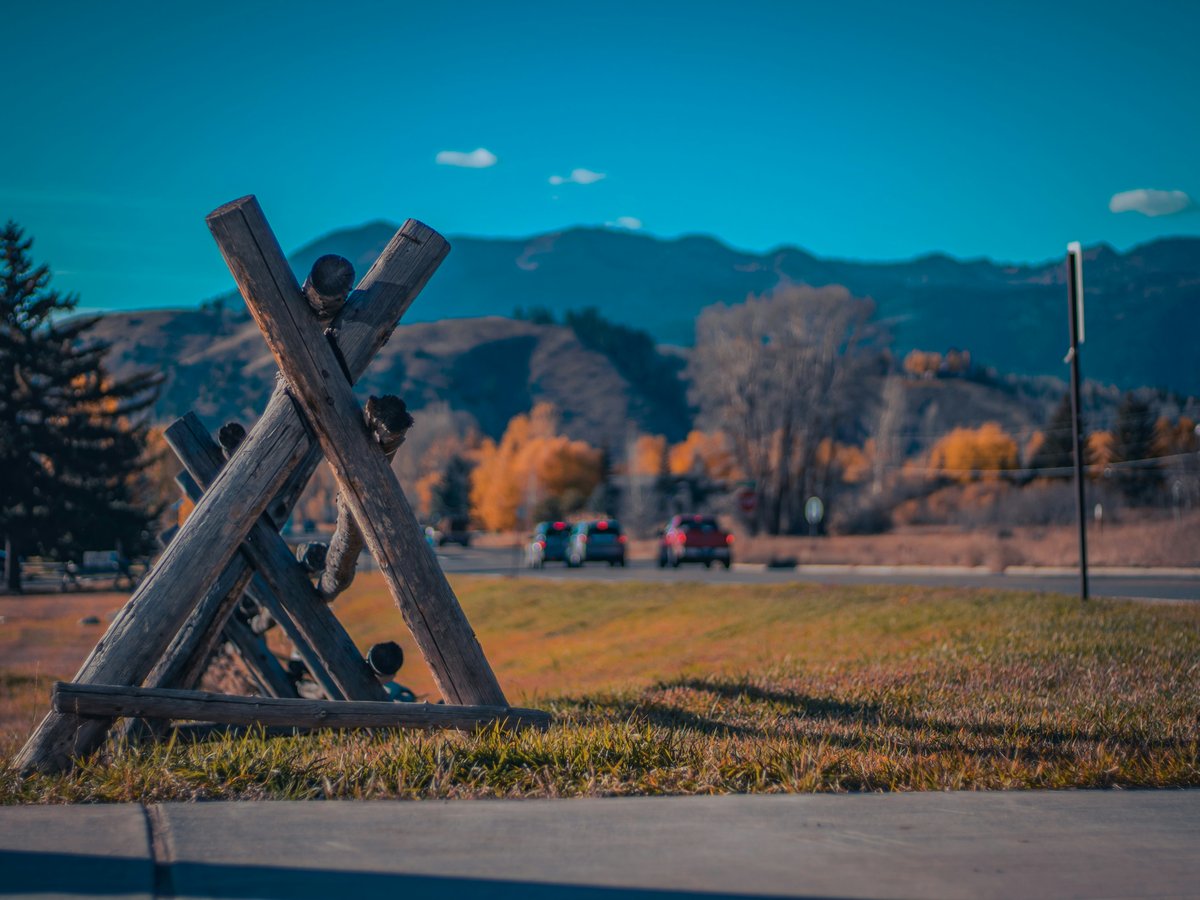
Jackson sits at about 6,237 feet in a broad valley of northwestern Wyoming, walled by the Teton Range to the west and the Gros Ventre Mountains to the east. About 97% of Teton County is publicly owned, split among Grand Teton National Park, Bridger-Teton National Forest, and the National Elk Refuge. The town itself is small enough to cross on foot in 20 minutes.
September mornings currently hover around 10°C under overcast skies, and the sage-scented air sharpens once you leave the boardwalks along Cache Street. You might know Jackson Hole as one of the more expensive resort valleys in the Mountain West, and that reputation is earned when it comes to hotel rates and restaurant tabs. But most of what draws visitors to Jackson has never required a ticket.
The 13,775-foot Grand Teton fills the western sky from nearly every street. Elk herds pass through town each autumn on their way down from the Gros Ventre high country. Trails along Cache Creek start at the edge of the grid. The valley scores 7.8/10 for family friendliness (see the TTDI Family-Friendliness Index), and the free tier, from federal wildlife facilities to summer evening shootout reenactments on Town Square, tends to surprise people who assume everything here costs $50 or more.
Free attractions
-
Town Square Elk Antler Arches
Four arches made from naturally shed elk antlers mark the corners of Jackson's Town Square. The Jackson Rotary Club assembled the original arches in the 1950s and 1960s, and each one contains thousands of interlocking antlers. Reconstruction happens roughly every decade, as exposure to Wyoming winters cracks and grays the older racks. Worth lingering around Town Square after dark, when the arches catch warm streetlight against the Teton silhouette. Free to visit 365 days a year.
Downtown Jacksonlandmark -
Jackson National Fish Hatchery
Established in 1950 by the U.S. Fish and Wildlife Service, this working hatchery raises native Snake River fine-spotted cutthroat trout about 4 miles north of Jackson off Highway 89. The visitor area includes outdoor rearing raceways where you can watch thousands of trout at different growth stages, plus indoor exhibits on the region's aquatic ecology. The grounds border the National Elk Refuge, so wildlife sightings from the parking lot are common in the mornings. Open daily, always free.
North of Jackson, Highway 89museum and wildlife facility -
National Elk Refuge
The refuge spreads across roughly 24,700 acres of valley floor stretching from the northern edge of Jackson toward the Gros Ventre River, providing critical winter range for around 7,500 elk. In summer, you can drive the gravel Refuge Road for free. Watch for elk, bison, trumpeter swans, and red-tailed hawks along the way. The Jackson Hole and Greater Yellowstone Visitor Center sits at the refuge entrance on North Cache Street, with free exhibits on the region's ecosystems and wildlife corridors. Winter sleigh rides through the wintering elk herds run through a concessionaire and currently cost around $30 per adult, but the visitor center remains free year-round.
North Cache Street, Jacksonwildlife refuge -
George Washington Memorial Park
A public park a few blocks south of Town Square in downtown Jackson, with open lawns, shade trees, and a playground. The park tends to be quieter than the commercial core around the square, and you'll find local families here on summer weekday afternoons. Free and open year-round.
Downtown Jacksonpark -
National Museum of Wildlife Art
The museum opened in 1987 on a hillside campus along the National Elk Refuge, about 2 miles north of Town Square. Its collection includes more than 5,000 works spanning centuries of wildlife art, from 16th-century European prints to contemporary sculpture by living artists. Standard adult admission typically runs around $15, but the museum has participated in Smithsonian Magazine's annual Museum Day, held on a Saturday in September, with free admission for ticketholders. The museum also runs periodic community days with reduced or waived fees throughout the year, so checking their current events calendar before visiting is worth the 2 minutes it takes.
National Elk Refuge, north of Jacksonmuseum -
Chapel of the Transfiguration
This small log chapel was built in 1925 near the Snake River in what is now Grand Teton National Park. The window behind the altar frames the Cathedral Group of the Tetons, and the effect on a clear morning is quietly striking. The chapel is an active Episcopal church, with Sunday services still held during summer months. Entering the chapel is free, but reaching it requires a Grand Teton National Park entrance pass at $35 per vehicle for 7 days. Mind you, the National Park Service designates several fee-free days per year when that cost drops to zero. The chapel sits near the Moose entrance to the park, about 12 miles north of Jackson on Highway 89.
Moose, Grand Teton National Parkhistoric church -
Manges Cabin
A homestead cabin built in 1911, preserved inside Grand Teton National Park along the Moose-Wilson Road. The cabin dates to the era when settlers were still filing claims in the Jackson Hole valley. The structure is visible from the road, and a short walk brings you to the cabin itself. Like the chapel described above, park admission or a fee-free day visit is needed to reach it. The Moose-Wilson Road is open from late May through October, weather permitting.
Moose-Wilson Road, Grand Teton National Parkhistoric site -
Murie Residence
The former home of conservationists Olaus and Mardy Murie, now a National Historic Landmark at Moose inside Grand Teton National Park. Olaus Murie led the Wilderness Society through the 1950s, and his advocacy contributed to the passage of the Wilderness Act of 1964. The ranch buildings sit in a clearing of cottonwood and spruce, and visitors can walk the grounds when the Murie Center has the site open. Reaching the ranch requires park admission, following the same fee-free day pattern as the other park sites described above. The ranch sits off Murie Ranch Road near the Snake River.
Moose, Grand Teton National Parkhistoric site
Free activities
-
Cache Creek Trail
Cache Creek Canyon opens less than a mile east of Town Square, with the trailhead at the end of East Cache Street. The main trail follows the creek upstream through a narrow canyon of cottonwood and aspen. You'll likely hear the water over cobble before you see the creek itself. The trail connects to over 30 miles of paths in the Bridger-Teton National Forest, with options to loop through via Game Creek or extend deeper into the Gros Ventre highlands. Wildlife encounters are common in this drainage, so carry bear spray between April and November.
East Jacksonhiking -
Snow King Mountain Summit Trail
Snow King Mountain rises directly behind downtown Jackson, and the summit trail to about 7,808 feet starts near Snow King Avenue. The hike gains roughly 1,500 feet over 1.5 miles. It is steep. The adjacent scenic gondola charges for rides, but the hiking trail is free year-round. From the summit on a clear day, you can see the full Teton Range, the Snake River bending south, and the valley floor spread below. In winter, packed-snow conditions draw locals with microspikes and traction devices, especially on clear December mornings.
South Jacksonhiking -
Gallery Browsing around Town Square
Jackson's gallery district surrounds Town Square, with roughly 30 galleries within a few blocks, all free to browse. The work ranges from Teton-landscape oils and wildlife bronze sculpture to contemporary photography and Native American art. Gallery owners in Jackson tend to welcome browsers without pressure toward a purchase. Displays rotate at most galleries between June and August, when the town sees its heaviest foot traffic.
Downtown Jacksonarts and culture -
Flat Creek Walking Path
Flat Creek runs through the center of Jackson, and you can follow a paved path along stretches of it through town. The creek supports native cutthroat trout, and in late summer you might see fish holding in the clear, shallow water. Moose appear on the creek banks in early mornings, especially between September and November. This is a 30-minute stroll through a residential part of Jackson, not a wilderness hike, but the riparian corridor feels surprisingly wild for a path that starts 3 blocks from Town Square.
Central Jacksonwalking -
Karns Meadow
A broad, open meadow on the west side of downtown Jackson. The meadow floods with snowmelt each spring and dries to wildflower grassland by August. Moose and mule deer wander through, especially at dawn between May and October. The Jackson Hole Community Pathways network links Karns Meadow to Cache Creek and other trail systems on foot or by bike. In winter, portions of the meadow serve as groomed cross-country ski terrain.
West Jacksongreen space and trails
Free events
-
Jackson Hole Shootout
Monday through Saturday evenings at 6:00 PM, Memorial Day through Labor DayA free Wild West gunfight reenactment performed on Town Square by a volunteer acting troupe. The tradition dates to the late 1950s and draws several hundred spectators on most summer evenings. The actors play frontier-era outlaws and lawmen, with blanks fired from period revolvers that echo off the storefronts along Broadway. The show runs about 15 minutes.
Town Square, Jackson -
ElkFest and Boy Scout Elk Antler Auction
One weekend each MayEach May, Town Square fills with pallets of naturally shed elk antlers collected from the National Elk Refuge by Jackson's Boy Scout troops. The public auction draws bidders from across the Mountain West, and watching the bidding costs nothing. ElkFest runs alongside the auction with live music, food vendors, and hands-on activities for families. Antler buyers haul off thousands of pounds of rack by the end of the weekend.
Town Square, Jackson -
Jackson Hole People's Market
Saturdays, late June through early OctoberA Saturday morning farmers and artisan market running through the summer months. Local vendors sell produce, baked goods, jams, and handmade crafts from the Teton County area. Browsing is free, and on a good morning you'll catch the smell of fresh bread and roasted coffee before you reach the first stall. The market has a slower, more neighborly feel compared to the tourist traffic around the square.
Jackson, WY -
Grand Teton Music Festival Free Community Concerts
Select dates during the July-August festival seasonThe Grand Teton Music Festival, based at Walk Festival Hall in Teton Village, runs a July-through-August season of orchestral and chamber performances. Most concerts are ticketed, but the festival has historically offered free community events, including outdoor performances and open rehearsals featuring musicians from major American orchestras. Check the festival's current season schedule for free dates, as offerings vary by year.
Walk Festival Hall, Teton Village
Free Inside Grand Teton National Park on Fee-Free Days
The National Park Service typically designates 5 or 6 fee-free days per year for all national parks, and Grand Teton participates in each one. Recent fee-free dates have included Martin Luther King Jr. Day in January, the first day of National Park Week in April, the anniversary of the Great American Outdoors Act in August, National Public Lands Day in late September, and Veterans Day on November 11. On these days, you can reach the Chapel of the Transfiguration, the Murie Residence, and Manges Cabin without paying the vehicle entrance fee. The Craig Thomas Discovery and Visitor Center at Moose is free on any day, fee-free or not, and its exhibits on Teton geology and Greater Yellowstone wildlife are worth 30 to 45 minutes. Schwabacher Landing, a Snake River access point about 4 miles north of Moose Junction, offers one of the most photographed Teton reflection views in the valley. Backcountry hikers with more time can reach the Upper Granite Canyon Patrol Cabin, a preserved structure roughly 6 miles into the Granite Canyon Trail. If you plan to visit Grand Teton more than once, the America the Beautiful annual pass at $80 covers every federal fee site in the country for 12 months. For a broader overview of what to see in the park, Wikivoyage's Jackson Hole attractions section (https://en.wikivoyage.org/wiki/Jackson_Hole#See) covers the main highlights.
Wildlife Viewing from Public Roads
Jackson Hole is one of the better places in the lower 48 states for free roadside wildlife viewing. The Elk Refuge driving route described in the attractions section is the most accessible option from town, but several other stretches of road deliver sightings without a spotting scope or a park pass. Highway 22 west of Jackson crosses the Teton Pass approach, where moose are regularly spotted in willow thickets along the road shoulders during May and June. The Gros Ventre Road, heading east from Gros Ventre Junction about 6 miles north of Jackson, passes through a valley where bison herds graze within 50 yards of the pavement. Trumpeter swans winter on open water near the Flat Creek viewing pullout on the refuge. In autumn, bull elk bugling carries across the valley floor at dusk. The sound is low, resonant, and distinctive enough to stop first-time visitors mid-step. Early mornings between 6:00 and 8:00 AM tend to produce the best sightings for large mammals along any of these routes. The National Park Service and U.S. Fish and Wildlife Service both ask visitors to stay at least 100 yards from bears and wolves and 25 yards from all other wildlife. For detailed safety guidance, Wikivoyage's Stay Safe section for Jackson Hole (https://en.wikivoyage.org/wiki/Jackson_Hole#Stay_safe) has practical advice.
Budget Tips by Season
Summer runs from Memorial Day through Labor Day and stacks the most free events alongside the longest window of trail access. The Town Square evening entertainment, the Saturday market, and the full Grand Teton trail system are all available between June and September. That said, summer is peak tourist season in Jackson, and you'll share trails and viewpoints with considerably more people than in any other month. September brings quieter conditions and fall color in the aspens along Cache Creek and Cottonwood Creek, though evening events wind down after Labor Day. Winter in Jackson delivers a different free experience. Snow King's summit trail becomes a snow hike with views above the valley's temperature inversion, and the town's holiday lighting around Town Square is worth a cold December evening walk. Spring is likely the least rewarding season for free outdoor activities in Jackson Hole. Trails above 7,000 feet tend to stay snowbound through May, and the summer event schedule has not kicked off yet. But the antler auction draws a lively crowd in late spring, and the elk refuge's wintering herds remain on the valley floor through March and sometimes into April.
FAQ
When is the best time of year for free activities in Jackson Hole?
The widest range of free things to do falls between late June and early September, when trails are snow-free, evening events fill Town Square, and the Saturday market is in full swing. September brings fewer crowds and excellent hiking weather, with fall color appearing in the aspens by mid-month. Winter has free options like Snow King hiking and the gallery district, but the overall selection narrows. Late spring offers ElkFest and early wildflowers, though higher trails typically remain snowbound into June.
Is Jackson Hole safe to explore on foot as a solo traveler?
Jackson scores 8.3/10 for solo-traveler safety (see the TTDI Solo-Safety Index). The town of Jackson is compact, well-lit, and walkable at any hour. The main safety considerations for solo visitors are wildlife encounters on trails, where carrying bear spray is standard practice in the Bridger-Teton backcountry, and winter driving conditions on Teton Pass. Trail-specific precautions apply to any solo hiker in bear and moose country, and checking in with a ranger station before longer outings is a reasonable habit.
Can I enter Grand Teton National Park for free?
Yes, on the fee-free days that the National Park Service designates each year. The dates vary annually, and the Park Service publishes the current year's schedule by January. Outside those days, you'll need a vehicle pass or an America the Beautiful annual pass to enter. The park's main visitor center at Moose is free regardless of whether it's a fee-free day.
Are there free things to do in Jackson Hole during winter?
Snow King's summit trail stays open for snow hiking through the colder months, and the gallery district around Town Square keeps its doors open regardless of season. Cross-country skiing on the valley's groomed community pathways costs nothing if you bring your own gear. The Elk Refuge's wintering herd is most visible from December through March, when thousands of animals concentrate on the valley floor near Highway 89.
Do I need a car to reach free attractions in Jackson?
Most free attractions within the town of Jackson are walkable from any downtown lodging. Town Square, the gallery district, George Washington Memorial Park, and the Cache Creek trailhead are all within a 15-minute walk of each other. The Jackson National Fish Hatchery and the National Museum of Wildlife Art sit about 3 to 4 miles north of the square and are more practical by car or bicycle. Grand Teton National Park requires a vehicle, though the START Bus system connects Jackson to Teton Village and has been fare-free on several of its routes. For detailed transit options, see Wikivoyage's Getting Around section (https://en.wikivoyage.org/wiki/Jackson_Hole#Get_around).
Last verified by automated review (v1.7.2) on . What is automated review?