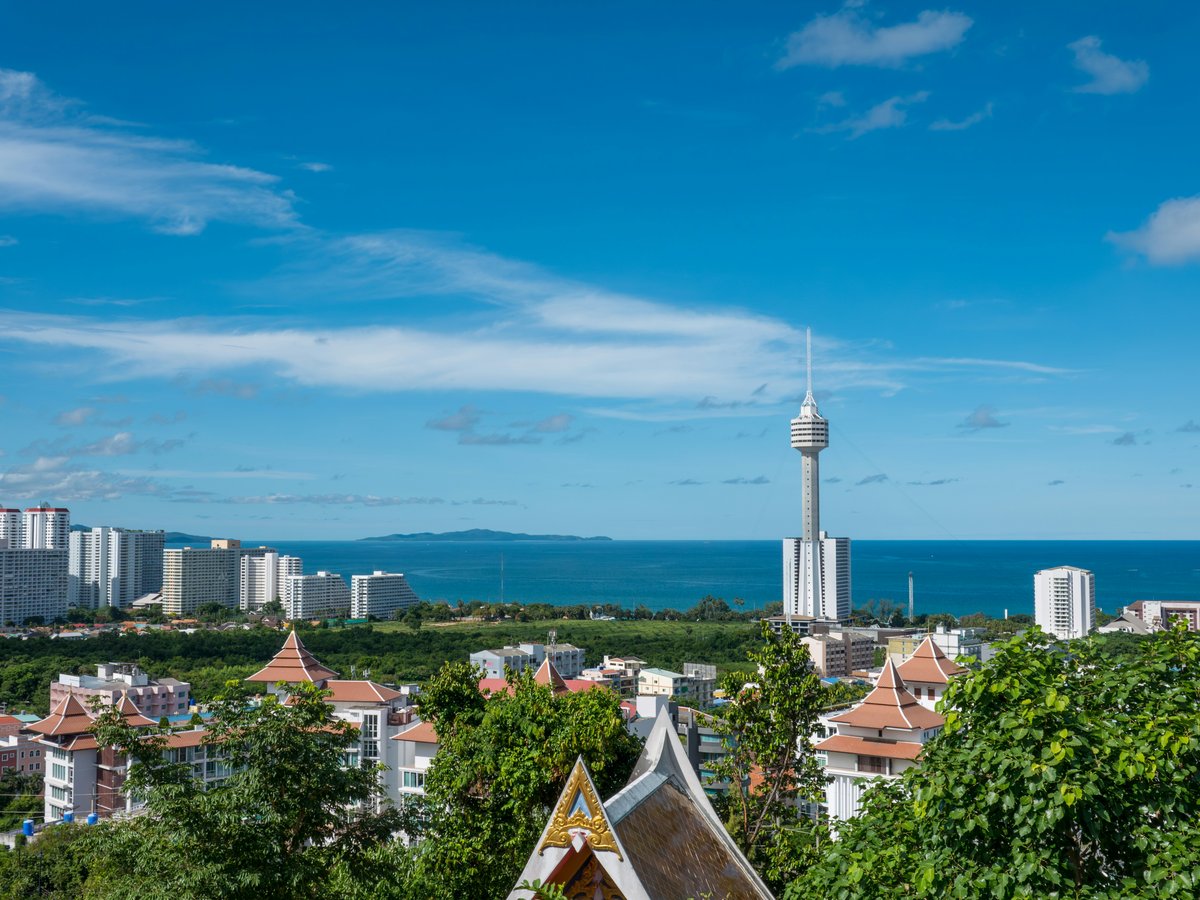
Pattaya stretches along roughly 15 km of Chon Buri coastline about 150 km southeast of Bangkok. The layout is simpler than most visitors expect. One main road, Sukhumvit (Highway 3), runs parallel to the coast and acts as the spine. Between Sukhumvit and the water, three numbered roads (Pattaya Sai 1, Sai 2, and Sai 3, which locals call First, Second, and Third Road) run north-south through the central district. Beach Road hugs the waterfront. Most of the city's density sits in this corridor, which is about 4 km long and barely 1.5 km wide. South of the center, the hill of Pratamnak separates central Pattaya from Jomtien. North Pattaya tends to be quieter and more residential. East of Sukhumvit, the Darkside (yes, that is what residents call it) sprawls into flat suburban territory with newer condos and Thai-oriented commerce. At current exchange rates, 1 USD converts to about 32.74 THB, which means a good pad thai from a street cart costs you roughly 40-60 baht, or under $2. The weather in late August sits around 27°C with high humidity, so the air feels thick and warm even after dark. Worth noting, Pattaya earns a 7.8/10 for LGBTQ+ friendliness (sourced from TTDI's editorial rubric), one of the higher scores in Southeast Asia, and the city's tolerance tends to be genuine rather than performative.
Neighborhoods
-
Central Pattaya (Walking Street and Beach Road)
This is the part everyone pictures. Walking Street runs about 500 meters from the southern end of Beach Road, lined with open-front bars, go-go clubs, and seafood restaurants with tanks out front. The noise level after 9 PM is considerable. Bass from competing sound systems, touts calling from doorways, the hiss of grills cooking satay. By day the same stretch feels oddly calm, with staff hosing down pavements and stray dogs sleeping in doorways. Beach Road itself is wider and more mixed. Hotels from the 1980s sit next to newer mid-rises, and the beachfront promenade gets a steady breeze off the Gulf. Second Road, one block inland, carries most of the through traffic and hosts the bigger shopping malls like Central Festival and Royal Garden Plaza.
- Best for
- Solo travelers and nightlife-oriented visitors who want to be in the middle of the action. Pattaya scores 6.2/10 for solo-traveler safety (see the TTDI Solo-Safety Index), so standard precautions apply, especially after midnight on the south end of Walking Street.
- Key streets
- Walking Street (Soi 13-16 area), Beach Road from Soi 6 to Soi 13, Second Road between Central Festival and Royal Garden Plaza, Soi Buakhao for the backpacker and budget-bar scene one block east of Second Road.
-
Naklua
North of central Pattaya, past the Dolphin Roundabout, the mood shifts. Naklua was a fishing village before the rest of Pattaya existed, and parts of it still feel that way. The fish market at Naklua Soi 33 operates from early morning, with vendors selling the overnight catch off concrete slabs. The smell of brine and diesel from the long-tail boats hits you before you see the stalls. Condos have moved in along the waterfront (Wongamat Beach sits here, noticeably cleaner than central Pattaya Beach), but the interior sois remain Thai-residential. Older shophouses, a temple or two, kids on motorbikes after school. The Sanctuary of Truth sits at the tip of Naklua's cape, a 105-meter wooden temple-museum that has been under construction since 1981. It is still unfinished. The carved teak detailing is genuinely striking up close.
- Best for
- Couples and older travelers who want proximity to central Pattaya (the Dolphin Roundabout is a 10-minute songthaew ride from Walking Street) without the noise. Families with young children might prefer Jomtien for the calmer water, but Naklua's Wongamat Beach is a strong second choice.
- Key streets
- Naklua Road (the main artery), Naklua Soi 16 and Soi 18 for local Thai food stalls, Wongamat Beach Road for the upscale condo and hotel strip, and the lane to the Sanctuary of Truth off Naklua Soi 12.
-
Jomtien
South of the Pratamnak Hill divide, Jomtien stretches for about 6 km along a beach that is wider and less built-up than central Pattaya's. The sand here is coarser, more of a tan color, and the water tends to be a shade clearer. Jomtien Beach Road runs the full length, lined with a mix of condominiums from the 1990s, newer boutique hotels, and restaurants serving both Thai and European food (the German bakery scene here is surprisingly strong, a legacy of long-stay retirees). The pace is noticeably slower. You hear waves more than traffic. The kiteboarding community clusters at the southern end near Jomtien Soi 17 during the windy months from November through February.
- Best for
- Families (Pattaya scores 6.2/10 for family friendliness, see /research/family-friendliness/), long-stay visitors, and anyone who wants a beach holiday without the Walking Street atmosphere. The condo rental market here is the most competitive in greater Pattaya, with furnished one-bedrooms starting around 8,000 to 12,000 baht per month on longer leases.
- Key streets
- Jomtien Beach Road (the full 6 km strip), Jomtien Soi 5 for a cluster of Thai restaurants, Thappraya Road connecting over Pratamnak Hill to central Pattaya, and Jomtien Second Road for the newer condo developments.
-
Pratamnak Hill
The hill between central Pattaya and Jomtien sits about 100 meters above sea level and holds some of the city's pricier real estate. The roads wind upward past gated villa compounds, a few luxury resorts like the Royal Cliff, and the big golden Buddha statue at Wat Phra Yai (built in 1977 and visible from the bay). The vegetation is denser here, palms and bougainvillea spilling over walls, and the temperature drops a degree or two in the shade. Traffic is lighter than anywhere else in central Pattaya. You hear birds more than engines. The downside is access. Getting to a beach or a restaurant means a steep walk or a motorbike ride down the hill.
- Best for
- Couples and mid-budget travelers who want quiet nights and do not mind being a short ride from restaurants and shops. Digital nomads rate Pattaya 7.2/10 for suitability (sourced from TTDI's editorial rubric), and Pratamnak's cafes with reliable wifi have become a draw for the remote-work crowd, though the options are fewer than in Jomtien.
- Key streets
- Pratamnak Soi 4 and Soi 5 for boutique hotels and restaurants, Thappraya Road as the main connector, and the access road to the Phra Tamnak viewpoint near Wat Phra Yai for the best panoramic view in the city.
-
Soi Buakhao and East Pattaya
Soi Buakhao runs parallel to Second Road, about 300 meters further inland. It started as a low-key alternative to Walking Street and has grown into its own ecosystem of bars, budget hotels, street food carts, and a day market that spills across the road. The architecture is functional, mostly 3-4 story shophouses with neon signage. The clientele tends toward long-stay expats and budget travelers rather than package tourists. East of Sukhumvit, the so-called Darkside (the name stuck because there were no streetlights when expats first moved out there) is residential Thai suburbia with big-box stores like Makro and Global House, gated housing estates, and international schools. It feels like a different city entirely. No beach access, but rents drop by 40-50% compared to beachside.
- Best for
- Budget-conscious long-stayers, expats setting up for months rather than weeks, and anyone who wants to live at Thai prices rather than tourist prices. A plate of khao man gai (chicken rice) on Soi Buakhao costs 50 baht. The same dish on Beach Road costs 120.
- Key streets
- Soi Buakhao from Soi Diana south to Soi Khao Noi, Soi Khao Noi itself for the cheaper end of the accommodation market, and Soi Siam Country Club on the Darkside for the newer condo estates near the golf courses.
-
Na Jomtien and Sattahip Direction
South of Jomtien proper, Na Jomtien extends toward Bang Saray and eventually Sattahip naval base. This stretch is still developing, with several large projects under construction. The existing landscape is a mix of empty lots, seafood restaurants built on stilts over the water, and a handful of destination attractions. Nong Nooch Tropical Botanical Garden sits about 15 km south of Jomtien, open since 1980, covering 500 acres of themed gardens, topiary, and a daily cultural show. Ramayana Water Park is nearby, one of the largest water parks in Southeast Asia. Viharn Sien, a Chinese art museum about 3 km from Nong Nooch, houses a collection of terracotta warrior replicas and Sino-Thai artifacts in a setting that feels more like a temple than a museum. The road down here follows the coast, and the seafood gets cheaper and fresher with every kilometer south.
- Best for
- Visitors with rental cars or motorbikes who want day-trip attractions, and travelers seeking newer, quieter resort properties away from the urban core. Some of the newest 5-star hotels have been built along this corridor in the past 3-4 years.
- Key streets
- Sukhumvit Road (Highway 3) south from Jomtien, the access road to Nong Nooch off kilometer marker 163, and the coastal road through Na Jomtien village where the stilt restaurants cluster.
-
North Pattaya (Naklua Road to Dolphin Roundabout)
The stretch from the Dolphin Roundabout northward along Naklua Road and eastward along North Pattaya Road straddles the line between the busy center and quieter Naklua. The Dolphin Roundabout itself is a local landmark, a traffic circle with a dolphin sculpture that everyone uses as a reference point. The Terminal 21 mall opened here in 2018, bringing a newer retail experience to the north end. The streets off North Pattaya Road hold a mix of mid-range hotels, massage shops, and Thai-Chinese restaurants. All Saints Church sits on Soi 13 near this area, one of the few Anglican churches in eastern Thailand. The atmosphere is lower-key than the Walking Street end, but you are still within a 5-minute songthaew ride of the center.
- Best for
- Travelers who want to walk to shopping (Terminal 21 and the older Tukcom electronics mall are both here) without sleeping on top of the bar district. This corridor tends to offer the best hotel value in central Pattaya, with 3-star rooms running 800-1,500 baht per night.
- Key streets
- North Pattaya Road (Pattaya Neua) from the Dolphin Roundabout to Sukhumvit, Naklua Road heading north, and the sois between North Pattaya Road and Second Road for mid-range accommodation.
FAQ
How do I get between neighborhoods without renting a motorbike?
The songthaew (converted pickup truck with benches in the back) runs a loop along Second Road southbound, Beach Road northbound, and connects to Jomtien via Thappraya Road. The fixed fare is 10 baht per person within central Pattaya. To Jomtien, expect 20-30 baht. Bolt (ride-hailing app) operates here and is often cheaper than negotiating with a motorbike taxi. Naklua is a quick ride from the Dolphin Roundabout. For Na Jomtien and attractions like Nong Nooch, you will need a private car or a Bolt ride (about 200-300 baht each way). See the Wikivoyage transit overview at https://en.wikivoyage.org/wiki/Pattaya#Get_around for route details.
Is Pattaya suitable for families with children?
It depends heavily on which neighborhood you pick. Jomtien and Pratamnak Hill are the most family-oriented areas, with calmer beaches, less nightlife noise, and proximity to attractions like Ramayana Water Park. Central Pattaya around Walking Street is not ideal for young children after dark. The city's family friendliness score reflects this split. Nong Nooch garden and the water park both work well for half-day outings with kids. Budget about 500-800 baht per adult for park entry fees.
Where should digital nomads base themselves in Pattaya?
Jomtien and Pratamnak Hill have the strongest concentration of cafes with reliable wifi and reasonable coffee prices (60-120 baht for a latte). Jomtien Second Road has several coworking-friendly spots. The Darkside east of Sukhumvit offers the lowest rents, but the cafe infrastructure is thinner. Central Pattaya has fast internet in most hotels but tends to be noisier for daytime focused work. Pattaya's digital-nomad suitability score reflects the solid internet infrastructure and affordable cost of living across most districts.
What is the best area to stay for first-time visitors?
North Pattaya near the Dolphin Roundabout and Terminal 21 gives you walking access to shopping and food without the intensity of Walking Street. From there, you can reach Naklua in 5 minutes and Jomtien in about 15 by songthaew. It tends to have the best balance of price, location, and comfort for visitors who are still figuring out which parts of the city they like. If you already know you want a beach-focused stay and quieter nights, book in Jomtien from the start.
Is Pattaya safe to walk around at night?
In central Pattaya and Jomtien Beach Road, the streets are well-lit and populated until late. The main risks are petty theft and drink-spiking scams in the bar district, not violent crime. The solo-traveler safety score reflects these conditions. Pratamnak Hill and the Darkside are quieter after dark, with less foot traffic but also fewer incidents. Standard precautions apply everywhere. Keep valuables in a front pocket, avoid accepting drinks from strangers on Walking Street, and use Bolt instead of negotiating with unlicensed taxis late at night. Wikivoyage's safety notes at https://en.wikivoyage.org/wiki/Pattaya#Stay_safe cover the common scams in detail.
When is the best time of year to visit Pattaya?
November through February brings the driest weather and temperatures around 28-31°C. Late August, where conditions currently sit at around 27°C with 83% humidity and overcast skies, is the wettest stretch. Rain in monsoon season tends to come in heavy afternoon bursts rather than all-day drizzle. Hotel rates in Jomtien drop by 30-40% in low season (June through September), making it the cheapest time to visit if you do not mind occasional downpours. The kiteboarding season at Jomtien's southern end aligns with the dry months when steady winds arrive.
Last verified by automated review (v1.7.2) on . What is automated review?