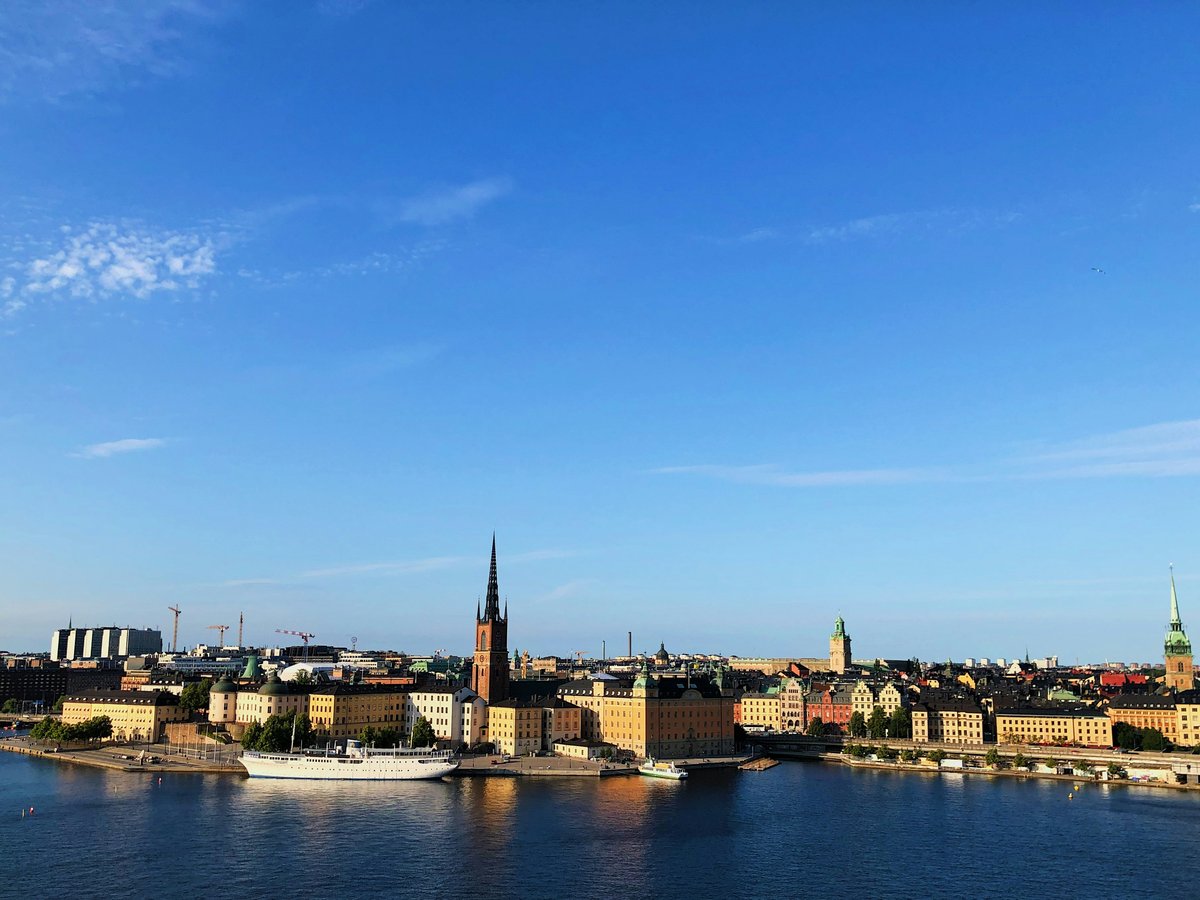
Stay in Stockholm in September
72 hotels in the Trip.com pool for Stockholm, from US$23 a night.
Opens Trip.com on Fri 25 Sep to Sun 27 Sep 2026; change the dates there.
September in Stockholm is defined by one thing above all. The light is leaving, dropping from about 14 hours of daylight on September 1 to under 12 by the 30th. You can feel the shift week to week along Strandvägen, where the sun hits the waterfront facades at an angle that July's overhead glare never manages, casting everything in amber and gold. Daytime temperatures sit around 17°C (62°F), dropping to 10°C (50°F) after dark. Comfortable for walking Djurgården in a light jacket. Not warm enough for swimming off Långholmen's rocks.
The summer crowds have thinned considerably across Gamla Stan and the major museums. Stockholmers return from their countryside stugor in late August, and by the first week of September the city runs on local rhythms. Restaurants in Södermalm that kept 45-minute waits through July have open tables. The cultural season opens with new programs at Kungliga Dramatiska Teatern, Konserthuset, and the Royal Swedish Opera on Gustav Adolfs torg. You'll still find outdoor seating along Götgatan, though you might want a wool layer by late afternoon.
Worth noting, the 49mm of rain across 8 days is lower than July's 87mm or August's 90mm. September is a drier month than high summer, even if it feels damper because of the cooler air. If you can handle crisp mornings and evenings that darken by 7pm, hotel rates in Östermalm and Södermalm run 15-25% below their July peaks.
Why visit in September
- Summer crowds at Gamla Stan and the Vasa Museum thin out by 30-40%, with noticeably shorter queues at Skansen and Fotografiska
- Rainfall of 49mm across 8 days is lower than both July (87mm) and August (90mm), making September statistically drier than high summer
- Hotel rates in central Stockholm typically drop 15-25% from the June-August peak, with shoulder-season deals appearing in Östermalm and Norrmalm
- The low-angle September sun creates warmer, more golden light across the waterfront than summer, particularly along Strandvägen and Skeppsholmen
- Stockholm's cultural season opens in September with new programs at Dramaten, Konserthuset, and the Royal Swedish Opera
Worth knowing
- Daylight drops from about 14 hours on September 1 to under 12 hours by September 30, limiting outdoor time in the evenings
- Water temperatures in the Baltic and Lake Mälaren drop below 15°C (59°F), making swimming uncomfortable for most visitors
- Waxholmsbolaget archipelago ferry services shift to reduced autumn schedules by mid-September, cutting service to outer islands like Sandhamn
- Outdoor dining season is ending, with many restaurant terraces in Södermalm and Gamla Stan closing by the third week of the month
Best for
Think twice if
September feels like Stockholm slowly exhaling after summer. Expect highs around 17°C (62°F) that feel pleasant in direct sunlight but cool quickly in shade or when wind picks up off Saltsjön. Nights drop to 10°C (50°F), cold enough that a walk along the waterfront after dinner requires real outerwear, not the hoodie that worked in August. Rain arrives in short, grey spells rather than all-day downpours, totaling about 49mm across 8 days. Humidity sits at 82%, which registers as a damp chill on your skin rather than tropical stickiness. By the last week of the month, mornings near the water can feel genuinely cold, with temperatures occasionally dipping below 8°C (46°F) before the sun clears the rooftops.
Year-round climate
Averages from the last 5 years.
| Month | Avg high (°C) | Avg low (°C) | Rainfall (mm) |
|---|---|---|---|
| Jan | 1 | -4 | 61 |
| Feb | 2 | -4 | 34 |
| Mar | 6 | -1 | 27 |
| Apr | 10 | 1 | 32 |
| May | 16 | 6 | 56 |
| Jun | 21 | 12 | 66 |
| Jul | 22 | 14 | 87 |
| Aug | 21 | 13 | 90 |
| Sep | 17 | 10 | 49 |
| Oct | 11 | 6 | 63 |
| Nov | 5 | 1 | 42 |
| Dec | 1 | -3 | 41 |
Best things to do in September
Walk Djurgården's forest paths for early autumn color
natureThe oak and birch forests on Djurgården island start turning yellow and amber in mid-to-late September. The 5km loop from Djurgårdsbron past Rosendals Trädgård to Blockhusudden follows the waterfront and cuts through old-growth forest that glows in the low afternoon sun. The crunch of the first dry leaves underfoot, the smell of damp earth and cooling bark. It is a different island from the one tourists walk in July.
Autumn color peaks in the second half of September before October's first hard winds strip the canopy.Booking tipNo booking needed. Go before 10am on weekdays for the quietest paths.
Kayak the inner archipelago before the season ends
outdoorSeptember is typically the last comfortable month for recreational kayaking around Stockholm's islands. Paddle from Djurgården out toward Fjäderholmarna, the closest archipelago islands at about 25 minutes from central Stockholm. The water is flat most September mornings, and you can smell pine resin off the island shores when the sun warms the rocks.
Water conditions are still calm enough for casual paddling, but most rental operators close for the season in early October.Booking tipBook weekend slots at least 5 days ahead. Weekday mornings often have same-day availability.
Visit Skansen with September's thinner crowds
cultureSkansen, the open-air museum founded in 1891 on Djurgården, covers 30 hectares of historical Swedish buildings, Nordic animals, and seasonal exhibits. In September, programming shifts to harvest themes with traditional bread-baking in wood-fired ovens and craft workshops in the 19th-century workshops. The smell of baking bread drifts across the hillside.
Summer crowds of 10,000+ daily visitors drop to a few thousand. The autumn light makes the red-painted historical buildings more photogenic than in flat summer sun.Booking tipBuy tickets online to skip the entrance queue. Wednesday and Thursday mornings have the smallest crowds.
Spectate or run Lidingöloppet
sportThe world's largest cross-country race has run annually on Lidingö island since 1965. The main event covers 30km through forests and residential hills, with about 15,000 runners in the primary race and tens of thousands more in shorter 10km and 15km distances. Spectators line the forest trails with cowbells and thermoses of coffee. The sound of thousands of feet on packed dirt is oddly moving.
Lidingöloppet is held on the last Saturday of September. No equivalent in any other month.Booking tipRace registration opens in January and fills for the 30km event. Register months ahead if you want to run. Spectating is free.
Explore Fotografiska's autumn exhibitions
cultureFotografiska, the photography museum in a 1906 Art Nouveau customs building on Södermalm's waterfront, opens its major autumn exhibitions in September. The museum stays open until 11pm on weekends, and its top-floor restaurant offers views across Saltsjön to Djurgården. Four floors of gallery space, with the top floor catching the kind of September afternoon light that makes even the stairwell feel curated by accident.
The autumn exhibition cycle launches in September, bringing new major shows to all 4 gallery floors after the summer program closes.Booking tipWeekend evenings get crowded. Visit on a weekday afternoon or buy timed-entry tickets online.
Forage for mushrooms in Tyresta National Park
natureTyresta National Park sits about 20km southeast of central Stockholm and protects one of the largest old-growth forests in Sweden. September is prime season for kantareller, karl-johan (porcini), and trattkantareller across the park's 2,000 hectares. The forest floor smells of damp moss and decomposing leaves, and the silence between the old pines is startling after central Stockholm.
September's combination of cooling air temperatures, residual soil warmth, and autumn rain creates peak conditions for mushroom fruiting.Booking tipNo booking for the park itself. Several Stockholm outdoor companies run guided foraging walks in September only, which are worth considering if you cannot confidently identify edible species.
Catch the Royal Stockholm Philharmonic season opener at Konserthuset
cultureKonserthuset, the blue-painted 1926 concert hall on Hötorget in Norrmalm, hosts the Royal Stockholm Philharmonic Orchestra's season-opening concerts in early September. The 1,800-seat main hall has acoustics that let you hear individual bow strokes from the back row. Opening programs often feature flagship symphonies with guest soloists.
The concert season opens in September after the summer recess. Opening-week programs tend to be the orchestra's most ambitious.Booking tipOpening-week concerts can sell out. Check Konserthuset's website in late August and book promptly.
Walk the Monteliusvägen sunset path
sightseeingMonteliusvägen is a 500-meter cliffside walkway in Södermalm overlooking Riddarfjärden, Stadshuset (City Hall), and the rooftops of Gamla Stan. The wooden path runs along the edge of Skinnarviksberget, the highest natural point in central Stockholm at 53 meters. The view catches the full sweep of the western skyline.
September's sunset shifts from about 7:45pm at the start to 6:30pm by the end. The low sun angle creates deep orange reflections on the water that summer's high sun never produces.Booking tipNo booking needed. Arrive 30 minutes before sunset for the best bench. West-facing spots fill up on clear evenings.
What to eat in September
In season: fruit
Hjortron (cloudberries)
These orange arctic berries ripen in northern Sweden in August and reach Stockholm markets by September as fresh berries and preserves. Cloudberry jam with whipped cream on warm waffles is a classic Swedish combination. The flavor sits somewhere between tart apricot and honey, with soft seeds that pop between your teeth.
On menus now
Kräftor (crayfish)
The Swedish crayfish season opens in August, and September is when supply peaks. Kräftskivor (crayfish parties) continue through early September with dill-cooked crayfish, snaps, and paper lanterns. The tradition involves wearing paper hats, singing drinking songs, and cracking shells in quantities that seem medically inadvisable.
Svampsoppa (wild mushroom soup)
Restaurants across Stockholm put wild mushroom soup on their autumn menus starting in September, made from foraged kantareller, karl-johan (porcini), and trattkantareller. The soup typically comes with a swirl of gräddfil and dark rye bread. The earthy, forest-floor aroma is difficult to replicate with cultivated mushrooms.
Surströmming (fermented herring)
The premiere is traditionally the third Thursday of August, but September is when Swedes gather for surströmming parties, always outdoors for obvious reasons. Eaten in thin tunnbröd with potatoes, red onion, and gräddfil, the taste is milder than the smell suggests. The smell, though, is something else entirely. It can clear a park.
What to drink
Äppelmust (fresh-pressed apple cider)
The Swedish apple harvest peaks in September, and must, the unfermented fresh-pressed juice, appears at farm shops and markets around Stockholm. Rosendals Trädgård on Djurgården presses their own from heritage orchard varieties like Ingrid Marie and Cox Orange. Served cold, it tastes nothing like commercial juice.
In markets
Kantareller (chanterelle mushrooms)
Swedish forests produce their best chanterelles from August through October, and September is the peak. You'll find them at Östermalms Saluhall piled in baskets for around 350-400 SEK per kilo, or sautéed in butter on toast at traditional restaurants across Södermalm and Vasastan. The smell of them cooking in brown butter is one of the defining scents of Stockholm's autumn.
Regular events in September
LidingöloppetFree
The world's largest cross-country race, held annually since 1965 on Lidingö island east of Stockholm. The main event covers 30km through forested hills, with 10km and 15km races drawing tens of thousands of participants. Spectating along the forest trails is free.
Last Saturday of SeptemberTjejmilen
Sweden's largest women-only running event, a 10km race through Djurgården and Gärdet in Stockholm. The event has run since 1984 and typically draws over 20,000 participants. The course passes through some of Djurgården's best autumn scenery.
Mid-September, typically second SaturdayRoyal Stockholm Philharmonic Season Opener
The Royal Stockholm Philharmonic Orchestra opens its concert season at Konserthuset on Hötorget with a flagship program, typically featuring a major symphony and a guest soloist. The 1926 hall's blue exterior is a Norrmalm landmark.
First or second week of SeptemberBest places this September
Rosendals Trädgård
gardenA biodynamic garden and cafe on Djurgården with greenhouse seating for rainy September afternoons. The apple orchard is at peak harvest in late September, and you can pick heritage varieties for about 30 SEK per kilo during their autumn harvest days. The greenhouse smells of warm soil and flowering herbs even when it is grey outside.
DjurgårdenSkinnarviksberget
viewpointThe highest natural point in central Stockholm at 53 meters, this rocky outcrop in Södermalm offers unobstructed views west over Riddarfjärden toward Stadshuset and Kungsholmen. September's low evening sun makes this the best month for sunset watching. Locals bring blankets and coffee.
SödermalmHagaparken
parkAn 18th-century English-style park in Solna, about 4km north of central Stockholm, with copper-roofed pavilions, a butterfly house, and old-growth oaks and lindens that start turning gold by mid-September. Gustav III's Pavilion sits at the southern end. Quieter than Djurgården, with wide gravel paths and the occasional jogger.
SolnaÖstermalms Saluhall
marketThe restored 1888 market hall in Östermalm reopened in 2020 after a multi-year renovation. September brings fresh kantareller, hjortron, and game meats to the vendor counters. You can build a lunch from the counter stalls for around 100-150 SEK. The hall smells of smoked fish and aged cheese.
ÖstermalmGamla Stan's backstreets
neighborhoodThe tourist foot traffic drops enough in September that you can explore alleys like Mårten Trotzigs Gränd (Stockholm's narrowest street at 90cm wide) without queueing behind tour groups. Prästgatan and Österlånggatan have small galleries and antique shops that are easier to browse when the cobblestones are not wall-to-wall visitors.
Gamla StanFjäderholmarna
archipelagoThe closest archipelago islands to central Stockholm, about 25 minutes by ferry from Slussen. Still accessible on regular service through September. Small craft studios, a brewery, and rocky shorelines for sitting with your face to the afternoon sun. The last comfortable month to make the crossing without heavy winter layers.
Archipelago
Your packing checklist
Tick items off as you pack. Your progress saves in this browser.
All packed — have a great trip.
Insider tips
The number 7 bus runs along Strandvägen and the eastern waterfront for the price of a regular SL transit ticket, about 39 SEK. It passes many of the same sights as the tourist sightseeing boats that charge 200+ SEK per person. Sit on the right side heading east.
Östermalms Saluhall is where Stockholmers shop for kantareller and seasonal produce in September. Prices at the market counters run lower than tourist-facing restaurants, and the quality is higher because vendors know their regulars will notice if it drops.
Skinnarviksberget in Södermalm is the best sunset spot in central Stockholm, and September's golden-hour light between 5 and 6pm makes it the strongest month for the view over Riddarfjärden. Locals bring thermoses and blankets. Tourists rarely find it because it has no signage from the main streets.
If you visit in the last week of September, Rosendals Trädgård on Djurgården holds apple-picking days where you can harvest heritage varieties like Ingrid Marie and Cox Orange for about 30 SEK per kilo. The orchard is behind the main greenhouse. Bring a bag.
Skip the central Systembolaget locations (Sweden's state liquor stores) on Friday afternoons, when every local in Norrmalm and Södermalm queues for weekend supplies. The branch in Vasastan on Odengatan tends to have shorter lines at the same hours.
Avoid these mistakes
- Packing only summer clothes because the calendar still says September. Evenings in Stockholm drop to 10°C (50°F) with wind off the water, and Gamla Stan's narrow alleys channel cold drafts straight through a t-shirt. You will see shivering tourists in shorts outside the Royal Palace while locals walk past in jackets.
- Booking archipelago day trips for late September without checking Waxholmsbolaget's schedule. Ferry services shift to reduced autumn timetables after mid-September, and some outer islands like Sandhamn lose daily connections. Check waxholmsbolaget.se before you plan around a specific island.
- Waiting until afternoon for outdoor activities. September daylight is best used in the morning, when the sun is warm, the wind is calm, and the light on the water is cleanest. By 4pm temperatures start dropping and the light turns flat and grey. Djurgården at 9am and Djurgården at 4pm are two different experiences.
- Assuming September prices are the same as July. Shoulder-season rates are real, and you can save 15-25% on hotels by booking central Stockholm in September versus the summer peak. But you need to book directly or comparison-shop. The discounts do not always appear on the first booking site you check.
Practical tips for September
Book any archipelago boat trips for the first 2 weeks of September, when Waxholmsbolaget still runs its extended summer timetable. Restaurant reservations in Södermalm and Östermalm are easier to get than in summer, but popular spots like Pelikan on Blekingegatan still fill up on Friday and Saturday evenings. The SL transit system runs its normal schedule throughout September with no seasonal reductions. A 72-hour SL Access card covers unlimited travel on buses, metro, trams, and commuter trains for 330 SEK. Dress in removable layers for museum visits. Indoor venues like Moderna Museet and Fotografiska keep their galleries warm, and you will overheat in a heavy jacket within 15 minutes. If you plan to visit Skansen, go on a weekday morning when school groups are smaller and the open-air exhibits have better light. Sunset times shift from about 7:45pm on September 1 to 6:30pm by September 30, so plan outdoor activities accordingly and do not assume you have daylight past early evening in the second half of the month.
FAQ
Is September a good time to visit Stockholm?
September is a solid shoulder-season choice that ranks about 5th out of 12 months for visiting. You trade the long daylight and warm temperatures of June through August for thinner crowds at Gamla Stan and the major museums, lower hotel rates by 15-25%, and the opening of Stockholm's cultural season at Dramaten and the Royal Opera. Expect highs around 17°C (62°F) and about 8 rainy days. Not the best month, but genuinely good if you prefer a calmer, more local version of the city.
What is the weather like in Stockholm in September?
Mild and cooling. Average highs reach 16.9°C (62°F) and lows sit around 10°C (50°F). Rainfall totals about 49mm across 8 days, which is less than July (87mm) or August (90mm). Humidity runs at 82%, felt as a damp chill rather than tropical stickiness. Mornings near the water on Strandvägen or Djurgården feel several degrees colder than the forecast suggests because of the humidity and wind off Saltsjön.
Is Stockholm crowded in September?
Noticeably less than summer. The peak tourist season runs June through August, and by September the queues at the Vasa Museum and Skansen drop to a fraction of their July length. You can walk through Gamla Stan's Västerlånggatan without shoulder-to-shoulder foot traffic. The city fills instead with returning locals, university students, and the quieter energy of a working Scandinavian capital rather than tour groups.
Can you still swim in Stockholm in September?
Technically yes, but most people find it too cold. Baltic water temperatures drop below 15°C (59°F) by early September. Långholmen and Smedsuddsbadet still have their swimming docks accessible, but you will likely have them to yourself. Some Stockholmers cold-swim year-round, and September is roughly when casual swimmers stop. If you want to swim comfortably, visit in July or early August.
What should I pack for Stockholm in September?
Layers over single heavy pieces. A medium-weight waterproof jacket handles the 8 rainy days. A wool or merino base layer takes the edge off 10°C (50°F) mornings near the water. Comfortable shoes with decent grip help on Gamla Stan's wet cobblestones and Djurgården's leaf-covered paths. Sunglasses remain useful for the low autumn sun that creates glare along east-west streets like Strandvägen, especially in the first half of the month.
Things to Do in Stockholm in September
 Free cancellation
 The Original Stockholm Ghost Walk and Historical Tour - Gamla Stan
City tour: 1.5 hours, free cancellation.
via Viator Free cancellation
 Open Electric Boat Ride in Stockholm with Live-Guide
Cruise: 50 minutes, free cancellation.
via Viator Free cancellation
 Stockholm Private Golf Cart Tours
City tour: 2 hours, free cancellation.
via Viator Free cancellation
 Stockholm at a Glance Bike Tour
City tour: 3 hours, free cancellation.
via Viator Free cancellation
 Walking Tour of Stockholm's Old Town, Gamla Stan
Day trip: 2 hours, free cancellation.
via Viator Free cancellation
 Ocean Bus - Sightseeing with a Splash
City tour: 1 hour, free cancellation.
via ViatorFind a flight to Stockholm
Live fares to Stockholm appear here once cookies are accepted.
Last verified by automated review (v1.7.2) on . What is automated review?