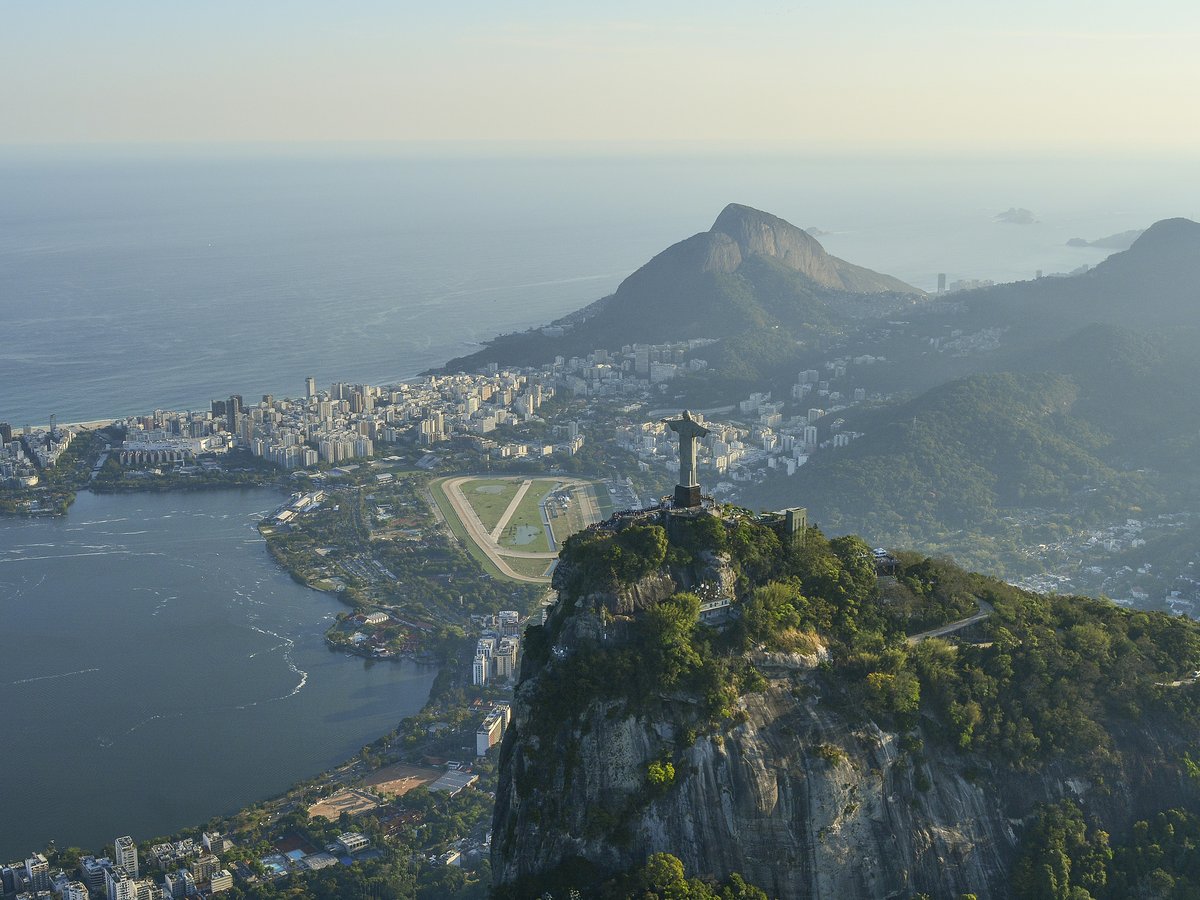
Rio de Janeiro sits between the Atlantic Ocean and a wall of granite peaks wrapped in Atlantic Forest. The city sprawls across a narrow coastal plain, hemmed in by Tijuca Massif to the north and the Serra do Mar escarpment further inland. Sugarloaf rises 396 meters straight out of Guanabara Bay. Pedra da Gávea, at 842 meters, is likely the tallest oceanside monolith in the world. This geography means you can leave a Copacabana cafe, ride 20 minutes by car, and be deep inside tropical forest with toucans overhead. The Tijuca National Park alone covers about 39 square kilometers inside city limits, which still feels unlikely for a metro area of 13 million people. Rio's outdoor culture runs deep. Cariocas treat the beach as a living room, but the mountains get serious weekend traffic too. You'll find trail runners on Pico da Tijuca before sunrise and stand-up paddleboarders on the Rodrigo de Freitas Lagoon by 7 a.m. The dry season, roughly May through September, brings cooler temperatures around 22 to 26°C and less humidity, which tends to make hiking more comfortable. Summer, from December through March, is hotter and wetter, with afternoon thunderstorms that can turn trails slick. That said, the ocean stays swimmable year-round, with water temperatures between 20 and 26°C depending on the month.
Outdoor activities
-
Hang Gliding from Pedra Bonita
Tandem hang gliding launches from the Pedra Bonita ramp at about 520 meters elevation in the Tijuca forest. The flight drops toward São Conrado beach over roughly 10 to 15 minutes, depending on thermals. You fly with a certified instructor from one of the clubs registered with the Brazilian Hang Gliding Association (ABVL). Flights currently run around R$700 to R$900 for tourists, though prices shift with demand. The ramp sits off Estrada das Canoas, accessible by car or the local vans that climb the hill from São Conrado. Wind conditions tend to be best in the morning, before the afternoon sea breeze picks up. Mind you, flights get cancelled when the wind direction is wrong, so book with some flexibility in your schedule.
- Difficulty
- Beginner-friendly (tandem)
- Duration
- 10-15 minutes airborne, plus transport
- Best season
- Year-round, though winter (June-August) tends to have more stable morning thermals
-
Rock Climbing at Urca and Sugarloaf
The granite walls around Morro da Urca and Pão de Açúcar have been climbed since the 1930s. Routes range from single-pitch sport climbs on Urca's south face to multi-pitch trad lines up Sugarloaf itself. The classic route up Sugarloaf, the Italian Route (Via dos Italianos), goes at roughly 5.6 in the Yosemite Decimal System across about 6 pitches. Costão do Pão de Açúcar has harder lines, some reaching 5.12. You'll want a local guide unless you already know the area and have your own gear. Several guiding outfits operate from Praia Vermelha at the base. The rock is coarse gneiss-granite, grippy when dry but treacherous when wet. Avoid climbing after rain.
- Difficulty
- Moderate to advanced, depending on route
- Duration
- 3-6 hours for a multi-pitch ascent
- Best season
- April through October (drier months, lower humidity)
-
Trail Running in Tijuca National Park
The park has a network of maintained trails that local running clubs use regularly. The Circuito das Grutas loop near the Cascatinha Taunay waterfall covers about 4 km with moderate elevation gain and roots underfoot. Longer loops connecting Pico da Tijuca, Bico do Papagaio, and the Açude da Solidão reservoir can total 12 to 18 km depending on route choice. The UTMB circuit event, Ultra Trail Tijuca, draws hundreds of runners each year on courses through the park. Footing is uneven, with exposed roots, wet rock sections, and short scrambles on some connectors. Carry water. The trails get muddy fast after rain.
- Difficulty
- Moderate to strenuous
- Duration
- 1 to 4 hours depending on distance
- Best season
- May through September for drier trails and cooler temperatures
-
Cycling the Rodrigo de Freitas Lagoon Loop
The paved path around Lagoa Rodrigo de Freitas runs about 7.5 km and is flat the whole way. It's the most popular casual cycling route in the Zona Sul, shared with joggers, walkers, and families on weekends. Bike Rio stations (the city's bike-share, operated by Tembici) have docks at several points around the lagoon, and a day pass costs around R$12. The loop passes the Parque dos Patins area, rowing clubs, and food kiosks where you can stop for água de coco. For something more demanding, the coastal bike path extends from Leblon through Ipanema and Copacabana to Leme, adding roughly 8 km each way along the waterfront.
- Difficulty
- Easy
- Duration
- 30-45 minutes for the lagoon loop at a relaxed pace
- Best season
- Year-round, though summer weekends get crowded
-
Surfing at Prainha and Grumari
Prainha, tucked between cliffs on Rio's western edge past Barra da Tijuca, is probably the best surf beach within city limits. It faces southwest, which picks up the dominant South Atlantic swell. Waves reach 1 to 2 meters on a good day, sometimes bigger in winter months. The beach is about 700 meters long with a sandy bottom, relatively safe for intermediates. Grumari, the next beach west, is quieter and has a more inconsistent break but fewer people. Both beaches are part of an environmental protection area (APA de Grumari), so there's no beachside development. Access is by car or the SC-Rio bus line 701 to Recreio, then a short ride. Board rental at Prainha runs about R$50 to R$80 for a half-day.
- Difficulty
- Intermediate (Prainha has a reasonably strong current)
- Duration
- Half-day session typical
- Best season
- April through September, when south swells are more consistent
-
Rappelling at Pedra da Gávea
Guided rappel descents off sections of Pedra da Gávea and the nearby Pedra Bonita are offered by several adventure operators. The standard Pedra Bonita rappel drops about 30 meters down a rock face overlooking the Tijuca canopy. It's geared toward first-timers and takes maybe 20 minutes of actual rappelling after a safety briefing. The full Pedra da Gávea experience is more serious and typically combined with the hike up, which involves the Carrasqueira scramble section. Operators provide all gear. Expect to pay R$200 to R$400 per person depending on the route.
- Difficulty
- Beginner (Pedra Bonita rappel) to advanced (Gávea descent)
- Duration
- 2-3 hours including transport and briefing
- Best season
- May through September for dry rock conditions
Day hikes
-
Pico da Tijuca (1,022 m)
The highest point in Tijuca National Park, and the highest peak within Rio's city limits. The standard route starts from the Bom Retiro entrance near Alto da Boa Vista. The trail passes through dense forest with some steep sections and stone steps built in the 19th century. The final ascent involves metal stairs and handrails bolted into the rock face. From the summit you can see Guanabara Bay, the Serra dos Órgãos range to the north, and the ocean beaches to the south. The trail is well-marked. Figure about 3.5 km each way from the Bom Retiro trailhead.
- Difficulty
- Moderate (steep final section with metal stairs, not recommended for anyone uncomfortable with heights)
- Duration
- 3 to 4 hours round trip
- Best season
- May through September for clear skies and dry trails
-
Pedra da Gávea (842 m)
This is probably the most demanding day hike inside Rio. The route starts from the Barra da Tijuca side, off Estrada do Sorimã. Most of the climb is through forest, but the final section, called the Carrasqueira, is a rock scramble that requires using hands and sometimes ropes. It's a roughly 2,500-meter approach with about 700 meters of elevation gain. On clear days the summit gives a 360-degree panorama. Worth noting, the Carrasqueira can be genuinely dangerous when wet. People do get stuck there. If you're not experienced with exposed scrambles, go with a guide.
- Difficulty
- Strenuous (the Carrasqueira scramble is Class 3, exposed, and not suitable for beginners)
- Duration
- 5 to 7 hours round trip
- Best season
- May through September for dry rock on the Carrasqueira
-
Morro Dois Irmãos (533 m)
Two Brothers peak overlooks Leblon and Ipanema from the western end of the Zona Sul. The main trail starts from the top of Vidigal favela, accessible by moto-taxi or on foot from the base. The hike climbs through a mix of community paths and forest trail. The last stretch is a scramble on exposed rock with fixed ropes. The summit view of the coastline, the Cagarras Islands offshore, and the Rodrigo de Freitas Lagoon behind the beachfront is the kind of perspective that makes the geography of Rio click in your head. Allow about 40 minutes from the Vidigal trailhead to the top if you're fit.
- Difficulty
- Moderate (short but steep, with some exposed rock near the summit)
- Duration
- 2 to 3 hours round trip including the walk through Vidigal
- Best season
- Year-round, but clearest views April through September
-
Pedra do Telégrafo (354 m)
Located in the Pedra Branca State Park on the far western side of Rio, near Guaratiba. The trail starts from the Morro do Silvério trailhead and climbs steadily for about 2.5 km through grassland and low scrub. The summit is famous for its overhanging rock where visitors take photos that look like they're dangling over a cliff. On weekends there's often a 30-minute queue for the photo spot. The view from the top covers Grumari beach, the Restinga de Marambaia, and the Sepetiba Bay. The hike itself is straightforward, mostly a wide dirt path with moderate incline.
- Difficulty
- Easy to moderate (steady uphill but no scrambling required)
- Duration
- 2 to 3 hours round trip
- Best season
- May through September for lower humidity and better visibility
-
Bico do Papagaio (989 m)
The second-highest peak in Tijuca, named for its parrot-beak rock formation. The trailhead is near the Excelsior gate in the park. The route passes through thick forest with a few stream crossings and then steepens sharply for the final approach. There are fixed ropes and metal handholds on the last section. The summit rock is narrow and exposed, not a place to linger if you're nervous about heights. Views extend across Tijuca forest and toward the Serra do Mar. This hike sees fewer people than Pico da Tijuca despite being nearby, so it tends to feel more remote.
- Difficulty
- Moderate to strenuous (steep final approach with fixed ropes, exposed summit)
- Duration
- 3 to 5 hours round trip
- Best season
- May through September for dry conditions on the roped sections
-
Parque Lage to Corcovado via the Forest Trail
An alternative to the train or van up Corcovado, this trail starts at Parque Lage and climbs through Atlantic Forest to reach the Christ the Redeemer statue at 710 meters. The route is about 3.5 km with roughly 700 meters of elevation gain, much of it on stone-paved colonial-era paths with roots and mud. You'll hear birdsong the entire way and might spot tufted-ear marmosets in the lower canopy. The trail emerges at the Corcovado complex, where you'll need to pay the normal entry fee (currently around R$80 for foreigners). Some hikers prefer to descend this way after taking the train up.
- Difficulty
- Moderate (sustained climb, slippery when wet, no technical sections)
- Duration
- 2 to 3 hours up, about 1.5 hours down
- Best season
- May through September, though it's hikeable year-round if you don't mind mud
Water activities
-
Stand-Up Paddleboarding on Lagoa Rodrigo de Freitas
The lagoon in the heart of the Zona Sul is calm, sheltered, and about 2.4 km across, which makes it ideal for stand-up paddleboarding. Several rental spots operate along the southern and eastern shores, near the Parque dos Patins area. Boards rent for about R$40 to R$60 per hour. The water is brackish and connected to the ocean via the Jardim de Alah canal. Early mornings are best, before the wind picks up around midday. You'll share the water with rowing teams from the local clubs, who train here and used it for the 2016 Olympic rowing and canoeing events.
- Difficulty
- Easy (flat water, no current)
- Duration
- 1-2 hours typical session
- Best season
- Year-round, calmest water March through September
-
Ocean Kayaking at Praia Vermelha and the Urca Coast
Praia Vermelha, the small beach at the foot of Sugarloaf, is a sheltered starting point for sea kayaking along the Urca peninsula. The paddle around the base of the Morro da Urca and Sugarloaf takes about 2 hours and passes rocky shoreline, small coves, and tidal pools. The water on the bay side of Urca tends to be calmer than the open ocean face. Several operators rent tandem kayaks from the beach or run guided tours for around R$150 to R$250 per person. You might spot sea turtles in the clearer patches near the rocks. The bay side also gives you a water-level perspective of the Fortaleza de São João.
- Difficulty
- Easy to moderate (dependent on wind and swell conditions)
- Duration
- 2-3 hours for the Urca peninsula circuit
- Best season
- March through October for calmer sea conditions
-
Swimming at Praias do Leme, Copacabana, Ipanema, and Leblon
Rio's main swimming beaches stretch about 6 km along the Zona Sul coast. Leme, at the eastern end, is the quietest. Copacabana's 4 km of sand gets heavy use but the waves are manageable for swimmers. Ipanema and Leblon face southwest and pick up a bit more swell. Lifeguard posts (postos) are numbered 1 through 12 and staffed daily. The strongest currents appear near Posto 6 (Copacabana/Leme border) and at the Arpoador end of Ipanema during south swells. Water temperature varies from about 20°C in August to 26°C in February. Worth noting, the undertow at Copacabana can be surprisingly strong even when the surface looks calm. Swim near a posto.
- Difficulty
- Easy to moderate (depends on swell, always respect the current flags)
- Duration
- As long as you like
- Best season
- October through April for warmest water, though swimmable year-round
-
Scuba Diving at the Cagarras Islands
The Ilhas Cagarras archipelago sits about 5 km offshore from Ipanema. The four main islands and surrounding rocks became a federal conservation unit in 2010. Dive sites around the islands have visibility that ranges from 5 to 15 meters depending on conditions and season, with the best clarity typically between June and October. Marine life includes sea turtles, rays, groupers, moray eels, and schools of sergeant major fish. Dive operators run boats from the Marina da Glória or from Copacabana, with two-tank trips running R$400 to R$600. You need at least an Open Water certification. The boat ride takes about 30 to 40 minutes.
- Difficulty
- Intermediate (open water conditions, variable visibility and current)
- Duration
- Half-day including boat transit and two dives
- Best season
- June through October for best water clarity
-
Waterfall Swimming at Cachoeira do Horto
A short walk from the Horto neighborhood, at the edge of Tijuca National Park, a series of small cascades and pools appear along the Horto stream. The main pool is deep enough to swim in and cold enough to feel restorative after a hike. The walk from the Horto gate takes about 20 to 30 minutes on a shaded forest trail. It gets busy on summer weekends, when Cariocas come to cool off. The water is clean mountain runoff. After heavy rains the stream rises and swimming can become risky, so check recent weather before going.
- Difficulty
- Easy (short, flat trail to the falls)
- Duration
- 1-2 hours including the walk and a swim
- Best season
- October through March when water volume is higher, though accessible year-round
Parks & gardens
-
Tijuca National Park (Parque Nacional da Tijuca)
FreeThe largest urban forest in the world by some measures, Tijuca covers about 39 square kilometers across four sectors. Most of this is secondary Atlantic Forest, replanted starting in the 1860s after coffee farming stripped the hillsides bare. Emperor Pedro II ordered the reforestation to protect Rio's water supply. Today the canopy is thick enough that you'll hear howler monkeys and spot coatis along the main trails. The Floresta da Tijuca sector, near the Alto da Boa Vista neighborhood, has the densest trail network. The park is free to enter on foot; there's a vehicle fee of around R$15 at the main gates.
Highlights: Cascatinha Taunay waterfall (a 30-meter cascade near the main entrance), the Chinese Pavilion (Vista Chinesa) with its panoramic lookout at 380 meters, Açude da Solidão reservoir surrounded by forest, and the chapel of Mayrink with Cândido Portinari panels
-
Jardim Botânico do Rio de Janeiro
Founded in 1808 by King João VI, the Botanical Garden covers 54 hectares at the foot of the Corcovado massif. The famous imperial palm avenue (Aleia Barbosa Rodrigues) runs 750 meters from the main gate, planted with royal palms that are now over 200 years old. The collections include about 6,500 species. Sections are organized by region and type, from the bromeliad house to the Japanese garden to the orchid nursery with around 600 species. It's a quiet contrast to the beaches, a few kilometers south. Toucans and marmosets are common in the canopy. Admission is currently R$27 for adults.
Highlights: The imperial palm avenue, the Orquidário with 600+ orchid species, the sensory garden, the Amazonian section with Victoria amazonica water lilies, and the Kubitschek fountain
-
Parque Lage
FreeThis public park sits at the base of Corcovado in the Jardim Botânico neighborhood. The main building is a 1920s mansion designed by Italian architect Mario Vodret, currently housing the Escola de Artes Visuais (School of Visual Arts). The grounds spread across about 52 hectares of landscaped gardens and forest, with trails that connect up to Corcovado and into Tijuca. On weekends, families and joggers fill the main lawn, and the mansion's ground-floor cafe, Plage Cafe, serves good coffee and acai with a view of the interior courtyard pool reflecting the Christ the Redeemer statue above.
Highlights: The mansion's courtyard pool with its Corcovado framing, the aquarium and small caves in the gardens, the trailhead to Corcovado via the forest path, and weekend art exhibitions in the Escola de Artes Visuais
-
Aterro do Flamengo (Parque do Flamengo)
FreeBuilt on landfill in the 1960s and designed by landscape architect Roberto Burle Marx, this 1.2 km-wide park stretches about 5.5 km along the Guanabara Bay waterfront from Centro to Botafogo. It's the largest public park in the Zona Sul. The design mixes modernist sculpture, native plantings, and open lawns with views across the bay to Niterói. On Sundays and holidays, the main road through the park closes to cars, turning into a long cycling and skating corridor. The Museu de Arte Moderna (MAM) sits at the northern end.
Highlights: Burle Marx's landscape design with native species plantings, the Marina da Glória yacht basin, views of Sugarloaf from the Botafogo end, the Museu de Arte Moderna (MAM), and the Sunday car-free road for cycling
-
Parque da Catacumba
FreeA small, steep sculpture park on the eastern shore of Lagoa Rodrigo de Freitas, this 30-hectare hillside was once a favela that the city controversially removed in 1970. Today it holds about 30 outdoor sculptures by Brazilian artists along a winding uphill path. The walk to the top takes roughly 15 to 20 minutes and reaches a lookout point with views over the lagoon, Ipanema, and Two Brothers peak (Morro Dois Irmãos). The park also has treetop adventure courses with zip lines and rappelling, operated by a private company. Fewer tourists come here than to the more famous parks, so weekday mornings can be genuinely quiet.
Highlights: The hilltop panoramic viewpoint over Lagoa Rodrigo de Freitas, roughly 30 sculptures along the trail, the treetop adventure course with zip lines, and the dense secondary Atlantic Forest canopy
-
Campo de Santana (Praça da República)
FreeA 15.5-hectare park in Centro, originally designed by Auguste Glaziou in 1873. It's where Princess Isabel signed the Lei Áurea abolishing slavery in Brazil in 1888. The park holds old fig trees, artificial grottoes, and a population of agoutis (large rodents the size of a small dog) that wander freely on the paths. It's a peaceful detour if you're in the Centro area, a green rectangle surrounded by colonial-era and early republic architecture. The bandstand and iron gates are original 19th-century work.
Highlights: Free-roaming agoutis, the historic bandstand, Glaziou's 1873 landscape design with artificial grottoes and ponds, and mature fig trees over 100 years old
Practical tips
- Sun Protection
- Rio sits at about 23°S latitude, and the UV index regularly hits 11 to 14 in summer months (December through March). Wear SPF 50+ sunscreen and reapply every 90 minutes if you're sweating. A hat with a brim and UV-blocking sunglasses are not optional for exposed hikes like Pedra do Telégrafo or Morro Dois Irmãos. Sunburn at this latitude can happen in under 30 minutes of direct exposure for lighter skin. Even on overcast days the UV index stays high.
- Hydration
- Carry at least 1.5 liters of water per person for any hike over 2 hours. In summer humidity above 80%, you'll sweat more than you realize. Coconut water (água de coco) vendors are everywhere at beach-level trailheads and charge about R$5 to R$10 per coconut. The tap water in Rio is treated but most locals drink filtered water. Refill stations are rare on trails, so bring enough from the start.
- Trail Conditions After Rain
- Trails in Tijuca and on the coastal peaks get slippery fast after rain. Red clay sections turn into mudslides. The Carrasqueira scramble on Pedra da Gávea becomes genuinely dangerous when wet. Check weather forecasts and consider postponing exposed hikes if rain fell in the previous 12 hours. The Parque Lage to Corcovado trail has stone steps that get moss-covered and slick. Sturdy hiking shoes with good tread matter more here than in drier climates.
- Footwear and Gear
- For hikes like Pico da Tijuca or Bico do Papagaio, wear ankle-supporting trail shoes with aggressive tread. Flip-flops (Havaianas are about R$30 everywhere) work for the beach, but people who attempt forest trails in them end up with injuries. Bring a lightweight rain jacket even in dry season, because the forest microclimate can produce quick showers. A headlamp is essential if you're starting early for sunrise hikes. Trekking poles help on the steeper Tijuca descents.
- Safety on Trails
- Most popular trails in Tijuca and the Zona Sul are well-trafficked and generally safe during daylight. Hike in groups of two or more. Avoid trails near favela edges after dark. Leave valuables at your accommodation and carry only what you need. The Vidigal trail to Dois Irmãos passes through a community, and locals are accustomed to hikers, but stick to the marked route. The Bombeiros (fire department, dial 193) handles mountain rescues. Cell signal is patchy inside the forest.
- Getting to Trailheads
- Uber and 99 (a Brazilian ride-hailing app) are the easiest way to reach trailheads like Bom Retiro (Tijuca), Estrada do Sorimã (Pedra da Gávea), or Prainha. Expect R$20 to R$50 from the Zona Sul depending on distance. Public buses run near some trailheads but rarely to the door. The yellow Tijuca park vans from Alto da Boa Vista cover interior park roads on weekends. For western beaches like Prainha and Grumari, budget 45 to 60 minutes from Copacabana by car.
FAQ
Do I need a guide for hiking in Tijuca National Park?
For the main trails like Pico da Tijuca or the Cascatinha Taunay loop, a guide is not required. The paths are marked and well-trafficked. For Pedra da Gávea, especially the Carrasqueira scramble, a guide is strongly recommended unless you have experience with exposed rock scrambles and route-finding. Several guiding companies operate from the park's main entrance or can be booked through platforms like GetYourGuide. Expect to pay R$150 to R$300 per person for a guided group hike.
Is it safe to swim at Copacabana and Ipanema beaches?
Generally yes, but respect the ocean. Lifeguards staff numbered posts (postos) along both beaches daily and use colored flags to indicate conditions. Red means dangerous current or high waves. The undertow at Copacabana can catch people off guard, especially between Posto 4 and Posto 6. Swim parallel to shore if caught in a rip current. Ipanema tends to have slightly calmer conditions except at the Arpoador end during south swells. Avoid swimming after heavy rains when runoff temporarily affects water quality.
What is the best time of year for outdoor activities in Rio?
The dry season from May through September offers the most comfortable hiking conditions, with temperatures around 22 to 26°C, lower humidity, and less rain. Water sports are good year-round, though ocean visibility for diving tends to peak between June and October. Summer (December through March) brings hotter days above 35°C, afternoon thunderstorms, and slippery trail conditions. That said, summer also means warmer ocean water and longer daylight hours. For surfing at Prainha, the winter south swells between April and September are more consistent.
How fit do I need to be for the day hikes around Rio?
The range is wide. Pedra do Telégrafo and the Parque Lage grounds are manageable for anyone who walks regularly. Pico da Tijuca and Dois Irmãos require moderate fitness and comfort with steep terrain. Pedra da Gávea demands genuine cardiovascular endurance and confidence on exposed rock. Humidity is the factor most visitors underestimate. Even a moderate hike at 80% humidity and 30°C feels significantly harder than the same distance in a drier climate. Start early, go slower than you think you need to, and carry more water than seems necessary.
Can I rent outdoor gear in Rio de Janeiro?
Yes, though options vary by activity. Surfboard and SUP board rentals are widely available at Copacabana, Ipanema, and Prainha for R$50 to R$80 per session. Bike-share stations (Tembici/Bike Rio) dot the Zona Sul, with day passes around R$12. For climbing gear, most guided operators supply harnesses, ropes, and helmets. Dedicated hiking gear rental is harder to find. If you need trekking poles or quality boots, buy them at Decathlon's Barra da Tijuca store (Avenida das Américas), which stocks gear at Brazilian prices lower than most specialist shops.
Are there any permits or entry fees for trails and parks?
Tijuca National Park is free to enter on foot. Vehicle entry costs about R$15. Corcovado (Christ the Redeemer) has a separate entry fee, currently around R$80 for foreign visitors, even if you hike up via the Parque Lage trail. The Jardim Botânico charges about R$27 for adults. Pedra Branca State Park (Pedra do Telégrafo) is free. Beach access is always free in Brazil by federal law. For scuba diving at the Cagarras Islands, there is no diver fee, but the conservation unit may restrict access to certain areas seasonally. Check with your dive operator.
Outdoor experiences in Rio de Janeiro
 Free cancellation
 Explore the Best of Tijuca Forest – Hike to Peaks, Caves & Falls
Outdoor experience: 5 hours, free cancellation.
via Viator Free cancellation
 Rio de Janeiro Helicopter Tour - Christ the Redeemer
Outdoor experience: free cancellation.
via Viator Free cancellation
 Rio de Janeiro Sunset Cruise or Sailing Tour
Outdoor experience: 3 hours, free cancellation.
via Viator Free cancellation
 Helicopter Flight - Wonderful City - RJ (Private Flight - 4 people)
Outdoor experience: free cancellation.
via Viator Free cancellation
 Rio de Janeiro: 35 min Private Helicopter Tour Christ
Outdoor experience: 35 minutes, free cancellation.
via Viator Free cancellation
 Telegraph Stone Adventure
Outdoor experience: free cancellation.
via Viator Free cancellation
 Rio de Janeiro: 35 Minutes Doors Off Helicopter Tour Christ
Outdoor experience: free cancellation.
via Viator Free cancellation
 Small-Group Panoramic Bike Tour in Rio de Janeiro
Outdoor experience: 4 hours, free cancellation.
via Viator Free cancellation
 Tijuca Forest Challenge Full-Day Hike (Small-Group or Private)
Outdoor experience: free cancellation.
via Viator Free cancellation
 Two brothers (Dois Irmãos) Hike
Outdoor experience: free cancellation.
via Viator Free cancellation
 Rio : Half-Day Jeep Tour at Tijuca Forest
Outdoor experience: 4 hours, free cancellation.
via Viator Free cancellation
 Tijuca National Park and all its wonders
Outdoor experience: free cancellation.
via ViatorLast verified by automated review (v1.7.2) on . What is automated review?