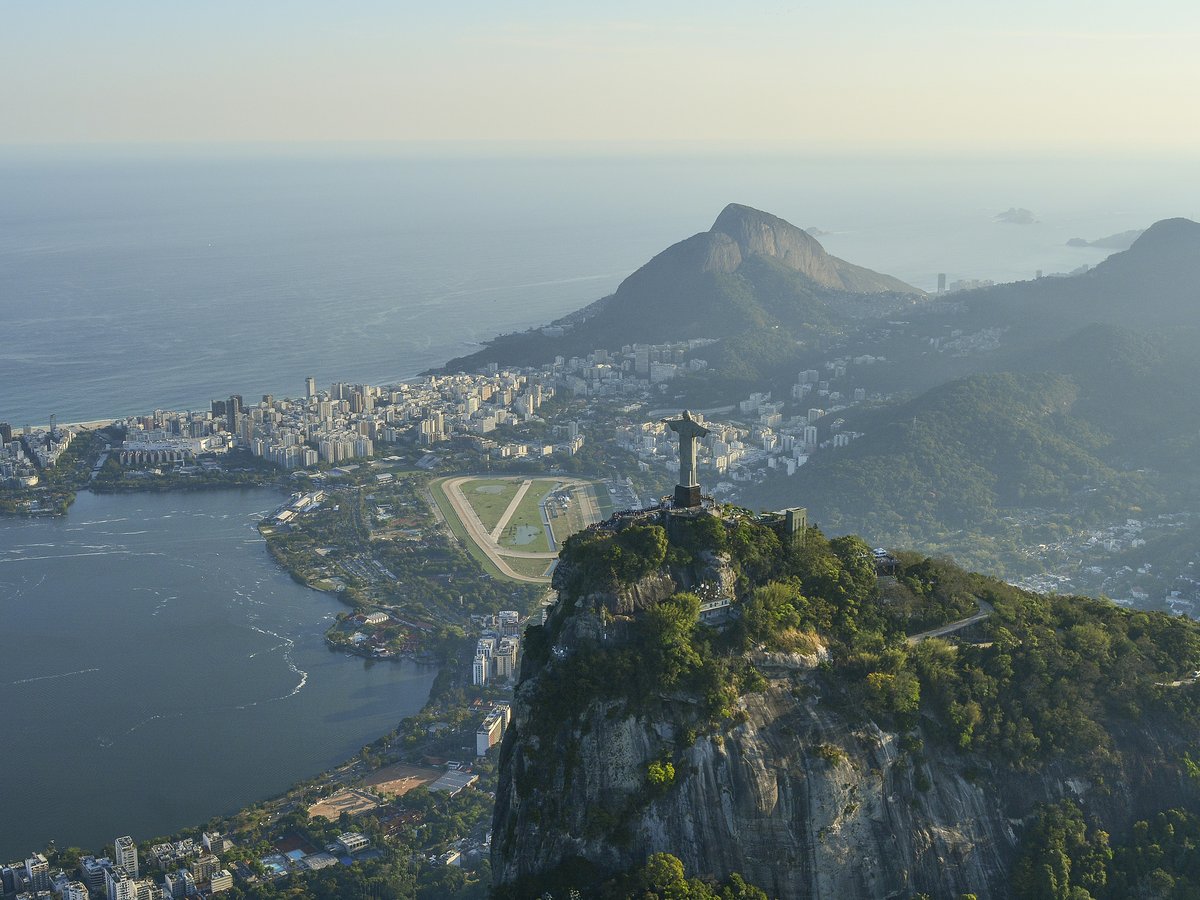
Rio de Janeiro sprawls between granite peaks and the Atlantic, pinched into a narrow coastal strip by the Serra da Carioca mountains. The city reads roughly south to north. Zona Sul, the beachfront arc from Leme through Copacabana, Ipanema, and Leblon, holds most of what visitors picture when they think of Rio. North of the Túnel Rebouças, Centro and Lapa form the old colonial core, still loud with street vendors and samba bars on weekend nights. The hillside neighborhood of Santa Teresa sits above Lapa, connected by the famous yellow bonde tram. Further inland, Botafogo and Flamengo line Guanabara Bay rather than the open ocean, which changes the water, the light, and the wind. Barra da Tijuca, about 25 kilometers west along the coast, feels like a different city entirely. Distances can be deceptive. Ipanema to Centro is only 12 kilometers, but traffic on the Aterro do Flamengo during rush hour can stretch that to 50 minutes by car. The Metrô runs from Zona Sul through Centro to Tijuca, and it remains the most reliable way to move between the southern beaches and downtown. Most first-time visitors stay in Zona Sul for proximity to the beaches and Sugarloaf, but repeat visitors tend to drift toward Botafogo or Santa Teresa, where the rent is lower and the restaurants are better.
Neighborhoods
-
Copacabana
Copacabana is dense, noisy, and perpetually awake. The 4-kilometer crescent of Avenida Atlântica runs from Leme at the northeastern end to Posto 6 near the Copacabana Fort. Apartment blocks from the 1950s and 1960s crowd together, many with crumbling Art Deco facades and tiny elevators that fit 3 people. The sidewalk mosaic, designed by Roberto Burle Marx in black and white Portuguese stone, is probably the most photographed pavement on earth. At night, the beachfront kiosks sell caipirinhas for R$15-20, and the smell of grilled queijo coalho drifts across the sand.
- Best for
- First-time visitors who want to be close to the beach and don't mind urban noise. Budget travelers will find more hostel options per block here than anywhere else in Rio.
- Key streets
- Avenida Atlântica for the beachfront promenade. Rua Barata Ribeiro and Rua Santa Clara for cheap lunch spots and juice bars. Rua Siqueira Campos leads to the Metrô station and has a concentration of pharmacies and shops. The area around Posto 6, near Rua Francisco Otaviano, tends to be quieter than the middle stretch.
-
Ipanema
Ipanema sits between Copacabana and Leblon, divided from each by the Arpoador rocks to the east and the Jardim de Alah canal to the west. The streets follow a grid that runs perpendicular to the beach, which makes navigation easy. Buildings here tend to be newer and better maintained than Copacabana's, mostly 8-12 story residential blocks from the 1970s onward. The pace feels noticeably slower. Praça General Osório hosts the Feira Hippie every Sunday, where about 700 stalls sell leather goods, paintings, and cachaça. The beach itself informally segments by crowd. Posto 9 has been the gathering spot for artists and left-leaning cariocas since the 1970s. Posto 8, near Rua Farme de Amoedo, is Rio's main LGBTQ+ beach section.
- Best for
- Couples and travelers who want good restaurants within walking distance of the beach. The R$200-400 per night mid-range hotel bracket is well-represented here.
- Key streets
- Rua Visconde de Pirajá is the main commercial strip, running the full length of the neighborhood with shops, banks, and restaurants. Rua Garcia D'Ávila has upscale boutiques and some of the better cafés. Rua Vinícius de Moraes leads to the Garota de Ipanema bar at number 49, where Tom Jobim and Vinícius de Moraes reportedly wrote the song in 1962.
-
Leblon
Leblon is the wealthiest residential neighborhood in Rio, tucked between the Dois Irmãos mountain and the Jardim de Alah canal. It has the feel of a small town grafted onto a big city. The streets are cleaner, the trees are older, and the stroller-to-surfboard ratio tilts heavily toward strollers. Real estate here runs R$15,000-25,000 per square meter, which prices out most of the backpacker crowd. The beach is less crowded than Ipanema's, especially near Posto 12 at the western end. Restaurateur Roberta Sudbrack's former fine-dining spot closed in 2019, but the neighborhood still has some of Rio's best-regarded restaurants, including CT Boucherie on Rua Dias Ferreira.
- Best for
- Families with young children, and travelers who prefer quiet evenings and high-end dining to nightlife. Hotel rates tend to start around R$500 per night.
- Key streets
- Rua Dias Ferreira is Leblon's restaurant row, packed into about 6 blocks with options ranging from Japanese at Sushi Leblon to steak at CT Boucherie. Rua General Urquiza has neighborhood bakeries and quieter cafés. The Baixo Bebê area near Posto 12 on the beach has a shaded playground and tends to be full of families on weekend mornings.
-
Botafogo
Botafogo faces Guanabara Bay, not the open Atlantic, which gives it a different feel from the Zona Sul beach neighborhoods. The water in Botafogo Bay is still too polluted for swimming in most conditions, but the view across to the Sugarloaf cable car station is one of Rio's best. The neighborhood has changed rapidly since about 2015. Rua Nelson Mandela, a pedestrian street near the Botafogo Praia Shopping, now has craft beer bars and third-wave coffee shops that didn't exist a decade ago. Old townhouses along Rua Voluntários da Pátria sit next to coworking spaces. The food scene here is arguably better pound-for-pound than Ipanema's, and a main course tends to cost R$30-55 compared to R$50-90 in Leblon.
- Best for
- Younger travelers, digital nomads, and repeat visitors who already know the beaches and want a neighborhood with personality. Hotel and Airbnb rates are 30-40% lower than Ipanema.
- Key streets
- Rua Voluntários da Pátria is the main artery, running from the bay up toward Humaitá. Rua Nelson Mandela has the densest concentration of newer bars and restaurants. Cobal do Humaitá, the covered market at Rua Voluntários da Pátria 446, has outdoor tables under trees where you can eat grilled fish or feijoada for R$35-45 on a Saturday afternoon.
-
Santa Teresa
Santa Teresa sits on a hill above Centro, reachable by the yellow Bondinho tram that climbs from the Carioca Metrô station. The tram resumed regular service in 2015 after a fatal accident in 2011 led to a 4-year suspension and rebuild. The neighborhood has cobblestone streets, colonial-era mansions with wrought-iron balconies, and walls covered in street art. The air up here is cooler and quieter than the flatlands below. You can hear birds. On weekends, the smell of feijoada drifts out of homes along Rua Almirante Alexandrino. The bohemian reputation dates to the 1960s and 1970s, when artists moved in because the rent was cheap. Galleries like Atelier 670 still operate out of converted houses.
- Best for
- Art-oriented travelers and couples who don't mind steep hills and limited transit options. Boutique guesthouses like the Hotel Santa Teresa (a Relais & Châteaux property) run R$800-1,500 per night, but simpler pousadas start around R$200.
- Key streets
- Rua Almirante Alexandrino is the main road, following the tram line along the ridge. Largo do Guimarães is the neighborhood's informal center, a small square with restaurants and a view down to Centro. Largo das Neves, a few blocks further, has a quieter pace and a good bar scene on Friday evenings. Rua Aprazível, steep even by Santa Teresa standards, has the celebrated restaurant Aprazível at number 62, which serves contemporary Brazilian food on a terrace overlooking Guanabara Bay.
-
Lapa
Lapa is Centro's nightlife district, anchored by the Arcos da Lapa aqueduct, a 42-meter-high stone structure built in 1750 that now carries the Santa Teresa tram. On Friday and Saturday nights, the streets around the arches and Rua Mem de Sá fill with thousands of people moving between samba clubs, forró dance halls, and open-air bars. The volume is intense. Bass from competing sound systems bleeds together, and the sidewalks get sticky with spilled beer by midnight. During the week, Lapa is quieter and somewhat run-down, with 19th-century commercial buildings in various states of repair. The Sala Cecília Meireles concert hall on Largo da Lapa hosts classical and instrumental shows in a 1,100-seat auditorium.
- Best for
- Nightlife seekers and live music fans who don't mind crowds and noise. Not ideal for families or light sleepers. Budget hostels near Rua do Lavradio charge R$60-120 per night.
- Key streets
- Rua Mem de Sá is the main bar strip. Rua do Lavradio hosts an antiques fair on the first Saturday of each month, and its restored colonial buildings house bars like the Scenarium, which operates across 3 floors of a former antique warehouse. Rua Joaquim Silva fills with street vendors and outdoor samba circles on weekend nights. The Escadaria Selarón, Jorge Selarón's tile-covered staircase connecting Lapa to Santa Teresa, has 215 steps covered in tiles from over 60 countries.
-
Urca
Urca is a tiny residential peninsula at the base of Sugarloaf Mountain, home to about 7,000 people. The pace here is closer to a fishing village than a metropolis. The Mureta da Urca, a low seawall along Avenida Portugal, is where locals sit with coolers of beer on weekend afternoons, watching the sunset over Botafogo Bay. The Brazilian Army's military school occupies a large compound on the peninsula, which kept development low and the streets quiet. Houses are mostly 2-3 stories, some dating to the 1920s, with small gardens behind walls. The air smells like salt water and frangipani.
- Best for
- Travelers who want peace and don't mind being a R$15-20 taxi ride from Copacabana's restaurants and shops. Limited hotel options, but a handful of guesthouses operate here.
- Key streets
- Avenida Portugal runs along the waterfront and leads to the Mureta da Urca seawall. Praia Vermelha, the small beach at the foot of Sugarloaf, is reachable on foot from the Bondinho cable car station. The Pista Cláudio Coutinho trail starts near Praia Vermelha and runs 1.25 kilometers along the base of Morro da Urca, paved and flat, with marmosets in the trees overhead.
-
Centro
Centro is Rio's downtown, a dense grid of streets that empties dramatically after 7pm on weekdays. During the day, it hums with office workers, street food carts selling tapioca and caldo de cana, and buses grinding through Avenida Rio Branco. The architecture spans 300 years. The Mosteiro de São Bento, a Benedictine monastery founded in 1590, sits on a hill above the port area, and its gold-leaf interior took monks 70 years to complete. Two blocks away, the CCBB (Centro Cultural Banco do Brasil) on Rua Primeiro de Março occupies a 1906 neoclassical bank building and consistently ranks among the most-visited art museums in the world, with free or near-free admission. The Boulevard Olímpico, developed for the 2016 Games, revived the old port district along the waterfront.
- Best for
- History and architecture enthusiasts, museum-goers, and budget travelers who prefer cultural weight over beach proximity. Hotels are scarce but cheaper, typically R$150-300 per night.
- Key streets
- Rua do Ouvidor is a narrow pedestrian street dating to the colonial period, still lined with shops and lunch counters. Avenida Rio Branco is the main boulevard, cut through older blocks during a 1904 urban renewal inspired by Haussmann's Paris. Praça XV de Novembro fronts the old royal palace and connects to the ferry terminal for Niterói. Rua Primeiro de Março has the CCBB and the Igreja da Candelária, an Italianate church completed in 1898.
-
Flamengo
Flamengo stretches along Guanabara Bay between Botafogo and Centro, separated from the water by the Aterro do Flamengo, a massive landfill park designed by Roberto Burle Marx and completed in 1965. The park has 1.2 million square meters of green space, running tracks, sports courts, and the Museu de Arte Moderna (MAM). The residential streets behind the park have a middle-class feel, with apartment buildings from the 1940s through the 1970s. Rents are lower than Botafogo's, and the neighborhood has a steady, unflashy quality. The Largo do Machado square, with its church and Metrô station, serves as the neighborhood's center of gravity.
- Best for
- Longer-stay visitors on a budget who want Metrô access and proximity to both Centro and Zona Sul. Monthly Airbnb rentals in Flamengo can run R$2,500-4,000, roughly half of Ipanema.
- Key streets
- Rua do Catete runs south from Largo do Machado past the Palácio do Catete, which served as Brazil's presidential palace from 1897 to 1960 and is now the Museu da República. Rua Marquês de Abrantes has a good concentration of everyday restaurants and bakeries. The Parque do Flamengo itself, with its curved pathways and views of Sugarloaf across the bay, is the main reason to walk through this neighborhood.
-
Barra da Tijuca
Barra da Tijuca, usually shortened to Barra, sits 25 kilometers southwest of Copacabana along the coast, past the Joá hills and the São Conrado neighborhood. It was developed mainly from the 1980s onward, following a master plan by Lúcio Costa. The result feels more like Miami than traditional Rio. Wide avenues, gated condominium complexes, large shopping malls like the BarraShopping (one of Latin America's biggest at 77,000 square meters of retail), and a 17-kilometer beach that is less crowded than Copacabana's on most days. The 2016 Olympic Park sits in Barra, and several of its venues still host events. The water is cleaner than the Zona Sul beaches, and the waves at Praia da Macumba on the western end draw surfers.
- Best for
- Families who prefer car-oriented logistics and shopping mall convenience, and visitors attending events at Riocentro or the Olympic Park. Hotels here tend to be resort-style, R$300-600 per night.
- Key streets
- Avenida das Américas is the main highway-like road running the length of Barra, with most commercial activity along it. Avenida Sernambetiba parallels the beach. The Cidade das Artes concert hall on Avenida das Américas 5300, designed by Christian de Portzamparc and opened in 2013, has a 1,300-seat main hall and hosts the Brazilian Symphony Orchestra.
FAQ
Is it safe to walk between neighborhoods in Rio de Janeiro?
It depends heavily on which neighborhoods and what time. Walking from Ipanema to Leblon along the beach or through the residential streets is routine at any hour. The Copacabana to Ipanema walk through Arpoador is popular even after dark. However, walking from Botafogo to Centro through less-trafficked streets at night is not advisable. The hillside areas between Santa Teresa and Centro have blind spots. As a general rule, stick to well-lit, populated streets after sunset, and use the Metrô or a ride-hailing app like 99 for longer distances. Petty theft tends to spike on quieter stretches of the beach after 10pm, particularly near Copacabana's Posto 3 and Posto 4.
Which neighborhood has the best food scene in Rio right now?
Botafogo has been the most interesting food neighborhood in Rio since roughly 2016-2017, when a wave of younger chefs opened smaller restaurants along Rua Nelson Mandela and Rua Voluntários da Pátria. Lasai, which held a Michelin star until it closed and relocated, helped put the area on the map. For traditional Rio food, Lapa and Centro still have the best per-kilo lunch restaurants, where a plate of rice, beans, farofa, and grilled meat runs R$25-35. Leblon's Rua Dias Ferreira remains the fine-dining strip, but you'll pay 2-3 times Botafogo prices for a comparable meal. Ipanema falls somewhere in between, with good options on Rua Garcia D'Ávila but fewer surprises.
Where should I stay if I want to be near the beach but avoid tourist crowds?
Leblon's Posto 12 end is significantly less crowded than Copacabana or central Ipanema, and the beach quality is equivalent. Urca's Praia Vermelha is a small cove beach that rarely gets packed, though it faces the bay rather than the open ocean. For the least crowded ocean beach accessible from Zona Sul, take a bus or taxi to Prainha, a 700-meter beach wedged between hills about 40 minutes west of Leblon. It's popular with surfers but has limited infrastructure. Staying in Botafogo gives you a 15-minute Metrô ride or R$20 taxi to Copacabana's sand without the nightly noise of beachfront Avenida Atlântica.
How do I get from the airport to Zona Sul hotels?
Rio has two airports. Galeão International Airport (GIG), where most international flights land, sits on Ilha do Governador about 25 kilometers north of Copacabana. A taxi from GIG to Ipanema costs approximately R$120-160 via the yellow airport taxis, or R$80-120 through 99 or Uber, depending on traffic. The trip takes 30-50 minutes outside rush hour, but can exceed 90 minutes during the 5-7pm window. Santos Dumont Airport (SDU), used for domestic shuttles to São Paulo and Brasília, is in Centro, only about 12 kilometers from Ipanema. A taxi from SDU to Zona Sul runs R$40-70. The BRT Transcarioca bus connects Galeão to Barra da Tijuca, but there's no direct rapid transit from GIG to Zona Sul without at least one transfer.
What is the best time of year to visit Rio de Janeiro?
Rio's high season runs from December through Carnival in February or March, when temperatures reach 35-40°C, hotel rates double, and Copacabana beach gets genuinely packed. The most comfortable weather tends to fall between May and September, Rio's dry winter, when daytime temperatures hover around 22-27°C and humidity drops. June and July bring the coolest nights, occasionally dipping to 15°C, which clears the beaches and drops hotel prices by 30-50% compared to January. September and October offer a middle ground, with warming temperatures, fewer tourists than summer, and jacaranda trees blooming purple across neighborhoods like Flamengo and Laranjeiras. Carnival week itself is a separate calculation entirely, as room rates in Zona Sul can reach 4-5 times the normal price.
Last verified by automated review (v1.7.2) on . What is automated review?