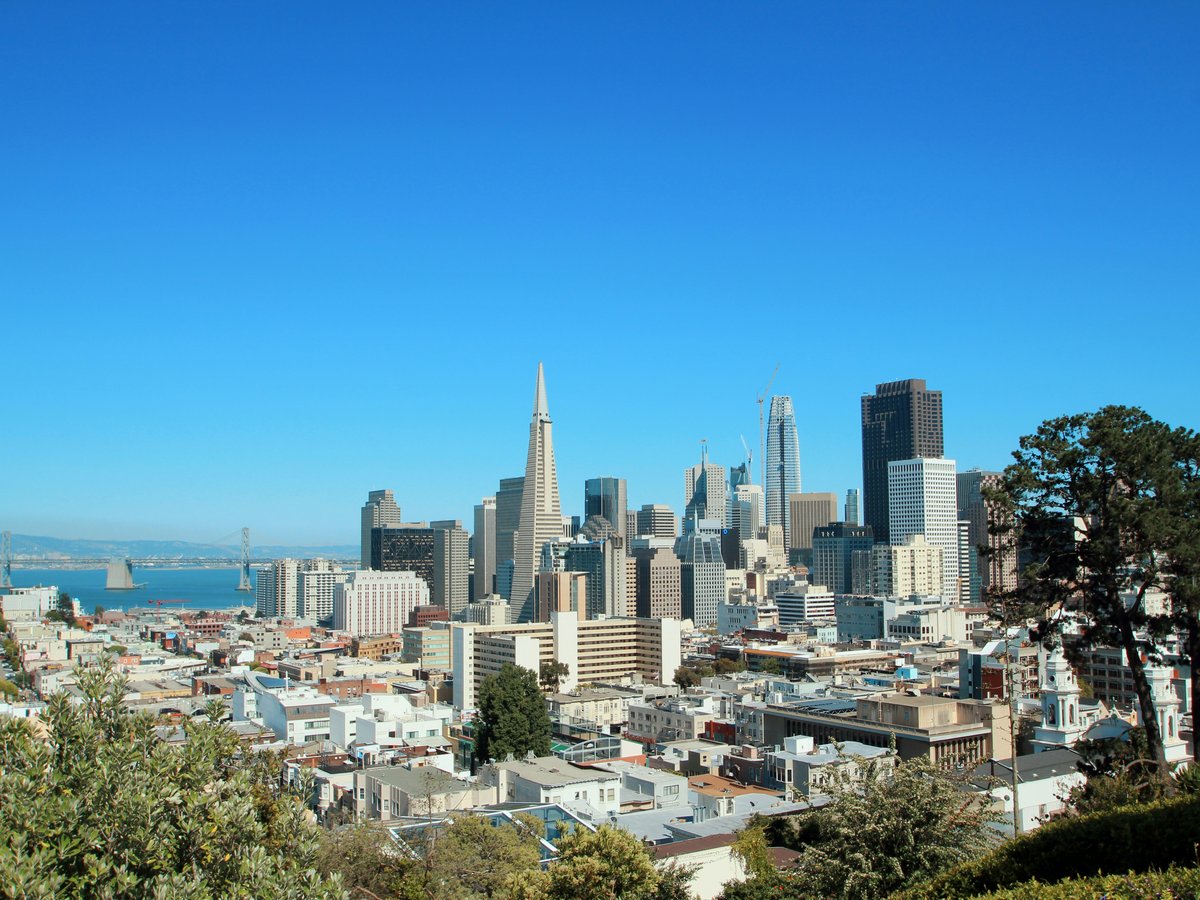
San Francisco covers a 7-by-7-mile peninsula with 47 named hills, and that compact geography packs in more free sightseeing than most cities manage at full price. Golden Gate Park runs 1,017 acres from Haight-Ashbury to Ocean Beach. The Presidio adds another 1,491 acres of coastal trails, eucalyptus groves, and former military architecture along the northern waterfront. Dolores Park fills with locals on any Saturday when the sun breaks through the fog layer. Mind you, September and October tend to be the warmest months here, not July and August. That catches a lot of first-time visitors off guard. The fog rolls through the Golden Gate most summer evenings. It drops the temperature 10 to 15 degrees in under an hour, so layers matter more in this city than almost anywhere else in California. You could fill 4 or 5 solid days here on nothing but public parks, coastal trails, free museums, and street art in the Mission. The WPA-era murals on Coit Tower's ground floor were painted in 1934 by 25 different artists working under the Public Works of Art Project.
Free attractions
-
Golden Gate Bridge Pedestrian Walkway
The east sidewalk runs 1.7 miles from the San Francisco toll plaza to the Vista Point parking area in Marin County. Open daily, currently 5 a.m. to 6:30 p.m. in winter and extended to 9 p.m. through summer. Wind picks up noticeably at mid-span, where the deck sits 220 feet above the water. Budget about 35 minutes each way at a comfortable pace. You'll feel the bridge vibrate slightly underfoot when heavy trucks pass, which is oddly reassuring rather than alarming. The bridge opened in 1937 and the pedestrian path has been free since day one.
PresidioLandmark -
Golden Gate Park
This 1,017-acre park stretches 3 miles from Haight-Ashbury to Ocean Beach. The Bison Paddock near the western end has held a small herd since 1891. Stow Lake offers a quiet loop walk around Strawberry Hill, and on weekday mornings the only sound tends to be ducks and the occasional heron taking off from the reeds. The park is larger than New York's Central Park by about 174 acres. On weekends the main roads fill with joggers, cyclists, and roller skaters.
Inner Sunset to Outer SunsetPark -
The Presidio
A former U.S. Army post that became part of the Golden Gate National Recreation Area in 1994. The 1,491 acres hold over 24 miles of hiking trails through forests of Monterey cypress and eucalyptus. The smell of eucalyptus is thick on warm afternoons along the Ecology Trail. Batteries to Bluffs Trail drops down to Marshall's Beach with views directly under the Golden Gate Bridge. Free to enter, free to park on weekdays. The Main Post area still has rows of former officers' quarters from the 1860s lining the central parade ground.
PresidioPark and Historic Site -
Fort Point National Historic Site
A Civil War-era brick fort completed in 1861, sitting directly beneath the south anchorage of the Golden Gate Bridge. The National Park Service operates it with free admission. The interior has three tiers of arched casemates, and you can feel the bridge traffic rumbling through the thick granite walls on the top level. Open Friday through Sunday, 10 a.m. to 5 p.m., with occasional closures for special events. The fort was built to protect the bay entrance from Confederate naval attack, which never came. Worth noting that the top tier offers one of the most unusual perspectives on the bridge from anywhere in the city.
PresidioHistoric Site and Museum -
Cable Car Museum
Located at 1201 Mason Street in the actual powerhouse that still drives the city's three cable car lines. Free admission, open daily from 10 a.m. to 5 p.m. You can watch the cable winding machinery working below the viewing platform. The mechanical clatter is constant and strangely satisfying. The system dates to 1873, and the three remaining lines carry roughly 7 million riders per year. The museum has several original grip cars from the 1870s and 1880s on display.
Nob HillMuseum -
Coit Tower Ground Floor Murals
The lobby of Coit Tower on Telegraph Hill has 27 fresco murals painted in 1934 by 25 artists under the Public Works of Art Project. Free to view during open hours, typically 10 a.m. to 5 p.m. daily. The murals depict California labor and daily life in a social realist style influenced by Diego Rivera. Going up to the observation deck currently costs around $10 for adults, but the ground floor artwork is open to everyone at no charge. You'll notice details about the 1934 waterfront strikes woven into several of the panels if you look closely.
Telegraph HillPublic Art and Landmark -
Lands End Trail and Sutro Baths Ruins
A 3.4-mile coastal trail along the northwestern tip of the peninsula with views of the Golden Gate Bridge, Marin Headlands, and Mile Rock. The Sutro Baths ruins at the western terminus are the concrete remains of a massive public bathhouse built by Adolph Sutro in 1896. The baths burned in 1966 and the ruins still sit in a rocky cove. At low tide you can walk among the old foundation pools. Cypress trees line sections of the path, and on clear days you might spot the Farallon Islands about 30 miles offshore.
Outer RichmondTrail and Historic Site -
Palace of Fine Arts
Built for the 1915 Panama-Pacific International Exposition, this Romanesque rotunda and colonnaded walkway sit on a small lagoon in the Marina District. The exterior and grounds are always free. Swans and various waterfowl have made the lagoon home for decades. The structure was originally built as a temporary exhibit hall, then rebuilt in concrete in the 1960s after the original plaster started crumbling. On still mornings the reflections in the water are nearly perfect, which is likely why wedding photographers seem to claim the spot by 9 a.m. on Saturdays.
MarinaLandmark -
Twin Peaks
Two hills reaching 922 feet near the geographic center of San Francisco with a 360-degree panoramic view of the city, the bay, and the Pacific. Free and open around the clock. The Christmas Tree Point parking area at the summit fills by mid-morning on weekends. On clear nights you can see the lights of Oakland, Berkeley, and the full span of the Bay Bridge from the north peak. It gets genuinely cold and windy up there. Even when it feels warm in the Mission, Twin Peaks might be 15 degrees cooler with a steady 20 mph breeze.
Twin PeaksViewpoint -
Dolores Park
A sloped, south-facing park at 18th and Dolores streets in the Mission District. Locals come for the views of downtown and the East Bay hills, and for the consistent sunshine when much of the city is socked in with fog. The park covers about 16 acres and fills to capacity on warm weekends, with crowds sometimes reaching several thousand. The J-Church Muni line stops a block away at Church and 18th. The southwest corner tends to be quieter than the main lawn. Mission Dolores, the oldest building in San Francisco at 235 years old, sits one block north on Dolores Street.
Mission DistrictPark -
de Young Museum (Free First Tuesdays)
The de Young Museum in Golden Gate Park currently offers free general admission on the first Tuesday of each month. Regular adult admission is $15. The collection spans American art from the 17th century onward, plus textile arts and works from Africa, Oceania, and the Americas. The building itself, designed by Herzog and de Meuron, opened in 2005 with a copper facade that has been slowly oxidizing to green. The Hamon Observation Tower on the 9th floor is always free, even on regular-price days, and offers views across the park to the ocean. Plan to arrive early on free Tuesdays since lines tend to build by 10:30 a.m.
Golden Gate ParkMuseum (free first Tuesdays) -
Asian Art Museum (Free First Sundays)
Located at 200 Larkin Street across from City Hall, the Asian Art Museum currently waives its $20 general admission on the first Sunday of each month. The permanent collection holds over 18,000 works spanning 6,000 years, with particular strength in Chinese jade, Japanese painted screens, and Southeast Asian sculpture. The Beaux-Arts building served as the city's main library until 2003. First Sundays can draw sizable crowds, so arriving when doors open at 10 a.m. tends to help. The Samsung Hall gallery on the ground floor often hosts special exhibitions that are included with the free admission.
Civic CenterMuseum (free first Sundays)
Free activities
-
Walking the Embarcadero Waterfront
The Embarcadero promenade runs about 3 miles along the eastern waterfront from Fisherman's Wharf south past the Ferry Building to the Giants' Oracle Park. You pass Pier 39 (loud with sea lions), the historic Pier 7 fishing pier, and a string of public art installations along the way. The numbered piers on the odd-numbered side have some of the best unobstructed views of the Bay Bridge and Treasure Island. On weekday mornings the stretch south of the Ferry Building is surprisingly quiet, with the salt air and the slap of water against pilings as the main soundtrack.
EmbarcaderoWalking Route -
Browsing the Ferry Building Marketplace
The Ferry Building at the foot of Market Street houses about 30 permanent food vendors and specialty shops. Free to enter and wander through. You'll pick up the smell of roasting coffee from Blue Bottle, fresh sourdough from Acme Bread, and aged cheese from Cowgirl Creamery within the first 50 feet. The Saturday morning farmers market out front has been running since 1993 and draws vendors from across Northern California, often 100 or more stalls by 8 a.m. Browsing costs nothing, though your willpower might be tested by the Rancho Gordo bean display.
EmbarcaderoMarket and Food Hall -
Mission District Mural Walk
Balmy Alley between 24th and 25th streets has over 30 murals on garage doors and fences, many reflecting the neighborhood's Latino heritage and political history since the 1970s. Clarion Alley between Mission and Valencia streets has another concentrated stretch of street art that changes regularly. The Women's Building at 3543 18th Street has a full exterior mural called MaestraPeace, completed in 1994 by seven women artists. The colors on Balmy Alley are intense in afternoon light. Allow about 90 minutes to walk all three locations at a comfortable pace.
Mission DistrictPublic Art Walk -
Exploring Chinatown
San Francisco's Chinatown is the oldest in North America, established in the 1840s. Enter through the Dragon Gate at Grant Avenue and Bush Street, then work your way north through the side alleys. Waverly Place, a two-block alley between Washington and Sacramento streets, has several historic temples with ornate painted balconies on the upper floors. Ross Alley is narrow enough that you can nearly touch both walls. The herb shops along Stockton Street have a particular smell, earthy and sharp, that hits you from the doorway. Stockton Street tends to feel more like a working neighborhood market than Grant Avenue's tourist-oriented storefronts.
ChinatownNeighborhood Walk -
Baker Beach
A half-mile stretch of sand on the western shoreline of the Presidio with a direct view of the Golden Gate Bridge from below. Free parking in the lot off Gibson Road, though it fills by noon on weekends. The water temperature hovers around 50 to 55°F year-round and currents are strong, so swimming is not advisable. That said, the beach is gorgeous for walking and the sand is coarse enough to stay out of your shoes. The north end is clothing-optional. On rare warm days the whole beach fills by mid-afternoon.
PresidioBeach -
Ocean Beach
A 3.5-mile stretch of Pacific coastline along the western edge of the city from the Cliff House area south to Fort Funston. The beach is wide, flat, and often windy. On winter afternoons the surf can reach 10 to 15 feet and draws experienced surfers to the north end. The Great Highway bike path runs parallel to the sand. Fire rings near the middle of the beach are free to use and first-come, first-served. They tend to fill by 4 p.m. on weekends. Watching the sun drop into the Pacific from a fire ring on a clear evening, with the sound of the waves and the smell of driftwood smoke, is one of those San Francisco moments that stays with you.
Outer SunsetBeach -
City Lights Bookstore and North Beach Literary Walk
City Lights at 261 Columbus Avenue has been open since 1953, when Lawrence Ferlinghetti co-founded it as the first all-paperback bookstore in the United States. Free to browse across three floors. The upstairs poetry room has a chair by the window overlooking Jack Kerouac Alley. From there you can walk next door past Vesuvio Cafe, the bar Kerouac and Ginsberg frequented in the 1950s, then through Washington Square Park to Saints Peter and Paul Church. Marilyn Monroe and Joe DiMaggio took their wedding photos on the church steps in 1954. The walk covers about 4 blocks and works well as a 45-minute loop.
North BeachLiterary and Cultural Walk
Free events
-
Stern Grove Festival
Sundays, mid-June through mid-AugustA free outdoor concert series held in Sigmund Stern Grove, a natural amphitheater surrounded by eucalyptus and redwood trees in the city's southwest corner. The festival has run every summer since 1938 and typically features a mix of genres from classical and jazz to rock and world music. Attendance often reaches 8,000 to 10,000 per show. Arrive at least an hour early for a decent spot on the meadow. The grove's natural acoustics are surprisingly good for an outdoor venue, and the tall trees block most of the Pacific wind. The concert is free, though organizers have recently asked attendees to RSVP online.
Sigmund Stern Grove, 19th Avenue at Sloat Boulevard -
Hardly Strictly Bluegrass
First weekend of October, Friday through SundayA free 3-day music festival in Golden Gate Park that has run every October since 2001. The late Warren Hellman founded and funded it as a gift to San Francisco. Despite the name, the lineup extends well beyond bluegrass into rock, folk, country, and indie. Multiple stages spread across the park's western meadows draw an estimated 500,000 or more attendees across the weekend. No tickets, no gates, no corporate sponsorship logos. The festival feels remarkably relaxed for its size. Bring layers, since the park's western end tends to be cooler and foggier than the rest of the city.
Hellman Hollow, Lindley Meadow, and Marx Meadow in Golden Gate Park -
Sunday Streets SF
Several Sundays per year, typically April through OctoberSan Francisco periodically closes major streets to car traffic, opening them up to pedestrians, cyclists, and community activities. Routes rotate through different neighborhoods, typically covering 1 to 2 miles per event. Past routes have included the Embarcadero, the Tenderloin, the Mission, and the Bayview. Local vendors, fitness instructors, and community groups set up along the route. The program has been running since 2008 and generally schedules several events between April and October each year.
Rotating neighborhoods across San Francisco -
Yerba Buena Gardens Festival
Weekends, May through OctoberA free outdoor arts festival at Yerba Buena Gardens, the 5-acre public park at 750 Howard Street between 3rd and 4th streets in SoMa. The festival runs from roughly May through October and programs live music, dance performances, and cultural events on the outdoor stage. Shows typically happen on weekends. The gardens sit on top of the Moscone Convention Center, and the Martin Luther King Jr. Memorial waterfall at the north end provides steady white noise behind the performances. Bring a blanket for the lawn seating area.
Yerba Buena Gardens, 750 Howard Street, SoMa -
Opera in the Park
One Sunday in September, typically the weekend after the opera season opensThe San Francisco Opera has traditionally opened its fall season with a free outdoor concert in Sharon Meadow in Golden Gate Park. The event usually takes place on the Sunday after opening night in September. Principal singers perform arias and scenes from the upcoming season with full orchestra. Attendance has historically reached 20,000 or more. The grass fills up fast, so many regulars arrive by late morning with picnic setups. The sound carries well across the meadow, even toward the back.
Sharon Meadow, Golden Gate Park
Free Viewpoints Worth the Walk
Twin Peaks gets the most attention, but San Francisco has a handful of other viewpoints that are arguably better and usually less crowded. Battery Spencer, a decommissioned military battery on the Marin side of the Golden Gate Bridge, gives you the classic postcard angle of the bridge with the city skyline behind it. It's a short but steep walk from the parking pullout on Conzelman Road. Hawk Hill, about a mile further up that same road, adds another 200 feet of elevation and a wider panorama that sweeps from Point Bonita lighthouse to the East Bay hills. Back in the city, Bernal Heights Hill has a grassy summit with a 360-degree view and far fewer tourists than Twin Peaks. The walk up from Folsom Street takes about 15 minutes and is steep enough to feel it. Tank Hill in the Cole Valley neighborhood is even less visited. A set of wooden stairs off Belgrave Avenue leads to a rocky outcrop with views of the Sutro Tower, Golden Gate Park, and the ocean. On clear evenings, the sunset from Tank Hill turns the fog bank orange and pink. The 16th Avenue Tiled Steps in the Inner Sunset neighborhood are a 163-step mosaic staircase installed in 2005 by artists Aileen Barr and Colette Crutcher. The steps themselves are the attraction, but the view from the top toward the Pacific is a solid bonus. All of these viewpoints are free and open to the public around the clock.
Practical Tips for Free Days at San Francisco Museums
The de Young Museum in Golden Gate Park currently offers free general admission on the first Tuesday of each month. The Asian Art Museum near Civic Center does the same on the first Sunday of each month. If your visit happens to land on both days, you could cover two major museums in the same week at no cost. The Cable Car Museum at 1201 Mason Street and Fort Point under the Golden Gate Bridge are always free, no special timing needed. The de Young's Hamon Observation Tower on the 9th floor is also always free, even on days when the museum charges its regular $15 admission. You can take the elevator up for the view without buying a ticket. The Randall Museum on Corona Heights, a small nature and science museum run by the city's Recreation and Parks Department, is free every day. It tends to draw a younger crowd, but the rooftop terrace has one of the more underappreciated views of the downtown skyline. For the de Young and Asian Art Museum free days, the practical advice is the same. Arrive within 30 minutes of opening. Lines build quickly after 10:30 a.m., and by noon the galleries can feel noticeably packed. Weekday free days at the de Young tend to be a bit calmer than the Asian Art Museum's Sunday slots, which draw families.
FAQ
Is it free to walk or bike across the Golden Gate Bridge?
Yes, always. The pedestrian walkway on the east side of the bridge is open daily and has been free since the bridge opened in 1937. Cyclists share the path during certain hours and have dedicated access on the west side at other times. The current hours are roughly 5 a.m. to 6:30 p.m. in winter and extended to 9 p.m. in summer, though exact times shift slightly by season. Only motor vehicles pay a toll, which is currently $9.75 for most cars using FasTrak.
Which San Francisco museums have free admission days?
The de Young Museum in Golden Gate Park is currently free on the first Tuesday of each month. The Asian Art Museum near Civic Center is free on the first Sunday of each month. Both normally charge $15 to $20 for adult admission. The Cable Car Museum at 1201 Mason Street and Fort Point National Historic Site under the Golden Gate Bridge are free every day they are open, no special timing required. The Randall Museum on Corona Heights is also always free. The de Young's Hamon Observation Tower on the 9th floor is free regardless of whether the museum is charging regular admission that day.
What is the best time of year for free outdoor activities in San Francisco?
September and October are typically the warmest and clearest months. This surprises most visitors, but San Francisco's famous fog is heaviest from June through August, when coastal temperatures often sit in the mid-50s to low 60s°F. Late September and October bring more sun, warmer days reaching the low 70s, and calmer wind. That said, the city's microclimates mean the Mission District or Dolores Park might be sunny while the Sunset District near Ocean Beach is under a fog bank on the same afternoon. If you are visiting during summer, plan outdoor time in the Mission, SoMa, or the East Bay side and save the coast for clearer days.
Can you visit Alcatraz Island for free?
No. Alcatraz Island requires a timed ticket that currently runs around $41 for adults through Alcatraz City Cruises, the official ferry operator from Pier 33. Tickets often sell out 2 to 3 weeks in advance during peak season. There is no free admission day. You can see the island from many free vantage points along the waterfront, including Aquatic Park, the Embarcadero, and Fort Point. The view from Crissy Field in the Presidio is particularly clear on fog-free mornings.
What should I wear for a day of walking around San Francisco?
Layers are more important here than in almost any other American city. The temperature can swing 15 degrees between neighborhoods on the same afternoon because of the fog patterns and hills. A base layer, a mid-weight fleece or sweater, and a wind-resistant outer layer will cover most situations from June through September. Comfortable walking shoes with good grip matter because the sidewalks on steeper hills like Telegraph Hill, Russian Hill, and Pacific Heights have genuine inclines. The wind at exposed viewpoints like Twin Peaks, Battery Spencer, and the Golden Gate Bridge pedestrian walkway can feel 10 to 15 degrees colder than sheltered spots downtown. Sunscreen is still necessary on clear days, especially at Baker Beach and Ocean Beach where the reflected light off the water and sand is strong.
Last verified by automated review (v1.7.2) on . What is automated review?