Compare every Turkey city in May →
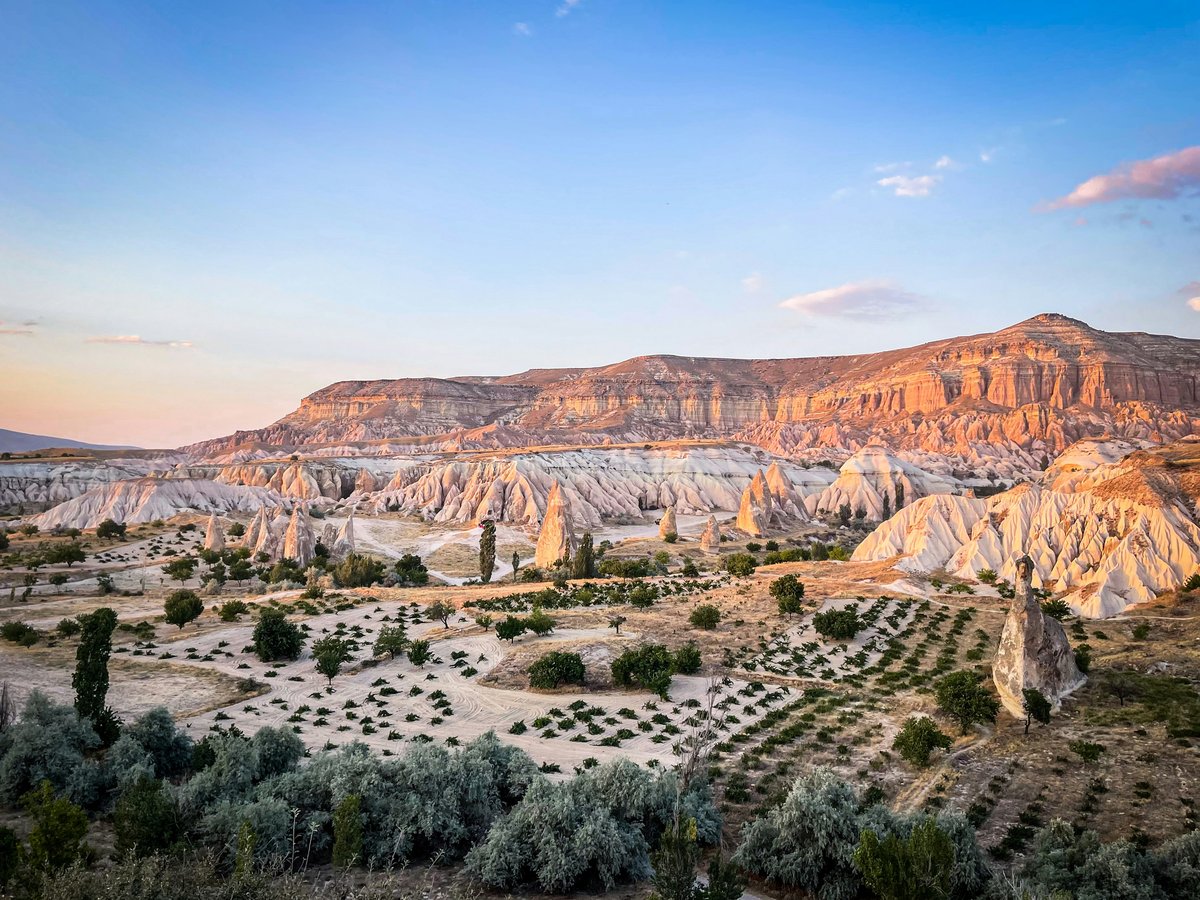
May in Cappadocia is, quite simply, one of the 2 or 3 best months to be here. Daytime temperatures reach about 22°C (72°F), the volcanic valleys are carpeted in wildflowers, and the morning air is still and cool enough for reliable hot air balloon launches over Göreme most days of the week. You'll feel the season turning. Winter's grip on this high Anatolian plateau, which sits at roughly 1,000 metres (3,280 feet) above sea level, has fully loosened, but the scorching July heat hasn't arrived. The tufa fairy chimneys of Paşabağ and Devrent Valley catch a quality of morning light that photographers chase specifically in spring.
That said, May is not flawless. Overnight lows still drop to around 8°C (47°F), which feels sharp at 5:30 AM when you're standing in a launch field near Göreme waiting for your balloon's envelope to inflate. Roughly 10 days of the month bring some rainfall, totalling about 49mm. Most showers arrive in short afternoon bursts, but they can ground balloon flights for a morning. Smart visitors build a buffer day into their schedule. The crowds are growing, too. Göreme's narrow lanes and the terrace cafes of Ürgüp are noticeably busier than April, though nothing like the domestic tourism wave that hits in July and August.
Prices reflect the shift. Hotel rates in Uçhisar and Ortahisar have climbed 20-30% above their winter lows, and cave hotel availability in Göreme for weekends can get tight with less than 2 weeks' notice. You're paying more than shoulder season but still less than the summer peak. The trade-off is worth it for most people. The valleys are green, the apricot and cherry orchards around Ürgüp are flowering, and Ihlara Valley's 14-kilometre gorge has water flowing through the Melendiz River from snowmelt. May delivers Cappadocia at its most photogenic without the extremes of winter cold or summer heat.
Why visit in May
- Wildflowers blanket Rose Valley (Güllüdere Vadisi), Love Valley, and Pigeon Valley through most of the month, peaking in the first 2 weeks. The poppies, chamomile, and wild thyme create a colour palette that vanishes by mid-June.
- Hot air balloon conditions are among the year's most reliable. May mornings tend to be calm with light winds, and operators in Göreme report fewer cancellations than in the rainier March-April window or the thermally turbulent July-August period.
- Comfortable hiking temperatures. The 22°C high means you can walk the 4-hour Rose Valley to Red Valley loop or the 14 km Ihlara Valley trail without heat stress, carrying less water than summer demands.
- The Kızılırmak river through Avanos is running well from spring snowmelt, and the riverside pottery workshops are pleasant to visit before summer tour-bus congestion.
Worth knowing
- Roughly 10 rainy days averaging 49mm total. Showers are usually short but can cancel a morning balloon flight with less than 12 hours' notice. Operators reschedule to the next available morning, which means a packed itinerary with no flex day can leave you grounded entirely.
- Morning temperatures around 8°C (47°F) catch visitors off guard. The 14°C daily swing between dawn and midday means you'll be layering and un-layering constantly.
- Weekend crowd pressure in Göreme is building. The town has roughly 50 hotels in a compact area, and by late May the main street feels noticeably more packed than early April, particularly around the Göreme Open-Air Museum entrance.
- Some outdoor restaurants and rooftop terraces in Ürgüp and Uçhisar haven't fully opened their summer menus yet in early May, and evening dining outdoors can feel cold without a jacket.
Best for
Think twice if
May brings Cappadocia's most comfortable conditions. Afternoons are warm and dry enough for hiking in a t-shirt, but mornings carry a real chill. The plateau's 1,000m elevation means the air is dry, with humidity averaging 54%. Rain falls on about 10 days, typically in short afternoon showers rather than all-day downpours. Clear skies dominate most mornings, which is why balloon operators favour this month. By late May the midday sun feels strong, a preview of the 31°C July peaks to come. Wind is generally light, though occasional gusts sweep the exposed ridgelines above Uçhisar and along the Göreme panoramic road.
Seasonal caution
- The 14°C daily temperature swing between dawn (8°C / 47°F) and midday (22°C / 72°F) is the biggest comfort risk. Visitors dressed for warm afternoons regularly underestimate the early morning chill at balloon launch sites near Göreme.
- UV intensity at 1,000m elevation is roughly 20% stronger than at sea level. Clear May skies and dry air offer less atmospheric filtering, so sunburn happens faster than the moderate temperature might suggest.
Year-round climate
Averages from the last 5 years.
| Month | Avg high (°C) | Avg low (°C) | Rainfall (mm) |
|---|---|---|---|
| Jan | 7 | -3 | 45 |
| Feb | 6 | -4 | 29 |
| Mar | 11 | -1 | 56 |
| Apr | 19 | 5 | 49 |
| May | 22 | 8 | 49 |
| Jun | 27 | 13 | 32 |
| Jul | 31 | 15 | 2 |
| Aug | 32 | 16 | 7 |
| Sep | 26 | 11 | 20 |
| Oct | 20 | 6 | 17 |
| Nov | 15 | 2 | 34 |
| Dec | 9 | -1 | 38 |
Holidays and festivals in May
Public holidays
- Labour Day(İşçi Bayramı)1 May 2027
- Eid al-Adha First Day (Tentative Date)(Kurban Bayramı 1. Gün (Tentative Date))16 May 2027
- Eid al-Adha Second Day (Tentative Date)(Kurban Bayramı 2. Gün (Tentative Date))17 May 2027
- Eid al-Adha Third Day (Tentative Date)(Kurban Bayramı 3. Gün (Tentative Date))18 May 2027
- Atatürk Commemoration & Youth Day(Atatürk'ü Anma, Gençlik ve Spor Bayramı)19 May 2027
- Eid al-Adha Fourth Day (Tentative Date)(Kurban Bayramı 4. Gün (Tentative Date))19 May 2027
Best things to do in May
Hot air balloon flight over fairy chimneys at dawn
adventureRoughly 100-150 balloons launch from fields near Göreme on clear mornings, drifting over the eroded tufa formations of Love Valley, Pigeon Valley, and the Göreme basin. Flights last 45-60 minutes and land in the surrounding farmland. The experience includes watching the inflation process in the dark, lifting off as the sun crests the ridge, and a champagne toast after landing.
May's calm, cool mornings produce some of the year's most stable flying conditions. Cancellation rates are lower than the rainy March-April period, and thermals are less disruptive than in midsummer. The green valley floors and wildflower patches are visible from altitude.Booking tipBook at least 2-3 weeks ahead for weekend flights. Build in 1-2 buffer days for weather cancellations. Operators typically reschedule to the next available morning at no charge.
Hiking the Rose Valley to Red Valley loop
hikingA 4-5 hour trail that winds between pink-and-orange tufa formations, past rock-cut churches with faded Byzantine frescoes, through pigeon houses carved into cliff faces, and along a valley floor dotted with small vineyard plots. The trail runs roughly 7 km from the Rose Valley entrance near Göreme to the Red Valley exit near Çavuşin.
Wildflowers line the valley floor in May, particularly poppies and wild chamomile. The 22°C high is comfortable for a morning hike without the heat exhaustion risk of July (31°C). The path is dry enough to walk in trail shoes rather than the boots needed in March.Booking tipNo booking needed. Start by 8 AM to finish before the afternoon heat and any shower risk. The Çavuşin end has minibuses back to Göreme.
Walking the Ihlara Valley gorge
hikingA 14 km canyon carved by the Melendiz River, with walls rising 100 metres on either side. The trail passes rock-cut churches dating to the 7th-11th centuries, including Ağaçaltı Kilise with its well-preserved Ascension fresco. The village of Belisırma, roughly midway, has riverside restaurants serving trout and gözleme.
The Melendiz River is running at its strongest from spring snowmelt in May, making the gorge floor lush and the sound of water constant. Summer reduces the flow to a trickle. The temperature inside the canyon is 3-5°C cooler than the plateau above, so May's 22°C topside translates to a pleasant 17-18°C on the valley floor.Booking tipHire a driver from Göreme (about 70 km each way) or join a guided day tour. The canyon has multiple entry points, so you can walk a 4 km section rather than the full 14 km.
Pottery workshop in Avanos
culturalAvanos sits on the Kızılırmak (Red River), and the town has produced pottery from the river's distinctive red clay for over 4,000 years. Several studios offer hands-on workshops where you throw your own pot on a kick wheel, guided by a local potter. Sessions run 1-2 hours. The Güray Museum, built inside a cave complex, displays Hittite-era pottery alongside contemporary pieces.
The walk along the Kızılırmak riverbank to the studios is pleasant in May's mild weather, and the workshops are less crowded than in summer when tour buses fill the town. The river is at a higher water level from snowmelt, making the riverside setting more scenic.Booking tipDrop-in is usually fine on weekday mornings. Weekend afternoons in late May can be busy with domestic day-trippers from Ankara.
Sunrise at Uçhisar Castle viewpoint
sightseeingUçhisar Kalesi is the highest point in Cappadocia, a massive rock formation honeycombed with tunnels and rooms. The summit platform offers a 360-degree view across Pigeon Valley, Göreme, and on clear mornings, the snow-capped peak of Erciyes Dağı (Mount Erciyes, 3,917m) to the east. The climb takes about 10 minutes from the ticket office.
May sunrises around 5:45 AM paint the fairy chimney landscape in warm orange light. The air clarity tends to be better than in summer when heat haze obscures the Erciyes view. The 8°C morning temperature at the summit is brisk but manageable with a fleece.Booking tipThe castle opens at sunrise for a small entry fee (around 60-80 TL). Arrive 15 minutes before opening to be among the first up.
Exploring Derinkuyu Underground City
historicalThe deepest accessible underground city in Cappadocia, reaching 8 levels below ground (about 55 metres deep). It held an estimated 20,000 people during Byzantine-era raids. The tunnels are narrow in places, with low ceilings on the lower levels. The temperature underground stays around 13-15°C year-round.
May's moderate visitor numbers mean shorter queues at the narrow single-file passages on levels 3-5. In July and August, the underground tunnels become uncomfortably crowded. The constant 13°C underground temperature is a welcome break from the midday surface warmth.Booking tipArrive before 10 AM to avoid tour groups. The underground city is about 40 minutes south of Göreme by car.
Mountain biking through Sword Valley and Meskendir Valley
adventureSeveral rental shops in Göreme offer mountain bikes for self-guided rides through the valley network. The Meskendir Valley route connects Göreme to Çavuşin through a narrow canyon with rock-cut dwellings and ancient pigeon houses overhead. Sword Valley (Kılıçlar Vadisi) is shorter but steeper, with eroded rock formations close enough to touch from the trail.
The trails are dry and firm after April's last major rains, but the ground hasn't baked to the dusty, loose surface that makes July-August riding gritty. Morning temperatures around 14-16°C are ideal for sustained pedalling without overheating.Booking tipHalf-day bike rental runs about 200-300 TL. Ask the rental shop for a printed valley map since phone signal drops in the deeper canyons.
Visiting Göreme Open-Air Museum early morning
historicalA UNESCO World Heritage Site containing over 30 rock-carved churches and chapels from the 10th-12th centuries, with Byzantine frescoes still visible in many. The Karanlık Kilise (Dark Church), which requires a separate entry fee, has some of the best-preserved 11th-century paintings in Anatolia, including a Crucifixion and a Last Supper.
May mornings are cool enough to explore the uphill site comfortably. Summer heat makes the exposed, shadeless hillside punishing by midday. The site opens at 8 AM, and arriving at opening in May means 30-45 minutes of relative quiet before the first tour buses unload around 9:30 AM.Booking tipBuy the Museum Pass Cappadocia if visiting multiple sites. It covers Göreme Open-Air Museum, Zelve, Derinkuyu, and Kaymaklı, and pays for itself in 3 visits.
What to eat in May
In season: fruit
Kiraz (early cherries)
The first Anatolian cherries of the season show up at roadside stands around Ürgüp in late May. They tend to be smaller and slightly more tart than the June peak harvest, but the flavour is bright. Orchards around the Damsa Dam area south of Ürgüp are the nearest source.
Çilek (strawberries)
May is peak season for Turkish strawberries, and the varieties grown in Nevşehir province are smaller and sweeter than the imported sort. Sold by the kilo at weekly pazars in Ürgüp (Saturdays) and Göreme. Often served at breakfast in cave hotels with kaymak (clotted cream).
On menus now
Kabak çiçeği dolması
Stuffed squash blossoms, filled with herbed rice and sometimes minced lamb, appear on menus across Göreme and Ürgüp from mid-May when the first zucchini flowers come in from Nevşehir province gardens. The blossoms are lightly fried or baked in olive oil. A short-season dish that disappears by July.
Taze fasulye (fresh green beans in olive oil)
Spring-harvest green beans braised slowly in olive oil with tomatoes and onion. This zeytinyağlı-style dish is a staple on Cappadocian tables from May onward when the first local beans appear. Served at room temperature, often alongside yogurt.
Kuzu tandır (spring lamb tandoor)
Young spring lamb slow-roasted in a sealed clay pit for 4-6 hours. The meat from spring lambs that grazed on the Anatolian plateau's fresh May grasses tends to be milder and more tender than autumn lamb. Restaurants in Avanos and Mustafapaşa serve it as a weekend special.
Testi kebab
Lamb and vegetable stew sealed inside a clay pot, then slow-cooked in a wood-fired oven. The pot is cracked open at the table. Available year-round, but in May the dish is made with younger spring lamb and early-season peppers. Avanos restaurants, where the clay pots are locally made, tend to serve the most traditional versions.
Regular events in May
Emek ve Dayanışma Günü (Labour and Solidarity Day)Free
National public holiday on May 1. Government offices, banks, and some smaller shops in Nevşehir and Ürgüp close for the day. Major tourist sites like Göreme Open-Air Museum and the underground cities remain open but may have adjusted hours. Some local demonstrations or gatherings occur in Nevşehir city centre.
May 1Hıdrellez spring festival celebrationsFree
A traditional Anatolian spring festival on May 5-6 marking the meeting of the prophets Hızır and İlyas, which signals the start of summer. In Cappadocia's villages, families light small bonfires, children jump over fires for good luck, and locals tie wish-ribbons to trees. Celebrations tend to be informal and village-level rather than organized tourist events, but Avanos and Mustafapaşa sometimes host community gatherings with folk music.
May 5-6Atatürk'ü Anma, Gençlik ve Spor Bayramı (Commemoration of Atatürk, Youth and Sports Day)Free
National holiday on May 19 commemorating the start of the Turkish War of Independence in 1919 from Samsun. In Cappadocia, ceremonies and youth sports events take place in Nevşehir's main square and at schools across the region. A festive atmosphere with Turkish flags displayed across Göreme and Ürgüp. Government offices and banks close. Tourist sites stay open.
May 19Best places this May
Güllüdere Vadisi (Rose Valley)
valleyThe pink-toned rock formations that give Rose Valley its name look their best in May when the low spring sun hits them at golden hour. But the real draw this month is the valley floor, which fills with wild poppies, chamomile, and sage. The 3 km trail from the Göreme entrance to the Çavuşin exit passes several rock-cut churches with faded frescoes, including the Haçlı Kilise (Church of the Cross).
GöremeMustafapaşa (formerly Sinassos)
townA quieter alternative to Göreme, about 6 km south of Ürgüp. This former Greek village retains Ottoman-era stone mansions with carved facades, the 19th-century Church of Constantine and Helena (now a mosque), and a handful of small cave hotels. May brings blooming wisteria on several of the old Greek houses along the main lane. The Saturday morning pazar sells local honey, dried apricots, and spring vegetables.
MustafapaşaPaşabağ (Monks Valley)
geological siteHome to some of the most distinctive multi-headed fairy chimneys in the region, including formations with 2-3 separate caps perched on a single column. A small chapel dedicated to St. Simeon is carved into one of the taller chimneys. In May the surrounding scrubland is green rather than the dusty brown of summer, and the contrast against the white-and-grey tufa is sharper.
ÇavuşinZelve Açık Hava Müzesi (Zelve Open-Air Museum)
museumThree interconnected valleys with cave dwellings inhabited until 1952, when the Turkish government relocated residents due to erosion risk. Less polished than Göreme Open-Air Museum and far less crowded. The mosque carved into the rock face and the tunnel connecting the first and second valleys are highlights. May's stable footing (dry but not dusty) makes the steep rock paths safer than in wet March or loose-gravel August.
ÇavuşinOrtahisar Kalesi (Ortahisar Castle)
viewpointA massive rock formation in the centre of Ortahisar town, similar to Uçhisar Castle but less visited. The climb to the top takes about 10 minutes and rewards with views across the valley toward Ürgüp. The town itself is quieter than Göreme, with a few family-run restaurants and a local lemon-storage cave system that supplied citrus to Central Anatolia for decades. May evenings in Ortahisar's small central square have a calm that Göreme's main strip has lost.
OrtahisarKızılırmak riverbank in Avanos
riverside walkThe Red River runs through the centre of Avanos, and in May the spring snowmelt from the mountains to the east brings the water level up and gives the current a rust-red colour from the clay sediment. Walking along the north bank from the old Ottoman bridge toward the pottery workshops takes about 20 minutes and passes several tea gardens. The willows along the bank are fully leafed out by mid-May.
AvanosGüvercinlik Vadisi (Pigeon Valley)
valleyThe trail between Göreme and Uçhisar runs along a valley riddled with carved pigeon houses, some still containing nesting birds in May. The valley takes its name from the thousands of pigeon nesting holes cut into the rock faces by Ottoman-era farmers who collected the droppings for fertilizer. In May, the vineyard terraces along the lower trail are green with new growth, and the Uçhisar end offers a panoramic view back toward Göreme.
UçhisarKaymaklı Yeraltı Şehri (Kaymaklı Underground City)
underground cityThe second-largest underground city in the region after Derinkuyu, with 4 levels open to visitors. Kaymaklı tends to be slightly less crowded than Derinkuyu and has wider passages on the upper levels, making it more comfortable for visitors uneasy in tight spaces. The ventilation shafts and stone-door defense systems are well-preserved. Only 20 km south of Göreme, it pairs well with a morning visit to Derinkuyu.
Kaymaklı
Your packing checklist
Tick items off as you pack. Your progress saves in this browser.
All packed — have a great trip.
Insider tips
The Saturday pazar (market) in Ürgüp is where locals buy their weekly produce, and spring strawberries, fresh walnuts, local honey, and dried apricots cost a fraction of what cave hotel breakfast spreads charge. It runs from about 7 AM to 1 PM near the town centre. The Wednesday pazar in Göreme is smaller but closer if you're based there.
Balloon operators price is roughly the same across companies, but the basket position matters more than the brand. When booking, ask specifically for a basket with 16 or fewer passengers rather than 24-28. The smaller baskets cost 30-50% more but you get rail access and can shoot photos without elbows in frame.
Mustafapaşa, 6 km south of Ürgüp, has cave hotels at 30-40% less than equivalent properties in central Göreme, and the town is quieter after dark. The trade-off is you need a car or taxi to reach trailheads and restaurants. If you are renting a car anyway, it is the better base.
The Göreme Open-Air Museum sells a combined ticket (Müze Kart Kapadokya) that covers Göreme, Zelve, Derinkuyu, and Kaymaklı. It pays for itself in 3 visits. Buy it at the first site you visit rather than hunting for it online.
For the Rose Valley hike, enter from the Göreme side (signed trailhead near the Kaya Camping area) and exit at Çavuşin rather than the reverse. The Göreme entrance starts higher, so you're walking downhill for most of the route. Çavuşin has minibuses back to Göreme roughly every 30-40 minutes until early evening.
Avoid these mistakes
- Booking a single balloon-flight morning with no backup day. May's 10 rainy days mean cancellations happen roughly 1 in 3 mornings. Visitors on tight 2-day itineraries from Istanbul regularly miss out entirely. Add at least one buffer day, ideally two.
- Dressing for the 22°C afternoon and arriving at a 5:30 AM balloon launch in a t-shirt. The 8°C pre-dawn temperature at 1,000m elevation is a genuine shock. Bring a fleece and a jacket for early mornings, then shed layers by 10 AM.
- Driving to Ihlara Valley without checking water levels. The Melendiz River runs higher in May from snowmelt, and the lowest stepping-stone crossings near Belisırma village can be submerged. Wear shoes you're willing to get wet, or stick to the sections that don't require river crossings.
- Trying to visit both Derinkuyu and Kaymaklı underground cities plus Ihlara Valley in a single day. The 3 sites are spread across roughly 80 km of winding Anatolian roads. Each underground city takes 45-60 minutes, and Ihlara Valley needs at least 3 hours for even the short section. Two sites per day trip is more realistic.
Practical tips for May
Book cave hotels in Göreme, Uçhisar, or Ürgüp at least 3-4 weeks ahead for May weekends, as availability tightens from late April onward. Most balloon companies require booking 2 weeks ahead for weekend flights, though weekday slots are easier. The region has no train service. Kayseri Erkilet Airport (ASR) is 75 km east of Göreme and receives direct flights from Istanbul (both airports). Nevşehir Kapadokya Airport (NAV) is closer at 40 km but has fewer flights. Shuttle transfers from either airport to Göreme run about 150-250 TL per person. Renting a car from Kayseri gives more flexibility for Ihlara Valley and the southern underground cities, and the roads are well-maintained. Two national holidays fall in May. Labour Day (May 1) and Youth and Sports Day (May 19) both close banks and government offices, but tourist sites stay open, sometimes with adjusted hours. ATMs are available in Göreme, Ürgüp, and Avanos, but smaller villages like Mustafapaşa and Çavuşin may have only one machine. Credit cards are widely accepted at hotels and restaurants, less so at market stalls and small village shops. Dress modestly if visiting any active mosques, including the converted church in Mustafapaşa. Tipping at restaurants is customary at 5-10% of the bill. Balloon pilots typically receive a small tip (50-100 TL) if the flight goes well.
FAQ
Is May a good time to visit Cappadocia?
May is one of the 3 best months to visit Cappadocia, alongside September and October. Daytime temperatures average 22°C (72°F), the valleys are green with spring wildflowers, and hot air balloon conditions are among the year's most reliable. The main drawback is rain. About 10 days in May bring some rainfall (49mm total), which can cancel morning balloon flights. Crowds are moderate and growing, prices are above average but below the July-August domestic tourism peak. If you have flexibility to build in 1-2 buffer days for weather, May is an excellent choice.
What is the weather like in Cappadocia in May?
Expect average highs of 22°C (72°F) and lows of 8°C (47°F). The 14-degree daily swing is the defining feature. Mornings are cool, sometimes brisk at altitude, while afternoons are warm and comfortable for hiking. Rainfall averages 49mm across roughly 10 days, typically in short afternoon showers. Humidity sits at a comfortable 54%. The UV index is elevated due to the 1,000m plateau elevation. Pack layers, sunscreen, and a rain shell.
Is Cappadocia crowded in May?
May is medium-crowd season. It is noticeably busier than the quiet December-March period but well below the July-August peak when domestic Turkish tourism fills the region. Göreme and the Open-Air Museum feel busy on weekends by late May, while weekdays remain manageable. Ürgüp and Ortahisar are calmer alternatives. Balloon launch fields are full on clear mornings (100-150 balloons fly on good days), but hiking trails like Rose Valley and Pigeon Valley still offer stretches of solitude, particularly before 9 AM.
How often do hot air balloon flights get cancelled in May?
Cancellation rates in May vary by operator and week, but as a rough guide, flights are grounded on perhaps 8-12 mornings of the month due to rain, fog, or high winds. That is better than the March-April window and comparable to the September-October period. The Civil Aviation Authority makes the call each morning around 4:30 AM based on wind speed and visibility. Operators notify passengers by phone or hotel. Cancelled flights are rescheduled to the next flyable morning at no extra charge, which is why building in buffer days matters.
What should I wear in Cappadocia in May?
Layer for a 14°C temperature swing. Mornings at balloon launches (5:30 AM, 8°C) need a warm fleece or merino layer plus a jacket. By 10 AM you'll be in a t-shirt or long-sleeve hiking shirt. Afternoons at 22°C are comfortable in light clothing, but carry a rain shell for afternoon showers. Evenings on rooftop terraces drop to 10-12°C, so bring a warm jacket for dinner. Sturdy trail shoes with ankle support are essential for the rocky valley paths. A hat and SPF 50 sunscreen handle the elevated UV.
Things to Do in Cappadocia in May

Cappadocia Hot Air Balloon Ride / Royal Balloon
Outdoor experience: 3.5 hours.
via Viator Free cancellation
 Full Day Cappadocia Tour( Red Tour + Underground City )
Day trip: free cancellation.
via Viator Free cancellation
 Cappadocia Hot Air Balloon Tour Over Fairychimneys
Outdoor experience: 3 hours, free cancellation.
via Viator Free cancellation
 Original Green Tour Ihlara Valley, Underground City & Monastery
Outdoor experience: 7.8 hours, free cancellation.
via Viator Free cancellation
 Cappadocia Green Tour - Classic Route (Popular)
Day trip: free cancellation.
via Viator Free cancellation
 Cappadocia Customizable Private Tour with Guide and Vehicle
Day trip: free cancellation.
via ViatorFind a flight to Cappadocia
Live fares to Cappadocia appear here once cookies are accepted.
Last verified by automated review (v1.7.2) on . What is automated review?