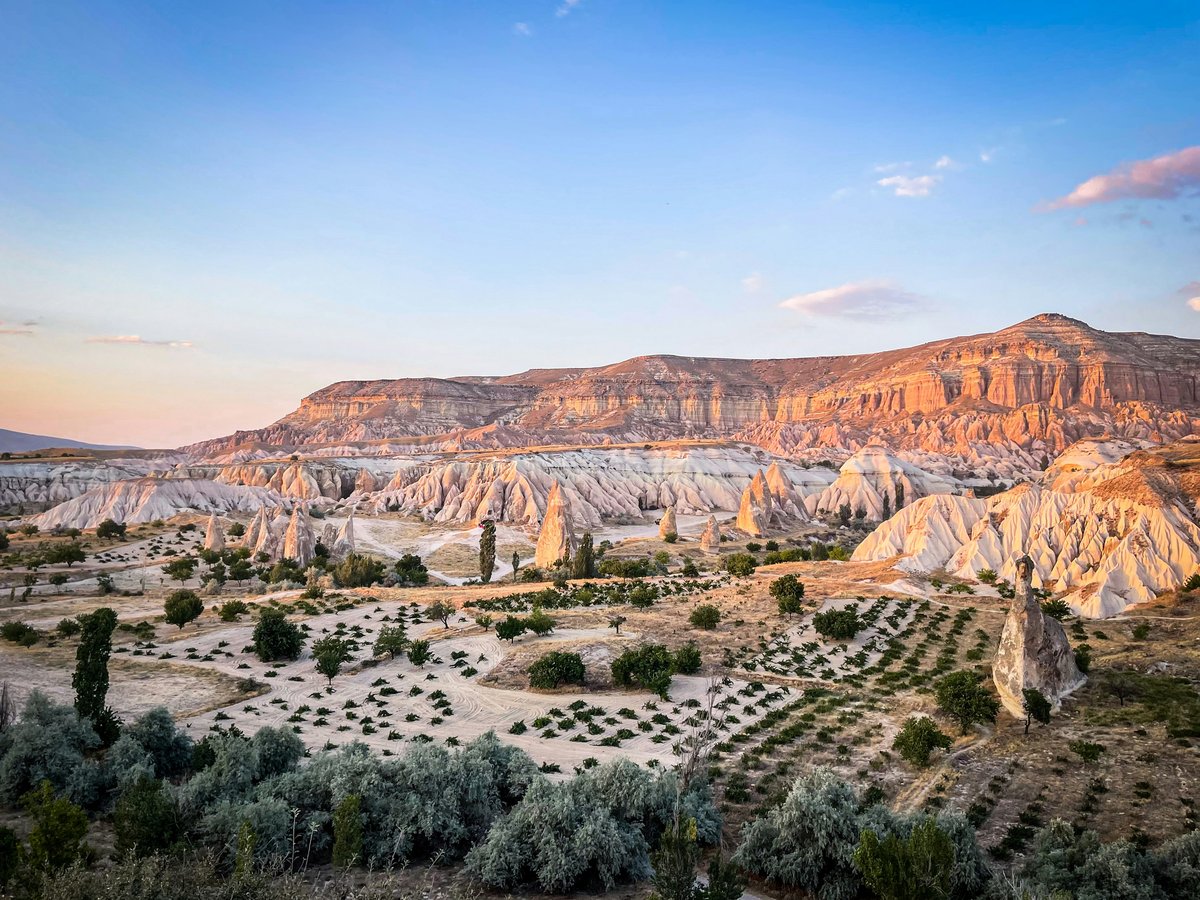
Cappadocia sits on a high plateau in central Anatolia, roughly 1,000 meters above sea level, where millions of years of volcanic eruption from Erciyes Dağı and Hasan Dağı left thick layers of tuff that wind and rain carved into the fairy chimneys, slot canyons, and rippled valley walls you see today. The region is not a single city but a cluster of small towns, Göreme, Ürgüp, Uçhisar, Ortahisar, Avanos, spread across an area about 40 kilometers wide. The landscape feels lunar in places, almost soft in others. Apricot orchards fill the valley floors, and the rock itself shifts color through the day, going from pale cream to burnt orange as the sun drops. Summers tend to be hot and dry, often reaching 35°C by July. Winters bring real cold and occasional snow. The sweet spot for outdoor activity falls in April through June and again in September through November, when daytime temperatures hover around 18 to 25°C and the light is extraordinary. The terrain is generally walkable, but the tuff can be crumbly underfoot, and trail markings range from decent to nonexistent depending on the valley.
Outdoor activities
-
Hot Air Ballooning over Göreme
The signature Cappadocia experience, and for good reason. Flights launch before sunrise from fields near Göreme, typically lasting 45 to 60 minutes. You drift over Love Valley's phallic spires, the pigeon houses of Güvercinlik Vadisi, and the clustered fairy chimneys around Paşabağ. On a busy morning in peak season, 100 or more balloons might be in the air at once. The Turkish Civil Aviation Authority (SHGM) licenses operators and caps daily flights based on weather. Prices currently sit around 150 to 250 euros per person, depending on basket size and season. Wind and visibility cancellations are common in winter months.
- Difficulty
- Easy, no physical effort required
- Duration
- 45 to 60 minutes airborne, 3 hours total with transport and setup
- Best season
- April through November, with the calmest winds typically in September and October
-
Horseback Riding through the Valleys
The name Cappadocia likely derives from 'Katpatuka,' meaning land of beautiful horses in Hittite. Several ranches near Göreme and Avanos run guided rides through valleys like Kılıçlar, Güllüdere, and Zemi. The terrain is mostly packed dirt and soft tuff, gentle on hooves. A 2-hour sunset ride through Rose Valley costs roughly 50 to 80 euros. Dalton Brothers Ranch near Göreme and Akhal-Teke Horse Farm near Avanos are both well-established operations. You'll pass pigeon houses cut into the rock, small vineyards, and the odd cave church. The smell of sage and dried grass follows you most of the way.
- Difficulty
- Beginner-friendly for short rides, intermediate for full-day excursions
- Duration
- 1 to 4 hours depending on route
- Best season
- March through November, though spring wildflower rides in April and May are particularly good
-
Mountain Biking in Cappadocia's Valleys
The network of dirt tracks connecting Göreme, Çavuşin, Uçhisar, and the surrounding valleys makes for surprisingly good mountain biking. The terrain mixes hard-packed clay, loose volcanic gravel, and rocky single-track. A popular loop runs from Göreme through Güllüdere Vadisi (Rose Valley) to Kızılçukur (Red Valley) and back via Çavuşin, roughly 15 kilometers with about 300 meters of elevation gain. Several shops in Göreme rent mountain bikes for 15 to 25 euros per day. The quality varies, so check the brakes and tires before heading out. Mind you, some valley descents are steep enough to walk.
- Difficulty
- Moderate, some steep and loose sections
- Duration
- 2 to 5 hours depending on route and stops
- Best season
- April through June and September through November, summer heat makes midday riding miserable
-
ATV and Quad Biking Tours
ATV tours run from several operators in Göreme, Ürgüp, and Uçhisar, typically covering terrain that's harder to reach on foot. A common sunset route loops through Swords Valley (Kılıçlar Vadisi) and up to viewpoints above Love Valley, about 15 to 20 kilometers over 1.5 to 2 hours. Prices tend to be around 40 to 70 euros per person. The dust can be thick in dry months. Wear a bandana or buff over your nose. To be fair, the noise and dust bother some hikers on shared trails, so operators have been steering toward less trafficked routes in recent years.
- Difficulty
- Easy to moderate, no prior experience needed
- Duration
- 1.5 to 2 hours for standard sunset tours
- Best season
- Year-round, though rain turns some tracks to mud in late autumn and winter
-
Paragliding from Ali Dağı near Ihlara
Tandem paragliding has been growing around Cappadocia, with launch sites near Ihlara Valley and some operators using slopes near Uçhisar. You fly over volcanic landscapes that look entirely different from above, the geometric patchwork of fields, the dark slash of Ihlara Canyon. Flight times run 15 to 25 minutes. This is still a smaller operation than the ballooning industry, with fewer licensed operators. Expect to pay around 100 to 150 euros for a tandem flight. Thermal conditions tend to be best from late morning to mid-afternoon in the warmer months.
- Difficulty
- Easy for tandem passengers, pilot handles everything
- Duration
- 15 to 25 minutes airborne
- Best season
- May through October, when thermals are most reliable
-
Rock Climbing on Tuff Formations
The volcanic tuff around Cappadocia offers a unusual climbing medium. The rock is softer than granite or limestone, almost chalky in places, which means holds can break. That said, established routes exist near Çavuşin and around some of the cliffs between Ortahisar and Ürgüp. Grades range from French 4 to 6b on the bolted sport routes. The local climbing community is small but growing, and a few guide services in Göreme offer introductory sessions on beginner-friendly walls. Bring your own gear if you're serious, rental options are limited. The rock warms up fast in direct sun, so morning climbing works best from June onward.
- Difficulty
- Beginner to intermediate depending on route selection
- Duration
- Half-day to full-day sessions
- Best season
- April through June and September through November, rock gets uncomfortably hot in July and August
Day hikes
-
Rose Valley (Güllüdere Vadisi) to Red Valley (Kızılçukur) Loop
This is likely the most popular hike in Cappadocia and for good reason. You start from the trailhead near Çavuşin or the Güllüdere entrance south of Göreme, descend into the valley, and wind through rock-cut churches (some with faded frescoes still visible), apricot orchards, and formations that shift from pink to deep rust as the light changes. The trail connects into Red Valley, where the rock turns a darker iron-oxide color. Most people hike from Çavuşin to the Red Valley sunset viewpoint, a distance of roughly 6 to 7 kilometers one way. The path is mostly clear but unsigned in places, so a downloaded GPS track helps. The sunset from the Kızılçukur viewpoint, overlooking the layered valleys with Erciyes in the background, might be the finest in the region.
- Difficulty
- Easy to moderate, some short scrambles and one or two spots where the trail fades
- Duration
- 3 to 4 hours for the full loop, add time for exploring cave churches
- Best season
- April through June for wildflowers and comfortable temperatures, September and October for the clearest light
-
Ihlara Valley (Ihlara Vadisi)
About 80 kilometers southwest of Göreme, Ihlara Valley is a deep gorge cut by the Melendiz River through volcanic rock, reaching depths of around 100 meters in places. The full trail runs roughly 14 kilometers from Ihlara village to Selime, passing dozens of rock-cut churches (Ağaçaltı Kilise and Yılanlı Kilise are standouts) and crossing the river on footbridges several times. Most visitors enter at the 382-step staircase midway and walk 4 to 5 kilometers to Belisırma village, where a handful of riverside restaurants serve trout and gözleme. It's a different world from the plateau above, green and cool even in summer, with the sound of the river echoing off the canyon walls. Entry is currently around 200 TL.
- Difficulty
- Easy along the valley floor, the initial descent via the staircase is steep but manageable
- Duration
- 2 to 3 hours for the Ihlara stairs to Belisırma section, 5 to 7 hours for the full Ihlara to Selime walk
- Best season
- April through October, the valley floor stays shaded and cool even in July
-
Love Valley (Aşk Vadisi)
Starting from the north edge of Göreme, Love Valley is a short but striking hike through some of Cappadocia's tallest and most distinctly shaped fairy chimneys, some reaching 30 to 40 meters. The valley is narrow and the formations press close to the trail. The path descends gradually for about 2 to 3 kilometers before connecting to the Göreme-Uçhisar road. You can loop back on the road or arrange transport. The name comes from the phallic shape of many chimneys, which draws a fair amount of giggling and photography. The morning light in the valley is particularly good, with balloons often floating directly overhead.
- Difficulty
- Easy, mostly gentle downhill on a well-trodden path
- Duration
- 1 to 1.5 hours one way
- Best season
- Year-round, though spring mornings with balloon traffic overhead are the most photogenic
-
Pigeon Valley (Güvercinlik Vadisi), Uçhisar to Göreme
This trail connects Uçhisar to Göreme along a valley named for the thousands of pigeon houses carved into the rock faces. Historically, locals used pigeon droppings as fertilizer for the vineyards. The trail is about 4 kilometers and drops gradually from Uçhisar's elevation down to Göreme. Rock formations line both sides, and you'll pass through patches of vineyard and orchard. The path is well-marked compared to most Cappadocian trails. A carved stone evil-eye tree (nazar tree) about halfway through has become a popular photo stop. You might notice the rock face pocked with hundreds of small rectangular openings, each one a pigeon nesting box, some still in use.
- Difficulty
- Easy, steady gentle descent from Uçhisar to Göreme
- Duration
- 1.5 to 2 hours
- Best season
- March through November, pleasant even on warmer days thanks to partial shade
-
Meskendir Valley
Less visited than Rose or Love Valley, Meskendir runs roughly between Göreme and Çavuşin and offers a wilder feel. The trail passes through narrow slot-canyon sections, past collapsed cave dwellings, and under overhanging rock. Some sections require light scrambling over fallen boulders. The route is about 4 to 5 kilometers and the markings are sparse, so either go with a local guide or carry a GPS track. The tunnel sections, where the trail passes through carved-out rock for 20 to 30 meters, feel almost subterranean. Worth noting, the valley is quieter in the morning before the ATV tours start using adjacent tracks in the afternoon.
- Difficulty
- Moderate, some scrambling over rocks and a few sections where route-finding is needed
- Duration
- 2 to 3 hours
- Best season
- April through June and September through November
-
Soğanlı Valley
About 35 kilometers south of Ürgüp, Soğanlı is a pair of valleys (Aşağı Soğanlı and Yukarı Soğanlı) with rock-cut churches and a small village that still uses some cave structures. The area gets far fewer visitors than the Göreme valleys and retains a quieter, almost forgotten feel. You can walk both valleys in a half day, covering roughly 6 to 8 kilometers total. The Karabaş Kilise (Black Head Church) has well-preserved frescoes. Local women in the village sell handmade dolls from stalls near the parking area. The drive alone is worth it, passing through rolling farmland that looks nothing like the Göreme moonscape. Entry to the valley is currently around 80 TL.
- Difficulty
- Easy, mostly flat valley-floor walking with optional scrambles to upper cave churches
- Duration
- 3 to 4 hours to explore both valleys
- Best season
- May through October
Water activities
-
Canoeing on the Kızılırmak near Avanos
Turkey's longest river passes right through Avanos, and a handful of operators offer canoe and kayak trips on the calmer stretches upstream and downstream of the town bridge. The current is gentle here, moving through clay banks where you can see the red sediment that gives the river its name (Kızıl means red). Trips typically cover 5 to 8 kilometers and last about 2 hours. The water is shallow in most sections, rarely deeper than 1.5 meters in late summer. A few operators run sunset paddles where you float past the cliff-cut facades on the south bank as the light turns warm. Prices sit around 30 to 50 euros per person.
- Difficulty
- Easy, calm flat water suitable for beginners
- Duration
- 1.5 to 2.5 hours
- Best season
- May through September, water levels drop significantly by late August in dry years
-
Wading and Picnicking along the Melendiz River in Ihlara Valley
The Melendiz River runs the length of Ihlara Valley, and at several points along the trail, flat rocks and shallow pools make natural rest stops. The water is cold even in midsummer, fed by snowmelt from Hasan Dağı (3,268 meters). This is not swimming in any formal sense. You wade, you cool your feet, you eat a packed lunch on the riverbank. Near Belisırma village, the riverside restaurants have platforms built right over the water, where you can eat fresh trout with your feet dangling above the current. The sound of the river in the canyon is constant and surprisingly loud.
- Difficulty
- Easy, no equipment needed beyond shoes that can get wet
- Duration
- As long as you like, most people spend 30 to 60 minutes at the water
- Best season
- June through September, water levels are highest in May from snowmelt but temperatures are more comfortable by July
-
Acıgöl Crater Lake Visit
Acıgöl (Bitter Lake) sits about 25 kilometers west of Nevşehir, a volcanic crater lake that formed roughly 20,000 years ago. The lake is shallow and seasonal in volume, sometimes barely more than a marshy depression by late summer in dry years. The mineral content gives the water a slightly milky appearance. This is more of a geological curiosity than a water-sport destination. You walk around the rim, look into the crater, and appreciate the volcanic history that created everything you've been hiking through. There are no facilities or entry fees. The surrounding steppe is flat and wide, and on a clear day Hasan Dağı dominates the southern horizon.
- Difficulty
- Easy, flat walking around the crater rim
- Duration
- 1 to 2 hours for a full circuit and exploration
- Best season
- April through June when the lake tends to have the most water
-
Swimming at Derinkuyu Underground City Pools (Kaymaklı area hotel pools)
To be honest, Cappadocia is not a swimming destination. The region is landlocked, arid, and at elevation. That said, several cave hotels near Ürgüp and Uçhisar have built pools, some carved into the rock, that are open to non-guests for a day fee (typically 200 to 400 TL). The Museum Hotel in Uçhisar and Argos in Cappadocia in Uçhisar both have pools with views over the valley. If you need a proper swim after days of dusty hiking, these are your realistic options. The water is cold in spring and heated in autumn at some properties.
- Difficulty
- Easy
- Duration
- As long as you like
- Best season
- June through September
Parks & gardens
-
Göreme Historical National Park
This UNESCO World Heritage site (inscribed 1985) covers about 100 square kilometers of the core Cappadocian landscape, including the famous Open-Air Museum with its Byzantine rock-cut churches. Beyond the museum entrance, the park extends into the surrounding valleys, fairy chimney clusters, and cave settlements. It functions less like a manicured park and more like a protected landscape that you walk through. The Tokalı Kilise (Buckle Church) near the museum entrance has some of the finest 10th-century frescoes in Anatolia. Entry to the Open-Air Museum currently costs 700 TL (roughly 20 euros), though the broader national park landscape is freely accessible.
Highlights: Tokalı Kilise frescoes, Elmalı Kilise (Apple Church), Karanlık Kilise (Dark Church, separate ticket), panoramic trail above the museum leading toward Kılıçlar Valley
-
Zelve Open-Air Museum and Valley
About 10 kilometers north of Göreme, Zelve was a functioning village until 1952, when rockfall risk forced evacuation. The three interconnected valleys hold cave dwellings, churches, a mosque, and a tunnel connecting the first and second valleys. It gets far fewer visitors than Göreme's museum, and the atmosphere feels more raw. You can spend a quiet 2 hours scrambling through the formations. The tufa here is more weathered and fragile than at Göreme, and some upper caves have been closed for safety. Entry is currently around 250 TL.
Highlights: The tunnel between Valleys 1 and 2, the Üzümlü Kilise (Grape Church), the carved mosque, the view from the ridge between Valley 2 and Valley 3
-
Uçhisar Castle Grounds and Viewpoint Park
The highest point in Cappadocia, Uçhisar Castle is a massive volcanic rock pinnacle riddled with tunnels and rooms carved over centuries. A small park and viewing terrace sit at the base, and the climb to the summit takes about 15 minutes. From the top, you can see Erciyes Dağı (3,917 meters) to the east on clear days, and the spread of Pigeon Valley stretching toward Göreme below. The town of Uçhisar wraps around the base with stone houses and a few cafes where the tea comes with that view included. Entry to the castle is around 150 TL.
Highlights: 360-degree panorama from the summit, the Pigeon Valley overlook on the south face, evening light turning Erciyes pink
-
Avanos Riverside Promenade
FreeThe town of Avanos sits along the Kızılırmak (Red River), the longest river in Turkey at roughly 1,355 kilometers. A tree-lined promenade runs along the north bank, passing pottery workshops, tea gardens, and a few small parks with benches and shade trees. Avanos has been a pottery town for centuries because of the red clay the river deposits. The walk from the old bridge to the eastern edge of town takes about 20 minutes. You'll likely hear the river, the potters' wheels through open workshop doors, and the call to prayer bouncing off the canyon walls behind town.
Highlights: The Ottoman-era stone bridge, riverside tea gardens, Chez Galip hair museum (strange but real), views of the cliff-cut houses on the south bank
Practical tips
- Footwear and Trail Surfaces
- The volcanic tuff is deceptive. It looks solid but crumbles under weight, especially on steeper sections in Rose Valley and Meskendir. Sturdy hiking shoes with good grip are essential. Trail runners work on the main valley paths, but proper boots are better for anything involving scrambling. Sandals are a mistake, the loose gravel gets everywhere and some trails have sharp rock edges.
- Sun Protection and Heat
- The plateau sits above 1,000 meters, so UV exposure is stronger than it feels. Sunburn happens fast even on hazy days, especially from April through September. Carry SPF 50 sunscreen, a wide-brimmed hat, and sunglasses with UV protection. In July and August, temperatures regularly reach 35°C with almost no shade on the plateau. Start hikes before 8 AM or after 4 PM in summer. The valley floors are 5 to 8 degrees cooler than the rim, but the climb out bakes you.
- Water and Hydration
- There are no reliable water sources on any Cappadocian trail except Ihlara Valley (and that river water needs treatment). Carry at least 2 liters per person for a half-day hike, 3 liters in summer. The small shops in Göreme, Çavuşin, and Uçhisar are the last supply points before most trails. Dehydration at altitude in dry heat can sneak up quickly, and shade is rare on the higher sections of most valleys.
- Navigation and Trail Marking
- Trail marking in Cappadocia ranges from adequate (Pigeon Valley has painted arrows) to nonexistent (Meskendir has none). Download offline maps and GPS tracks before heading out. Maps.me and AllTrails both have user-submitted Cappadocia routes that are mostly reliable. The valleys branch and fork, and a wrong turn can lead to a dead-end canyon or a crumbling cliff. In Rose Valley alone there are at least 3 paths that look like the main trail but peter out after 200 meters.
- Seasonal Planning
- The window from mid-April through mid-June offers the best combination of comfortable temperatures (18 to 28°C), wildflowers in the valleys, long daylight hours, and manageable crowds. September through early November is nearly as good with clearer skies and harvest season, when the apricot and grape vineyards in the valleys are active. July and August bring 35°C heat and peak tourist crowds. December through February sees snow, frozen trails, and many outdoor operators shut down, though balloon flights still run on clear days.
- Getting Between Trailheads
- The valleys around Göreme are close enough to link on foot, but getting to Ihlara Valley (80 km), Soğanlı (35 km from Ürgüp), or Acıgöl requires transport. Rental cars start around 40 to 60 euros per day and roads are paved and well-signed. Dolmuş (shared minibuses) connect Göreme to Avanos, Ürgüp, Uçhisar, and Nevşehir frequently, but service to Ihlara and Soğanlı is limited. Many hotels arrange day-trip shuttles. The Green Tour, sold by every agency in Göreme for about 50 to 70 euros, covers Ihlara Valley, Derinkuyu underground city, and a few other stops in a single day.
FAQ
What is the best time of year for outdoor activities in Cappadocia?
Mid-April through mid-June and September through early November are the strongest windows. Spring brings wildflowers, mild temperatures around 18 to 25°C, and the valleys at their greenest. Autumn offers clearer skies and harvest activity. July and August are possible but hot, often 35°C or above, with limited shade on most trails. Winter (December through February) brings occasional snow and freezing temperatures, which closes some trails and reduces outdoor operator schedules significantly.
Can I hike the Cappadocia valleys without a guide?
Yes, for most of the popular valleys like Rose Valley, Love Valley, and Pigeon Valley you can hike independently. The trails are fairly intuitive, though markings are inconsistent. Download GPS tracks beforehand and carry offline maps. Meskendir Valley and some lesser-known routes benefit from a local guide because the paths fork frequently and markings are sparse. For Ihlara Valley, the main trail is straightforward once you're on the valley floor. A half-day guided hike from Göreme typically costs 30 to 60 euros per person.
Is Cappadocia suitable for families with young children doing outdoor activities?
Several options work well for families. Pigeon Valley (Uçhisar to Göreme) is mostly flat and shaded. Love Valley is a gentle downhill walk of about 2 to 3 kilometers. The short section of Ihlara Valley from the staircase entrance to Belisırma (about 4 km) is flat along the river with restaurants at the end. Children under 6 might struggle with the 382-step descent into Ihlara, and Rose Valley has a few sections with loose scree that require sure footing. The ATV tours have minimum age requirements, typically 6 or 12 depending on whether children ride with an adult.
How much does a hot air balloon ride cost in Cappadocia?
Prices currently range from about 150 to 250 euros per person, depending on basket size (fewer passengers costs more), season, and operator. Standard baskets hold 16 to 24 passengers. Premium flights with 8 to 12 passengers run closer to 250 euros. Flights launch at sunrise year-round, weather permitting. Cancellations happen frequently in winter due to wind. Most hotels can arrange bookings, but book at least a few days ahead in peak season (May, June, September, October) as flights sell out.
Are there any swimming options in the Cappadocia region?
Cappadocia is landlocked and arid, so natural swimming options are very limited. The Kızılırmak river near Avanos is generally too shallow and silty for swimming. In Ihlara Valley, the Melendiz River has some wading pools but nothing deep enough for a proper swim. Your best realistic options are the pools at upscale cave hotels in Uçhisar and Ürgüp, several of which allow day visitors for a fee of 200 to 400 TL. If a beach matters to you, the nearest Mediterranean coast at Mersin or Antalya is a 4 to 5-hour drive south.
What gear should I bring for a multi-day visit focused on hiking and outdoor activities?
Sturdy hiking shoes are the single most important item. The volcanic tuff crumbles and the gravel is loose. Beyond that, bring a daypack (20 to 25 liters), a wide-brimmed hat, SPF 50 sunscreen, at least a 2-liter water bottle, and a headlamp if you plan sunrise or sunset hikes. A lightweight windbreaker is useful on the plateau, where wind picks up quickly even on warm days. In spring and autumn, temperatures can drop to 8 to 10°C by evening, so a fleece layer is wise. A buff or bandana protects against trail dust, especially if ATVs share the route.
Outdoor experiences in Cappadocia

Cappadocia Hot Air Balloon Ride / Royal Balloon
Outdoor experience: 3.5 hours.
via Viator Free cancellation
 Cappadocia Hot Air Balloon Ride
Outdoor experience: free cancellation.
via Viator Free cancellation
 Cappadocia Sunrise Hot Air Balloon Flight / Discovery Balloons
Outdoor experience: 3 hours, free cancellation.
via Viator Free cancellation
 Cappadocia Hot Air Balloon Tour Over Fairychimneys
Outdoor experience: 3 hours, free cancellation.
via Viator Free cancellation
 Sunrise Hot Air Balloon Flight Over Göreme & Fairy Chimneys
Outdoor experience: 3 hours, free cancellation.
via Viator Free cancellation
 Original Green Tour Ihlara Valley, Underground City & Monastery
Outdoor experience: 7.8 hours, free cancellation.
via Viator Free cancellation
 Atv Sunset Tour in Cappadocia
Outdoor experience: 2 hours, free cancellation.
via Viator Free cancellation
 Turkıye Balloons Standart Flight
Outdoor experience: 2.5 hours, free cancellation.
via Viator Free cancellation
 Full-Day Tour in Cappadocia with Ihlara Hiking and Underground City
Outdoor experience: free cancellation.
via Viator Free cancellation
 Cappadocia Horseback Ride through Valleys — Sunset/hoteltransfer
Outdoor experience: 1.5 hours, free cancellation.
via Viator Free cancellation
 Private Balloons watching Tour w/ PickUp, Breakfast/Photographer
Outdoor experience: 2 hours, free cancellation.
via Viator Free cancellation
 Cappadocia Sunset ATV Experience through Valleys
Outdoor experience: 2 hours, free cancellation.
via ViatorLast verified by automated review (v1.7.2) on . What is automated review?