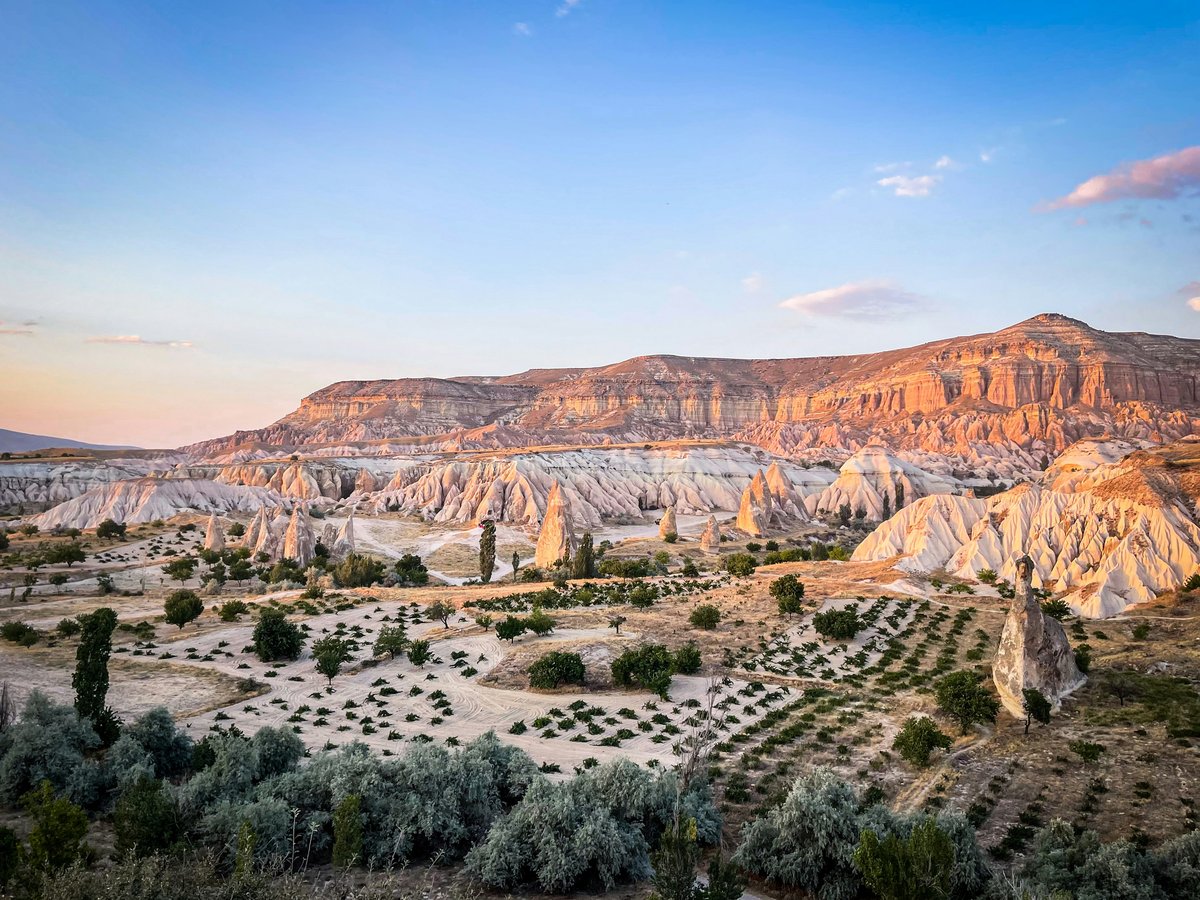
Cappadocia is not a single city. It's a region spread across a lunar landscape of tufa valleys and volcanic plateaus in central Turkey's Nevşehir Province. The main towns sit roughly 5 to 20 kilometers apart, connected by the D300 highway and a web of smaller roads that wind through fairy chimney formations. Göreme tends to function as the tourist center of gravity, with Ürgüp about 8 km east playing the slightly more upscale alternative. Uçhisar perches on the highest point in the area, Avanos sits north along the Kızılırmak river, and Ortahisar holds down the quieter middle ground. Mustafapaşa, about 6 km south of Ürgüp, is where you go when you want the old Greek stone houses without the crowd noise. Most first-time visitors pick Göreme or Ürgüp as a base. The balloon launches happen over the valleys between them, so you'll see them from almost anywhere. That said, where you sleep still shapes what version of Cappadocia you experience. The distances are short enough that a 15-minute drive changes the whole atmosphere.
Neighborhoods
-
Göreme
Göreme is the backpacker-to-boutique center of Cappadocia, population around 2,000 permanent residents but swelling to many times that in summer. The town sits in a bowl surrounded by tufa pillars, and the main drag, Müze Caddesi, runs from the otogar up toward the Open Air Museum about 1.5 km away. Cave hotels stack up the hillsides in every direction. The smell of fresh gözleme drifts from street-side griddles by mid-morning. At night the restaurants along Müze Caddesi fill up and you'll hear a mix of Turkish pop, conversation in 6 or 7 languages, and the occasional call to prayer from the mosque near the town center. The architecture is a strange collision of carved-rock facades, concrete additions from the 1980s, and recent boutique renovations with exposed stone walls and linen curtains. It's gotten more polished since 2018 or so, but the bones are still a farming village built into volcanic rock.
- Best for
- Solo travelers, couples on a first visit, and anyone who wants restaurants, tour agencies, and balloon launch sites within walking distance
- Key streets
- Müze Caddesi is the main artery, running from the bus station to the Göreme Open Air Museum. Uzundere Caddesi branches south toward Pigeon Valley. The small square near Flintstones Cave Hotel has a cluster of carpet shops and cafes worth sitting in. For a quieter walk, follow the path behind the mosque toward the trailhead for Rose Valley.
-
Ürgüp
Ürgüp feels like a proper Turkish town that happens to have cave hotels carved into its eastern cliff face. The population is around 20,000, and it has a year-round life that Göreme lacks in winter. Cumhuriyet Meydanı, the central square, has tea gardens, a few banks, a PTT post office, and a statue of Atatürk. The stone houses climb uphill to the east, where the old Kayakapı neighborhood has been partly restored into boutique properties. The pace is slower than Göreme. You might hear a tractor rumbling through the back streets at 7 AM. The wine scene is concentrated here, with Turasan Winery operating since 1943 on the edge of town and smaller producers scattered around. Friday market days bring farmers in from surrounding villages, and the smell of roasting peppers and fresh pekmez fills the side streets near the bazaar.
- Best for
- Couples and wine-interested travelers who want a more residential Turkish atmosphere, families who prefer a town with pharmacies and supermarkets within walking distance
- Key streets
- Cumhuriyet Meydanı is the anchor. Kayseri Caddesi runs east toward the cave neighborhoods and the Kayakapı restoration area. İstiklal Caddesi connects to the western edge of town. The Temenni Tepesi (Wish Hill) path climbs from behind the Turasan complex to a panoramic cemetery with views toward Ortahisar.
-
Uçhisar
Uçhisar is built around and into the tallest fairy chimney formation in the region, a massive rock castle (Uçhisar Kalesi) that rises about 60 meters above the village. The town has a split personality. The lower section along the D300 highway feels like a rest stop, with a few gas stations and roadside restaurants. But climb the narrow streets toward the castle and the texture changes completely. Old stone houses with blue-painted wooden shutters, cats sleeping on warm rocks, the sound of wind in the pigeon houses carved into the cliff faces. The Musée Hotel and Argos in Cappadocia, two of the region's most expensive properties, are up here. At sunset the castle terrace gives a 360-degree view across Pigeon Valley to Göreme, and the light turns the tufa from white to orange to rose. It is about 4 km from Göreme and 7 km from Ürgüp.
- Best for
- Travelers who want quiet evenings and wide-open views, honeymooners willing to pay more for a sense of altitude and privacy, photographers who need that unobstructed sunrise angle
- Key streets
- The main climb is Tekelli Sokak, which winds up from the lower parking area toward the castle entrance (15 TL admission). Belediye Caddesi loops around the south side with several pansiyons and a couple of small restaurants. The footpath from the castle's western base drops into Pigeon Valley and connects to Göreme in about 45 minutes on foot.
-
Avanos
Avanos is the pottery town, sitting on the north bank of the Kızılırmak, Turkey's longest river. The red clay from the riverbed has supported ceramic workshops here for something like 4,000 years, going back to Hittite-era production. The town center has a different feel from the rest of Cappadocia. Less rock-carved, more Ottoman-era stone and plaster buildings with wooden balconies. The Saruhan Kervansarayı, a 13th-century Seljuk caravanserai about 6 km east on the Kayseri road, hosts whirling dervish ceremonies some evenings. The town itself is quieter after dark than Göreme. You'll hear the river, maybe a dog barking. The hair museum inside Chez Galip's pottery workshop holds over 16,000 locks of hair from women visitors, pinned to the cave walls. It is genuinely one of the stranger things you'll encounter in Turkey.
- Best for
- Families with kids who want hands-on pottery workshops, travelers looking for cheaper accommodation outside the main tourist bubble, anyone staying more than 3 nights who wants a lived-in Turkish town as a base
- Key streets
- Atatürk Caddesi runs through the center, crossing the old stone bridge over the Kızılırmak. The pottery workshops cluster along Yeni Mahalle, uphill from the river. Baklacı Sokak has a couple of lokantas serving proper home-style Turkish lunch for 80 to 120 TL per plate.
-
Ortahisar
Ortahisar means 'middle fortress,' and the town clusters around another castle rock, smaller than Uçhisar's but less touristed. The streets are narrow, steep, and largely empty of souvenir shops. You'll see more produce trucks than tour buses. The surrounding valley is where much of Cappadocia's citrus and dried fruit storage happens. Huge cave chambers carved into the cliffs serve as natural cold-storage for lemons and oranges. The smell of drying apricots hangs in the air during late July and August. The town has a handful of small cave hotels, a few simple restaurants, and a genuine quiet that Göreme lost around 2015. It sits about 5 km from both Göreme and Ürgüp, making it a decent midpoint if you have a rental car.
- Best for
- Travelers who have a car and want an unhurried base between the main towns, anyone returning to Cappadocia for a second or third visit and looking for something less produced
- Key streets
- Kale Caddesi leads up to the Ortahisar Castle (10 TL admission). Cumhuriyet Meydanı, the small central square, has 2 tea houses and a bakery that does fresh simit by 6:30 AM. The road south toward Pancarlık Kilisesi (Church of the Virgin) passes through orchard land and takes about 20 minutes on foot.
-
Mustafapaşa
This was Sinasos until the 1923 population exchange emptied it of its Greek Orthodox residents. The Greek stone mansions are still standing, many with carved facades, iron balconies, and faded blue window frames. The Church of Constantine and Helena (Aziz Konstantin ve Helena Kilisesi) sits near the center, its courtyard now quiet but the stonework still sharp. The town has maybe 1,500 residents. It feels like a place that time genuinely forgot, in the sense that nobody invested in tearing down or over-renovating the old architecture. A few mansions have become small hotels. The Monastery Valley (Manastır Vadisi) trail starts from the south edge of town and drops into a canyon with several rock-cut churches, most without frescoes but with interesting architectural carving. The nearest ATM is in Ürgüp, 6 km north.
- Best for
- Architecture enthusiasts, history-focused travelers, anyone who actively wants to avoid balloon-selfie tourism and does not mind a 10-minute drive to the nearest full-service town
- Key streets
- The main village road passes the church and the old medrese (theological school) building. Cumhuriyet Caddesi has 3 or 4 small pansiyons and a single restaurant that does a good mantı (Turkish dumplings with yogurt and dried mint). The path to Manastır Vadisi is marked from the south end of the village, past the cemetery.
-
Çavuşin
Çavuşin sits on the road between Göreme and Avanos, about 2 km north of Göreme. The old village is a cliff face full of abandoned cave dwellings, partially collapsed and genuinely haunting in the late afternoon light when the stone goes amber. The Church of St. John the Baptist (Vaftizci Yahya Kilisesi) near the top of the old settlement has some of the oldest frescoes in Cappadocia, likely 5th century. The new village below is small and functional, a few pensions, a market, a couple of restaurants. It has none of Göreme's polish but also none of the crowd density. The sound environment is wind, roosters, and occasionally a tractor. Rose Valley and Red Valley trailheads are a short walk south.
- Best for
- Hikers using the Rose and Red Valley trails daily, budget travelers who want proximity to Göreme without Göreme prices, anyone who finds crumbling ancient settlements more interesting than renovated ones
- Key streets
- The D300 highway runs through the new village. A footpath climbs from behind the mosque to the old cliff settlement and the St. John church. The Rose Valley trailhead is signed from the southern end of the village, about a 5-minute walk from most pensions.
FAQ
Do I need a rental car to get around Cappadocia?
It depends on your base. If you stay in Göreme, you can walk to the Open Air Museum, the Rose Valley trailhead, and most restaurants without a car. Shuttle buses and tour vans connect to balloon launch sites. But if you want to reach Mustafapaşa, the underground cities at Derinkuyu (about 30 km south) or Kaymaklı (20 km south), or the Ihlara Valley (80 km southwest), a rental car saves a lot of time and tour-group logistics. Avanos is about 8 km from Göreme with limited dolmuş service, especially after 7 PM. A compact rental runs roughly 1,200 to 1,800 TL per day in 2024 high season.
Which town is best for watching the hot air balloons?
The balloon flights launch from fields near Göreme most mornings, weather permitting, typically between 5:30 and 7:00 AM from April through November. You can see them from almost anywhere in the region, but the closest ground-level views are from Göreme itself, the terrace restaurants in Uçhisar, and the ridge path between the two. Many cave hotels in Göreme have rooftop terraces specifically positioned for watching the launch. Ürgüp sees the balloons too, but they appear smaller and more distant. A flight costs between 150 and 300 EUR per person depending on the operator and basket size.
Is Cappadocia worth visiting in winter?
The landscape covered in snow is genuinely striking, and the balloon flights still operate on clear days, though cancellations are more frequent from December through February due to wind and visibility. Temperatures drop to -5 to -10°C at night. Many smaller hotels and restaurants in Göreme close from mid-November to mid-March. Ürgüp stays more alive year-round because it has a resident population that does not depend on tourism. Hotel prices in January can be 40 to 60 percent lower than July rates. The underground cities at Derinkuyu and Kaymaklı are a constant 13 to 15°C inside regardless of the season, which makes them more comfortable in winter than in the summer crowds.
How many nights should I plan for Cappadocia?
Three nights is the practical minimum if you want a balloon flight (allow 2 mornings in case the first is cancelled for weather), a day of valley hiking (Rose Valley to Red Valley is about 4 hours), and a visit to one underground city. Four nights lets you add a pottery workshop in Avanos or a day trip to Ihlara Valley. Some travelers do 2 nights and feel rushed, especially if the balloon gets weather-cancelled on their only eligible morning. Five or more nights suits people who want to hike multiple valleys or explore the quieter towns like Mustafapaşa and Ortahisar at a slow pace.
What is the food scene like outside the tourist restaurants?
Cappadocia's signature dish is testi kebabı, meat and vegetables slow-cooked in a sealed clay pot that the waiter cracks open at the table. It runs 250 to 400 TL in Göreme's tourist restaurants. The local lokantas in Avanos and Ortahisar serve it for closer to 150 TL. Mantı (tiny dumplings with garlic yogurt and sumac butter) is the other regional staple, best eaten in Ürgüp or Mustafapaşa rather than the Göreme tourist strip. For breakfast, look for the spreads that include pekmez (grape molasses) with tahini, local tulum peyniri (a crumbly aged cheese stored in goatskin), and stone-oven flatbread. The Friday markets in Ürgüp and Avanos sell dried apricots, walnuts, and local wine directly from producers.
Last verified by automated review (v1.7.2) on . What is automated review?