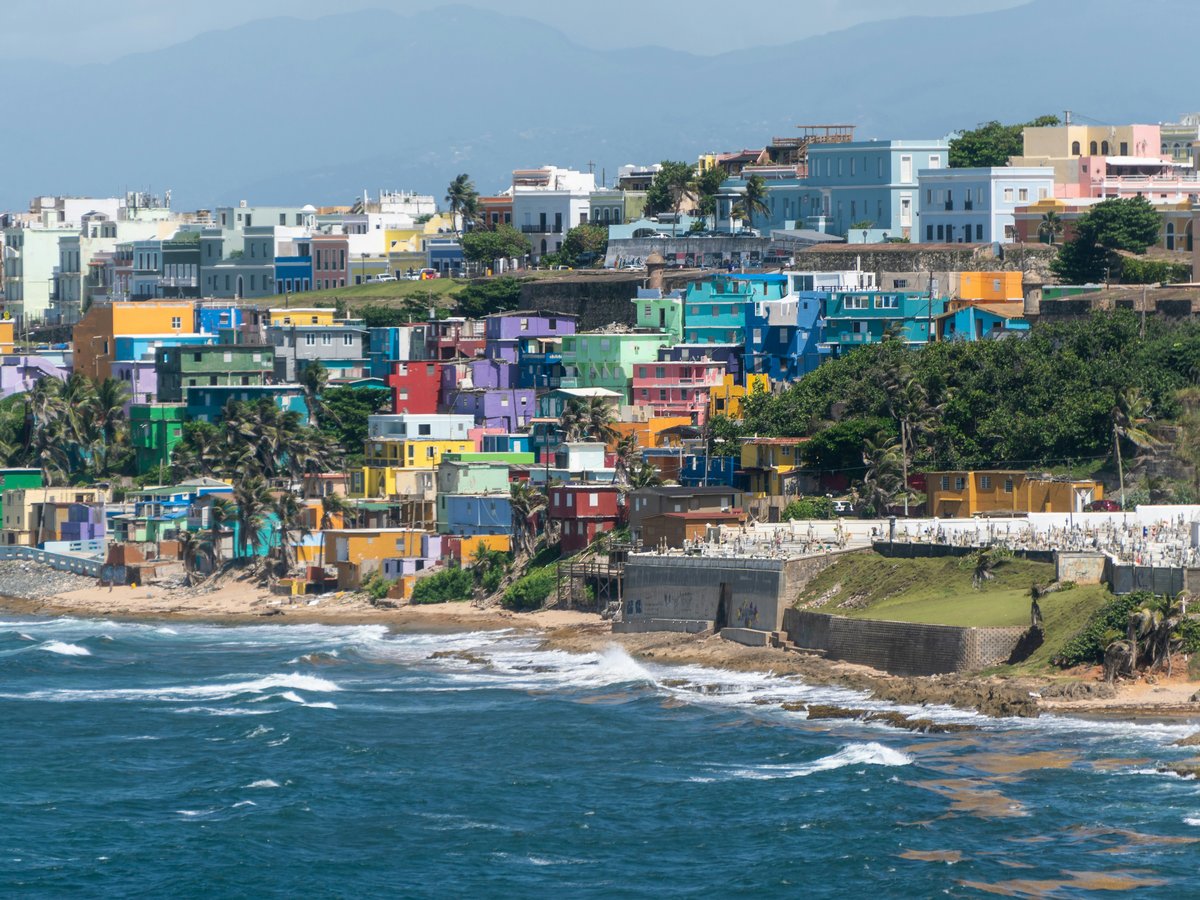
San Juan occupies a narrow coastal strip on Puerto Rico's northeast shore, caught between the Atlantic Ocean to the north and a chain of bays and lagoons to the south. The terrain within city limits stays mostly flat. The Sierra de Luquillo range rises about 40 kilometers to the southeast, and tropical rainforest sits within a 45-minute drive. Year-round temperatures hover between 24°C and 31°C. The wet season runs May through November, with September the rainiest month. A mid-September afternoon might bring 28.5°C with 77% humidity and a passing drizzle, the kind that evaporates off hot pavement within five minutes. Even during the wet months, mornings tend to be clear enough for a bike ride or beach session before the clouds pile up around 2 PM. The city's outdoor character leans toward salt and mangrove. Condado Lagoon reflects the high-rises of Miramar on still mornings. The Piñones coast begins 10 minutes east of Isla Verde, where coconut groves and tidal flats replace hotel rows and brown pelicans fish in the shallows. Old San Juan's 16th-century fortification walls trace the shoreline in a route that works as one of the Caribbean's better urban walks, with the Atlantic crashing against worn sandstone below. San Juan scores 7.8/10 for family friendliness (see the TTDI Family-Friendliness Index), largely because so many of these outdoor spaces cost nothing and welcome all ages. Worth noting, the solo-traveler safety score sits at 5.8/10 (see the TTDI Solo-Safety Index), so the practical tips below cover common-sense precautions for heading out alone.
Outdoor activities
-
Cycling the Paseo Piñones
The Piñones bike path runs about 11 kilometers along the northeast coast from Piñones toward Loíza. The first stretch follows a raised boardwalk over mangrove wetlands, then the route continues on paved road past coconut groves and roadside food kiosks selling fried alcapurrias and bacalaítos. You can rent bikes near the trailhead for roughly $5-10 per hour. The flat terrain suits most fitness levels. Weekend mornings draw big crowds from San Juan proper, so a Tuesday or Wednesday ride feels noticeably more open. The smell of frying batter from the kiosks and the sound of waves through the mangroves make it feel far from Condado, even though you're only 15 minutes east of the hotel zone.
- Difficulty
- Easy
- Duration
- 1.5 to 3 hours
- Best season
- December through April, when afternoon showers are less frequent
-
Zip-lining at Toro Verde Nature Adventure Park, Orocovis
Toro Verde sits in the central mountains about 90 minutes south of San Juan. The park's longest line, nicknamed The Monster, stretches about 2.5 kilometers across a river valley at speeds that can reach 150 km/h. Several shorter lines and suspension bridges make up the rest of the course. The montane forest stays noticeably cooler than the coast, typically 5-7°C lower. Reservations are a good idea on weekends. The drive from San Juan follows Highway 52 south through gradually steepening terrain. The mountain air carries the scent of wet earth and wild ginger, and tickets start around $75-100 per person depending on the package.
- Difficulty
- Moderate (requires basic fitness, no experience needed)
- Duration
- Half day including the 90-minute drive each way
- Best season
- Year-round, though January through April has the driest weather for the mountain roads
-
Paseo del Morro Coastal Trail
This paved path follows the outer wall of the San Juan National Historic Site, established in 1949 to protect the colonial-era fortifications. The route runs about 2.5 kilometers along the Atlantic waterfront, from the gate near Santa María Magdalena de Pazzis Cemetery (dating to 1863) to the lawns below Castillo San Felipe del Morro. Green iguanas sun themselves on the rocks, and trade winds off the Atlantic can gust to 30 km/h along exposed sections. Late afternoon light turns the sandstone walls a deep gold. No entrance fee applies to the trail itself, though entering the fort requires a National Park Service pass.
- Difficulty
- Easy
- Duration
- 45 minutes to 1.5 hours
- Best season
- Year-round, best in late afternoon when the light softens and the heat eases
-
Cueva Ventana Day Trip, Arecibo
Cueva Ventana is a limestone cave about 90 minutes west of San Juan, near Arecibo. The cave opens into a natural window overlooking the Río Grande de Arecibo valley, and the view from inside the cave mouth is one of the more striking sights on the island. The walk from the parking area takes about 20 minutes on a rocky, sometimes slippery trail. Admission runs around $20 per adult. The cave interior is cool and damp, a welcome break from the valley heat. Mind you, the trail has no handrails in some sections and the limestone footing can be slick after rain, so closed-toe shoes with tread are essential.
- Difficulty
- Easy to moderate
- Duration
- Half day with driving
- Best season
- December through May for the driest trail conditions
-
Bird-Watching at Bosque Estatal de Piñones
The Piñones State Forest covers about 1,200 hectares of mangrove, coastal scrub, and lagoon habitat at the eastern edge of metro San Juan. The area supports over 40 resident bird species. You might spot great blue herons in the shallows, white-crowned pigeons in the canopy, and brown pelicans diving offshore. An elevated boardwalk section gives good sightlines over the mangrove channels. Mornings before 7 AM, when the food kiosks haven't fired up yet and the road is quiet, offer the best chance of seeing wading birds feeding in the tidal pools. Bring compact binoculars and insect repellent with at least 25% DEET.
- Difficulty
- Easy
- Duration
- 2 to 4 hours
- Best season
- November through March, when migratory species from North America pass through
Day hikes
-
La Mina Trail, El Yunque National Forest
The most popular trail in El Yunque starts near the Palo Colorado recreation area and descends roughly a kilometer to La Mina Falls, a 10-meter cascade into a shallow pool where swimming is allowed. The path is paved in the upper section, then shifts to packed earth and exposed roots. It gets slippery after rain, which in El Yunque means most afternoons. Expect company on this trail. Early arrivals before 9 AM tend to have the falls mostly to themselves. The canopy overhead blocks direct sun on about 80% of the route, and the sound of coquí frogs builds as you descend toward the water. El Yunque requires advance vehicle reservations for entry through Recreation.gov.
- Difficulty
- Easy to moderate
- Duration
- 1.5 to 2 hours round trip
- Best season
- January through April for the least rainfall, though some rain falls every month here
-
El Yunque Peak Trail
This trail climbs to the summit of El Yunque peak at 1,065 meters, the highest point in the forest accessible by marked trail. The path is steep in the final stretch, with rock steps carved into the mountainside. Cloud forest begins above 900 meters, where sierra palms replace the tabonuco canopy. At the top, if the clouds cooperate, you can see the Atlantic coast to the north and the Luquillo range to the south. That said, the summit is socked in about half the time. The vegetation shifts noticeably as you gain altitude. Allow extra time if you plan to combine this with the Mt. Britton spur.
- Difficulty
- Moderate to strenuous
- Duration
- 3 to 4 hours round trip
- Best season
- January through April, mornings before 10 AM for the best chance of clear summit views
-
Mt. Britton Trail, El Yunque National Forest
A 1.4-kilometer trail that climbs to Mt. Britton Tower, a stone observation platform built by the Civilian Conservation Corps in the 1930s. The trail gains about 300 meters of elevation through dense palo colorado forest. The tower offers 360-degree views when the clouds lift. The path is well-maintained but can be muddy in the lower sections. It connects to the El Yunque Peak route, so many hikers combine both in a single outing. The air up here smells like wet moss and the temperature tends to sit around 20°C, noticeably cooler than the 30°C coast.
- Difficulty
- Moderate
- Duration
- 1.5 to 2 hours round trip
- Best season
- December through April for clearer skies at altitude
-
Cañón San Cristóbal, Aibonito
About 90 minutes south of San Juan, this canyon near Aibonito drops roughly 150 meters into a river gorge. Guided hikes descend to waterfalls at the canyon floor. The terrain involves scrambling over boulders and crossing the river multiple times. This is not a trail with railings and steps. Local guides from Aibonito typically charge $40-60 per person and know the safest crossing points. The canyon walls are covered in ferns, orchids, and bromeliads. It tends to be cooler down in the gorge, and the acoustics of the narrow rock walls turn falling water into a low roar. Water temperature in the river pools holds around 22°C year-round.
- Difficulty
- Strenuous
- Duration
- 5 to 7 hours including the drive and canyon descent
- Best season
- December through March, when river levels are lowest and footing is most stable
-
Bosque Estatal de Guajataca, Isabela
A state forest about two hours west of San Juan with roughly 40 kilometers of marked trails through karst limestone terrain. The Cueva del Viento trail is the most popular route, passing through a short limestone tunnel before opening onto a forested valley. The trails are well-shaded by mature subtropical moist forest. This forest sees far fewer visitors than El Yunque, so weekday hikes here might feel solitary. The drive follows Highway 2 along the north coast through Arecibo and Quebradillas. The forest office near the entrance off PR-446 sometimes has printed trail maps available.
- Difficulty
- Easy to moderate, depending on the trail chosen
- Duration
- Half day with the two-hour drive each way
- Best season
- November through April for the driest trail conditions
Water activities
-
Kayaking Condado Lagoon
Condado Lagoon separates the Miramar and Condado neighborhoods, and its calm, sheltered water makes it one of the more accessible urban kayaking spots in the Caribbean. Several outfitters along the Condado waterfront rent single and tandem kayaks for roughly $25-35 per hour. Manatees frequent the lagoon, and you might see one surface 10 meters from your bow. Sea turtles also appear, particularly before 8 AM. The mangrove edges are home to blue herons and juvenile fish. Sunset paddles draw a crowd, and the Miramar skyline reflects cleanly on the flat water around 6 PM.
- Difficulty
- Easy
- Duration
- 1 to 2 hours
- Best season
- Year-round, calmest water in the morning before trade winds pick up around 11 AM
-
Snorkeling at Playa Escambrón
Playa Escambrón sits in the Puerta de Tierra section, protected by a natural reef that forms a calm, shallow pool. Visibility on clear days reaches 10-15 meters. Parrotfish, sergeant majors, sea fans, and the occasional hawksbill turtle inhabit the reef. The beach has showers, restrooms, and a lifeguard during daytime hours. Estadio Sixto Escobar, a sports venue dating to 1935, sits across the road from the beach access. Snorkel gear rentals are available at nearby shops for about $10-15 per set. The calmest conditions and clearest water tend to come between January and May.
- Difficulty
- Easy
- Duration
- 1 to 3 hours
- Best season
- January through May for the best underwater visibility
-
Surfing at La Pared and Pine Grove Beach
La Pared sits at the western edge of Condado Beach, where a rocky reef produces consistent breaks year-round. Waves range from 0.5 to 2 meters depending on swell direction. The spot works best for intermediate surfers who are comfortable with reef breaks. Pine Grove Beach near Isla Verde is friendlier for first-timers, with sandy-bottom breaks and gentler whitewater. Board rentals along Ashford Avenue in Condado run about $25-35 for a half day. Surf schools in the same area offer 90-minute lessons starting around $75. Winter swells between November and March deliver the most reliable overhead conditions.
- Difficulty
- Moderate at La Pared (reef break); easy at Pine Grove (sandy bottom)
- Duration
- 2 to 4 hours per session
- Best season
- November through March for consistent winter north swells, though summer south swells also produce rideable waves
-
Bioluminescent Bay Kayak Tour, Laguna Grande, Fajardo
About 45 minutes east of San Juan, Laguna Grande near Fajardo contains microscopic dinoflagellates that glow blue-green when disturbed. Guided kayak tours depart nightly from the Las Croabas area and last roughly 75 minutes on the water. The effect is strongest on moonless nights. Each paddle stroke creates a trail of light, and fish darting below the kayak leave blue streaks through the water. Several licensed operators run tours, and reservations are essential during peak weeks. The bio bay recovered well after Hurricane Maria, though the brightness varies with water temperature and nutrient levels from month to month.
- Difficulty
- Easy (guided, calm water)
- Duration
- 2 to 3 hours including transit from San Juan and the pre-paddle briefing
- Best season
- Year-round, strongest glow during new moon phases; book moonless nights when possible
-
Ocean Swimming at Ocean Park Beach
Ocean Park Beach stretches about 1.5 kilometers between Condado and Isla Verde. The beach is popular with locals, less crowded than the Condado strip, and the waves tend to be moderate enough for confident swimmers. There is no lifeguard, so you need to judge conditions yourself. The sand is fine and light-colored, and the water stays warm year-round, typically 26-28°C. Kitesurfers use the eastern end on trade-wind afternoons. To be fair, the undertow can surprise visitors on days with north swell. A row of restaurants and guesthouses lines Calle McLeary behind the beach. A cold Medalla at any of them runs about $2-3.
- Difficulty
- Easy to moderate depending on surf conditions
- Duration
- As long as you like
- Best season
- Year-round for warm water, calmest swimming conditions December through April
Parks & gardens
-
Jardín Botánico de la Universidad de Puerto Rico
FreeThis 120-hectare botanical garden in the Río Piedras district holds one of the largest tropical plant collections in the Caribbean. The palm garden alone has over 30 species. A lotus-covered lagoon sits at the center, and the orchid house contains roughly 200 varieties. Bamboo groves create tunnels of shade where the temperature drops a few degrees. The grounds are quiet on weekday mornings, a stark contrast to the traffic noise on Route 1 outside the gates. You'll share the paths mainly with joggers and botany students from the adjacent UPR campus.
Highlights: Lotus lagoon, palm garden with 30+ species, orchid house, bamboo-shaded trails, heliconia collection
-
Parque Luis Muñoz Rivera
FreeThis 11-hectare park in the Puerta de Tierra sector sits between the Capitol building and the ocean. Named after the Puerto Rican political leader, the grounds have shaded walking paths beneath large rain trees, a children's playground, and a central gathering space called the Pabellón de la Paz. Weekend afternoons draw families from the Condado and Miramar neighborhoods for pickup volleyball and kite-flying. The park's northern edge looks out over the Atlantic. You can hear the surf from the benches near the playground on calm days.
Highlights: Pabellón de la Paz, ocean-facing benches, shaded rain-tree canopy, children's play area
-
Paseo de la Princesa
FreeThis tree-lined waterfront promenade runs along the southern wall of Old San Juan, from the cruise port area to the Raíces Fountain at its western end. The walkway stretches about 800 meters. On weekend evenings, food vendors set up along the path. The Raíces Fountain, a large bronze sculpture surrounded by water jets, becomes a gathering spot after dark. Street artists and craft sellers often line the promenade on Friday and Saturday nights. The bay sits a few meters to your left as you walk west, and the 19th-century paving stones can be uneven near the eastern end.
Highlights: Raíces Fountain, weekend food vendors, bay views, colonial-wall backdrop, evening craft market
-
Parque de las Palomas
FreeA small park perched on the city wall above the Paseo de la Princesa in Old San Juan. The park is known for its resident pigeon colony, hundreds strong, that will land on your arms and head if you bring birdseed. The sightline south over San Juan Bay includes the distant Bacardí distillery across the water in Cataño. A low stone wall separates the viewing area from a steep drop to the waterfront below. It takes about 10 minutes to see everything, but the sunset angle from this perch is reliable through most of the year.
Highlights: Harbor views toward Cataño, pigeon colony, sunset sightline, access from Calle del Cristo
-
Parque Lineal Enrique Martí Coll
FreeThis linear park follows the Caño Martín Peña channel through the Santurce and Hato Rey neighborhoods. A boardwalk section passes through mangrove habitat right in the middle of the metro area. The Martín Peña community reclaimed this corridor from decades of illegal dumping. You'll see mangrove crabs, small fish, and the occasional great blue heron from the boardwalk. Dense apartment blocks line both banks, and the green mangrove corridor between them feels like a separate ecosystem. Additional phases continue toward the Sagrado Corazón transit station to the south.
Highlights: Mangrove boardwalk, urban wildlife corridor, community murals along the canal, cycling-friendly sections
Practical tips
- Sun protection
- The UV index in San Juan stays between 10 and 12 for most of the year, even on overcast days. Apply SPF 50+ sunscreen before leaving your hotel and reapply every 90 minutes, more often after swimming. A wide-brimmed hat and UV-rated sunglasses are worth the luggage space. Sunburn can happen in as little as 15 minutes of unprotected midday exposure. For water activities, reef-safe sunscreen is both a courtesy to the marine environment and a local expectation.
- Hydration
- Carry at least 1 liter of water per person per hour for any hike, and more for El Yunque, where humidity can top 85%. San Juan's tap water is treated and generally safe to drink, so refilling a reusable bottle at your hotel works fine. Coconut water from the roadside vendors in Piñones is cold and full of electrolytes if you need a mid-ride boost. Dehydration sneaks up fast in high humidity because you don't notice how much you're sweating.
- Trail conditions and timing
- In El Yunque, trails get slippery after rain, and it rains most afternoons between May and November. Start hikes before 8 AM to avoid both the midday heat and the afternoon downpours. Paved sections near trailheads are manageable in sport sandals, but anything past the first kilometer requires closed-toe shoes with grip. Karst terrain at Guajataca and Cueva Ventana is sharp limestone, so ankle-supporting boots help. Carry a lightweight rain shell year-round. September sits at the peak of hurricane season, so check NOAA forecasts before committing to backcountry plans.
- Gear essentials
- A dry bag of 10-15 liters keeps your phone and wallet safe during kayaking and beach days. Bring water shoes for reef snorkeling and any river crossing. Quick-dry clothing performs better than cotton in tropical humidity, where a wet cotton shirt stays damp for hours. For the bio bay tour at Fajardo, leave the flashlight at the hotel. Bright lights diminish the bioluminescence for everyone on the water.
- Safety and awareness
- Avoid hiking alone in isolated areas, particularly Cañón San Cristóbal and other backcountry routes without regular foot traffic. El Yunque's main trails are well-trafficked and generally safe during daylight. Don't leave valuables visible in parked cars at trailheads. Rip currents along the north-facing beaches can be strong during winter swells. If you get caught in a current, swim parallel to shore rather than fighting it directly. For remote trail hikes, let someone know your planned route and expected return time.
- Reservations and access
- El Yunque requires advance vehicle reservations through Recreation.gov. Slots fill up during peak season from December through April and on holiday weekends, so book at least a week ahead. Bio bay tours at Laguna Grande also sell out several days in advance around new moons. Toro Verde's zip-line slots go fast on Saturdays and Sundays. For most beach and urban park activities, no reservations are needed. The Wikivoyage San Juan guide at https://en.wikivoyage.org/wiki/San_Juan covers current transit and arrival logistics if you need to plan ground transport to trailheads.
FAQ
What is the best time of year for outdoor activities in San Juan?
The dry season from December through April offers the most reliable weather for hiking, cycling, and water sports. Mornings are often clear year-round, so even during the wet months you can fit in a beach session or bike ride before the afternoon rain develops. Hurricane season peaks in August and September. Ocean temperatures hold around 26-28°C throughout the year, so water activities are comfortable in any month.
Can you visit El Yunque National Forest as a day trip from San Juan?
El Yunque sits about 45 minutes east of San Juan by car, and you can comfortably hike two or three trails in a morning and return to the city by lunch. A rental car gives the most flexibility, though some tour operators run shuttle services from the hotel districts. Advance vehicle reservations are required, and the parking areas near popular trailheads fill by mid-morning on weekends and holidays.
Is it safe to swim at San Juan's beaches?
Beaches with lifeguards on duty, like Escambrón and Balneario de Carolina near Isla Verde, are generally safe for swimming. Ocean Park and Condado can have stronger currents when there's a north swell. Always check conditions before going in and look for the flag system that indicates hazardous water. Jellyfish appear occasionally, though serious stings are uncommon along the metro beaches.
Do you need a rental car for outdoor activities around San Juan?
For beach activities, lagoon kayaking, and the Old San Juan coastal walks, you can manage without a car using buses and ride-hailing apps. The Piñones bike path is reachable by a short taxi from Isla Verde. For El Yunque, Toro Verde, Cueva Ventana, or the Fajardo bio bay, a rental car is the practical option. Rates at Luis Muñoz Marín International Airport start around $35-50 per day. The Wikivoyage transit overview at https://en.wikivoyage.org/wiki/San_Juan#Get_around has current bus route details.
What should you wear for hiking in Puerto Rico's tropical climate?
Lightweight, moisture-wicking fabrics work best. Cotton absorbs sweat and stays damp, which makes for a miserable hike in 80%+ humidity. Closed-toe trail shoes or hiking sandals with good tread are essential for anything beyond a paved waterfront walk. Long sleeves help with sun protection and mosquitoes on forested trails. Bring a packable rain jacket even on clear mornings, because mountain weather in El Yunque shifts fast.
Are there outdoor activities suitable for families with young children in San Juan?
Escambrón's protected reef pool is shallow and calm enough for supervised kids to paddle. Condado Lagoon kayak rentals work well for families, and spotting manatees keeps younger ones engaged. The botanical garden in Río Piedras has flat, paved paths suitable for strollers. Parque Luis Muñoz Rivera has a playground and shaded lawn. The Paseo del Morro walk is stroller-accessible and flat. For older children, the Piñones bike path is level and scenic, and El Yunque's shorter trails are manageable for most kids over age 6.
Last verified by automated review (v1.7.2) on . What is automated review?