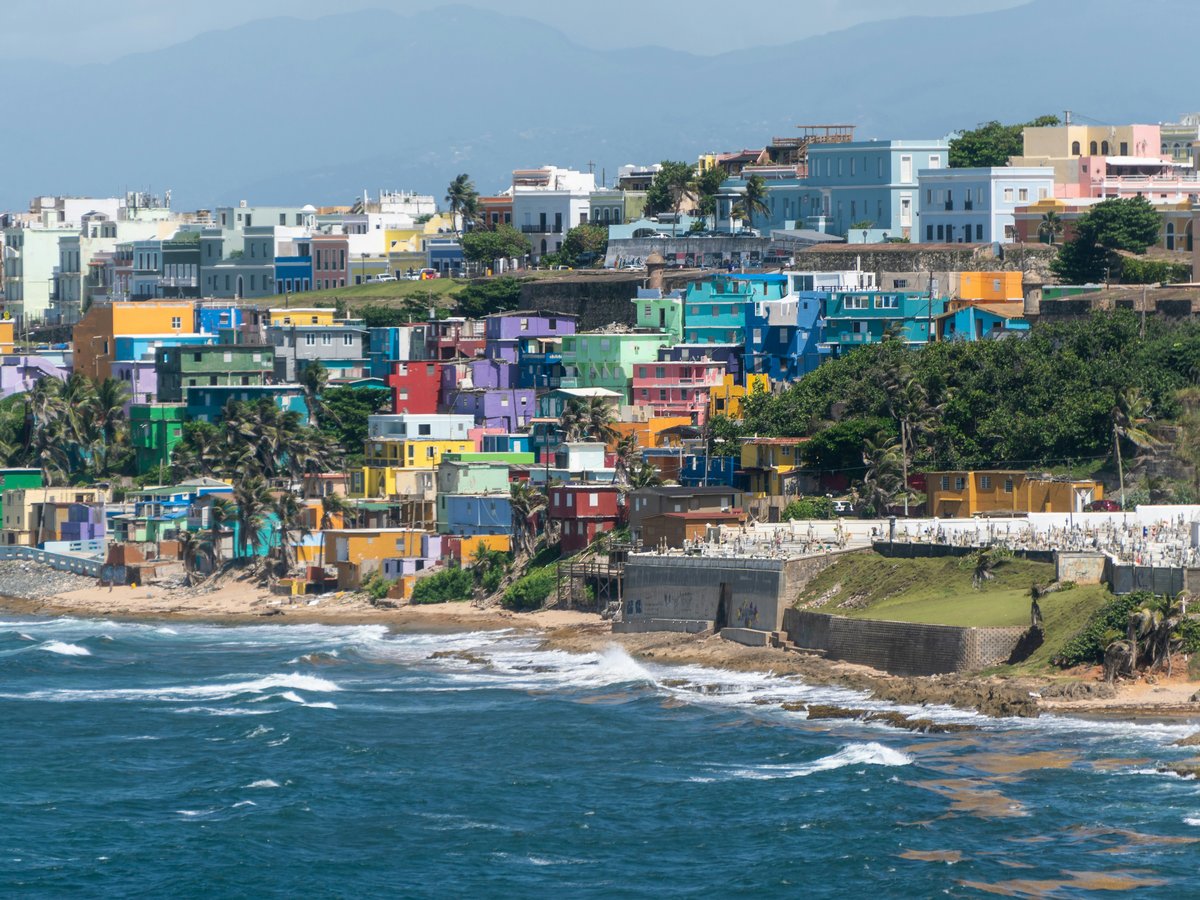
San Juan sits on Puerto Rico's northern Atlantic coast. The metro area stretches roughly 12 kilometers from the fortified colonial islet in the west to the resort towers near Luis Muñoz Marín International Airport in the east. Old San Juan occupies a narrow peninsula connected to the mainland by three bridges, and from there the city loosens eastward through Condado, Ocean Park, Santurce, and the financial district of Hato Rey. Most first-time visitors stay within the 6-kilometer coastal strip between the colonial district and Isla Verde, but the interior neighborhoods, particularly Santurce and Río Piedras, tend to offer better food at lower prices. September air currently sits at 28.5°C with 77% humidity, and afternoon drizzle arrives near-daily during the wet season from June through November. The AMA bus network covers the main corridors along Avenida Ponce de León, though ride-shares are the practical default after dark. Usual urban precautions apply at night, particularly in blocks inland from the Condado-to-Isla Verde corridor.
Neighborhoods
-
Old San Juan (Viejo San Juan)
The colonial grid dates to 1521, when Plaza de Armas was first laid out as the settlement's central square. Blue adoquín cobblestones cover the streets, and the facades run in pastels from salmon pink to pale yellow, with iron balconies that trail bougainvillea overhead. Cruise-ship passengers fill Calle Fortaleza by 10 a.m. on port days. Three to four ships dock at the cruise port on busy weeks, but by 8 p.m. the streets thin out and belong to residents. The smell of roasting pork from lechoneras on Calle San Justo mixes with salt air off the Atlantic. Cathedral of San Juan Bautista, founded in 1529, stands at the top of Calle del Cristo as the second-oldest cathedral in the Americas. The whole islet is walkable end to end in about 45 minutes.
- Best for
- First-time visitors, history lovers, couples, and photographers. The cobblestones are rough on strollers, so families with very young children may find the terrain tiring.
- Key streets
- Calle Fortaleza is the main shopping street. Calle del Cristo runs uphill to the cathedral. Calle San Sebastián is the nightlife strip, with rum bars that fill up after 10 p.m. on weekends. La Fortaleza, the governor's official residence since 1533, sits at the western end of its namesake street. The San Juan National Historic Site, designated in 1949, encompasses both El Morro and San Cristóbal fortresses at opposite ends of the city walls.
-
Condado
Condado is San Juan's mid-rise beach district. Avenida Ashford runs the length of the neighborhood, lined with hotels, restaurants, and chain pharmacies. The beach is narrow but swimmable, and the undertow tends to be milder than Isla Verde's on most days. A 10-minute walk east from the Condado Plaza area brings you to quieter sands near Calle Vendig. The neighborhood around Avenida Ashford has a visible LGBTQ+ presence, and San Juan scores 7.5/10 for LGBTQ+ friendliness (sourced from TTDI's editorial rubric). Restaurants along Ashford range from $12 lunch plates to $80-per-person tasting menus. The pace feels urban-resort, with traffic, music from open-air bars, and the clatter of dishes from sidewalk tables competing through the evening.
- Best for
- Beach-goers who want restaurants and nightlife within walking distance, LGBTQ+ travelers, and couples looking for a more urban setting than Ocean Park
- Key streets
- Avenida Ashford is the commercial spine. It runs roughly 1.5 kilometers from the Condado Lagoon bridges toward the Atlantic. Calle Vendig has quieter beach access at the eastern end. Calle Condado, one block south of Ashford, has some of the better sit-down restaurants.
-
Santurce
Santurce is the neighborhood San Juan residents tend to claim as their own. La Placita de Santurce, a produce market at the intersection of Calle Dos Hermanos and Calle Capitol, is quiet during weekday mornings with vendors selling recao, ají dulce peppers, and tropical fruit. By Thursday evening the same square becomes an open-air party, with salsa from corner bars and plastic cups of rum and Coke for $3. Calle Loíza, about 10 blocks east of La Placita, has become the city's most interesting food corridor over the past several years. The buildings are low-rise concrete, covered in large-scale murals from the Santurce es Ley street-art project. You'll smell sofrito from residential windows mixed with espresso from the newer specialty coffee shops.
- Best for
- Foodies, nightlife seekers, art lovers, and anyone who wants to eat where locals eat rather than on a hotel strip
- Key streets
- Calle Loíza likely has the densest restaurant stretch in San Juan. La Placita de Santurce on Calle Dos Hermanos anchors the Thursday-through-Saturday nightlife. Lote 23, a food-truck park on Calle Tabonuco, operates nightly near the border with Hato Rey.
-
Ocean Park
Ocean Park sits between Condado and Isla Verde, and it feels like a different city from either. The streets are residential, lined with low concrete houses and small guesthouses behind garden walls. Parque Barbosa separates the neighborhood from the beach, and on weekend mornings you'll find families and kite-surfers on the wide sand. The beach has no high-rises behind it, and the noise level drops noticeably compared to Condado. Mind you, even here you'll hear roosters at dawn and coquí frogs after dark, which tends to surprise people staying this close to the hotel strip.
- Best for
- Digital nomads and long-stay visitors. San Juan scores 7.8/10 for digital-nomad suitability (sourced from TTDI's editorial rubric), and Ocean Park's residential calm and proximity to Santurce's food scene serve that profile well. Couples who want quiet mornings with a 15-minute walk to Condado's restaurants at night.
- Key streets
- Calle McLeary runs through the heart of the neighborhood and has the bakery Kasalta, known for its mallorcas and medianoche sandwiches. Calle Santa Ana leads directly to the beach. Calle Italia connects south to the Loíza restaurant corridor in Santurce.
-
Isla Verde
Isla Verde is the resort strip, a 2-kilometer stretch of wide beach backed by high-rise hotels and condo towers. Worth noting, the municipality line puts this strip in Carolina, not San Juan proper, though the boundary is invisible on the ground. The sand is the widest in the metro area, and the water stays calm enough for small children most of the year. San Juan scores 7.8/10 for family friendliness (see the TTDI Family-Friendliness Index), and Isla Verde is a significant part of that number. Beyond the beach, the surroundings are mostly chain retail along Avenida Isla Verde.
- Best for
- Families, resort travelers, anyone with an early flight. Luis Muñoz Marín International Airport is a 5-minute taxi ride from most Isla Verde hotels.
- Key streets
- Avenida Isla Verde is the only real commercial strip. Beach access points near the public Balneario de Carolina at the eastern end tend to be wider and less crowded than the hotel-fronting stretches to the west.
-
Miramar
Miramar sits south of the Condado Lagoon, across the water from Condado's hotel strip. The neighborhood is residential and quiet, with Art Deco and midcentury houses along tree-lined streets. The Puerto Rico Convention Center District anchors the eastern edge, which brings a few business hotels but little tourist foot traffic. The pace is slow for metro San Juan. Birdsong from the lagoon reserve and the steady hum of window air-conditioning units are more common than car horns here.
- Best for
- Business travelers attending events at the Convention Center. That said, anyone wanting a quiet residential base within walking distance of Condado's beaches will find Miramar comfortable.
- Key streets
- Avenida Ponce de León passes through the southern edge and has AMA bus connections east toward Hato Rey and west toward Old San Juan. Calle Miramar runs north toward the lagoon boardwalk.
-
Río Piedras
Río Piedras is the university district, home to the University of Puerto Rico's main campus. The streets have a grittier, more unpolished feel than the tourist corridor. Paseo de Diego, a pedestrian street near the campus, is lined with discount shops, electronics vendors, and lunch counters serving $5 to $7 plates of arroz con pollo and pernil. The architecture is mid-20th-century commercial, with some older buildings surviving near the public market. The UPR campus itself is a shaded, green space with mature trees and academic buildings from the early 1900s.
- Best for
- Budget travelers, Spanish-language students, anyone curious about Puerto Rican university culture and the working-class neighborhoods that most tourists skip
- Key streets
- Paseo de Diego is the commercial spine. Avenida Universidad leads to the UPR campus gates. The Río Piedras public market, on the eastern edge of Paseo de Diego, sells produce, herbs, and prepared food at local prices.
-
Hato Rey
Hato Rey is San Juan's financial district, sometimes called the Golden Mile for the bank and insurance towers along Avenida Chardón. The Tren Urbano, San Juan's only rail line, stops at Hato Rey Central, making this one of the few neighborhoods accessible by train. Hiram Bithorn Stadium, built in 1962, sits nearby and hosts baseball, concerts, and large-scale events. The neighborhood has a lunch-hour energy that fades after 6 p.m. on weekdays.
- Best for
- Business travelers and Tren Urbano connections. To be fair, Plaza Las Américas draws more foot traffic than most tourist spots, so shoppers have a reason to come here.
- Key streets
- Avenida Chardón is the corporate corridor. Avenida Roosevelt leads to Plaza Las Américas, the largest enclosed shopping center in the Caribbean, with over 300 stores.
FAQ
Where should I stay if it's my first time visiting San Juan?
Old San Juan for history and walkable colonial architecture. Condado for beach access with restaurants and bars on the same strip. Isla Verde for resort-style convenience close to the airport, which suits families particularly well. Ocean Park for a quieter, residential feel with a wide beach. Santurce offers the best value for food and nightlife but has fewer accommodation options. For more on moving between these neighborhoods, see https://en.wikivoyage.org/wiki/San_Juan#Get_around.
Is San Juan safe for walking around at night?
San Juan's solo-traveler safety sits at 5.8/10 (see the TTDI Solo-Safety Index). The tourist corridor from Old San Juan through Condado and Isla Verde is generally safe during daylight. After dark, stick to well-lit streets and populated areas, especially in Santurce south of Calle Loíza and in the transitional blocks between neighborhoods. Ride-shares are widely available and inexpensive, usually $5 to $10 within the tourist zone. For additional safety context, see https://en.wikivoyage.org/wiki/San_Juan#Stay_safe.
Are there interesting places to visit outside San Juan's municipal limits?
Bayamón, directly south, has Juan Ramón Loubriel Stadium, built in 2003 for soccer and concerts, and several large shopping centers. Guaynabo, between San Juan and Bayamón, is home to the ruins of Caparra, the first European settlement on the island, founded in 1508. Carolina, east of San Juan, has Roberto Clemente Stadium, built in 2000, which hosts professional winter-league baseball from November through January. All three municipalities are reachable by car or ride-share in 15 to 30 minutes from central San Juan.
How does the food scene differ across San Juan's neighborhoods?
Old San Juan has tourist-oriented places along its main streets and better local spots on quieter side roads. Condado ranges from casual $12 lunch plates to multi-course tasting menus. Santurce, particularly Calle Loíza, is currently the strongest food corridor, with Puerto Rican, Peruvian, and Asian restaurants at local prices. Ocean Park has a handful of bakeries and cafes. Isla Verde skews toward hotel dining. Río Piedras offers the cheapest lunch plates in the city, mostly $5 to $7 for a full plate. For the full rundown, see https://en.wikivoyage.org/wiki/San_Juan#Eat.
When is the best time to visit San Juan?
The dry season from December through April brings temperatures between 26°C and 30°C with lower humidity. June through November is hurricane season, and September tends to be the wettest month. Hotel rates drop 20% to 40% during the wet season, and the beaches are less crowded. The trade winds keep conditions manageable year-round, though September and October can feel heavy. For practical arrival logistics, see https://en.wikivoyage.org/wiki/San_Juan#Get_in.
Last verified by automated review (v1.7.2) on . What is automated review?