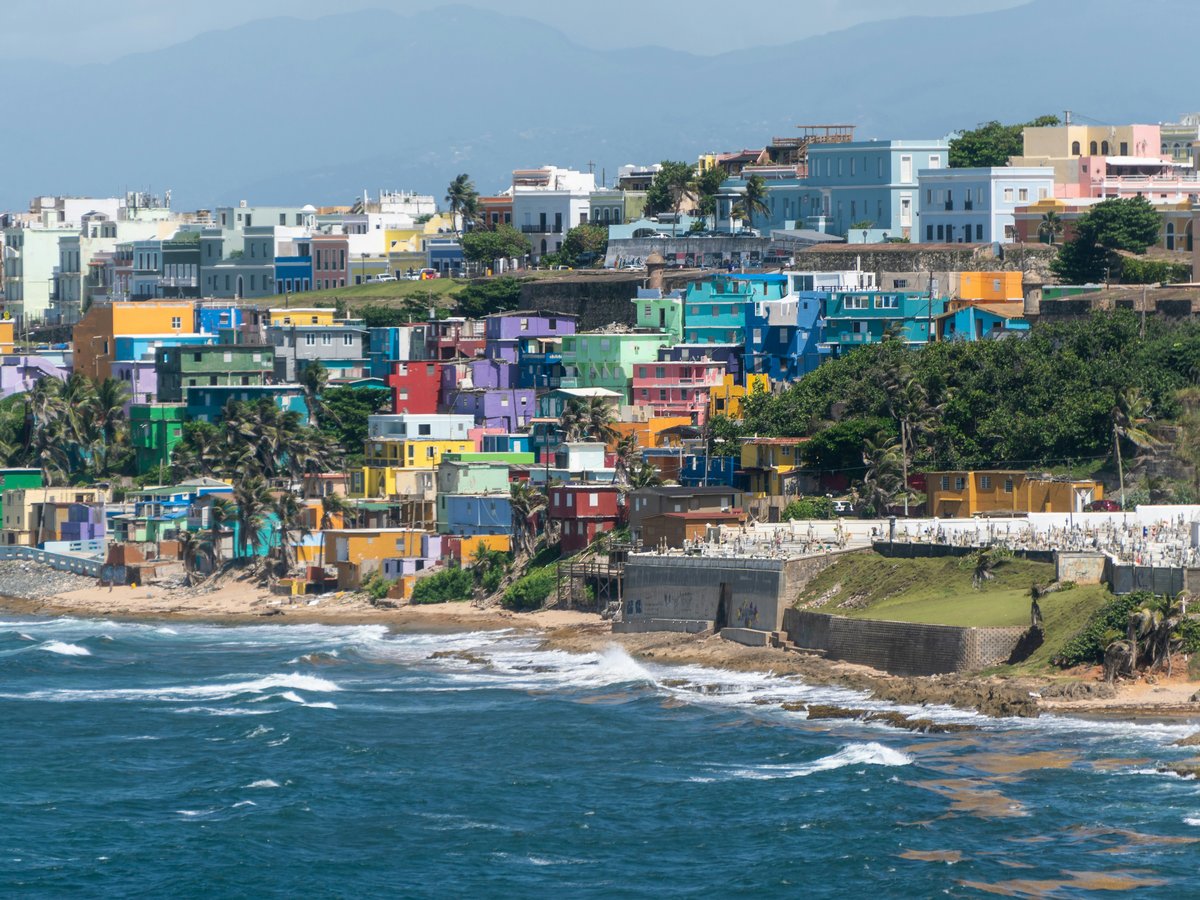
San Juan sits on a narrow spit between the Atlantic Ocean and the Bahía de San Juan, and nearly 500 years of Spanish colonial investment left the city with an unusual density of open-access public spaces. The 7-block-wide walled quarter of Old San Juan is itself a free attraction, all blue adoquine cobblestones and fortress walls at every turn. Three public beaches stretch east from Condado through Ocean Park to Isla Verde, each open around the clock with no entry fee. An active art scene centered in Santurce spills onto walls and sidewalks at no charge. The city scores 7.8/10 for family friendliness (see the TTDI Family-Friendliness Index), and plazas that date to the 1520s still function as neighborhood commons.
Free attractions
-
Cathedral of San Juan Bautista
The cathedral was founded in 1529. It is the second-oldest in the Americas and still holds regular services. Entry is free during visiting hours. The marble tomb of Juan Ponce de León rests in the south transept, and morning light through the stained glass shifts colored patterns across the tile floor.
Old San Juanreligious site -
Santa María Magdalena de Pazzis Cemetery
Established in 1863 between the Atlantic Ocean and the Old San Juan city walls, the cemetery is one of the first landmarks visible from the sea approach to the old quarter. Entry is free and the gate opens during daylight hours. Hundreds of above-ground tombs in white marble and stone step down the terraced hillside, and the sound of waves carries up from the rocks below.
Old San Juancemetery -
Plaza de Armas de San Juan
The main public square has served as the city's civic center since 1521, making it one of the oldest continuously used plazas in the Western Hemisphere. Four statues representing the seasons stand at the corners. The Alcaldía lines the north side, and you can usually hear a mix of buskers and conversation echoing off the surrounding facades.
Old San Juanpublic square -
La Fortaleza exterior and gardens
La Fortaleza was built in 1533 as a military fortress. It is the official residence of the Governor of Puerto Rico and a UNESCO World Heritage Site. Free guided tours of the gardens have been available on weekday mornings, though the schedule depends on the governor's agenda. The blue-and-white facade is visible from Calle Fortaleza, and the surrounding gardens carry the scent of frangipani year-round.
Old San Juanhistoric site -
Paseo de la Princesa
A tree-lined promenade that runs along the southern city wall from the cruise port to the Raíces Fountain at its western end. Free to walk at any hour. The path is shaded by mature fig trees, and the breeze off the Bahía de San Juan is strong enough to carry salt spray. Feral cats sun themselves on the low walls near the entrance gate.
Old San Juanpromenade -
Puerta de San Juan
One of the original entry gates to the walled city, this red-painted wooden door set into the stone fortifications dates to the 16th century. Free to walk through at any time. The gate connects the Paseo del Morro coastal trail to the interior streets, and the thick stone archway stays cool even in midday heat.
Old San Juanhistoric gate -
Parque Luis Muñoz Rivera
A public park in the Puerta de Tierra district, roughly midway between Old San Juan and Condado. Named after the Puerto Rican statesman, the grounds include walking paths through tropical trees, playground equipment, and open lawns. Weekday afternoons draw more locals than tourists, and the shade cover makes it a useful rest stop when the humidity peaks.
Puerta de Tierrapark -
Campo del Morro
The broad, sloping esplanade in front of Castillo San Felipe del Morro. Free and open at all hours. The grassy field faces the Atlantic, and locals fly kites here on weekend afternoons when the trade winds pick up. A free coastal trail circles the headland below the fortress walls.
Old San Juanpark -
Parque de las Palomas
A small park at the southern end of Calle del Cristo, perched on the city wall above the Bahía de San Juan. The name translates to Park of the Pigeons, and hundreds of them gather around anyone carrying bread or seeds. The elevated position gives clear sightlines across the bay toward Cataño and the ferry terminals.
Old San Juanpark -
Museo de las Américas
Housed on the upper floor of the 1854 Cuartel de Ballajá, a former Spanish military barracks. The museum covers cultural history across the Americas with collections on African heritage and indigenous crafts. Sunday admission has traditionally been free, though a modest fee applies on other days. Confirm hours before visiting.
Old San Juanmuseum -
Museo de Arte de Puerto Rico
Puerto Rico's principal art museum occupies a 1920s neoclassical hospital building and its modern wing on Avenida De Diego. The permanent collection ranges from colonial-era Santos de Palo carvings through contemporary Puerto Rican installations. Free admission has been offered on Wednesdays, though the specific day has shifted over the years.
Santurcemuseum -
Capilla del Cristo
A small stone chapel built in the 1750s at the foot of Calle del Cristo, set into the old city wall. Free to view from outside at any time. The interior opens on a limited schedule, reportedly Tuesdays, for about an hour. The silver altar and collection of milagros (small devotional charms) are visible from the entrance when the doors are open.
Old San Juanchapel
Free activities
-
Walking the colonial streets of Old San Juan
The walled quarter fits inside a 15-minute walk end to end, compact enough to explore on foot in a single morning. The blue-tinted adoquine cobblestones were cast from iron furnace slag brought as ballast on Spanish trade ships. Each block turns up painted facades in pastel yellows, pinks, and blues, and the narrow streets funnel ocean air that takes the edge off the humidity. Calle Fortaleza and Calle San Sebastián have the densest concentration of colonial-era buildings.
Old San Juanwalking -
Street art in Santurce
The Santurce neighborhood south of Condado has become the center of San Juan's mural scene. Calle Cerra and the surrounding blocks are painted with large-scale works, many added during the annual Santurce es Ley art festival. The main concentration takes about 45 minutes to walk. Murals change as older ones get painted over, so the route varies between visits.
Santurceart -
Condado Beach and Ocean Park
Two public beaches on San Juan's north coast, east of the old quarter. Condado Beach sits below the hotel strip and can have strong currents. Ocean Park, a few blocks further east, is wider and less crowded, with a local feel and fewer high-rises behind the sand. Both are free, with lifeguards on duty most days. The sand is warm enough to feel through sandals year-round.
Condado and Ocean Parkbeach -
Sunset from the city walls
The western-facing fortification walls near Bastión de las Palmas offer unobstructed sunset views over the bay. Free to access, popular with locals and visitors in roughly equal measure. The stone retains the day's warmth and radiates it noticeably after sundown, keeping the spot comfortable into the evening.
Old San Juanviewpoint -
La Placita de Santurce
By day, Plaza del Mercado de Santurce is a working produce market where locals buy tropical fruits, herbs, and fresh fish. The surrounding streets are lined with small restaurants serving criollo plates. Browsing the market costs nothing, and vendors are generally happy to talk about what is in season.
Santurcemarket
Free events
-
Noches de Galería
First Tuesday of each monthGalleries, cultural spaces, and some restaurants across Old San Juan open their doors for free evening visits. The route typically spans from Plaza de Armas to Calle San Sebastián, with some galleries offering wine and live music on the cobblestones. The crowd tends to mix tourists with local art collectors and students.
Old San Juan -
Fiestas de la Calle San Sebastián
Third weekend of January, annuallySan Juan's largest annual street festival fills the Calle San Sebastián corridor with live music, traditional vejigante masks, parades, and food vendors. Free to attend, though food and drink cost extra. The festival typically spans 4 days and draws tens of thousands of visitors from across Puerto Rico and the mainland.
Calle San Sebastián, Old San Juan -
Live music at La Placita
Thursday through Saturday eveningsThe outdoor square surrounding the Santurce produce market transforms into a free open-air music venue as the sun goes down. Bands cycle through salsa, reggaetón, and bomba y plena, and the crowd fills the plaza and spills onto the surrounding blocks. No cover charge for the outdoor areas.
Plaza del Mercado de Santurce
Free beaches beyond the hotel strip
Condado and Ocean Park draw the most foot traffic, but San Juan has quieter free options. Playa del Escambrón sits in a cove at the eastern edge of the Puerta de Tierra district, sheltered by a natural reef that makes the water calmer than the open-coast beaches. Lifeguards are on duty most days, and you can snorkel the reef if you bring your own mask. Further east, Balneario de Carolina near Isla Verde offers a wider, sandier stretch that local families favor on weekday mornings. Between the Condado and Ocean Park strips, the rocky shoreline at Parque del Indio attracts surfers and sunset watchers. September air temperatures hover around 28 to 30°C with high humidity, and afternoon rain tends to arrive in short bursts that clear within 20 minutes. All beaches in San Juan are public under Puerto Rico law, and none charge admission.
What charges admission
Castillo San Felipe del Morro and Castillo San Cristóbal, the two main fortifications, are managed as part of the San Juan National Historic Site, designated in 1949. A single National Park Service pass covers both forts and currently costs $10. The NPS offers several fee-free days each year, typically on Martin Luther King Jr. Day and National Public Lands Day. Across the bay, the Bacardí distillery in Cataño runs tours starting around $15 for the basic tasting. A short public ferry connects Old San Juan's Pier 2 to the Cataño waterfront.
FAQ
Is San Juan safe to explore on foot alone?
The city scores 5.8/10 for solo-traveler safety (see the TTDI Solo-Safety Index). Old San Juan and the Condado hotel strip feel comfortable during daylight, with a visible police presence in the main tourist zones. After dark, stick to well-lit streets and avoid the La Perla neighborhood along the northern city wall between the two main forts. The beach areas in Condado and Ocean Park are generally walkable at night along the main roads.
Do I need to pay to enter El Morro?
The fortress interior requires a National Park Service entrance pass. The esplanade and grounds in front of the fort are free and open at all hours. Occasional NPS fee-free days are announced on the park service website. The free coastal trail below the walls takes about 20 minutes to walk.
Which free beach has the calmest water for swimming?
Playa del Escambrón in Puerta de Tierra tends to have the calmest conditions of San Juan's free beaches. The open Atlantic-facing stretches further east carry stronger currents, particularly from November through February. Lifeguards are on duty at the busier beaches most days.
Can I walk between Old San Juan and the Condado beach area?
The walk takes about 25 minutes along Avenida Muñoz Rivera, through the Puerta de Tierra district. Parque Luis Muñoz Rivera sits roughly at the midpoint if you want shade. The route is flat and paved the entire way.
Is there free WiFi in San Juan?
Several plazas in Old San Juan have municipal WiFi networks, and most cafes along Calle Fortaleza and in Santurce offer connectivity to customers. San Juan scores 7.8/10 for digital-nomad suitability (sourced from TTDI's editorial rubric), partly because internet access across the main neighborhoods has been steady.
Is San Juan welcoming for LGBTQ+ visitors?
San Juan scores 7.5/10 for LGBTQ+ friendliness (sourced from TTDI's editorial rubric). The Condado and Santurce neighborhoods have the most visible queer community and nightlife. Pride events in June draw crowds along the Condado waterfront. Same-sex marriage has been legal in Puerto Rico since 2015.
Last verified by automated review (v1.7.2) on . What is automated review?