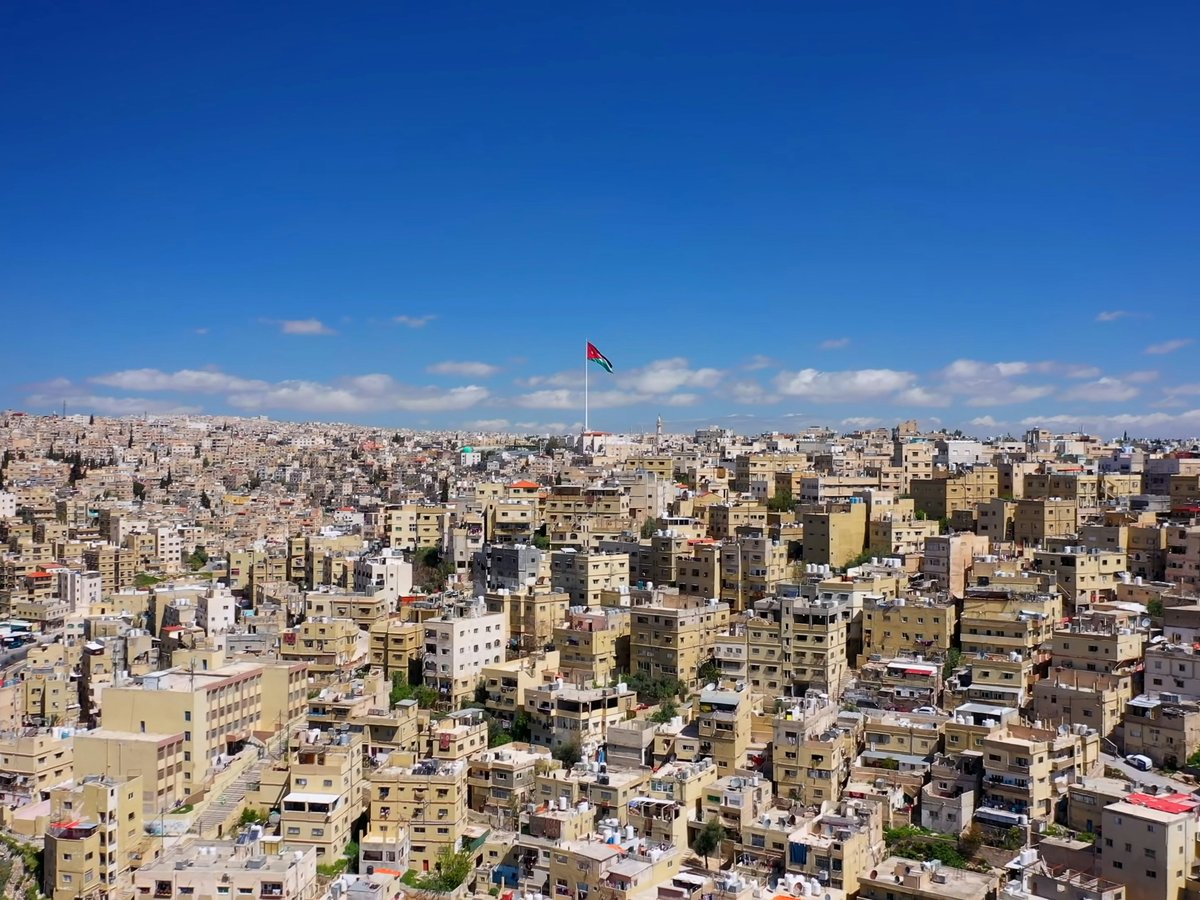
Amman spreads across a series of steep limestone hills in northwest Jordan, about 80 km east of Jerusalem and 35 km from the Dead Sea. The city's oldest core fills a low wadi between Jabal Al-Qal'a and Jabal Amman. From that valley floor near the Husseini Mosque, neighborhoods climb westward across progressively higher ridges. East Amman, in districts like Jabal Al-Nasr and Al-Ashrafiyeh, tends to be more conservative and densely built. West Amman, from the 1st Circle through Abdoun and out toward Sweifieh, carries most of the hotels, restaurants, and bars. At the current exchange rate of 1 USD to 0.709 JOD, a taxi between western neighborhoods rarely costs more than 2-3 JOD. Most visitors base themselves between the 1st Circle and the Abdoun Bridge, a corridor of roughly 5 km along the western ridge. The city sits at 750-800 meters elevation, which keeps mid-September afternoons around 26.6°C with 40% humidity and clear skies. That altitude also means Amman gets genuinely cold in January, with overnight lows near 3-4°C. You might assume two neighborhoods 1 km apart on a map are a quick walk, but the grade between the 1st and 3rd Circles will leave you winded, and sidewalk coverage drops off fast outside commercial streets like Rainbow Street and King Faisal Street.
Neighborhoods
-
Downtown (Al-Balad)
The wadi between Jabal Al-Qal'a and Jabal Amman holds the part of the city where human settlement goes deepest. The Amman Citadel crowns the hill to the north, with the Temple of Hercules standing on its terrace since 162 CE. Below in the valley, the Roman Theatre of Amman, a 2nd-century theatre carved into the opposing hillside, seats about 6,000. Stone buildings from the 1930s and 1940s rise above ground-floor shops selling gold, spices, keffiyeh scarves, and kitchenware. Noise in Al-Balad is relentless. Car horns compete with the call to prayer from the Husseini Mosque and produce vendors calling prices on King Talal Street. Ground cardamom and lamb fat from the shawarma stands scent the air along Hashemi Street by mid-morning. The falafel at Hashem Restaurant, open since 1952 on a narrow alley near Al-Amir Mohammad Street, costs under 1 JOD per plate.
- Best for
- Budget travelers and history-focused visitors who want walking access to the Citadel, the gold souk, and Roman-era archaeology. Accommodation near Al-Balad tends to run 15-25 JOD per night for basic hotels.
- Key streets
- King Faisal Street runs north-south as the main commercial artery. King Talal Street connects the souk area to the theatre. Hashemi Street passes the theatre entrance and leads east toward Raghadan Terminal, where buses depart for Jerash and other northern cities.
-
Jabal Amman (1st to 3rd Circle)
Jabal Amman was the first residential hill developed outside the downtown valley, and 1920s-era stone houses still define the side streets. Rainbow Street, the pedestrian-friendly stretch near the 1st Circle, draws most of the visitor foot traffic. The street holds several independent galleries, at least 3 bookshops, and a row of cafes with tables spilling onto the sidewalk. The Wild Jordan Center sits at the edge of Rainbow Street. It is run by the Royal Society for the Conservation of Nature and serves organic meals on a terrace with a clear sightline to the downtown wadi. The architecture here is low-rise limestone, 2-3 stories, with arched windows and overgrown gardens behind iron gates. Friday evenings bring foot traffic to Rainbow Street that makes driving impossible. You'll hear Arabic pop from parked cars, smell grilled corn from vendors at the curb, and see families walking between the ice cream shops near the 1st Circle.
- Best for
- First-time visitors who want a walkable base near both the cafe scene on Rainbow Street and the historic sites below in Al-Balad. Hotels in the 30-60 JOD range cluster around the 1st and 2nd Circles.
- Key streets
- Rainbow Street is the main draw. Abu Bakr Al-Siddiq Street connects from the 3rd Circle. The staircase streets that drop downhill from Rainbow toward downtown pass through residential blocks and take about 10 minutes to descend to Hashemi Street.
-
Jabal Al-Weibdeh
Jabal Al-Weibdeh sits on the next ridge north of Jabal Amman and feels like a different city. The foot traffic is lighter than on Rainbow Street, and the cafes tend toward the sit-and-stay-for-hours kind. Paris Circle, a small roundabout also called Paris Square, serves as the informal center of the neighborhood. Independent coffee shops and a few gallery spaces ring the circle. Darat al Funun, a contemporary art foundation housed in 1920s stone buildings, occupies a hillside compound with rotating exhibitions and free admission. The apartment blocks date mostly from the 1940s through the 1960s, with balconies heavy with jasmine and laundry on drying racks. You'll smell roasting coffee from the specialty roasters around Paris Circle before you spot their signs. Amman scores 5.8 out of 10 on digital-nomad suitability (sourced from TTDI's editorial rubric), and Weibdeh is the neighborhood responsible for most of those points, with several cafes near the circle keeping reliable Wi-Fi and tolerating laptop workers through the afternoon.
- Best for
- Digital nomads, solo travelers, and anyone who prefers a quieter neighborhood base within a 10-minute taxi ride of downtown.
- Key streets
- Paris Circle is the anchor. Omar bin Al-Khattab Street leads toward Jabal Amman. The alleys that branch off the main roads hide smaller cafes with 2-3 tables and no English menus.
-
Abdali
Abdali is the newer commercial district north of the old city center. The Abdali Boulevard development brought glass-fronted towers and chain restaurants to what was previously a military zone. The Jordan Museum opened in 2014 on Ali bin Abi Taleb Street nearby. It holds fragments of the Dead Sea Scrolls and Neolithic statues from Ayn Ghazal, a settlement in eastern Amman dated to approximately 7300 BC. King Abdullah I Mosque, with its blue mosaic dome visible across several blocks, marks the district's western edge. The area feels corporate from Sunday through Thursday, with more suits than tourists on the sidewalks. It quiets down considerably on Friday mornings. Mind you, Abdali is more useful as a transit point between neighborhoods than for its own street life, with taxis to Jabal Amman or Shmeisani running about 1-1.5 JOD.
- Best for
- Business travelers and anyone who wants a modern hotel base with easy taxi access to both the old city and western Amman's restaurants. Hotels here tend to be 4-5 star chains in the 70-150 JOD range.
- Key streets
- Abdali Boulevard is the main pedestrian-commercial strip. Ali bin Abi Taleb Street leads to the Jordan Museum. Sulayman Al-Nabulsi Street connects north toward Shmeisani.
-
Shmeisani
Shmeisani is the business and institutional district north of Abdali, stretching toward the 5th and 6th Circles. Most of the major hotel chains, including the Four Seasons and the InterContinental, have their Amman properties here or nearby. The streets are wider than in Jabal Amman, the buildings 6-8 stories instead of 2-3, and the foot traffic predominantly office workers. King Abdullah Stadium, built in 1999, and the older Amman International Stadium from 1968 sit in the Al-Hussein Youth City complex near the district's eastern edge. The food scene in Shmeisani leans toward upscale Lebanese and international restaurants rather than street food. You might walk 10 minutes through the district without hearing a single car horn, which is rare anywhere in Amman.
- Best for
- Business travelers, visitors who prefer large hotel chains, and anyone who values quiet streets. The walk downhill to Rainbow Street takes about 20-25 minutes, or a 2 JOD taxi.
- Key streets
- Queen Noor Street cuts through the district from east to west. The 5th Circle connects to highways toward Queen Alia International Airport and the Dead Sea. The 6th Circle area has a cluster of international restaurants.
-
Abdoun
Abdoun sits south of Shmeisani on one of the higher western ridges, and it is where Amman's money concentrates. The neighborhood houses diplomatic compounds for countries including the United States, alongside gated residential villas behind high walls. Abdoun Circle is the district's center, a roundabout ringed by coffee shops, fast-food outlets, and at least 3 shisha lounges. The Abdoun Bridge, a cable-stayed span completed around 2006, connects the neighborhood south across Wadi Abdoun. Restaurant prices run 15-30 JOD per person for dinner, roughly double what you would pay in Jabal Al-Weibdeh. Buildings date from the 1990s onward, more glass and concrete than the limestone of the older jabals. Evening foot traffic picks up around 9-10 PM, later than in most of western Amman.
- Best for
- Visitors with a higher budget who want proximity to nightlife and upscale restaurants. Couples and groups rather than solo travelers. Hotels here start around 80 JOD per night.
- Key streets
- Abdoun Circle is the hub, with restaurants and cafes lining the streets that radiate from it. Mecca Street runs northwest toward Sweifieh and the major shopping malls.
-
Sweifieh
Sweifieh lies further west along Mecca Street and feels more suburban than urban. The major shopping malls, including Taj Mall and Mecca Mall, anchor the district. The streets here are wide and car-oriented, with little in common with the walkable lanes of Al-Balad. The food scene skews toward chains like McDonald's and Popeyes rather than independent restaurants. For visitors, Sweifieh tends to be a destination for specific errands. You come here for a mall trip, a phone SIM, or grocery shopping at Cozmo or Carrefour. The neighborhood sits about 7-8 km from downtown Al-Balad, a 15-20 minute taxi ride depending on traffic.
- Best for
- Long-stay visitors, self-catering travelers who need supermarket and mall access, and anyone staying in serviced apartments in the western suburbs. Budget stays in shared apartments run 20-30 JOD per night.
- Key streets
- Mecca Street is the main east-west artery and carries most of the commercial traffic. The blocks around Taj Mall have the highest concentration of shops and restaurants.
FAQ
Which neighborhood should a first-time visitor to Amman stay in?
The area around the 1st Circle on Jabal Amman is the most practical base for a first visit. It puts Rainbow Street within walking distance and downtown Al-Balad about 15 minutes downhill on foot. Hotels in the 30-60 JOD range cluster here, and the taxi ride to Abdoun or Shmeisani takes under 10 minutes. Jabal Al-Weibdeh, on the neighboring ridge, is a strong alternative if you prefer a quieter pace and the cafe cluster around Paris Circle.
Is Amman safe for solo travelers?
Amman scores 6.2 out of 10 for solo-traveler safety (see the TTDI Solo-Safety Index). The western neighborhoods, particularly Jabal Amman, Jabal Al-Weibdeh, and Abdoun, feel generally safe to walk at night. Petty crime is low by regional standards, though pickpocketing near the downtown souks does occur. Solo female travelers should expect more unsolicited attention than in most European cities, but Jordan is widely considered one of the more approachable countries in the broader region for independent visitors. Ride-hailing apps like Uber and Careem are the safest option for late-night transport.
Is Amman a good city for families with children?
Amman scores 5.2 out of 10 for family friendliness (see the TTDI Family-Friendliness Index). The city is not hostile to families, but it was not designed with them in mind. Sidewalks are uneven, stroller navigation through the downtown streets is difficult, and the hills add a physical challenge for young children. The Children's Museum in King Hussein Park near the 7th Circle is well-regarded, and the Roman-era sites tend to hold kids' attention. Abdoun and Sweifieh have the widest sidewalks and the most familiar restaurant options for selective eaters.
What should LGBTQ+ travelers know about visiting Amman?
Amman scores 3.9 out of 10 for LGBTQ+ friendliness (sourced from TTDI's editorial rubric). Same-sex relations are not criminalized in Jordan, unlike in several neighboring countries, but public displays of affection between same-sex couples draw negative attention. The nightlife areas in Abdoun and parts of Jabal Amman are relatively more tolerant than the rest of the city, though discretion remains the norm. Amman has no openly LGBTQ+ venues as of 2026. Booking a double room as a same-sex couple at the international-chain hotels in the Shmeisani area is generally straightforward.
What day trips are within easy reach of Amman?
The town of Salt sits about 30 km northwest and is worth a half-day trip for its Ottoman-era stone architecture and steep hillside streets. Heshbon, roughly 20 km southwest, has excavated Bronze Age and Roman ruins with far fewer visitors than Jerash. Qasr Mshatta, an unfinished 8th-century Umayyad palace near Queen Alia International Airport, is free to visit and takes about an hour to walk through. The Dead Sea resorts lie roughly 60 km west, about an hour by car. Jerash, 50 km to the north, is the most popular excursion and contains some of the best-preserved Roman provincial architecture outside Italy.
How do visitors get between neighborhoods in Amman?
Taxis and ride-hailing apps like Uber and Careem are the most practical option. Fares between western neighborhoods typically run 1-3 JOD. Amman does have a public bus network, but routes are poorly signed in English and service drops off after about 8 PM. Walking between adjacent neighborhoods is possible but tiring, especially in the July-August heat when afternoon temperatures approach 35°C. The walk from the 1st Circle down to Al-Balad takes about 15 minutes, while the return uphill takes closer to 30 minutes.
Last verified by automated review (v1.7.2) on . What is automated review?