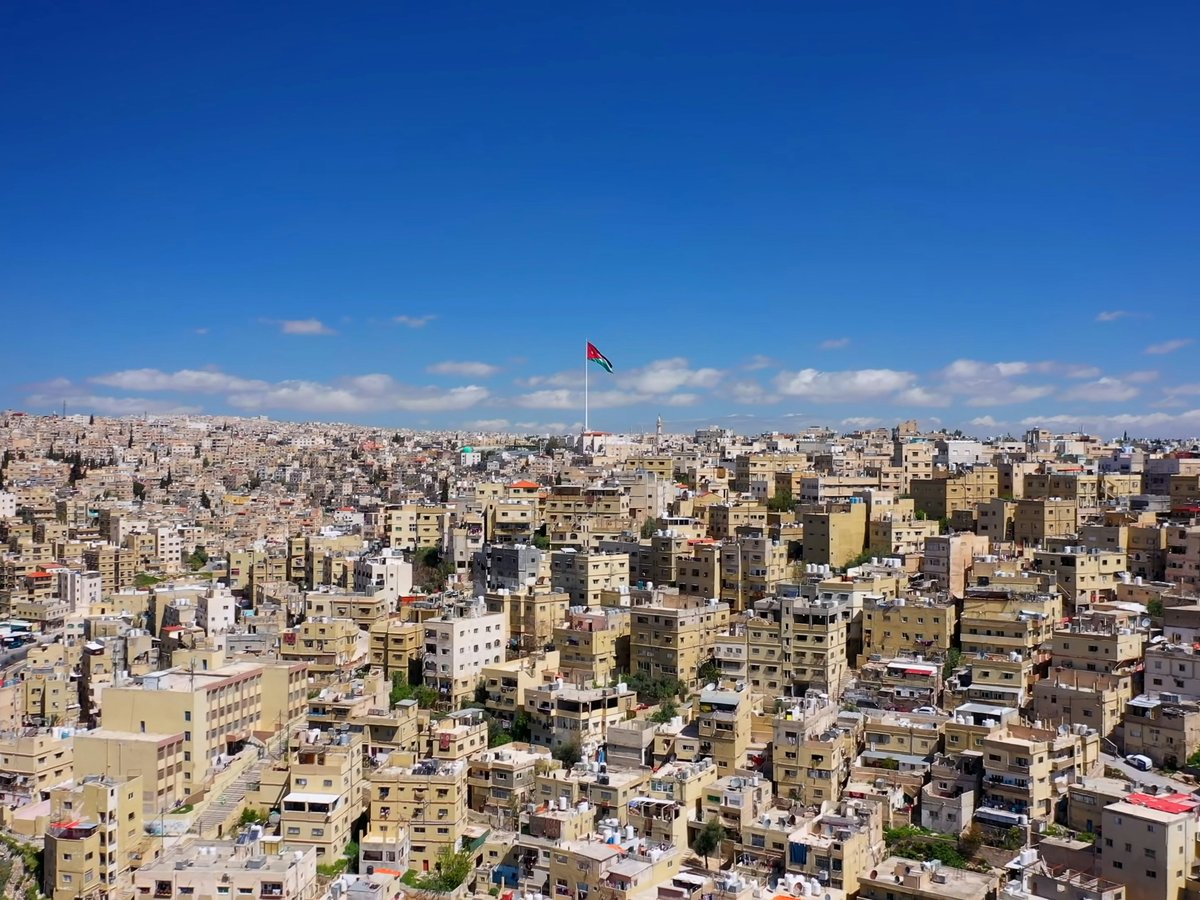
Amman sprawls across 19 limestone hills at roughly 800 meters above sea level, perched where the Arabian Plateau drops into the Jordan Rift Valley. Within 50 kilometers to the west, the terrain plunges over 1,200 meters to the Dead Sea shore at 430 meters below sea level. That elevation swing gives you pine forests to the north and hypersaline shoreline to the west, all reachable before lunch. Spring from March through May is the prime window, with daytime highs around 22-26°C and wildflowers on the hillsides. Autumn, roughly October to mid-November, brings similar temperatures and drier air. Mid-summer regularly tops 35°C with near-zero rainfall, though early-morning starts remain workable. On September 13, the city sat at 26.6°C with 40% humidity under clear skies, fairly typical for this transitional stretch. The land itself is arid and rocky, cut by seasonal wadis that run with flash floods in winter and bake dry by June. The western neighborhoods of Abdoun and Dabouq hold surprisingly green pockets where elevation and aspect coax a bit more moisture from the air. Mind you, Amman is not a lush city. Its appeal lies in the desert-edge terrain, the deep archaeological layers underfoot, and immediate access to some of the most distinctive natural sites in the Middle East. The Temple of Hercules, built around 162 AD on the Citadel hilltop, still stands as one of the most visible landmarks from the valleys below. Qasr Mshatta, an 8th-century Umayyad palace ruin, sits in open desert near Queen Alia Airport about 30 kilometers south of the center.
Outdoor activities
-
Cycling the Dead Sea Highway
The road from Amman down to the Dead Sea drops roughly 1,200 meters over about 50 kilometers, passing through barren desert hills with wide-open views across the Rift Valley. Most riders start from the Na'ur area southwest of the city and follow the winding descent toward the shore. The climb back is punishing, so many arrange a vehicle pickup at the bottom. Traffic is moderate on weekdays but picks up on Fridays. You'll feel the air thicken and warm as you descend, and the terrain shifts from scrubby grey limestone to rust-colored sandstone and salt flats. Organized group rides run seasonally through Amman cycling clubs, typically departing around 6:00 AM.
- Difficulty
- Moderate to hard (1,200 m descent, strenuous return climb)
- Duration
- 3-5 hours one way depending on fitness
- Best season
- October through April, when valley temperatures stay below 35°C
-
Rock Climbing at Wadi Rum
Wadi Rum sits about 280 kilometers south of Amman, making it a long day trip or, more realistically, an overnight. The sandstone towers and walls offer multi-pitch trad routes up to 300 meters, along with shorter sport climbs and bouldering problems. Routes range from French grade 4 to 7b. Local Bedouin guides run climbing operations out of Rum Village, and most provide gear. The rock tends to be grippy but sandy in places, and afternoon sun on south-facing walls makes morning starts essential in the warmer months. Worth noting, this is not a gym-climbing destination. The approaches involve desert walking, and the routes are often sparsely bolted.
- Difficulty
- Moderate to expert depending on route selection
- Duration
- Full day minimum, overnight recommended
- Best season
- October through April, when desert temperatures are manageable
-
Trail Running on Amman's Hills
The hilly terrain across Amman's western districts makes for surprisingly good trail running. A popular loop starts near the Royal Automobile Museum in King Hussein Park and winds through the surrounding pine-planted hillsides. The ground is a mix of packed dirt, loose gravel, and exposed limestone. Elevation changes of 50-100 meters per kilometer are common across the city's wadis and ridgelines. Friday mornings are the quietest time on these paths. You'll pass olive groves on the outskirts and hear the call to prayer echoing across the valleys, a sound that carries well between the limestone escarpments.
- Difficulty
- Easy to moderate depending on distance and route
- Duration
- 45 minutes to 2 hours
- Best season
- March through May and October through November
-
Paragliding above the Dead Sea Escarpment
Several operators run tandem paragliding flights from the escarpment above the Dead Sea's eastern shore. You launch from around 300-400 meters above sea level and descend to the shoreline far below, giving a total altitude difference of over 700 meters. The thermals along the Rift Valley edge are strong and fairly consistent in the cooler months. Flights last 15-30 minutes depending on conditions. The view takes in the salt-blue water surface, the West Bank hills across the basin, and the Moab Mountains to the south. Operators pick up from Amman and the total outing runs about half a day including transport.
- Difficulty
- No experience required for tandem flights
- Duration
- Half day including transport from Amman
- Best season
- September through May, when thermals are more predictable
-
Bird Watching at Azraq Wetland Reserve
Azraq Wetland Reserve lies about 100 kilometers east of Amman in the basalt desert, reachable in roughly 90 minutes by car. Managed by the RSCN, this Ramsar-designated wetland is a critical stopover on the African-Eurasian flyway. Bird hides along the marsh boardwalks let you watch migrant species in spring and autumn, including herons, egrets, and occasionally cranes. The reserve is small enough to cover on foot in 2-3 hours. The silence out here is remarkable after the city. Winter flooding expands the pools significantly, while summer reduces them to a fraction. You might spot water buffalo that were reintroduced to maintain the wetland ecosystem.
- Difficulty
- Easy (flat boardwalks and short paths)
- Duration
- 2-3 hours at the reserve, plus 1.5-hour drive each way
- Best season
- March through April and September through November for peak migration
Day hikes
-
Wadi Al-Seer to Iraq Al-Amir
This walk starts in the Wadi Al-Seer valley about 20 kilometers west of downtown Amman and follows a mix of paved village roads and dirt tracks through olive and fig groves. The route descends gently into a broadening valley. The destination is Qasr al-Abd, a partially reconstructed Hellenistic palace dating to roughly 200 BC, built by the Tobiad family. The palace sits among irrigated fields with a spring-fed stream nearby. The return involves moderate uphill walking on the same route. Mornings are best, as the valley heats up quickly after 10:00 AM in summer months.
- Difficulty
- Easy to moderate (gentle elevation changes, some uneven footing on village tracks)
- Duration
- 3-4 hours round trip
- Best season
- March through May and October through November
-
Ajloun Forest Reserve Trails
Ajloun Forest Reserve sits about 75 kilometers north of Amman in the highlands above the Jordan Valley. The RSCN maintains several marked trails through oak, pine, pistachio, and strawberry tree forest. The Roe Deer Trail, about 2 kilometers, loops through dense woodland and works well for families. The Soap House Trail, roughly 7 kilometers, passes through villages where locals still produce olive oil soap in traditional workshops. The forest floor is carpeted with cyclamen and anemones in spring. Bird sounds are constant, and you might spot a Eurasian jay or a Bonelli's eagle overhead.
- Difficulty
- Easy (Roe Deer Trail) to moderate (Soap House Trail, longer with village sections)
- Duration
- 1-4 hours depending on trail choice
- Best season
- March through May for wildflowers, October through November for comfortable temperatures
-
Salt Heritage Trail
The town of Salt lies about 30 kilometers northwest of Amman. The old town is built on a steep hillside with Ottoman-era yellow limestone buildings linked by narrow stairways and cobbled paths. Walking from the lower town to the hilltop involves about 200 meters of elevation gain on stone steps. It is more of an urban heritage walk than a wilderness hike, but the physical effort is real, and the calves feel it. The local souk sells fresh-pressed pomegranate juice for about 0.5 JOD, and the bakeries have warm kaak bread in the mornings. On clear days, you can see the Jordan Valley from the upper terraces.
- Difficulty
- Easy to moderate (steep stairs, 200 m elevation gain on paved surfaces)
- Duration
- 2-3 hours for a thorough walking tour
- Best season
- Year-round, though summer afternoons above 33°C make the exposed stairs uncomfortable
-
Wadi Zarqa Ma'in Descent to the Hot Springs
The trail descends from the plateau near Madaba through a rocky canyon toward the thermal springs at Hammamat Ma'in, about 60 kilometers southwest of Amman. The route drops roughly 500 meters over 5-6 kilometers through arid terrain with sparse vegetation. The canyon walls narrow as you descend, and the air grows noticeably warmer and more humid near the geothermal vents. That said, the descent is fully exposed with no shade for long stretches. Bring more water than you think you need. The thermal springs at the bottom are covered separately under water activities.
- Difficulty
- Moderate to difficult (steep descent, 500 m elevation loss, no shade, loose rock sections)
- Duration
- 4-6 hours round trip
- Best season
- October through March, when temperatures on the exposed upper section remain bearable
-
Ayn Ghazal Archaeological Walk
The Ayn Ghazal site in northeastern Amman dates to approximately 7300 BC, making it one of the oldest known large settlements in the world. The area follows the Zarqa River valley, and walking along the valley floor takes you through a mix of urban fringe and open ground. The terrain is flat and easy, though the surroundings are more industrial than scenic in places. It tends to appeal more to archaeology-minded walkers than pure hikers looking for wilderness. The remarkable Neolithic plaster statues excavated here are displayed at the Jordan Museum downtown, so pairing the site visit with the museum gives the full picture.
- Difficulty
- Easy (flat terrain, minimal elevation change)
- Duration
- 1-2 hours at the site
- Best season
- Year-round, though early morning is preferable in summer
Water activities
-
Dead Sea Floating and Mud Bathing
The Dead Sea shoreline lies about 50 kilometers west of Amman, reachable in under an hour by car. The water's salinity of roughly 34% makes sinking physically impossible. The sensation is strange, like lying on a firm liquid cushion that pushes back at every angle. Public access is available at Amman Beach, where entry runs around 20 JOD (about $28 USD) on weekends and includes showers, pools, and changing facilities. The mineral-rich mud along the shore is slippery underfoot and tightens into a grey mask on your skin as it dries. A few cautions. Do not shave within 24 hours before going in. Keep the water away from your eyes. It stings with a ferocity that is hard to overstate. The shoreline has been receding roughly 1 meter per year, so facilities periodically relocate to keep up.
- Difficulty
- None (no swimming skill required, buoyancy is automatic)
- Duration
- Half day including the drive from Amman
- Best season
- October through April, when the temperatures at the lowest elevation on Earth are around 25-35°C rather than 45°C
-
Wadi Mujib Wet Canyon (Siq Trail)
The Siq Trail in Wadi Mujib, about 90 kilometers south of Amman, combines hiking with wading and swimming through a sandstone gorge that cuts to the Dead Sea. Water depth varies from ankle-high to chest-deep depending on the season and recent rainfall. The canyon walls rise 50-80 meters above the riverbed at the narrowest points, and sunlight reaches the bottom only for a few hours each day. The water runs noticeably cool relative to the baking air above the rim, typically 18-22°C. The RSCN provides life jackets and requires a guide for certain routes. You will get completely wet. Bring a dry bag for anything that cannot handle full immersion.
- Difficulty
- Moderate (requires comfort in water, scrambling over wet boulders, some swimming)
- Duration
- 2-4 hours on the trail, plus a 1.5-hour drive each way from Amman
- Best season
- May through September, when the reserve opens the wet canyon routes
-
Hammamat Ma'in Hot Springs
The thermal springs at Hammamat Ma'in sit in a canyon about 60 kilometers southwest of Amman, below the town of Madaba. Hot water cascades over mineral-stained rock faces at temperatures between 40-63°C depending on the source vent. A resort occupies the main waterfall area, but a public section with pools is accessible for a lower entry fee. The combination of cool canyon shade and scalding water creates a peculiar sensation of being chilled and overheated at the same time. The drive down from the plateau is steep and winding, with switchbacks dropping about 500 meters. Locals often visit on weekday mornings when the crowds are thin and the sound of the falling water carries clearly off the rock walls.
- Difficulty
- None (soaking, no swimming required)
- Duration
- Half day including the drive from Amman
- Best season
- November through March, when the hot water feels most welcome against cool canyon air
-
Aqaba Red Sea Snorkeling and Diving
Aqaba sits 330 kilometers south of Amman on the Red Sea. It is not a day trip, but many Amman residents drive 4 hours south for a long weekend. The coral reefs begin meters from shore at the Aqaba Marine Park, and underwater visibility regularly exceeds 20 meters. Water temperature ranges from 21°C in February to 27°C in August. PADI dive centers operate along the South Beach strip, with a single-tank dive running 35-50 JOD. The Japanese Garden reef and the Cedar Pride wreck are among the better-known sites. To be fair, this is more of an overnight trip than a day outing from the capital, but most visitors pair it with a Wadi Rum stop to justify the distance.
- Difficulty
- Easy (snorkeling) to moderate (diving requires prior certification)
- Duration
- Overnight trip, minimum 2 days with travel from Amman
- Best season
- Year-round, with warmest water from June through October
Parks & gardens
-
King Hussein Park
FreeThe largest public park in Amman, King Hussein Park covers roughly 100 hectares in the western part of the city near the 7th Circle. The grounds include walking paths lined with pine and cypress, open lawns, playgrounds, and a small mosque. The Cultural Village within the park hosts occasional exhibitions. On Friday afternoons, families spread picnic blankets across the grass and the smell of grilled meat drifts from portable barbecues all across the grounds. It tends to be 2-3°C cooler here than in the downtown valleys thanks to the elevation and tree cover. Joggers circle the main paths early in the morning before the midday heat settles in.
Highlights: Walking and jogging paths through pine groves, Cultural Village exhibition space, children's play areas, and shaded Friday afternoon picnic grounds
-
Amman Citadel (Jabal al-Qal'a)
The Citadel hill is as much an outdoor destination as an archaeological one. The hilltop site covers about 7.5 hectares and offers 360-degree views across downtown Amman. You can see the Roman Theatre in the valley below. The exposed hilltop catches a breeze that the lower city misses entirely, and the golden limestone of the Umayyad Palace ruins glows in late-afternoon light. Walking the full perimeter takes 30-45 minutes at a relaxed pace. Admission is 2 JOD for non-residents, roughly $2.80 USD at current exchange rates.
Highlights: Panoramic city views from the hilltop, the Umayyad Palace ruins, and an afternoon breeze that cuts through the valley heat
-
Royal Botanic Garden
Located about 25 kilometers north of central Amman near the town of Tell Al-Rumman, this 180-hectare site preserves native Jordanian plant communities across several reconstructed habitat zones. The garden holds over 600 native plant species organized by type, from Mediterranean woodland to dry steppe grassland. Trails wind through the property with interpretive signs. The spring wildflower bloom from late February through April is the main draw. The air smells of sage and wild thyme on the drier slopes, and you'll hear larks overhead on quiet mornings. It is still relatively uncrowded compared to the city parks.
Highlights: Over 600 native Jordanian plant species, spring wildflower displays from February through April, and marked nature trails through reconstructed habitat zones
Practical tips
- Sun Protection and Hydration
- UV index in Amman regularly hits 9-11 from May through September. Wear a wide-brimmed hat, SPF 50+ sunscreen, and UV-blocking sunglasses. At lower elevations near the Dead Sea, the reflected glare off the water and salt flats intensifies the exposure. Carry at least 2 liters of water per person for any hike, and 3 liters for routes below sea level where temperatures consistently run 10-15°C hotter than the city above.
- Footwear and Trail Surfaces
- Most trails near Amman cross loose limestone scree, packed dirt, or sandy wadi beds. Lightweight hiking shoes with firm grip work for the majority of routes. For the wet canyons at Wadi Mujib, bring water shoes or old trainers you do not mind soaking. Sandals are not adequate for the boulder scrambling. Wadi terrain can shift significantly after winter rains, so paths that were clear in October might have fresh rockfall or erosion gullies by March.
- Currency and Entry Fees
- Jordan's dinar is pegged near the US dollar at 1 USD to 0.709 JOD. Entrance fees at RSCN reserves like Wadi Mujib and Ajloun Forest run 10-22 JOD depending on the activity, with guided wet-canyon routes at the higher end. ATMs are plentiful in Amman but nonexistent along the Dead Sea Highway or at remote trailheads. Carry cash for entry fees and small village purchases.
- Safety and Flash Floods
- Amman scores 6.2/10 for solo-traveler safety (see the TTDI Solo-Safety Index). The city itself is walkable and generally secure. Flash floods are the primary outdoor hazard from October through March, and they can arrive in any wadi or canyon without visible rain at your location. Check the weather forecast for the entire watershed upstream of your route, not only the trailhead. The RSCN closes wet canyon trails during flood warnings. Cell coverage drops to nothing in deep canyon sections.
- Clothing and Cultural Courtesy
- Jordan is relatively moderate, but covering shoulders and knees is respectful outside of resort beaches and hotel pools. At the Dead Sea, swimwear is standard at the paid beach facilities. On trails and in towns like Salt, lightweight long sleeves serve double duty as sun protection and cultural courtesy. Women hiking alone or in pairs may attract some friendly curiosity in rural areas, though interactions tend to be limited to greetings and offers of tea.
- Transport to Trailheads
- Public transport from Amman to outdoor destinations is limited. JETT buses run to the Dead Sea and Aqaba on fixed schedules. For Wadi Mujib, Ajloun, and the Ma'in hot springs, hiring a car or arranging a taxi is more practical. Expect to pay 25-40 JOD for a return taxi to Wadi Mujib with a few hours of waiting time. Ride-hailing apps like Careem operate in the city but drivers often decline trips to remote areas outside the metro. Rental cars start around 20 JOD per day from agencies near the 7th Circle.
FAQ
What is the best time of year for outdoor activities near Amman?
March through May and October through November offer the most comfortable conditions, with daytime temperatures around 22-28°C in the city. Summer hikes are still possible with early-morning starts before 7:00 AM, but anything at lower elevations near the Dead Sea becomes dangerously hot from June through August, regularly exceeding 45°C. Winter brings occasional rain and cooler conditions around 8-12°C, which can be pleasant for highland hiking but closes the wet canyon routes at Wadi Mujib.
Can I visit Wadi Mujib and the Dead Sea in one day from Amman?
Yes, though it makes for a long, full day. Both destinations lie to the southwest, with Wadi Mujib about 30 kilometers farther south along the Dead Sea shore. A typical itinerary starts with the canyon trail at Wadi Mujib in the morning, then stops at a Dead Sea beach on the return drive. Leave Amman by 7:00 AM to reach the canyon before midday heat, and budget time to change out of wet clothes between the two stops.
Do I need a guide for hiking trails near Amman?
It depends on the route. For the wet canyon at Wadi Mujib, RSCN guides are mandatory and their cost is included in the entry fee. The Ajloun Forest Reserve trails are well-marked and manageable independently. The walk from Wadi Al-Seer to Iraq Al-Amir follows village roads and is straightforward to navigate without assistance. For remote off-trail routes in the eastern desert or deeper wadis, a local guide is strongly recommended.
Is it safe to hike solo in the area around Amman?
City parks and the well-trafficked trails near Amman are generally fine for solo walkers. The Salt heritage walk and the Ajloun Reserve trails see enough visitors that you will not be isolated. The Wadi Mujib canyon requires guided groups regardless of experience. The main solo risks are environmental: heat exposure, flash floods in wadi systems between October and March, and limited mobile coverage in deeper canyons. Personal security concerns are less of a factor than the terrain.
What should I bring for a day at the Dead Sea?
Bring at least 1.5 liters of fresh drinking water per person, sunscreen rated SPF 50+, a towel, and flip-flops for the salt-encrusted shoreline. If you wear contact lenses, switch to glasses for the swim because even a small splash in your eyes causes intense stinging. The mineral mud dries to a tight grey film on your skin and rinses off at the shower facilities available at the paid beach entrances. Leave any fresh cuts or scrapes covered, as the salt concentration makes even minor nicks burn.
Are there parks in Amman suitable for a morning jog?
King Hussein Park in western Amman has both paved and packed-dirt paths through pine-shaded grounds, making it the most popular choice for runners. The park opens early, and the tree canopy keeps temperatures tolerable until mid-morning even in the hotter months. Some runners also use the hillside roads around Dabouq and Abdoun for more challenging elevation work, though these routes involve road crossings and vehicle traffic. Friday mornings tend to be the quietest across all of these options.
Outdoor experiences in Amman
 Free cancellation
 From Amman :Private or Group Full day tour to Petra
Outdoor experience: free cancellation.
via Viator
Dana to Petra Trek + Wadi Rum & the Dead Sea - 9 Days
Outdoor experience: 9 days.
via Viator Free cancellation
 Petra & Dead Sea - One day Private tour
Outdoor experience: free cancellation.
via Viator
Jordan Private 4-Day Tour: Mt Nebo, Kerak, Petra, Wadi Rum, Baptism Site, Amman
Outdoor experience: 4 days.
via Viator Free cancellation
 2-Day Private Tour from Amman: Petra, Wadi Rum Camp & Dead Sea.
Outdoor experience: 2 days, free cancellation.
via ViatorLast verified by automated review (v1.7.2) on . What is automated review?