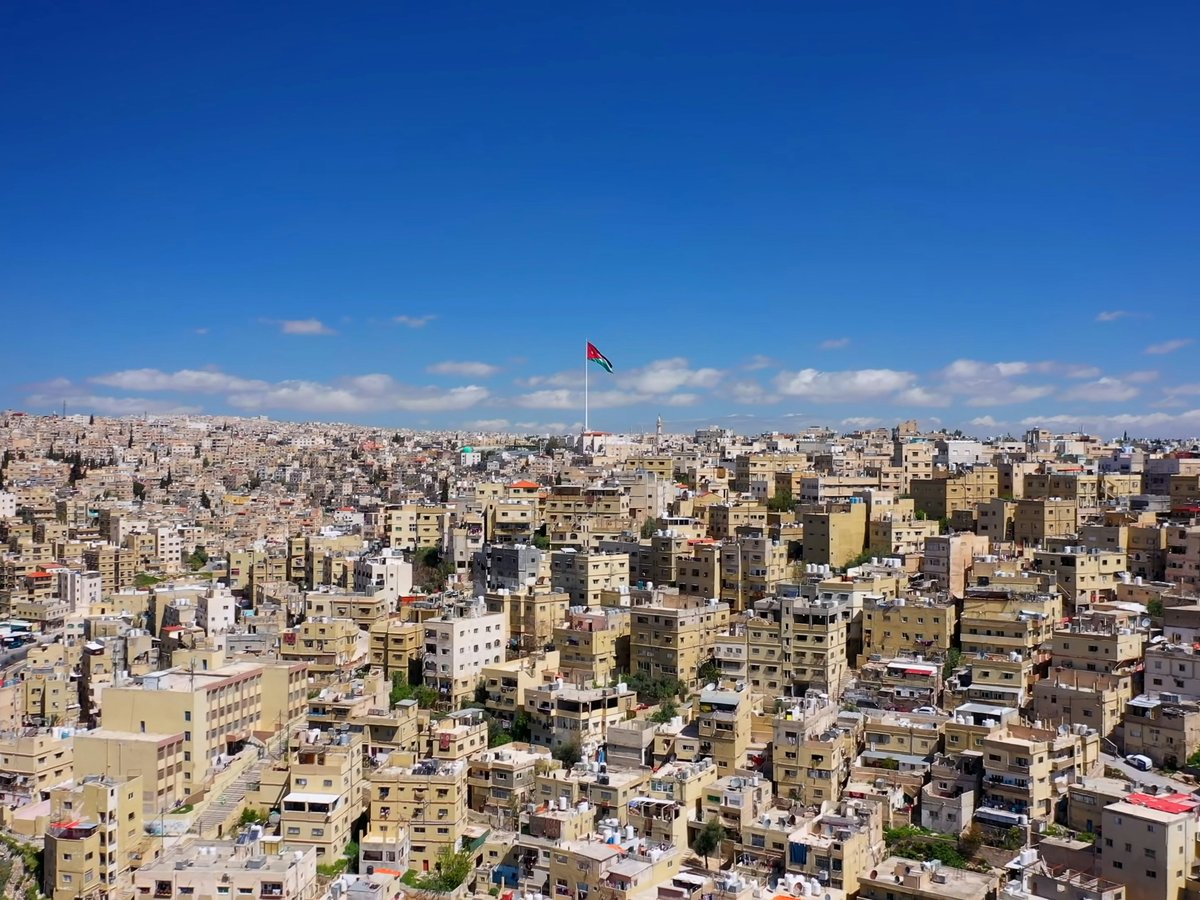
Amman spreads across a series of steep limestone jabals, each hilltop capped with its own neighborhood feel and open vantage points over the valley below. Al Balad, the old downtown, sits in a natural bowl where the smell of roasted coffee beans drifts from the souks and heritage buildings press close together within about 15 minutes of walking. Climb any surrounding hill and the cityscape reshuffles beneath you, minarets and apartment blocks layered against pale stone. A mid-September morning reads around 27 degrees Celsius with clear skies and 40% humidity. Afternoons run hotter. The city's most rewarding free pursuits are spatial. Open galleries on Jabal al-Weibdeh, mosques in the valley, and public plazas all welcome visitors without a ticket. The local instinct to offer tea to someone standing outside a shop means you might leave a market having spent nothing but time in conversation. Amman scores 6.2/10 for solo-traveler safety (see the TTDI Solo-Safety Index), which matters when the best free activity involves walking steep streets into unfamiliar quarters after dark.
Free attractions
-
Darat al Funun
A sculpture garden and contemporary art center on Jabal al-Weibdeh that never charges admission. The terraced grounds include mature olive trees, outdoor sculpture installations, and the excavated foundations of a 6th-century Byzantine church. Indoor galleries occupy several 1920s-era stone houses across the compound. The garden terrace at the compound's edge gives one of the best free panoramas of downtown and the Citadel hill opposite.
Jabal al-WeibdehSculpture Garden / Gallery -
The Duke's Diwan
A restored Ottoman-era townhouse on Al-Malek Faisal Street, open to visitors at no cost. The building dates to the late Ottoman period and has served as a post office, a hotel, and government offices since the early decades of the 20th century. Its current role as a cultural salon means you can walk in, browse the small ground-floor exhibition, and sit in the courtyard with Arabic coffee that the host typically offers. The tiled floors and arched doorways give a sense of what domestic architecture in Al Balad looked like before concrete took over.
Al Balad (Downtown)Heritage House / Museum -
King Hussein Park
Western Amman's largest public green space, spread across hillside terraces with paved walking paths, playgrounds, and open lawns. Free at all hours. The park includes a small mosque, a cultural village section, and enough mature trees to take the edge off a midday visit in summer. Families tend to gather here on Fridays, the weekly holiday, so a Friday afternoon visit gives a window into how Ammani weekends work.
Western AmmanPark -
Al-Husseini Mosque
The main Ottoman-era mosque at the center of downtown, constructed in 1924 on the foundations of an older structure. Visitors are welcome outside prayer times, and the interior's calm contrasts with the market noise pressing in from the streets around it. Women should bring a headscarf. No admission fee, though modest dress is expected for both men and women.
Al Balad (Downtown)Mosque -
Hashemite Plaza
The large open plaza at the base of Jabal al-Qala'a, directly facing the Roman Theatre's full limestone facade. You can sit on the stone benches and take in the theatre's roughly 6,000-seat bowl without buying a ticket to enter. The Nymphaeum, a partially excavated 2nd-century Roman public fountain, stands near the plaza's edge. Free to walk through at any hour, and a natural meeting point between the souk streets and the Citadel stairway.
Al Balad (Downtown)Public Plaza / Viewpoint -
Abu Darwish Mosque
A mosque on the summit of Jabal al-Ashrafiyeh, recognizable from across the city by its black-and-white alternating stone bands. Free to enter outside prayer times. The hilltop around the mosque gives a 270-degree view of eastern Amman that most visitors miss because the jabals west of downtown get all the attention. The walk up from Al Balad is steep but takes only about 15 minutes.
Jabal al-AshrafiyehMosque / Viewpoint -
Sports City Park
The open green grounds surrounding King Abdullah Stadium, which opened in 1999 for the Pan Arab Games. The park area is free and popular with joggers and families during early mornings and late afternoons. Paved tracks loop the perimeter near the Amman International Stadium, built in 1968, and the elevated areas give a decent view across the city's eastern neighborhoods.
Al-Hussein (Sports City)Park
Free activities
-
Downtown Souk Walk through Al Balad
The market streets radiating from Al-Husseini Mosque sell gold, dried herbs, spices, household goods, and off-brand sneakers in roughly that order of interest. Browsing costs nothing. The smell of roasted nuts drifts from corner carts while recorded calls to prayer echo off stone walls. The gold souk on Al-Quds Street catches afternoon light in a way that makes the window displays worth a slow pass. Vegetable sellers in the lower market start packing up by mid-afternoon, so mornings are livelier.
Al Balad (Downtown)Market / Walking -
Rainbow Street Promenade
Jabal Amman's most walked stretch. It runs about 1 kilometer along a ridgeline lined with cafes, bookshops, and restored stone houses. Weekend evenings bring out families and couples who spill across the sidewalk. Free seating on low stone walls overlooks the valley toward downtown. Near the 1st Circle end, a public stairway drops to Al Balad, so you can loop down to the souks on foot and catch a servis back up the hill.
Jabal AmmanWalking Route -
Jabal al-Weibdeh Art Walk
This residential hilltop has become Amman's loosely defined art district, with murals painted on apartment buildings and small galleries tucked into ground-floor shops. Start at Darat al Funun and walk south through Paris Circle (Duwwar Paris). Street art changes every year or two as walls get repainted. The neighborhood's side streets carry the smell of jasmine from garden walls in spring, and cardamom-scented coffee from open doorways year-round. Most galleries clustered near Paris Circle are free to enter.
Jabal al-WeibdehWalking Route / Public Art -
Jabal Stairway Walks
Amman's jabals are connected by steep stone stairways cut into the hillsides, originally built as foot paths before cars dominated the city. The stairway from Al Balad up to Jabal al-Qala'a covers roughly 200 steps and offers changing angles on downtown's rooftops and satellite dishes. Another set climbs from near the Hashemite Plaza toward Jabal al-Jofeh. These stairways are public, always open, and lightly used by visitors. Shoes with grip matter. The stone gets slippery after rain.
Multiple neighborhoodsWalking Route / Viewpoints -
Sunset at the Citadel Rim
The hilltop of Jabal al-Qala'a gives the widest free panorama in the city. The archaeological site within the Citadel walls, which includes the Temple of Hercules dating to 162 CE, requires a ticket. But the public road and open ground along the hill's northern and eastern edges cost nothing. At sunset the view stretches from the downtown mosques to the eastern suburbs. On clear evenings you can make out a faint haze where the Jordan Valley drops toward the Dead Sea, roughly 40 kilometers west. Locals gather here with takeaway falafel sandwiches in the warmer months.
Jabal al-Qala'aViewpoint
Free events
-
Souk Jara
Fridays, typically late May through SeptemberA seasonal open-air flea market on Rainbow Street, Jabal Amman. Local vendors sell handmade jewelry, ceramics, vintage clothing, and street food along a blocked-off section of the road. Free to browse. Live music performances sometimes appear in the evening. The market has been a fixture of Amman summers since around 2005 and tends to draw a mix of locals and visitors.
Rainbow Street, Jabal Amman -
Darat al Funun Exhibition Openings and Film Screenings
Varies. New exhibitions roughly every 2 to 3 months, with weekly or biweekly events during active runsThe Darat al Funun art center hosts exhibition openings, artist talks, and occasional outdoor film screenings on its terrace, all at no cost. New exhibitions typically launch with an evening opening event that draws Amman's art crowd. Programming rotates every few months. Check their posted schedule before visiting, as event nights are the liveliest time to see the compound.
Darat al Funun, Jabal al-Weibdeh -
Ramadan Evenings in Downtown
Nightly during Ramadan (dates shift annually per the Islamic lunar calendar)Al Balad shifts rhythm during Ramadan. After sunset, the streets around the mosques fill with foot traffic heading to iftar meals. Vendors sell qamar al-din (dried apricot juice) and jallab from carts, and public spaces tend to host free cultural performances and seasonal market stalls. Dates shift roughly 10 to 11 days earlier each Gregorian year, following the lunar calendar.
Al Balad (Downtown)
Paid Attractions Worth Knowing About
Several of Amman's most prominent sites charge admission. Knowing where the paywall starts helps plan a day that mixes free and paid stops. The Amman Citadel archaeological site, whose hilltop columns you can spot from the valley floor, costs around 3 JOD for foreign visitors. The Roman Theatre near the Hashemite Plaza charges a similar amount. The Jordan Museum, which opened in 2014 and houses the Ayn Ghazal statues from a settlement dating to around 7300 BC, typically costs 5 JOD for non-Jordanians. Worth noting, the Jordan Pass that many visitors buy for Petra access includes entry to both the Citadel and the Roman Theatre but not the Jordan Museum. If your budget allows one paid visit, the Citadel site gives the most return per dinar since the hilltop view is integrated into the archaeological walk. With the Jordanian dinar at about 0.709 per US dollar, a 3 JOD Citadel ticket works out to roughly 4.23 USD. For a full overview of what to see, Wikivoyage's Amman article covers ticketed sites in detail (https://en.wikivoyage.org/wiki/Amman#See).
Planning a Zero-Budget Day in Amman
Start early. The downtown souks are liveliest between 9 and 11 in the morning, and pre-noon walking in summer months is far more comfortable. From Al Balad, walk the souk streets first, then climb the stairway to the Citadel rim for the free viewpoint before the midday sun hits full strength. Drop down to Jabal al-Weibdeh around midday when the indoor galleries are open and the rooms stay cool. In the afternoon, a servis from Weibdeh toward 3rd Circle takes roughly 10 minutes and puts you within walking distance of Rainbow Street for the evening crowd. Carry a refillable water bottle. Amman's municipal supply runs intermittently, often filling rooftop tanks once a week, so many locals filter or buy bottled water. A 1.5-liter bottle from a corner shop runs about 0.30 JOD. Free public restrooms are rare outside mosques and parks, so plan stops accordingly. If you're visiting during Souk Jara's Friday season, time your walk to end on Rainbow Street by late afternoon.
FAQ
Are there beaches or swimming spots near Amman?
Amman is landlocked, sitting on a plateau at roughly 750 to 900 meters above sea level depending on the jabal. The nearest swimmable body of water is the Dead Sea, about 55 kilometers west and around 430 meters below sea level. Dead Sea beach access is not free. Public beach areas charge entry fees starting around 15 to 20 JOD, and most visitors use resort day passes. Aqaba, Jordan's Red Sea coastal city, is roughly 330 kilometers south and better treated as a separate trip.
Can non-Muslims enter mosques in Amman?
Al-Husseini Mosque in downtown welcomes non-Muslim visitors outside prayer times, as described above. King Abdullah I Mosque, the large blue-domed mosque in the Abdali neighborhood, also permits visits but typically asks non-Muslim visitors to contribute about 2 JOD, which includes a borrowed robe and headscarf. Modest dress, shoe removal, and quiet behavior are expected at both. Abu Darwish Mosque on Jabal al-Ashrafiyeh follows similar visitor etiquette. Avoid visiting during Friday midday prayers when the spaces are busiest.
Is Amman a walkable city?
Amman is walkable but steep. The jabals involve serious inclines, and sidewalks range from well-maintained to nonexistent depending on the neighborhood. Downtown Al Balad is flat and compact. Getting between hilltops on foot means climbing and descending stone stairways, which takes energy and time. That said, the public transport system includes shared minibuses (servises) that run fixed routes for about 0.25 to 0.35 JOD per ride, and yellow taxis with meters starting at 0.25 JOD. Wikivoyage's transit section covers routes and fares well (https://en.wikivoyage.org/wiki/Amman#Get_around).
Is Amman suitable for families on a zero budget?
The city scores 5.2/10 for family friendliness (see the TTDI Family-Friendliness Index). Free options for children include King Hussein Park, with open lawns large enough for running, the bird aviaries on the hillside below the Citadel, and the wide Hashemite Plaza where kids can circle on foot while parents sit. That said, Amman's steep terrain makes stroller navigation difficult outside the flat downtown zone and the parks themselves. Older children who can handle stair climbs tend to find the jabal walks and souk browsing engaging. Friday is the family day, and the parks fill up in the afternoon.
What should LGBTQ+ travelers know about visiting Amman?
Amman scores 3.9/10 for LGBTQ+ friendliness (sourced from TTDI's editorial rubric). Same-sex relations are not explicitly criminalized in Jordan's penal code, which sets it apart from several of its neighbors, but social attitudes remain conservative. Public displays of affection between same-sex couples draw attention and are not socially accepted. Discretion is standard practice. The more liberal neighborhoods like Jabal al-Weibdeh and parts of Jabal Amman feel more relaxed than conservative East Amman, though no area has visible LGBTQ+ venues or nightlife. Safety information for solo travelers applies broadly (https://en.wikivoyage.org/wiki/Amman#Stay_safe).
What is the best time of year for free outdoor activities in Amman?
Spring, roughly March through May, brings daytime highs between 15 and 25 degrees Celsius and is likely the most comfortable season for long walks. Autumn from late September through November starts warm and cools as the weeks pass. Summer from June through August pushes above 35 degrees, which makes the stairway walks and hilltop viewpoints punishing at midday. Winter brings rain from December through February and occasional temperatures near freezing, though the souks and indoor galleries stay open year-round. The shoulder months of April, May, October, and November tend to hit the sweet spot for outdoor time.
Last verified by automated review (v1.7.2) on . What is automated review?