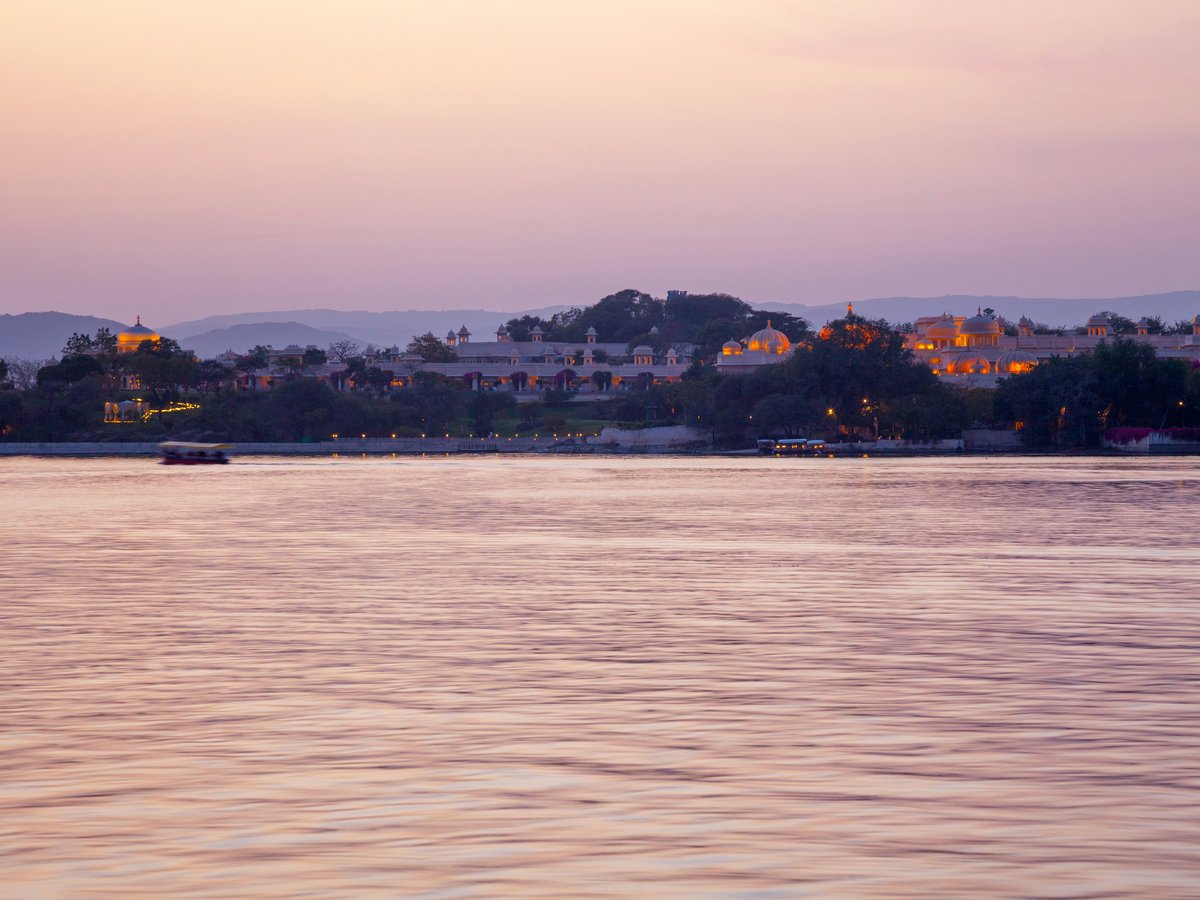
Stay in Udaipur in April
64 hotels in the Trip.com pool for Udaipur, from US$5 a night.
Opens Trip.com on Fri 2 Apr to Sun 4 Apr 2027; change the dates there.
April in Udaipur is scorching. That is the first thing you need to know, and the fact that shapes every other decision about this trip. Daytime temperatures average 36.6°C (98°F), with late-April peaks regularly crossing 40°C (104°F). The Aravalli hills ring the city on three sides and trap heat in the lake basin, so the narrow lanes around Hathi Pol and Jagdish Chowk hold radiated warmth from the sandstone walls well past sunset. The one saving grace is the aridity. Shade provides real relief rather than the illusion of it, and the temperature swing between day and night is dramatic, dropping to around 23°C (74°F) after midnight.
The trade-off for enduring the heat is solitude and price. December through February is Udaipur's peak season, when City Palace ticket lines extend past Tripolia Gate and rooftop restaurants in Chandpole fill by 6 PM. In April, the tourist population thins to a fraction of that. Lake Pichola boat rides have no wait. The courtyard galleries inside Bagore-ki-Haveli might hold four visitors instead of forty. Heritage hotel rates along the lakeshore fall substantially below their winter highs, and walk-in prices tend to beat online booking platforms.
But honesty matters. April demands a split-day strategy. You sightsee before 10 AM and after 5 PM, then spend the 7 hours between in air-conditioned rooms, lakeside restaurant shade, or the naturally cool interior halls of the City Palace. If that rhythm bothers you, wait for October or November, when post-monsoon Udaipur has full lakes, comfortable temperatures, and the Aravalli hillsides still carrying green from the rains. If you can live with the schedule, April offers a version of Udaipur that most tourists never see. Empty, affordable, and blazingly honest about its desert geography.
Why visit in April
- Heritage hotel rates along Lake Pichola drop 40-50% from December-February peaks, making lakeside properties in Chandpole and Ambrai accessible on a modest budget.
- City Palace, Jagdish Temple, and Bagore-ki-Haveli all have minimal queues, so you can explore for 3-4 hours at your own pace rather than shuffling through with tour groups.
- The bone-dry atmosphere produces sharp sunsets over the Aravallis and clear sightlines from Monsoon Palace that monsoon-season haze and winter dust both obscure.
- Lake Pichola evening boat rides are available on demand with no advance booking and no 45-minute pier waits.
Worth knowing
- Highs in the high 30s°C (approaching 100°F) limit comfortable outdoor time to roughly 4 hours per day, split between dawn and dusk. Midday sightseeing is genuinely miserable.
- Lake levels reach their annual low after 8 dry months, leaving parts of Pichola and Fateh Sagar visibly receded, with exposed mud banks along the eastern shore.
- Several rooftop restaurants, smaller guesthouses, and tour operators reduce hours or close outright during low season, narrowing your dining and activity options.
- Late-April heat spikes above 40°C (104°F) are common, and the old city's narrow lanes trap warmth radiating from the sandstone facades for hours after sunset.
Best for
Think twice if
April delivers unbroken dry heat with almost zero precipitation. The sun feels strong by 8 AM and the air temperature climbs through the morning, peaking in the mid-to-high 30s through the afternoon. Nights cool noticeably, making open-air dining after 9 PM genuinely pleasant. The air feels parched, a scratchy dryness in the throat by mid-morning. Your lips will crack by day 2 without balm. Wind tends to pick up in late afternoon, sometimes carrying fine grit from the Thar Desert to the northwest. Rain is essentially absent, with barely 2mm recorded across the entire month, typically as a single brief shower that evaporates within the hour.
Seasonal caution
- Sustained temperatures above 36°C with late-April spikes regularly exceeding 40°C (104°F). Heat exhaustion and sunstroke are genuine risks during midday hours, particularly on exposed rooftops and around the unshaded Ahar Cenotaphs.
- Thar Desert dust storms (locally called loo) occasionally reach Udaipur in April, reducing visibility and filling the air with fine grit. They typically last 2-4 hours and can ground Lake Pichola boat services temporarily.
- UV index frequently reaches 10-11 (extreme) by midday. Sunburn can occur within 15-20 minutes of unprotected exposure, especially near the reflective lake surfaces.
Year-round climate
Averages from the last 5 years.
| Month | Avg high (°C) | Avg low (°C) | Rainfall (mm) |
|---|---|---|---|
| Jan | 23 | 10 | 11 |
| Feb | 28 | 14 | 0 |
| Mar | 32 | 19 | 7 |
| Apr | 37 | 23 | 2 |
| May | 37 | 25 | 44 |
| Jun | 35 | 25 | 135 |
| Jul | 30 | 24 | 242 |
| Aug | 29 | 23 | 221 |
| Sep | 30 | 23 | 180 |
| Oct | 30 | 20 | 35 |
| Nov | 27 | 16 | 14 |
| Dec | 24 | 12 | 7 |
Headline events
Mewar Festival (Gangaur)
Late March to mid-April (18 days after Holi, shifting annually with the Hindu lunar calendar)
Udaipur's own celebration of the pan-Rajasthani Gangaur festival, honoring Goddess Gauri. A procession carrying traditional images of Gauri and Isar winds through the old city from the royal palace grounds to Gangaur Ghat, where the figures are ceremonially immersed in Lake Pichola. Women in traditional Mewari dress carry decorated clay pots, folk musicians accompany the march, and the ghats fill with spectators and devotees. The smell of jasmine garlands and incense hangs thick around the procession route. The date depends on the Hindu lunar calendar and falls 18 days after Holi, placing it in late March or early-to-mid April depending on the year. Worth noting, in some years it lands entirely in March, so confirm the specific calendar before planning around it.
Best things to do in April
Dawn boat ride on Lake Pichola
sightseeingBoard a motorboat or shared shikara at Rameshwar Ghat before 7 AM, when the water is glassy calm and the City Palace's eastern facade catches the first orange light. The 1-hour circuit passes Jag Mandir, the island palace started in 1560, and the Lake Palace Hotel. In April, the air is still cool enough at dawn that the ride feels comfortable rather than endured.
The only comfortable outdoor window is before 9 AM. No queues at the jetty, no competition for boats, and the dry atmosphere means unusually sharp reflections on the lake surface.Booking tipWalk up to Rameshwar Ghat by 6:30 AM. No advance booking needed in April. Negotiate the fare before boarding.
City Palace interior galleries
sightseeingThe City Palace complex spans 11 connected palaces built over 400 years along the eastern bank of Pichola. The interior sections, particularly the Zenana Mahal, Moti Mahal, and the crystal gallery, stay naturally cooled by sandstone walls up to 3 meters thick. April's minimal crowds mean you can stand alone in the mirrored chambers that are normally packed shoulder-to-shoulder.
The thick-walled interiors sit 8-10°C cooler than the street, making this the single best midday refuge. Winter crowds of several thousand daily visitors shrink to a few hundred.Booking tipEnter when gates open at 9:30 AM and head straight to the upper galleries. Allow 3-4 hours. A composite ticket covers the museum sections.
Evening cultural show at Bagore-ki-Haveli
cultureThe 18th-century haveli on Gangaur Ghat hosts a nightly Rajasthani folk dance and puppet show at 7 PM. Ghoomar, Kalbeliya (the snake-charmer dance recognized by UNESCO), and Kathputli puppetry rotate on the programme. The open-air courtyard catches the evening lake breeze, and by showtime the temperature has typically eased below 32°C. The ankle bells and drum rhythms carry across the water to the far ghats.
Shows run year-round but winter performances sell out days ahead. In April, you can buy tickets at the door 30 minutes before showtime and sit front-row without competition.Booking tipArrive by 6:30 PM to walk the haveli's museum galleries (over 100 rooms) before the show. The museum closes once the performance starts.
Sunrise from Monsoon Palace (Sajjangarh)
sightseeingThe 19th-century hilltop palace sits at 944 meters elevation, roughly 300 meters above the city floor. The climb by auto-rickshaw takes about 20 minutes from the old city. At dawn, the air gives visibility that can extend 30+ km across the Aravalli range, a sweep of brown ridgelines and pale valleys. The palace itself is partially ruined but the panoramic terrace rewards the early wake-up. Sajjangarh Biological Park sits at the base of the hill.
The near-zero humidity in April means the clearest long-distance views of the year. Monsoon and winter haze both cut visibility significantly. Early morning temperature at altitude is around 20°C.Booking tipThe road gate opens at sunrise. Go by auto-rickshaw and negotiate a round-trip fare including 30 minutes wait time at the top.
Cooking class in the old city
foodSeveral family-run cooking schools in the Chandpole and Brahmpuri neighborhoods teach Mewari home cooking in small groups. April classes typically cover summer-specific recipes like gatte ki sabzi, aam panna, and chapati cooked on a tawa. The kitchens are indoors with fans or air conditioning, making this a practical mid-afternoon activity when the streets are unbearable.
The summer menu differs from winter classes, focusing on cooling drinks and lighter preparations. Low season means groups of 2-4 instead of 10-12, and last-minute booking is usually fine.Booking tipAsk your guesthouse for a referral. Most classes run 3-4 hours and include the meal you prepare.
Morning walk through Gulab Bagh
natureUdaipur's largest public garden, founded in 1881, covers over 100 acres between the old city and Fateh Sagar. The rose collection that gives it its name (gulab means rose) is past its February peak by April, but the mature neem and banyan canopy provides the densest shade in the city. The smell of damp earth under the trees is one of the few non-dusty scents you will encounter this month.
The mature tree canopy keeps ground temperature 5-6°C below ambient, making this the most comfortable outdoor walk during the 7-10 AM window. The adjacent zoo charges a small fee.Booking tipFree entry to the garden. Go before 9 AM when the shade still holds cool air from the night.
Night walk through the illuminated old city
experienceAfter 9 PM, temperatures ease to the mid-20s°C, and the old city takes on a different character. The floodlit City Palace reflects off Pichola's surface, the ghats along Gangaur Ghat glow with string lights, and the lanes between Jagdish Temple and Chandpole are quiet enough to hear your footsteps on the stone. Street food vendors selling kulfi and paan set up near Jagdish Chowk around this hour.
April turns Udaipur into a nocturnal city. The heat pushes local life into the evening hours, so the streets between 9 PM and midnight feel more alive than they do at 2 PM. In peak winter, tourists are in bed by 10 and miss this entirely.Bharatiya Lok Kala Mandal folk-art museum
cultureThis folk-art institution on Panchwati Road, established in 1952, houses one of Rajasthan's best collections of traditional puppets, masks, folk instruments, and tribal jewelry. The indoor galleries stay cool, and the attached puppet theater runs short Kathputli performances. The collection includes pieces from across Mewar, Marwar, and the Bhil tribal regions.
The air-cooled interior makes this a valuable 2-3 hour midday refuge. In low season, the puppet shows sometimes run as nearly private performances for small groups, which is unexpectedly intimate.Booking tipCheck showtimes at the ticket window. Morning performances are less likely to be canceled than afternoon ones.
What to eat in April
In season: fruit
Kesar mango (early season)
Gujarat's prized Kesar mangoes start appearing in Udaipur markets by mid-April, arriving via overnight truck from Junagadh, roughly 500 km southwest. The early-season fruit tends to be smaller and more tart than the May peak, but the fragrance, a mix of saffron and stone fruit, is unmistakable at the Surajpole Gate vendors.
On menus now
Ker Sangri
A signature Rajasthani desert dish of dried ker berries and sangri beans, sauteed with red chilies and dried mango powder (amchur). Summer is when Mewari households prepare it most frequently, as the tangy, sharp-spicy flavors tend to stimulate appetite in the heat. It shows up on thali plates across the old city.
Daal Baati Churma
Rajasthan's signature trio of baked wheat balls, lentil curry, and sweet crushed wheat is served year-round, but April's heat means the baati are cooked in outdoor clay ovens before dawn rather than at midday. Several family-run kitchens in Brahmpuri still use traditional dung-fuel ovens, producing a distinctly smokier crust than gas-oven versions.
What to drink
Aam Panna
Raw mango drink boiled down with sugar, cumin, and black salt, served ice-cold. April marks the peak of raw mango season in Rajasthan, and every roadside stall in the Hathi Pol market area sells this for a few rupees. The tartness and salt content make it a natural rehydration drink.
Chaas (masala buttermilk)
Spiced yogurt drink thinned with water, seasoned with roasted cumin, fresh coriander, green chili, and rock salt. Rajasthani households drink chaas daily through the summer months, and old-city dhabas around Jagdish Chowk serve it complimentary with thalis from April onward. The cooling effect on a scorched palate is immediate.
Sattu Sharbat
Chilled drink made from roasted black chickpea flour mixed with lemon, salt, and sometimes jaggery. Originally from Bihar and eastern Rajasthan, it has become a staple summer street drink. The high protein content makes it surprisingly filling. Vendors appear along Fateh Sagar's promenade starting in April.
Regular events in April
Ram NavamiFree
Hindu festival celebrating Lord Rama's birth, observed with processions (shobha yatras) through the old city and special prayers at Jagdish Temple and smaller neighborhood shrines. The Chandpole bazaar area is typically decorated with saffron banners and marigold garlands.
Early to mid-April (Chaitra Shukla Navami, shifting with the Hindu lunar calendar)Mahavir JayantiFree
Birth anniversary of Lord Mahavira, the 24th Tirthankara of Jainism. Rajasthan has a large Jain community, and Udaipur's Jain temples in the old city hold special abhisheka (ritual bathing) ceremonies and community processions. Vegetarian food distribution (bhandara) is common near the temple complexes.
Mid-April (Chaitra Shukla Trayodashi, shifting with the Jain lunar calendar)Ambedkar JayantiFree
National holiday honoring Dr. B.R. Ambedkar's birth. Government offices and some businesses close for the day. Public programs and gatherings are held at various locations.
April 14 (fixed date)Hanuman JayantiFree
Celebration of Lord Hanuman's birth, marked by prayer gatherings and distribution of prasad (blessed food) at Hanuman temples throughout the city. The temple area near Fateh Sagar sees one of the larger local gatherings.
Late April (Chaitra Purnima, full moon of the Chaitra month)Best places this April
Ambrai Ghat
viewpointThe west-bank ghat directly across from City Palace offers the most photographed view in Udaipur. In April, the absence of atmospheric haze means the palace facade reflects with unusual sharpness, and the ghat-side restaurants serve cold drinks into the warm evening. Sunset here is more vivid in the dry months than during the humid post-monsoon period.
AmbraiJagdish Temple
templeThis 17th-century Indo-Aryan temple dedicated to Lord Vishnu sits at the heart of the old city, elevated on 32 marble steps. The carved stone exterior stays cool to the touch until about 11 AM. The inner sanctum is dark and noticeably cooler than the street, with the scent of sandalwood incense hanging in the still air. Morning aarti around 7 AM draws mostly local worshippers in April.
Jagdish ChowkFateh Sagar Lake promenade
waterfrontThe tree-lined road along the northern shore is Udaipur's evening gathering spot. Locals arrive after 6 PM to walk, eat chaat and gola (ice candy) from the vendor carts, and watch the light change over Nehru Garden island. In April, the water level is lower than its post-monsoon peak, but the promenade atmosphere is at its most local, with few foreign tourists present.
Fateh SagarSaheliyon-ki-Bari (Garden of the Maidens)
gardenAn 18th-century ornamental garden with lotus pools, marble elephants, and gravity-fed fountains running year-round from Fateh Sagar's water supply. The mist from the central fountain cluster creates a micro-climate several degrees cooler than the surrounding streets. Built for the queen and her 48 attendants, the scale is intimate rather than grand. You can feel the temperature difference on your skin the moment you step inside the gate.
Fateh SagarAhar Cenotaphs
monumentA cluster of over 250 royal cenotaphs (chhatris) marking the cremation site of Mewar's maharanas, about 2 km east of the old city. The sandstone structures are largely unshaded, so visit at first light when the warm stone glows against the flat morning sky. The adjacent Ahar museum displays artifacts from the 4,000-year-old Ahar civilization excavation.
AharHathi Pol bazaar
marketThe market lane running from the Elephant Gate toward Jagdish Chowk sells miniature paintings, silver jewelry, leather mojari shoes, and Rajasthani textiles. April's low foot traffic means shopkeepers are more willing to negotiate, and you can browse the miniature painting studios without a crowd looking over your shoulder. The lane narrows enough that upper-floor balconies cast useful shade for most of the day.
Hathi Pol
Your packing checklist
Tick items off as you pack. Your progress saves in this browser.
All packed — have a great trip.
Insider tips
The rooftop restaurants near Gangaur Ghat that face City Palace charge a significant markup for the view. Walk 5 minutes east to the guesthouses along Lal Ghat for comparable lakefront sightlines with lower menu prices and fewer touts at the entrance.
Auto-rickshaw drivers near City Palace quote inflated fares year-round, but in April they are more willing to use the meter or negotiate because business is slow. Set the price before you sit down. A ride across the old city should cost the equivalent of well under a dollar at current exchange rates (1 USD is roughly 95.7 INR).
Udaipur's solo-traveler safety scores 5.8/10 (see the TTDI Solo-Safety Index). The old city around Jagdish Chowk is well-lit and active until late, but the lanes between Brahmpuri and Chandpole get very dark after 10 PM. Stick to main roads at night if walking alone.
The miniature painting workshops on Hathi Pol sell directly to visitors, but quality varies enormously. Ask to see the artist working. Shops showing only finished inventory are more likely selling factory prints marketed as handmade. A genuine hand-painted piece on silk takes 3-4 weeks to complete.
Fill water bottles at your hotel before heading out. Branded 1-liter bottles from street vendors are sometimes refilled from tap water and resealed. Check that the cap seal is intact and cracks cleanly when you twist it.
Avoid these mistakes
- Scheduling a full-day outdoor itinerary. Visitors who plan City Palace, Monsoon Palace, the cenotaphs, and a boat ride all in one day routinely hit a wall by 1 PM. Split sightseeing across 2-3 days, using mornings and evenings only.
- Sleeping in past 8 AM. By 10 AM the heat window closes. If you wake at 9, you have lost 2-3 hours of comfortable outdoor time. Set an alarm for 5:30 AM, eat early, and sightsee until the heat builds.
- Wearing dark-colored synthetic clothing. Black polyester in desert sun at these temperatures is a fast path to heat exhaustion. Light-colored natural fabrics make a measurable difference in body temperature regulation.
- Assuming lake water levels match online photos. Most promotional images of Udaipur show post-monsoon conditions (October to December) when the lakes are full. April's lower water lines reveal mud banks and exposed foundations. It is still beautiful, differently so.
Practical tips for April
Book accommodation with reliable air conditioning and confirm the unit works before paying. Power fluctuations in April can strain older systems, and budget guesthouses sometimes run AC on a timer rather than continuously. Heritage hotels with inverter backup are worth the modest premium. Temple dress codes apply year-round, with covered shoulders and knees required at Jagdish Temple and the Eklingji complex 22 km north. Lightweight cotton that covers skin is more comfortable than bare arms in direct sun anyway. Pharmacies near Surajpole Gate stock oral rehydration salts (sold as Electral or ORS), sunscreen, and basic heat-related supplies. The nearest major hospital is Geetanjali Medical College, about 5 km north of the old city. Train tickets between Udaipur and Jaipur or Ahmedabad should be booked at least a week ahead even in low season, as the overnight services fill early. For detailed arrival options by rail, road, and air, see https://en.wikivoyage.org/wiki/Udaipur#Get_in and for getting around the city, see https://en.wikivoyage.org/wiki/Udaipur#Get_around. ATMs are the simplest currency option. UPI digital payments are increasingly accepted at sit-down restaurants and shops but not at market stalls or auto-rickshaw stands, so keep cash for those.
FAQ
Is April a good time to visit Udaipur?
Not particularly. April is one of the 3 hottest months, with temperatures approaching 37°C and peak days above 40°C. The heat limits outdoor sightseeing to early morning and evening hours. That said, hotel prices hit their annual low, crowds are minimal, and the dry air means the heat is less oppressive than humid-summer destinations at similar temperatures. If you are comfortable with a dawn-and-dusk schedule and want the city largely to yourself, it can work. If you want full days of exploring, visit between October and February.
What is the weather like in Udaipur in April?
Hot and completely dry. Daytime highs average in the high 30s°C (upper 90s°F) with late-month spikes above 40°C (104°F). Nighttime lows drop to a more comfortable low-20s range. Rainfall is negligible for the entire month. The air feels parched and the sun is intense by 8 AM. Occasional dust carried from the Thar Desert to the northwest can reduce visibility for a few hours at a time.
Is Udaipur crowded in April?
No. April is deep low season. The tourist population is a fraction of the December-February peak. You will find short or nonexistent queues at major landmarks, available tables at rooftop restaurants that require reservations in winter, and lake boat rides without any wait at the jetty. The trade-off is that some smaller restaurants and tour operators reduce hours or close entirely until the season picks up.
Are the lakes in Udaipur full in April?
Typically not. After months without meaningful rain since the previous monsoon, Lake Pichola and Fateh Sagar tend to sit at or near their annual low. Water levels vary year to year depending on how strong the prior monsoon was, but expect to see receded waterlines and some exposed banks, particularly on the eastern and southern shores. The lakes fill during July through September and are at their fullest in October and November.
What should I do during the hottest part of the day in April?
Between roughly 11 AM and 5 PM, stay indoors. The interior galleries of City Palace stay cooler behind thick sandstone walls. The folk-art museum on Panchwati Road has air-cooled galleries and puppet shows. A cooking class in Chandpole or Brahmpuri fills 3-4 hours in a kitchen with fans. Many visitors use the midday break for a meal at an air-conditioned lakeside restaurant followed by rest, then head out again at 5 PM for the evening light. For general safety and practical guidance, see https://en.wikivoyage.org/wiki/Udaipur#Stay_safe.
Things to Do in Udaipur in April
 Free cancellation
 Private Sunrise Taj Mahal Tour from Delhi By Car -All inclusive
Day trip: 12 hours, free cancellation.
via Viator Free cancellation
 Private Udaipur Sightseeing Tour by Tuk-Tuk or Car with Driver
City tour: free cancellation.
via Viator Free cancellation
 Kumbhalgarh & Ranakpur Day Trip from Udaipur with Guide and Lunch
Day trip: 5 hours, free cancellation.
via Viator Free cancellation
 Udaipur Sightseeing Tour Package with Guide and Private Taxi
City tour: 8 hours, free cancellation.
via Viator Free cancellation
 Udaipur Sightseeing Tour by Private Car and Privet Tour Guide
Day trip: 8 hours, free cancellation.
via Viator
Udaipur Sightseeing Tour
City tour: 8 hours.
via ViatorFind a flight to Udaipur
Live fares to Udaipur appear here once cookies are accepted.
Last verified by automated review (v1.7.2) on . What is automated review?