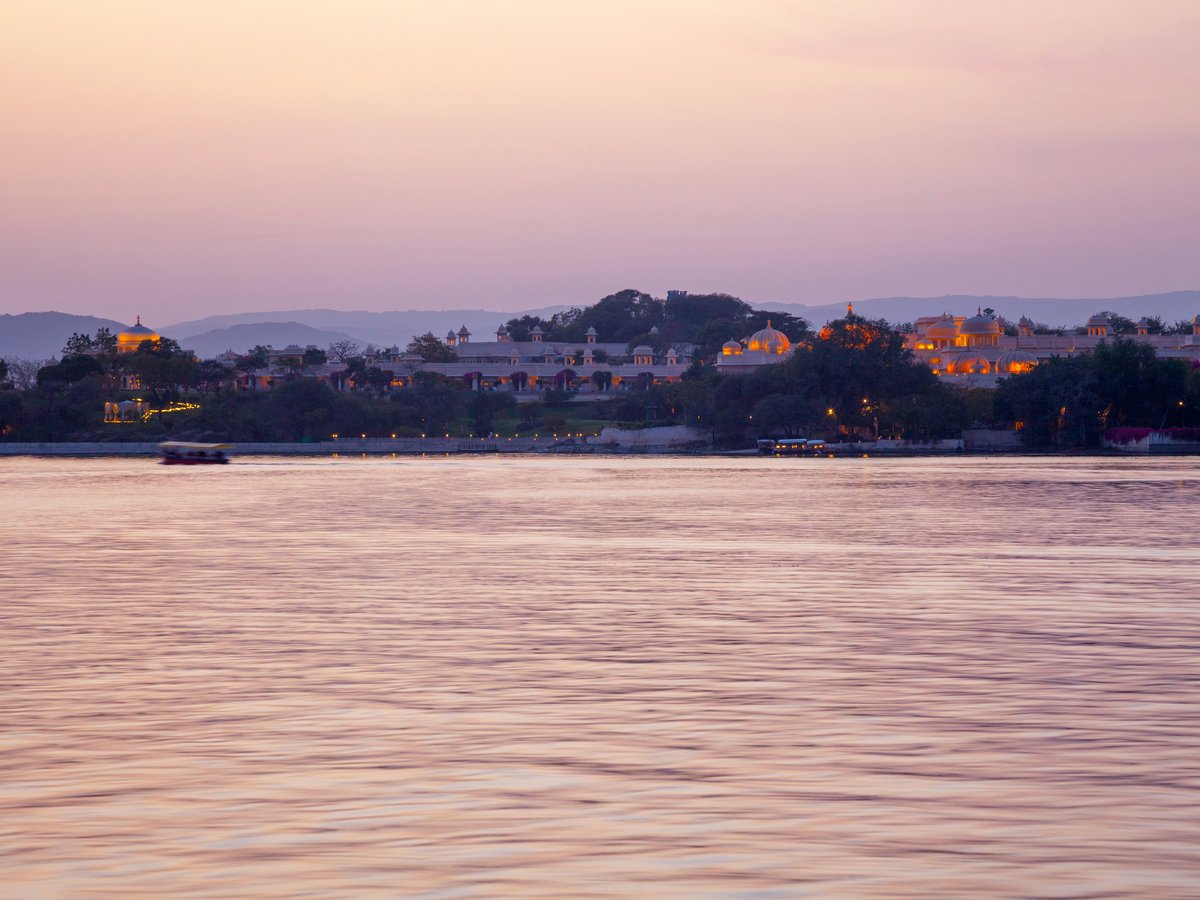
Udaipur sits in a valley of the Aravalli Hills, organized around two lakes that define everything. Lake Pichola fills the south. City Palace rises directly from its eastern shore, its white facade visible from half the neighborhoods in the city. Fateh Sagar Lake lies about 2 km north, separated from Pichola by a low forested ridge. The walled Old City presses tight against Pichola's eastern bank, still entered through original gates at Chandpole, Hathi Pol, and Delhi Gate. Beyond the walls, modern Udaipur fans east toward the NH-48 highway and north along Fateh Sagar's shore. Monsoon Palace crowns a hilltop 5 km west, visible from most of the city on clear days, with Sajjangarh Biological Park spreading across the forested slopes below it. Most visitors stay within a 10-minute walk of the Pichola lakefront. That works for a short trip, though you'll miss real neighborhood texture if you never cross Chetak Circle into the modern east side. At roughly 95.7 INR to 1 USD, Udaipur remains affordable by Rajasthan standards. Mid-August mornings currently sit around 23°C with 89% humidity and overcast skies, so the pace of sightseeing naturally slows during monsoon weeks.
Neighborhoods
-
Lal Ghat
This is the postcard Udaipur. Whitewashed havelis lean over lanes barely wide enough for two people to pass. Rooftop restaurants stack 3 and 4 stories above Lake Pichola, each claiming the best sunset view. The smell of dal baati and incense hangs in the evening air. You'll hear temple bells from Jagdish Temple mixing with Bollywood tracks leaking out of the guest houses. Bagore-ki-Haveli sits on the neighboring Gangaur Ghat, and its nightly folk-dance performance draws crowds that fill the lanes around 7 PM. From the lower ghats you can see Jag Mandir on its island in the lake, a palace dating to 1560 that catches the late-afternoon light in a way that stops conversations mid-sentence. The architecture is old Mewar sandstone under lime wash, cool to the touch even in the afternoon heat. To be fair, the density of touts near Jagdish Temple gets tiring after 2 days, but the lakefront itself tends to feel peaceful by 6 AM before the guest houses wake up.
- Best for
- First-time visitors, solo travelers, photographers, and anyone who wants lake views from their breakfast table
- Key streets
- Lal Ghat Road, Gangaur Ghat Marg, and the stepped lanes climbing toward Jagdish Chowk. The alley connecting Lal Ghat to Hanuman Ghat follows the waterline and stays cooler than the interior lanes during monsoon afternoons.
-
Chandpole
Chandpole Gate marks the western entry to the walled city. The neighborhood behind it is where Udaipur does its actual shopping. Bara Bazaar spreads from the Clock Tower in every direction, with different sections for silver, fabric, spices, and vegetables. The pace around Ghanta Ghar is fast and loud. Auto-rickshaws honk through gaps that seem too narrow for a bicycle. The smell shifts block by block, from turmeric and cumin near the spice sellers to jasmine garlands at the flower stalls on the south side. Buildings stand taller and more commercial than in the lakefront area, with shops at street level and workshops above. This has been Udaipur's working center for several hundred years, and it still sounds like it.
- Best for
- Budget travelers who prefer real-city texture over lakefront scenery, and anyone serious about Rajasthani textiles or silver jewelry
- Key streets
- Clock Tower Road from Ghanta Ghar outward, Bara Bazaar's interior lanes, and the stretch from Chandpole Gate toward Shastri Circle. Fabric shops cluster on the north side of the Clock Tower.
-
Hathi Pol
Hathi Pol means Elephant Gate. The neighborhood beyond it still holds some of the quietest lanes in the old city. This is where Udaipur's miniature painters have their workshops, many operating from the same family havelis for 3 or 4 generations. You'll see artists cross-legged on floor cushions, painting on handmade paper with brushes made from squirrel hair. The lanes are narrower than Chandpole's but far less congested. Carved jharokha windows line the upper floors, catching the light differently at each hour. The lanes around Hathi Pol smell faintly of linseed oil and old stone. Gulab Bagh and Zoo, Rajasthan's oldest public garden founded in 1881, forms the neighborhood's eastern boundary and still contains the state's oldest public library inside its walls.
- Best for
- Art buyers, people who want a quieter old-city base, and anyone interested in traditional Mewar painting techniques
- Key streets
- Hathi Pol Road from the gate inward, and the side lanes branching south toward Bhatiyani Chohatta. Painting workshops concentrate in the first 200 meters past the gate.
-
Fateh Sagar Lakeside
North of the old city, the road curves along Fateh Sagar Lake's eastern shore. This area feels like a different town entirely. The buildings are mid-century modern by Udaipur standards, mostly 1970s and 1980s construction with flat roofs and plastered walls. The lakefront promenade fills with local families after 5 PM. Street food vendors set up carts selling pav bhaji, golgappa, and kulfi, and the smell of butter on a hot tawa carries across the road. The water here looks greener than Pichola's. Nehru Garden sits on an island in the middle, reachable by a short motorboat ride. Bharatiya Lok Kala Mandal, the folk-art museum established in 1952, sits a 5-minute walk from the lakefront on Panchwati Road. The noise level drops noticeably compared to Pichola's ghats. You might hear kingfishers along the shore in the early mornings if you walk the north end.
- Best for
- Families, longer-stay visitors, digital nomads who need reliable wifi in newer hotels, and anyone who wants evening lakeside walks without navigating old-city lanes
- Key streets
- Fateh Sagar Road along the promenade, Panchwati Road, and Rani Road connecting back toward the old city. The stretch between the railway overbridge and Moti Magri hill has the best unobstructed water views.
-
Ambamata and Chetak Circle
Modern Udaipur starts about 3 km east of the lakes. Chetak Circle is the main traffic roundabout, anchored by the Maharana Pratap statue. The area has chain restaurants, working ATMs, medical clinics, and shopping plazas like Celebration Mall. The architecture is unremarkable concrete and glass, but hotels in this stretch deliver reliable AC and consistent hot water. Roads are wide enough for taxis, which is worth more than it sounds after the old-city lanes. Maharana Bhupal Stadium, built in 1982, sits nearby and hosts local cricket on weekends. The air smells like any mid-size Indian commercial district. Diesel, frying samosas, warm photocopier toner from the stationery shops along Court Road.
- Best for
- Business travelers, families with small children who need predictable amenities, medical tourists visiting hospitals along the Ahmedabad highway, and anyone arriving late at night who wants a straightforward hotel check-in
- Key streets
- Chetak Circle, Court Road (sometimes called Surajpol Road), and the NH-48 stretch toward Ahmedabad where most of the mid-range chain hotels sit. Durga Nursery Road heads north into quieter residential colonies.
-
Brahmpuri
Across the ridge west of the old city, Brahmpuri climbs a hillside above Lake Pichola's far shore. The lanes are steep, unpaved in places, and almost entirely residential. A handful of heritage properties have converted old Brahmin-quarter havelis into small hotels with 6 to 10 rooms each. The views back toward City Palace and Lake Pichola from the upper streets are likely the best in Udaipur, because you see the full palace facade reflected in the water without standing directly beneath it. Brahmpuri's defining feature is the quiet. You hear goat bells, the occasional motorbike grinding uphill, and not much else after 8 PM. Food options are limited to 1 or 2 small dhabas serving basic thalis. A proper meal means a 15-minute walk downhill to the Chandpole area.
- Best for
- Couples, photographers after the classic palace-over-water composition, repeat visitors who already know the old city, and anyone willing to trade convenience for sunset views
- Key streets
- The main route starts near Chandpole Gate and follows a switchback road through the residential colony. There is no real named commercial street here. The path toward the Sunset Point viewpoint is the most walked route in the area.
-
Ahar
About 2 km east of the old city, Ahar is a residential neighborhood that most visitors pass through only for the Ahar Cenotaphs. The royal cremation ground holds 19 domed chattris marking Mewar rulers across several centuries. The site is dusty and seems underfunded, with goats wandering between the cenotaphs and a small museum that keeps irregular hours. The surrounding streets have a college campus, a government hospital, and sweet shops selling jalebi by the kilo. Architecture is low-rise residential blocks, mostly from the 1990s. The air smells like neem trees and cooking oil. Mind you, Ahar has genuine archaeological significance beyond the royal memorials. Excavations here have uncovered settlement remains dating back more than 4,000 years.
- Best for
- History-focused travelers, archaeology students, and visitors who want rock-bottom accommodation near the university area
- Key streets
- Ahar Road from the main junction to the cenotaphs is the one route visitors follow. Residential lanes north of the site lead into university territory. Sweet shops cluster along the 200-meter approach to the entrance.
FAQ
Where should I stay in Udaipur for a first visit of 3 to 4 days?
Lal Ghat works best for a short first visit. The lakefront location puts the major old-city landmarks within walking distance, and the rooftop restaurants make orientation easy on the first evening. You can reach Fateh Sagar by auto-rickshaw in about 10 minutes for 80 to 100 INR. The trade-off is noise from temple loudspeakers starting around 5 AM and lanes too narrow for wheeled luggage.
Is Udaipur safe for solo travelers?
Udaipur scores 5.8 out of 10 for solo-traveler safety (see the TTDI Solo-Safety Index). The lakefront areas and main tourist lanes feel manageable during daylight and early evening. After about 10 PM, old-city lanes empty out and lighting gets uneven. The Fateh Sagar promenade stays populated later into the night. Common irritations include persistent touts near the temples and inflated rickshaw fares, but serious crime targeting visitors appears uncommon based on available reporting.
Which neighborhood suits families with young children?
Udaipur scores 6.2 out of 10 for family friendliness (see the TTDI Family-Friendliness Index). Fateh Sagar Lakeside tends to be the most practical family base. The promenade is stroller-accessible, newer hotels have more reliable amenities, and the street food scene along the lakefront is gentle on cautious stomachs. The old-city lanes around the ghats involve steep steps and no vehicle access, which gets tiring fast with small children or a pram.
How well does Udaipur work for digital nomads?
Udaipur rates 6.2 out of 10 for digital-nomad suitability (sourced from TTDI's editorial rubric). Wifi in old-city guest houses tends to be unreliable, especially during monsoon power fluctuations. Newer hotels around Fateh Sagar and the Chetak Circle area have better connectivity. A few cafes on Rani Road have started welcoming laptop workers, though dedicated coworking spaces remain limited compared to Jaipur or Goa. Monthly furnished-room rentals in the Ambamata area run 8,000 to 15,000 INR.
Is Udaipur welcoming for LGBTQ+ travelers?
Udaipur scores 3.5 out of 10 for LGBTQ+ friendliness (sourced from TTDI's editorial rubric). Public affection between same-sex couples tends to draw stares and occasional comments, particularly outside the tourist zones. Heritage hotels and higher-end properties in Lal Ghat are generally professional at check-in. There are currently no openly LGBTQ+ venues or community spaces in the city. Discretion remains the practical approach for now.
Can I walk between Udaipur's neighborhoods or do I need transport?
The old city, from Chandpole Gate to Lal Ghat, covers roughly 1.5 km and takes 20 to 25 minutes through the lanes. Reaching Fateh Sagar from the old city takes about 30 minutes on foot via Rani Road, mostly uphill. Brahmpuri is a steep 15-minute walk from Chandpole. For anything beyond these distances, auto-rickshaws run 50 to 150 INR within the city. Agree on the fare before getting in, since metered rides remain rare despite the meters being installed.
Last verified by automated review (v1.7.2) on . What is automated review?