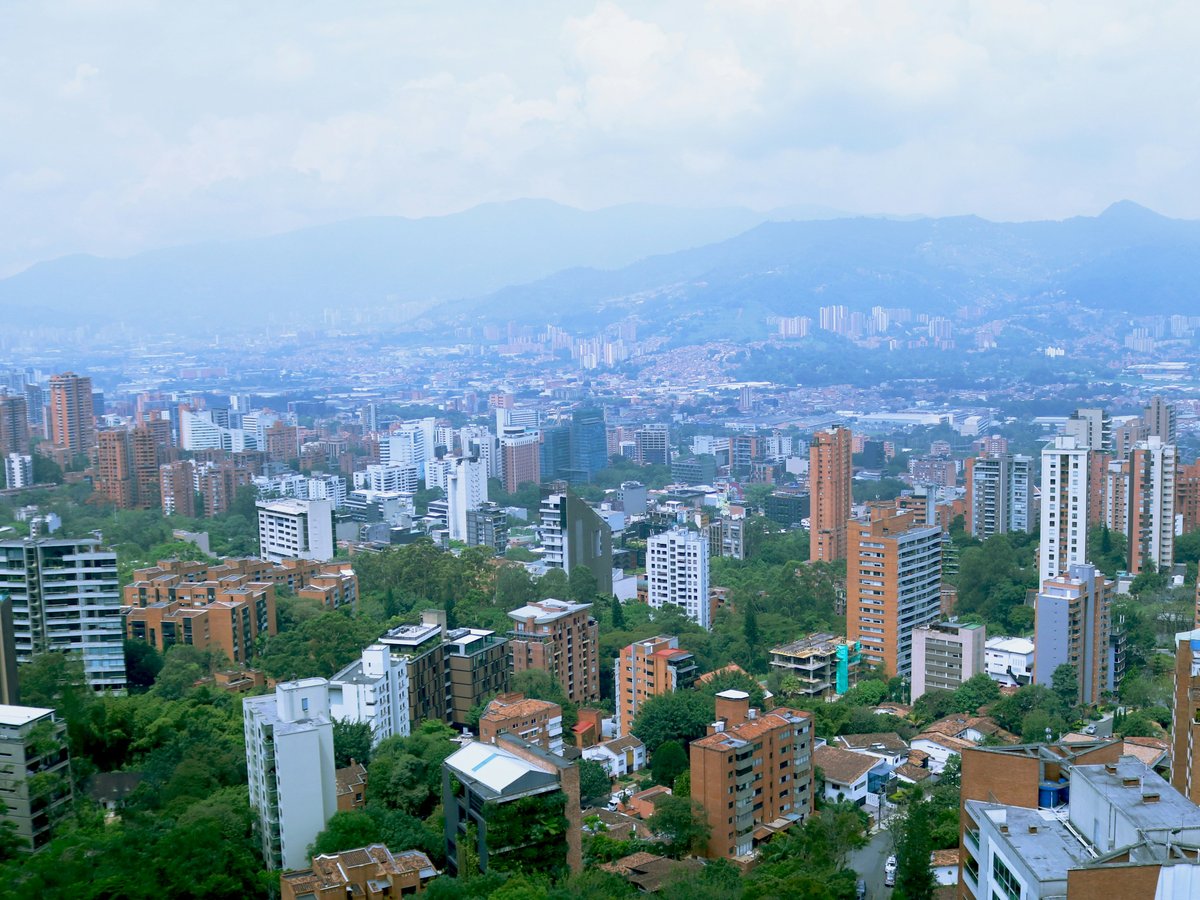
Medellin sits in the Aburrá Valley, a narrow north-south corridor about 1,500 meters above sea level in the Andes of Antioquia. The city stretches roughly 30 kilometers along the Medellín River, with neighborhoods climbing the steep hillsides on both the eastern and western slopes. Comunas (administrative districts) are numbered 1 through 16, though locals rarely use the numbers for the well-known barrios. The Metro runs the length of the valley floor, and two Metrocable lines climb into the hillside comunas to the east and west. Most visitors end up in the southern third of the city, somewhere between Laureles and El Poblado, which sit on opposite sides of the river and feel like different cities entirely. The western slope tends to be more residential, more Colombian in daily rhythm. The eastern slope, particularly El Poblado, has absorbed the bulk of international tourism since roughly 2015. To be fair, the central districts around La Candelaria and the Alpujarra government complex still function as the civic and commercial heart of Medellin, even if fewer tourists sleep there. Understanding Medellin means understanding altitude. A 10-minute taxi ride can drop you 200 meters in elevation, and the temperature shifts with it.
Neighborhoods
-
El Poblado
El Poblado climbs from Avenida El Poblado at 1,500 meters up through Parque Lleras to the residential towers near El Tesoro mall at around 1,800 meters. The lower section along the avenue has a commercial, slightly hectic energy. Taxis idle in traffic, food delivery motorcycles weave between cars, and the sidewalks narrow near the Oviedo shopping center. Higher up, the streets quiet down considerably. You'll hear birdsong and the hum of air conditioning units on luxury apartment blocks. The architecture is a collision of 1970s concrete apartment buildings, glass-fronted restaurants, and newer 30-story residential towers that went up during the 2010s construction boom. The food scene here skews international. Japanese, Peruvian, Italian, and burger spots line the streets around Parque Lleras, with dinner prices typically running COP 45,000 to COP 90,000 per person. The smell of grilled meat drifts from the Argentine steakhouses on Calle 10. Mind you, the Parque Lleras zone after 10pm on weekends is loud, crowded, and oriented almost entirely toward nightlife.
- Best for
- First-time visitors, solo travelers who want English-friendly services, and anyone prioritizing restaurant variety over local immersion
- Key streets
- Calle 10 (the main dining strip between Carreras 35 and 37), the pedestrian stretch of the Vía Primavera, Avenida El Poblado from the Monterrey bridge south to Manila, and the Milla de Oro (Carrera 43A) where the corporate towers and upscale hotels cluster
-
Laureles - Estadio
Laureles feels like the Medellin that existed before the tourist wave. The streets follow a circular grid pattern designed by Pedro Nel Gómez's urban planning influence in the 1940s, with wide sidewalks, mature ceiba trees, and low-rise apartment buildings rarely above 6 stories. The pace is slower than El Poblado. Old men sit on benches along the Carrera 70 corridor. Bakeries sell pandebono and buñuelos from glass cases for COP 2,000 each. The area around the Estadio Atanasio Girardot sports complex has a concentration of gyms, sports bars, and casual restaurants. On match days when Atlético Nacional or Independiente Medellín play, the streets around Carrera 70 and Calle 48 fill with fans in green or red jerseys, hawking beer from coolers at COP 3,000 a can. The noise is considerable. Between matches, Laureles has a quiet residential hum. You might hear a parrot squawking from a balcony or the clatter of a domino game in a tienda. The food here leans Colombian and affordable. A lunch corriente runs COP 12,000 to COP 16,000.
- Best for
- Longer-stay visitors, digital nomads on a budget, Spanish learners who want daily Colombian interactions, and anyone who finds El Poblado too sanitized
- Key streets
- La 70 (Carrera 70, the main commercial and nightlife strip), Circular 1 through Circular 4 (the concentric ring roads unique to this barrio), Calle 33 near the Primer Parque de Laureles, and the blocks around Avenida Nutibara leading to the UPB university campus
-
La Candelaria (Centro)
La Candelaria is the original core of Medellin, anchored by the Parque Berrío and the Basílica de Nuestra Señora de la Candelaria, which dates to 1649. The streets here are loud. Street vendors shout prices for socks, phone cases, and SIM cards. Buses brake with a metallic screech. The air smells like diesel and arepas frying on carts. The architecture mixes colonial-era churches, Art Deco commercial buildings from the 1920s and 1930s, and boxy mid-century concrete. The Palacio de la Cultura Rafael Uribe Uribe, finished in 1937, dominates the east side of Parque Berrío with its black-and-white checked Gothic Revival facade. Nearby Plazuela Botero holds 23 bronze sculptures by Fernando Botero, donated to the city in 2000. This is working Medellin. Office workers, street hawkers, pensioners, and students from the Universidad de Antioquia all crowd the same sidewalks. Few tourists stay here overnight, though the area is safe during daylight hours and is served by the Parque Berrío Metro station.
- Best for
- Day visitors interested in Medellin's history and civic architecture, budget travelers comfortable with urban density, and anyone who wants to see the city at its most unfiltered
- Key streets
- Calle 52 (known as La Playa) running east from the Museo de Antioquia, the Junín pedestrian walk between Carreras 49 and 50, Carrera Bolívar from Parque Berrío south to Alpujarra, and the blocks around Parque San Antonio
-
Envigado
Technically its own municipality, Envigado bleeds into southern Medellin so seamlessly that most visitors assume it is a barrio. The Parque Principal de Envigado, anchored by the Santa Gertrudis church, has a small-town plaza feel despite being 15 minutes by taxi from El Poblado. The residential streets south of the park are quiet, lined with single-family houses and low-rise apartments with terracotta tile roofs. The food scene here tends toward traditional Antioqueño. Fríjoles (bean stew) at places like Mondongos on Calle 37 Sur draw long weekend lines. The Calle de la Buena Mesa, a 2-block stretch of Carrera 43A south of the park, has about 15 restaurants ranging from pizza to sushi to classic Colombian. Prices run 20% to 30% below equivalent El Poblado spots. The elevation sits at about 1,575 meters, fractionally warmer than upper El Poblado. You'll notice the difference in the afternoons, when Envigado tends to feel a degree or two more humid. The Envigado Metro station on Line A connects to the rest of Medellin in about 12 minutes to Parque Berrío.
- Best for
- Visitors who want a quieter, more local pace with easy Metro access to central Medellin, families, and anyone seeking traditional paisa food without the tourist markup
- Key streets
- Carrera 43A (Calle de la Buena Mesa) south of the Parque Principal, Calle 37 Sur for traditional restaurants, the pedestrian blocks around the Parque Principal, and Carrera 27 heading toward the Zuñiga neighborhood
-
Comuna 13 (San Javier)
Comuna 13 sits on the steep western hillside of the Aburrá Valley above the San Javier Metro station. The barrio became internationally known after the installation of outdoor escalators in 2011, which replaced a grueling 350-step climb for roughly 12,000 residents. The escalators still function as daily transit, though they have also become Medellin's most-visited attraction. The walls along the escalator route and the surrounding alleys are covered in street art, repainted and refreshed regularly by local and visiting artists. The paint smell is still wet on some walls. Hip-hop plays from small speakers at the informal shops and juice stands lining the route. On weekends, the foot traffic can feel heavy, with guided tour groups moving through every 10 to 15 minutes. Worth noting, the neighborhood beyond the tourist corridor is a residential hillside community where laundry hangs from balconies and kids play fútbol on sloped concrete courts. The views of Medellin from the upper sections, near the Mirador de las Escaleras Eléctricas, stretch across the valley floor to the eastern ridgeline.
- Best for
- Visitors interested in urban transformation, street art, and Medellin's recent history. Best visited on a weekday morning to avoid the weekend crowds
- Key streets
- The escalator route from San Javier Metro station up through Calle 107, the graffiti alleys branching off the main path near the Mirador, and Carrera 109 running uphill through the residential sections
-
Belén
Belén sprawls across the western mid-slope of the valley, roughly between Laureles to the north and the Cerro Nutibara park to the east. It is one of the larger comunas in Medellin by population, currently home to about 200,000 residents, and it has a solidly middle-class character that rarely appears in travel guides. The streets are wide by Medellin standards. Low-rise commercial strips alternate with residential blocks of 4- to 8-story apartment buildings. The Parque de Belén, a modest tree-lined square anchored by the Iglesia de Nuestra Señora de Belén, still draws evening crowds of families and seniors. The food is firmly Antioqueño here. Corriente lunches run COP 10,000 to COP 14,000 at the small comedores along Calle 30A. On warm evenings, the arepa vendors set up charcoal grills on the sidewalks, and the smell of toasted corn carries a full block. That said, Belén is not a nightlife destination. The pace slows considerably after 9pm. The area feels like it belongs to the people who live there, which is part of its appeal if you want a break from tourist-oriented Medellin.
- Best for
- Budget-conscious travelers who want a local residential experience, visitors planning day trips to Cerro Nutibara or Pueblito Paisa, and anyone who prefers a quiet evening over a loud one
- Key streets
- Calle 30A (the main commercial corridor through the neighborhood), the blocks around Parque de Belén, Carrera 76 heading north toward the Estadio area, and the access road to Cerro Nutibara from Calle 30
FAQ
What is the safest neighborhood to stay in Medellin for first-time visitors?
El Poblado is currently the most tourist-adapted neighborhood in Medellin, with English-speaking staff at most hotels and restaurants, well-lit streets, and a visible police presence around the Parque Lleras area. Laureles is also considered safe and tends to be quieter at night. Both neighborhoods are served by the Medellin Metro, which runs from about 4:30am to 11pm on weekdays.
How do the neighborhoods in Medellin compare on cost for food and accommodation?
El Poblado is the most expensive area, with dinner plates averaging COP 45,000 to COP 90,000 and Airbnb studios starting around COP 120,000 per night. Laureles runs about 25% to 35% cheaper for both food and rent. Envigado is 20% to 30% below El Poblado. La Candelaria and Belén are the most affordable, with corriente lunches under COP 14,000 and monthly apartment rentals starting around COP 1,200,000.
Can you get around Medellin without speaking Spanish?
In El Poblado, yes, with relatively little difficulty. Restaurant menus are often bilingual, and many service workers speak some English. In Laureles, you will need basic Spanish for daily interactions, though the digital nomad community there means some cafés have English-speaking staff. In La Candelaria, Belén, and Envigado, Spanish is essentially required for anything beyond pointing at a menu. The Medellin Metro system has signage in Spanish only, but the single-line layout makes navigation straightforward.
Which Medellin neighborhood is best for nightlife?
El Poblado's Parque Lleras area is the most concentrated nightlife zone in Medellin, with bars and clubs open until 3am or later on Fridays and Saturdays. La 70 in Laureles has a more local nightlife scene, with Colombian music bars, salsa spots, and cheaper drinks. Cover charges on La 70 tend to run COP 10,000 to COP 20,000, compared to COP 30,000 to COP 50,000 at Parque Lleras clubs. La Candelaria has very limited nightlife and is best avoided after dark by visitors unfamiliar with the area.
Is it worth visiting Comuna 13 in Medellin, or is it too touristy now?
Comuna 13 draws significant tourist traffic, particularly on weekends when guided groups move through every 10 to 15 minutes. The street art and escalators are still genuinely interesting, and the transformation from the early 2000s is real. Going on a weekday morning, ideally before 10am, cuts the crowd density considerably. The neighborhood beyond the main escalator route remains a working residential community and gives a more honest picture of daily life on Medellin's hillside comunas.
Last verified by automated review (v1.7.2) on . What is automated review?