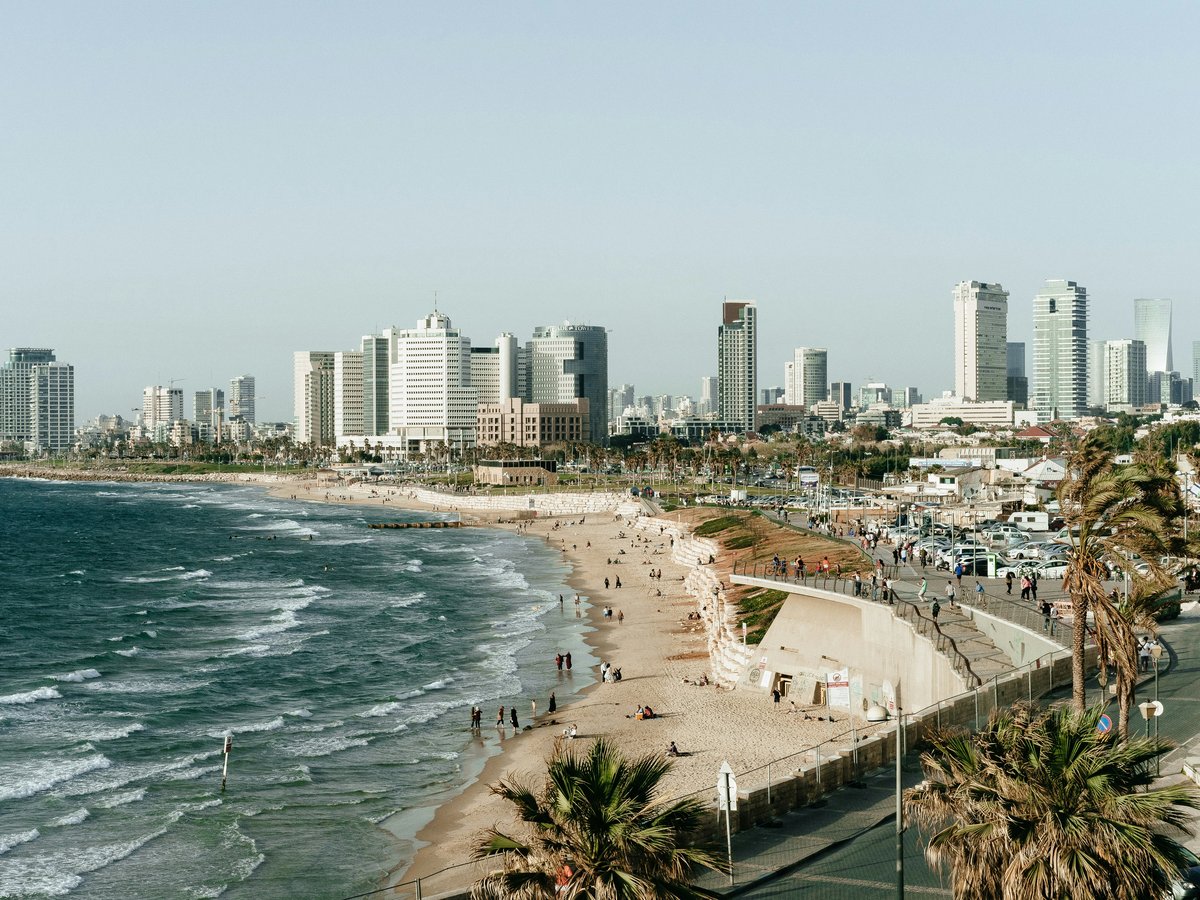
Best Time to Visit Tel Aviv, by Season
Five-year daily-observation averages show Tel Aviv swinging from February's 17.6°C high to August's 31.8°C peak, a 14-degree range that creates two different cities depending on when you book.
Published
1 Tel Aviv Swings 14 Degrees Between February and August. That Gap Defines Every Booking Decision.
Step off a plane at Ben Gurion in February and the air sits at 17.6°C, light-jacket weather with a salt breeze drifting in from the Mediterranean. Walk the Tayelet promenade and you might hear the low crash of winter waves before you spot the joggers and the wetsuits. Return in August and 31.8°C meets you at the terminal doors, thick and immediate. The same Tayelet is packed shoulder to shoulder past midnight, and the stone pavers radiate heat you can feel through your sandals.
That 14.2-degree swing across Tel Aviv's 12 months is wider than most travelers expect from a coastal Mediterranean city, and it splits the year into 2 very different trips. January averages 18.3°C for a daily high and drops to 10.3°C overnight. February is the coolest month by a fraction, at 17.6°C highs and 9.7°C lows. From March, the calendar tilts sharply upward. That month reaches 20.2°C. April hits 24.0°C, and the cafe tables along Rothschild Boulevard fill by mid-morning. By May the daily high sits at 26.7°C, and the Mediterranean summer pattern locks in. June averages 29.1°C, July 31.2°C, August peaks the year at 31.8°C.
Nighttime temperatures tell a more important story for anyone booking accommodation. In April, the overnight low settles at 14.4°C, comfortable sleeping weather with a window cracked open at a guesthouse in Neve Tzedek. By August, the low is 24.5°C. That 10.1-degree gap between spring and summer nights separates restful evenings from sticky, sleepless ones where air conditioning is non-negotiable.
The steepest single jump is March to April, a 3.8-degree climb from 20.2°C to 24.0°C. After June's 29.1°C, the gains flatten. September holds at 30.7°C. October falls to 28.3°C. November cools to 25.0°C. December returns to 20.4°C with 12.2°C lows. Worth noting, the descent is more gradual than the spring ascent. October at 28.3°C runs 1.6 degrees warmer than May at 26.7°C, even though both sit roughly equidistant from August's 31.8°C peak. Tel Aviv's autumn holds its warmth longer than its spring builds it.
October at 28.3°C runs 1.6 degrees warmer than May at 26.7°C, even though both sit equidistant from August's peak. Tel Aviv's autumn holds its warmth longer than its spring builds it.
2 December Through February Averages 17.6°C to 20.4°C. No Beach, but Ideal Walking Weather.
The smell of rain-washed stone carries through Neve Tzedek's narrow streets after a December shower, sharp and mineral against the limestone facades. December sits at 20.4°C for a daily high, dropping to 12.2°C after sunset. January cools to 18.3°C highs and 10.3°C lows. February reaches the year's floor at 17.6°C and 9.7°C.
This is museum weather. The Tel Aviv Museum of Art on Shaul Hamelech Boulevard tends to be uncrowded in January, and the Palmach Museum and Bialik House are both walkable from central Tel Aviv without breaking a sweat. Carmel Market runs all winter, its stalls piled with clementines and halva, the air smelling of roasted coffee and za'atar. On a clear February morning, the 17.6°C reading feels warmer than it sounds when direct sunlight hits the cafe tables outside Arcaffe on Dizengoff.
The beach is not the draw in this window. With highs of 18.3°C in January and 17.6°C in February, the waterfront belongs to joggers and morning walkers rather than swimmers. Gordon Beach sits mostly empty at this temperature, save for a few surfers in wetsuits.
February's 9.7°C overnight lows bring a genuine evening chill. Pack a light jacket and closed-toed shoes for after dark. The contrast with August is stark. August's overnight low of 24.5°C sits 14.8 degrees above February's 9.7°C floor.
The trade-off favors culture-first travelers. Jaffa's flea market and the galleries along the Old City's alleys are easier to browse at 18°C than at 31°C. Dinner reservations at places like Claro in Jaffa Port or Delicatessen Brassery on Yehuda Halevi are likely easier to secure than in peak season. For travelers who prioritize food and streets over sand and surf, February at 17.6°C tends to be the quietest month and likely the best value on Tel Aviv's calendar.
3 March Reaches 20.2°C and April Hits 24.0°C. The Two Best Months on the Calendar.
The morning light changes in March. It hits harder, whiter, and the Bauhaus facades along Rothschild Boulevard start throwing crisp shadows by 9 AM. March's average high reaches 20.2°C, a 2.6-degree jump from February's 17.6°C. April climbs another 3.8 degrees to 24.0°C. In 2 months, Tel Aviv transforms from a city where you carry a jacket to one where you leave it at the hotel.
March's 20.2°C highs and 11.7°C overnight lows make it transitional. Midday is warm enough for a T-shirt and a slow walk through Yarkon Park, where the grass is still green from winter rain and the citrus trees along the northern edge carry the last of the season's blossom scent. Evenings at 11.7°C still carry a genuine chill, so you'll want a layer for dinner outdoors at Cafe Barzilay in the old Jaffa port area.
April is where the calculus shifts. At 24.0°C for a daily high and 14.4°C overnight, the weather pattern settles into something close to ideal for covering a city on foot. Warm enough to eat outdoors comfortably at midday on Habima Square. Cool enough at 14.4°C to sleep well without air conditioning. Gordon Beach and Frishman Beach start to fill on April weekends, though the Mediterranean water still tends to hover around 19-20°C.
Compare April to its autumn mirror. November averages 25.0°C, 1.0 degree warmer than April's 24.0°C. November's overnight low of 16.1°C sits 1.7 degrees above April's 14.4°C. On paper, November appears to edge April out. In practice, April follows the winter pause, and the cafe patios along Dizengoff Street carry a specific early-season energy that November, trailing 5 months of summer heat, does not.
For first-time visitors, April at 24.0°C and 14.4°C overnight represents the strongest single month on Tel Aviv's calendar. March at 20.2°C is the budget alternative, with cooler 11.7°C evenings but the same quality of daylight and fewer crowds at places like the Eretz Israel Museum.
April at 24.0°C and 14.4°C overnight represents the strongest single month on Tel Aviv's calendar.
4 May and June Cross the 26°C Line. The Beach Opens and the Heat Follows.
The air thickens in May. You feel it crossing from shade into sunlight along the Tayelet promenade, a weight that April's 24.0°C never carried. May averages 26.7°C for a daily high and 17.6°C overnight. June pushes to 29.1°C and 20.9°C. These 2 months carry Tel Aviv across the line from comfortable to properly hot.
May's 26.7°C marks the difference between walking all day without thinking about the temperature and needing to plan around midday heat. Bring a wide-brimmed hat, sunscreen, and a refillable bottle. Every 200 meters along the Tayelet you'll find a water fountain. May remains manageable. The 17.6°C overnight lows let the city cool after dark, and a breeze off the Mediterranean still reaches the streets nearest the shore.
This is when Tel Aviv's beaches shift from backdrop to main event. Gordon Beach, opposite the Hilton Tel Aviv, tends to draw a younger local crowd and smells of coconut sunscreen and salt by 10 AM. Frishman Beach, a 5-minute walk south, is calmer. Hilton Beach at the northern breakwater has a dedicated section for surfers and another popular with the LGBTQ+ community. All three are free to access, with lounger rentals running around 30-40 NIS for the day.
June at 29.1°C changes the equation. Overnight lows of 20.9°C mean the temperature never truly drops below room temperature. The 3.3-degree rise in overnight lows from May's 17.6°C to June's 20.9°C is the gap that separates spring from summer in Tel Aviv. That said, evenings along the Tel Aviv Port boardwalk are still pleasant at 20.9°C, and the outdoor tables at restaurants like Goocha and Benedict fill through 11 PM.
If the choice sits between June and August for a beach trip, June wins by 2.7 degrees on the daily high and 3.6 degrees overnight. Book accommodation with air conditioning for June. In May, you can likely get away without it.
5 July and August Pin the Mercury Above 31°C. Nights Never Drop Below 23.6°C.
Shade becomes currency in Tel Aviv's July. You press against building walls along Allenby Street, measuring comfort in centimeters of shadow. July averages 31.2°C for a daily high and 23.6°C overnight. August pushes slightly higher to 31.8°C and 24.5°C. The difference between the 2 months is 0.6 degrees on the high and 0.9 degrees on the low. They are functionally the same month at 31°C.
The overnight temperatures carry the real weight. August's 24.5°C low is the warmest overnight reading on Tel Aviv's entire 12-month calendar. The stone, asphalt, and buildings along Rothschild Boulevard hold the day's 31.8°C and release it slowly through the small hours. Air conditioning is not optional. Book a hotel with reliable climate control. The Hilton Tel Aviv, The Carlton, and the Brown Beach House all sit within 2 blocks of the waterfront, which helps with any breeze that rolls in off the water.
Activity patterns shift visibly. Locals tend to move outdoors early, before 10 AM, and again after 7 PM when the sun drops lower. The midday stretch from roughly noon to 4 PM belongs to air-conditioned interiors. The Tel Aviv Museum of Art, Dizengoff Center, and the Design Museum Holon in the southern suburb are all reliable retreats. Gordon Beach fills by 8 AM on Saturdays with swimmers getting in before the worst heat. Mind you, the sand itself is too hot for bare feet by noon.
For travelers who handle heat well and want the full Mediterranean summer, July at 31.2°C is marginally less punishing than August at 31.8°C, with 0.9 degrees of advantage on overnight lows. For everyone else, these are the 2 months to avoid. Pack light linen, a hat, and electrolyte packets. Drink constantly. October at 28.3°C drops 3.5 degrees from August's peak and reopens the city for full-day exploration.
August's 24.5°C overnight low is the warmest reading on Tel Aviv's entire 12-month calendar.
6 September Still Reads 30.7°C. October and November Are Tel Aviv's Second Window.
There is a specific afternoon in late October when Tel Aviv's air shifts. The morning still reads near 28°C, consistent with October's 28.3°C average high, but by late afternoon a breeze off the Mediterranean carries something cooler and the waterfront chairs at Alma Beach fill before sunset. October averages 28.3°C for a daily high and 19.6°C overnight. November falls to 25.0°C and 16.1°C. September at 30.7°C is the preamble, still summer by any honest measure.
September's 30.7°C high sits only 1.1 degrees below August's 31.8°C. Its 22.8°C overnight low drops 1.7 degrees from August's 24.5°C. Both improvements are real but too small to change the fundamental experience. September in Tel Aviv is hot. Treat September as summer's last month, not autumn's first.
October is where the opening appears. At 28.3°C and 19.6°C overnight, the city becomes walkable again for full days. The Jaffa Clock Tower area, Neve Tzedek's boutique-lined Shabazi Street, the narrow lanes around Magen David Square. All benefit from 28°C instead of 31°C. The 19.6°C overnight low matters most. It falls below 20°C for the first time since May, which means long outdoor dinners without the sticky August air. Carmel Market's evening food stalls are worth lingering at by October, the smell of grilled corn and fresh-squeezed pomegranate thick in the cooler air.
November has a strong claim as Tel Aviv's most underrated month. Its 25.0°C daily high and 16.1°C overnight low land remarkably close to April's 24.0°C and 14.4°C. Evenings at 16.1°C invite open-air dining on Habima Square or along the Old Port boardwalk without any need for a heater or extra layer.
For repeat visitors who have experienced Tel Aviv in spring, November offers the same temperature comfort with fewer competing travelers. The real autumn window runs October through November, from 28.3°C down to 25.0°C, with September's 30.7°C as a hotter prologue.
7 The Single Best Month for Every Kind of Traveller. And the One Month to Skip.
Sit at any sidewalk table outside Benedict on Rothschild Boulevard long enough and you feel the year turn. April's 24.0°C settles around you like a warm handshake. August's 31.8°C presses down like a physical weight on your shoulders. Between those 2 months, 7.8 degrees separate Tel Aviv's most comfortable window from its least.
For first-time visitors who want to walk, explore, and eat outdoors, April at 24.0°C highs and 14.4°C lows is the single best month. Base yourself in Neve Tzedek or the Old North for walkability to both the beach and the Rothschild Boulevard cafe strip. March at 20.2°C with 11.7°C lows is the budget-conscious alternative, with similar daylight quality and cooler evenings.
For beach-first travelers, May at 26.7°C is the opening. Warm enough for full days on Gordon Beach or Frishman Beach. Cool enough overnight at 17.6°C to sleep well. Pack sunscreen and a rash guard if you burn easily. June at 29.1°C provides hotter beach conditions, but 20.9°C lows start to compress the comfort window after dark.
For repeat visitors who already know Tel Aviv in spring, November at 25.0°C and 16.1°C overnight deserves serious consideration. It mirrors April within 1.0 to 1.7 degrees on both measures, and Tel Aviv tends to run quieter after the long summer. The Jaffa galleries and Neve Tzedek side streets are less crowded.
For travelers who skip the beach entirely, December at 20.4°C and February at 17.6°C are the value picks. Spend the days at the Tel Aviv Museum of Art, Carmel Market, and Jaffa's old city. February's 9.7°C overnight lows need a light jacket. December's 12.2°C lows are milder.
The month to avoid is August. At 31.8°C highs and 24.5°C lows, it is the hottest month on Tel Aviv's calendar by both measures. The data names a 4-month sweet spot. April, May, October, and November span 24.0°C to 28.3°C on the highs and 14.4°C to 19.6°C on the lows.
April, May, October, and November span 24.0°C to 28.3°C on the highs. Those 4 months are the sweet spot.
Last verified by automated review (v1.7.2_onboard-tel-aviv-flagship-2026-08-18) on . What is automated review?