Madrid has a reputation as one of Europe's more affordable capitals, but what might surprise you is how much of the city's A-list culture costs nothing at all. The Museo del Prado, Museo Reina Sofía, and Museo Thyssen-Bornemisza, three of the most important art collections on the continent, all open their doors free during evening and weekend windows. Parque del Buen Retiro covers 125 hectares right in the center, with free exhibition halls tucked inside it. The Templo de Debod, a 2nd-century BC Egyptian temple rebuilt in Parque del Oeste in 1972, has no entry fee. And honestly, the real rhythm of Madrid tends to play out on its streets anyway. A slow evening near the bronze statue of Felipe III in Plaza Mayor. The Sunday morning crush at El Rastro flea market, which stretches from La Latina metro down to Ronda de Toledo. The sound of someone's guitar drifting from a bar on Calle de la Cava Baja. You could fill 5 or 6 full days here without paying admission to anything. The free evening window at the Prado alone would take at least 3 visits to cover properly.
Free attractions
-
Parque del Buen Retiro
Madrid's signature park covers 125 hectares east of the Prado. The Estanque Grande has rowing boats for rent, but walking the perimeter costs nothing. The Rosaleda rose garden blooms heavily from May through June, filling that corner of the park with a sweetness you can smell from 20 meters away. Peacocks wander near the Jardín de Vivaces. The park opens daily at 6am, closing at midnight in summer and 10pm in winter.
Retiropark -
Templo de Debod
This 2nd-century BC Egyptian temple was dismantled, shipped from Aswan, and rebuilt stone by stone in Parque del Oeste, opening to the public in 1972. It was a gift from the Egyptian government to Spain for helping rescue the Abu Simbel temples from flooding. The temple interior has had extended closures for restoration in recent years, so check current status before visiting specifically for the inside. Worth noting that the surrounding terrace might be the best sunset viewpoint in Madrid regardless. The Guadarrama mountains glow pink on clear evenings to the northwest.
Moncloa-Aravacahistorical landmark -
Palacio de Cristal
This glass-and-iron pavilion sits at the edge of a small lake in the southeast corner of El Retiro. It was built in 1887 to house a Philippine flora exhibition. The Museo Reina Sofía now uses it for rotating contemporary art installations, all free. Light pours through the glass walls and the arched ceiling, and in summer the interior gets warm enough that you feel the greenhouse effect firsthand. The reflecting pool outside tends to fill with turtles from around April onward.
Retiroexhibition space -
Palacio de Velázquez
About 200 meters north of the Palacio de Cristal in El Retiro, this brick-and-tile exhibition hall dates to 1883. It serves as another free annex of the Museo Reina Sofía. Shows rotate every few months. The building itself, designed by Ricardo Velázquez Bosco with ceramic tiles by Daniel Zuloaga, is worth the visit even between installations.
Retiroexhibition space -
Museo de San Isidro
Tucked behind Plaza de San Andrés in La Latina, this free museum covers Madrid's origins from prehistoric times through the establishment of the medieval Moorish settlement of Mayrit. The Roman mosaic from a 4th-century villa found in the Carabanchel district tends to surprise people who weren't expecting Roman artifacts in Madrid. The building sits on the site where San Isidro, the city's patron saint, reportedly lived in the 12th century. Open Tuesday to Sunday, 10am to 8pm.
La Latinamuseum -
Ermita de San Antonio de la Florida
This small chapel near Príncipe Pío station holds one of Francisco de Goya's major works. He painted the frescoes directly onto the dome and walls in 1798, and the colors still hold after more than 225 years. The ceiling depicts the miracle of Saint Anthony of Padua, with Goya's characteristic crowd scenes swirling around the full circumference of the dome. Entry is free. The chapel sits in a quiet park along the Manzanares River, and you can hear the trains pulling into Príncipe Pío from the garden.
Moncloa-Aravacachapel -
Jardines de Sabatini
These formal neoclassical gardens sit on the north side of the Palacio Real, where the royal stables stood until 1933. They opened to the public in 1978. The clipped hedges form geometric patterns around a central reflecting pool, and the limestone balustrades frame a view down toward the Campo del Moro and the Casa de Campo beyond. At night the gardens stay lit and take on a cooler, quieter character. Open 24 hours in summer, closing at 9pm in winter.
Centrogarden -
Campo del Moro
The gardens on the western slope below the Palacio Real drop down to the Manzanares River through 20 hectares of English-style landscape. The Fuente de los Tritones, a 17th-century fountain, marks the central axis. Peacocks roam free. The entry is on Paseo de la Virgen del Puerto, not from the palace itself, and that is a 15-minute walk from the nearest metro at Príncipe Pío. Open daily from 10am, with closing times that shift by season.
Centrogarden -
Matadero Madrid
A former slaughterhouse complex in the Arganzuela district, converted into a contemporary arts center that opened in its current form around 2007. The Nave 16 hall and the Central de Diseño host free exhibitions that rotate every 2 to 3 months. Cineteca, the on-site cinema, screens some free programming as well. The building's industrial brick shell has been left deliberately raw in places, with the smell of old stone mixing with fresh paint from whatever installation is going up. It sits directly on Madrid Río, so you can combine both in a single walk.
Arganzuelaarts center -
Madrid Río
This 10-kilometer linear park follows the Manzanares River from the Puente de los Franceses in the north to beyond the Puente de Toledo in the south. The city buried the M-30 motorway underground and opened the park in 2011. It includes playgrounds, wading pools that fill in July and August, and long stretches of path shaded by stone pines. The section near the Puente de Segovia has views up to the Palacio Real and the Catedral de la Almudena.
Multiple districtspark -
Museo de Historia de Madrid
On Calle de Fuencarral in Malasaña, this museum occupies the former Real Hospicio de San Fernando, built between 1721 and 1726. The baroque entrance portal by Pedro de Ribera is one of the finest in Madrid. The permanent collection is free. Inside, a detailed wooden scale model of Madrid from 1830, built by León Gil de Palacio, fills an entire room. Open Tuesday to Sunday, 10am to 8pm.
Malasañamuseum -
Cerro del Tío Pío
Locals call this hill in the Vallecas district the Parque de las Siete Tetas, and you'll understand why when you see the seven rounded hilltops from a distance. It sits southeast of the center, about a 20-minute metro ride to Buenos Aires station on Line 1. The 360-degree panorama from the top takes in the entire Madrid skyline, from the Torre Picasso and the Cuatro Torres complex in the north to the Cerro de los Ángeles in the south. It has become the default sunset-picnic spot for locals, especially from May through September.
Puente de Vallecasviewpoint
Free activities
-
El Rastro Flea Market
Madrid's biggest open-air flea market has been running every Sunday and public holiday morning since at least the 1740s. It fills the streets around Calle de la Ribera de Curtidores, radiating outward from Plaza de Cascorro in La Latina. Browsing is free. You'll find everything from vintage leather jackets to mid-century furniture to boxes of old postcards. The crowd gets thick by noon, so earlier mornings tend to be easier. The surrounding bars on Calle de la Cava Baja fill up with vermut drinkers by 1pm.
La Latinamarket -
Walking the Madrid de los Austrias
The Habsburg quarter around Plaza Mayor, Plaza de la Villa, and the Catedral de la Almudena dates to the 16th and 17th centuries. A self-guided loop of about 3 kilometers covers the old city from Puerta del Sol through Calle Mayor past the Plaza de Oriente to the Palacio Real, then south through the Viaducto de Segovia back to La Latina. The cobblestones in the narrower streets tend to be uneven, so flat shoes help. Buildings along Calle del Codo and Calle del Sacramento still have their original stone facades.
Centrowalking route -
Gran Vía and Cibeles Walk
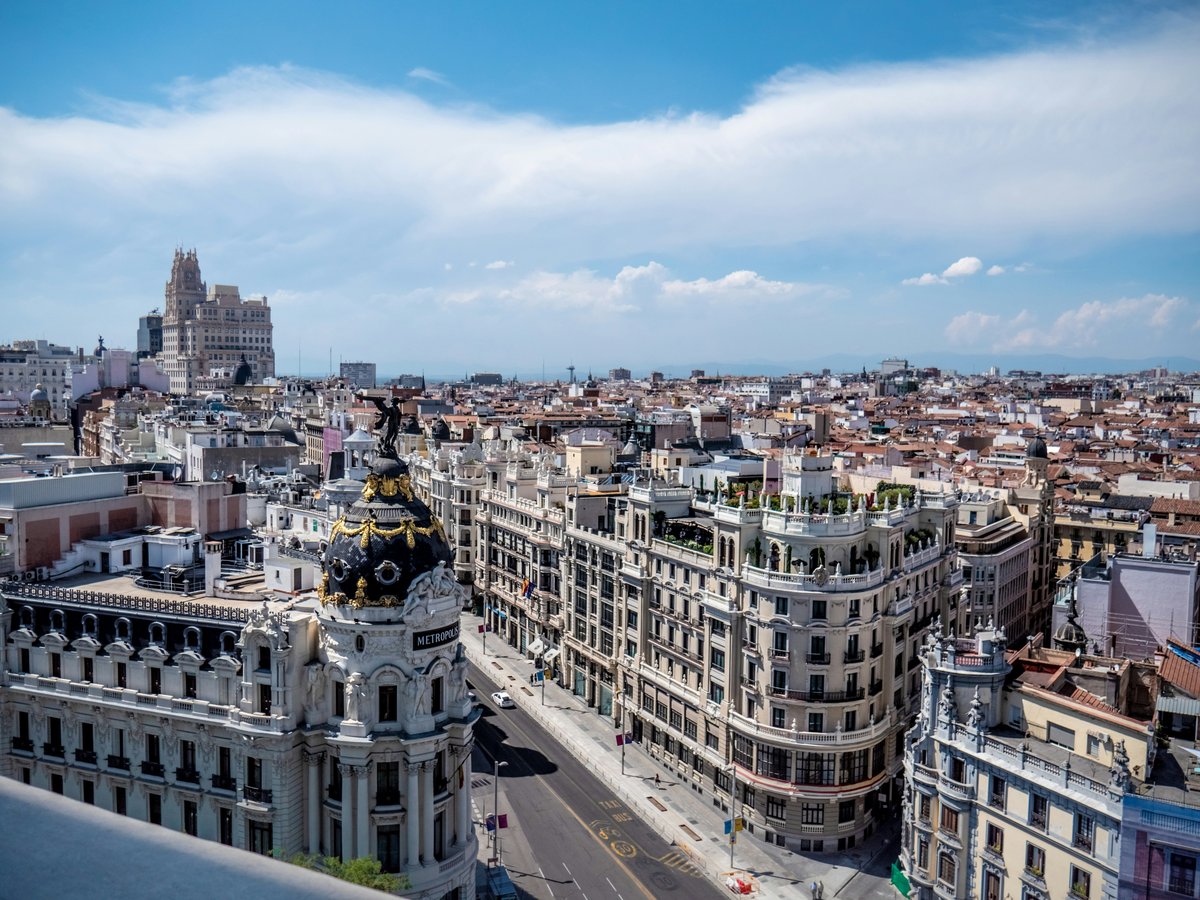
Gran Vía runs about 1.3 kilometers from Plaza de España to Calle de Alcalá. The architecture shifts from early 20th-century Beaux-Arts near the Edificio Metrópolis to Art Deco around the Edificio Telefónica, completed in 1929 as Madrid's first skyscraper. Turn south on Calle de Alcalá and you'll reach the Plaza de Cibeles and the Palacio de Cibeles, now Madrid's city hall, within 10 minutes. The noise level on Gran Vía might catch you off guard. Traffic, buskers, and the sheer density of foot traffic on a Saturday afternoon make conversation difficult.
Centrowalking route -
Barrio de las Letras Literary Walk
The Barrio de las Letras, also called the Huertas neighborhood, sits between the Prado and Puerta del Sol. Cervantes lived on Calle de Cervantes. Lope de Vega's house still stands at number 11 on the same street. The interior is a museum with a small entry fee, but the exterior and the neighborhood are free. Literary quotes are set in bronze into the sidewalks throughout the district. The streets narrow as you move east toward Plaza de Santa Ana, which has been a theater district since the 17th century.
Barrio de las Letraswalking route -
Street Art in Lavapiés
The Lavapiés neighborhood, centered around the triangular Plaza de Lavapiés off metro Line 3, has one of Madrid's densest concentrations of street art. Murals cover the walls along Calle de Embajadores, Calle del Ave María, and around the Tabacalera building at Calle de Embajadores 53. The Tabacalera, a former tobacco factory, hosts a self-managed cultural center with rotating exhibitions and graffiti-covered corridors that are free to walk through during open hours. The neighborhood has a noticeably different acoustic texture from the center. More languages in the air, more music drifting out of open windows.
Lavapiésstreet art
Free events
-
Museo del Prado Free Evening Hours
Mon-Sat 6-8pm, Sun/holidays 5-7pmThe Museo del Prado currently opens free of charge Monday through Saturday from 6pm to 8pm, and on Sundays and public holidays from 5pm to 7pm. Lines form well before 6pm on weekdays, so arriving 15 to 20 minutes early is a practical move. A visit on a rainy Tuesday evening tends to mean a shorter wait. The collection includes over 8,000 paintings, with rooms dedicated to Velázquez, Goya, El Greco, and Bosch. The ground-floor Velázquez rooms, particularly Las Meninas in Room 12, get the heaviest traffic.
Paseo del Prado -
Museo Reina Sofía Free Hours
Mon, Wed-Sat 7-9pm, Sun 12:30-2:30pm (closed Tuesdays)The Reina Sofía currently offers free entry Monday and Wednesday through Saturday from 7pm to 9pm, and Sundays from 12:30pm to 2:30pm. The museum is closed on Tuesdays. Picasso's Guernica sits in Room 206 on the second floor, and that room stays crowded even during the free windows. The collection runs from the early 20th century through contemporary work, with strong holdings of Dalí, Miró, and Juan Gris. The Sunday midday window tends to be less frantic than the weekday evening ones.
Calle de Santa Isabel 52 -
Museo Thyssen-Bornemisza Free Mondays
Mondays, noon to 4pmThe permanent collection at the Museo Thyssen-Bornemisza is currently free on Mondays from noon to 4pm. The museum sits on the Paseo del Prado between the Prado and the Reina Sofía, completing the Golden Triangle of Art. Its permanent collection spans 8 centuries of European painting, with works by Caravaggio, Rembrandt, Hopper, and Rothko all under one roof. That said, only the permanent collection is covered by the free entry. Temporary exhibitions require a separate ticket.
Paseo del Prado 8 -
Fiestas de San Isidro
Annually, approximately 10 days around May 15Madrid's biggest annual festival runs for about 10 days around May 15, the feast day of San Isidro Labrador, the city's patron saint. Free concerts, dance performances, and theatrical shows take over stages in the Pradera de San Isidro park and Las Vistillas. Locals dress in traditional chulapo and chulapa outfits. The chotis dance happens right in the streets. Food vendors line the pradera, and the smell of rosquillas, ring-shaped anise pastries, carries on the warm May air. The program is published by the Ayuntamiento de Madrid each April.
Pradera de San Isidro, Las Vistillas, and stages across the city -
La Noche en Blanco
Annually, one Saturday in September or OctoberMadrid's Noche en Blanco typically happens on a Saturday in September or October. Museums, galleries, theaters, and public spaces open late, many until 2am or later, with free programming across the city. The 2023 edition included free access to over 100 venues. Routes through the Barrio de las Letras, Malasaña, and the Paseo del Arte tend to draw the biggest crowds. The event is modeled on Paris's Nuit Blanche and Madrid adopted the format in 2006. Check the Ayuntamiento de Madrid website for exact dates, which are usually confirmed about 6 weeks in advance.
Citywide -
Veranos de la Villa
Late June through AugustThe Veranos de la Villa summer cultural festival runs from late June through August, organized by the Ayuntamiento de Madrid. It stages concerts, dance performances, circus acts, and film screenings across venues like the Jardines de Sabatini, Matadero Madrid, and the Centro Cultural Conde Duque. Many events are free, though some headline concerts sell tickets. The festival program is usually published in early June. Evening performances at outdoor venues tend to start at 9:30pm or 10pm, when the Madrid heat has finally dropped to something bearable.
Jardines de Sabatini, Matadero Madrid, Conde Duque, and other venues
Free Viewpoints Worth the Climb
Madrid sits on a plateau at 667 meters above sea level, the highest capital in the European Union, and several free vantage points take advantage of the elevation. The terrace around the Templo de Debod in Parque del Oeste faces west toward the Guadarrama mountains and is likely the most popular sunset spot in the city. Cerro del Tío Pío in Vallecas offers a full 360-degree panorama from the southeast. The rooftop terrace of the Palacio de Cibeles currently charges around 3 euros, so it is not strictly free, but the ground-floor gallery space at CentroCentro is free and has tall windows facing the plaza. The western edge of the Jardines de Sabatini looks out across the Casa de Campo, which extends over 1,700 hectares. Mind you, the Faro de Moncloa observation tower also charges admission, so skip that if you are holding to a strict zero budget. The Puente del Rey at the north end of Madrid Río gives you a view of the Palacio Real from below that most visitors miss entirely.
Getting Through a Madrid Summer for Free
Madrid summers are serious. July and August temperatures regularly hit 38 to 40 degrees Celsius by mid-afternoon, and the streets empty between about 2pm and 6pm. Madrid Río's wading pools and splash areas near the Puente de Toledo are free and open from late June through early September. The Piscina del Lago in Casa de Campo is a public pool with a small fee, so not free, but the shaded lakeside areas beside it cost nothing. El Retiro's tree cover keeps temperatures a few degrees lower than the surrounding streets. The Jardín Tropical inside Atocha station, a small indoor garden under the glass roof of the old terminal building, is air-conditioned and free to sit in for as long as you like. That said, the best free strategy during a Madrid heatwave is the local one. Stay inside during peak hours. Live outdoors from 8pm until well past midnight, when the streets finally cool and the terrace bars fill up. The temperature at 11pm in August still tends to hover around 28 degrees.
Neighborhood Walks Beyond the Center
Once you have covered Sol, Gran Vía, and the Palacio Real area, the neighborhoods are where Madrid gets more interesting. Malasaña, centered on Plaza del Dos de Mayo, has the city's densest concentration of independent record shops, vintage stores, and small bars. The walls along Calle del Espíritu Santo and Calle de la Palma tend to rotate street art every few weeks. Chueca, the LGBTQ+ neighborhood north of Gran Vía, is worth a walk along Calle de Hortaleza and through the Mercado de San Antón. Browsing the market is free, though eating there is not. South of the center, Usera has developed into Madrid's Chinatown, with the area around Calle del Olvido and Plaza de Pradolongo offering bakeries and shops you will not find anywhere else in the city. The walk from Atocha south along the Manzanares through Arganzuela to Matadero Madrid takes about 40 minutes and follows the river park the entire way. The section between the Puente de Toledo and Matadero is the quietest stretch of Madrid Río, and on weekday mornings you might have it nearly to yourself.
FAQ
Are the big three museums in Madrid really free?
The Museo del Prado, Museo Reina Sofía, and Museo Thyssen-Bornemisza all offer free entry during specific hours. The Prado is currently free Monday through Saturday from 6pm to 8pm and on Sundays and holidays from 5pm to 7pm. The Reina Sofía is free Monday and Wednesday through Saturday from 7pm to 9pm, and Sundays from 12:30pm to 2:30pm. It is closed on Tuesdays. The Thyssen is currently free on Mondays from noon to 4pm for the permanent collection only. These windows are well-known and draw lines, so arriving 15 to 20 minutes before the free window opens is a practical move. Schedules have shifted in the past, so checking each museum's website before your visit is worth the 2 minutes.
Can you visit the Palacio Real in Madrid for free?
The Palacio Real has historically offered free entry to EU and Ibero-American citizens during certain weekday afternoon hours, typically the last 2 hours before closing. The exact windows and eligibility requirements have shifted in recent years, so checking the Patrimonio Nacional website before visiting is worth the effort. For everyone else, general admission currently runs around 16 euros. That said, the exterior of the Palacio Real and the surrounding areas are always free. Plaza de Oriente, the Jardines de Sabatini, and the Campo del Moro gardens cost nothing to enter at any time.
Is El Rastro flea market safe to visit?
El Rastro draws thousands of people every Sunday, and the density of the crowd between about 11am and 2pm makes it a known area for pickpockets. Keep your phone in a front pocket, carry bags in front of you, and stay aware of your belongings in the tightest stretches along Calle de la Ribera de Curtidores. Violent crime is extremely rare. The general atmosphere is lively and good-natured. Going earlier, around 9am to 10am, means thinner crowds and a calmer browsing experience along the stalls.
Is Madrid's tap water safe to drink?
Madrid's tap water comes from reservoirs in the Sierra de Guadarrama and is considered among the best municipal water in Spain. It is safe to drink everywhere. Fill a reusable bottle at any public fountain or ask for agua del grifo at restaurants. The Canal de Isabel II, Madrid's water utility, publishes quality reports regularly. Drinking tap water instead of bottled can save you roughly 3 to 4 euros per day, which adds up over a week.
What is the best day of the week for free activities in Madrid?
Sunday tends to be the strongest single day. El Rastro runs from roughly 9am to 3pm, El Retiro fills with musicians and street performers, and the Reina Sofía offers free entry from 12:30pm to 2:30pm. Monday is also strong. The Thyssen is free from noon to 4pm, and the Prado's free evening window runs from 6pm to 8pm. Some smaller museums close on Mondays, but the three that matter most stay open. A Wednesday-through-Saturday evening lets you hit the Prado and Reina Sofía free windows on consecutive days if you plan the schedule out.
Do I need to book ahead for the free museum hours?
The Prado and Reina Sofía currently allow walk-in entry during free hours with no reservation required. Lines can get long, especially at the Prado on Saturday evenings and at the Reina Sofía on Sunday mornings. The Thyssen has sometimes required online registration for Monday free entry, so checking their website a day or two ahead is a good habit. Policies have shifted occasionally at all three museums, so a quick check of each museum's website before your visit takes almost no effort and prevents surprises at the door.
Last verified by automated review (v1.7.2) on June 17, 2026. What is automated review?