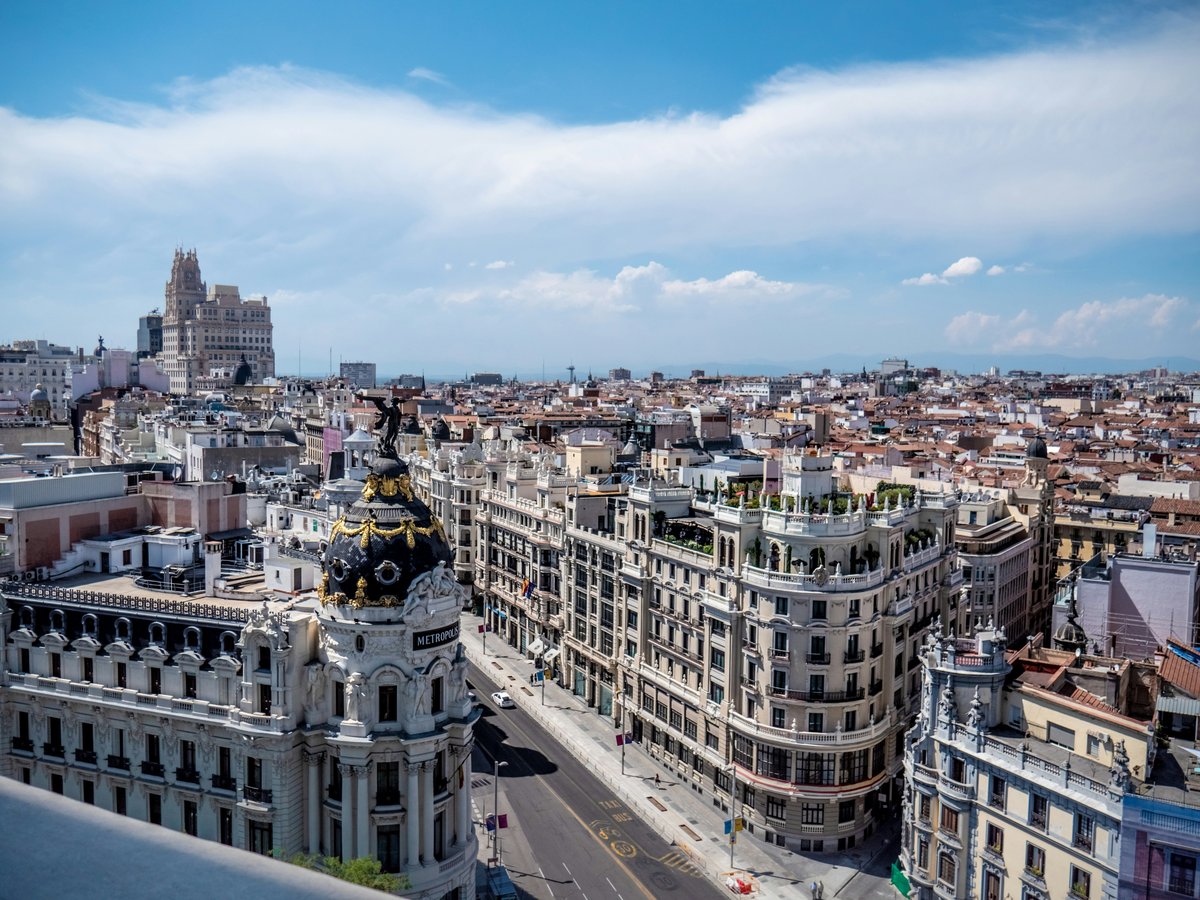
Madrid sits at 650 meters on the Meseta Central, which makes it the highest capital in the European Union. That altitude means something for anyone spending time outdoors. Summers are dry and hot, regularly pushing past 38°C in July and August. Winters bring cold, clear days where temperatures hover around 6°C. The Sierra de Guadarrama rises to the north and northwest, its granite peaks visible from rooftops across the city on clear mornings. The Manzanares River threads through Madrid from north to south, and several large reservoirs sit within 60 to 90 minutes by car. Worth noting, this is not a city that feels outdoorsy at first glance. The central neighborhoods are dense, loud, paved. But Madrid has over 300,000 trees lining its streets, the enormous Casa de Campo park covers more than 1,700 hectares on its western flank, and the mountains are close enough for a morning hike before a late lunch back in Malasaña. The outdoor life here tends to happen early or late. You adapt to the rhythm or you cook.
Outdoor activities
-
Rock Climbing at La Pedriza
La Pedriza, inside the Sierra de Guadarrama National Park, is a massive granite landscape about 50 minutes north of Madrid by car. The area has hundreds of documented climbing routes across boulders and walls, ranging from grade III to 8a+ on the French scale. The rock is coarse-grained granite with good friction when dry. You'll find bouldering sectors scattered across the lower areas near the Tranco stream, and multi-pitch routes on formations like El Yelmo, a prominent dome visible from the parking area at Canto Cochino. Weekend mornings in spring get busy. The approach walks vary from 15 minutes to over an hour depending on the sector.
- Difficulty
- Varies: beginner bouldering (V0-V2) to expert trad and sport (8a+)
- Duration
- Half day to full day
- Best season
- March to June, September to November
-
Road Cycling to Puerto de Navacerrada
The climb from Cercedilla up to Puerto de Navacerrada at 1,858 meters is one of the classic road cycling routes in the Madrid region. It covers roughly 8 kilometers of steady ascending with gradients that average around 5-6%, though some stretches hit 8%. The road surface is generally good. You'll share the M-601 with cars, but weekday mornings are quieter. Many Madrid cycling clubs do this climb as a Saturday morning staple. Cercedilla is reachable by Cercanías train (line C-8b), so you can ride from the station without needing a car. The descent is fast and the curves tighten near the top, so mind your speed.
- Difficulty
- Moderate to challenging
- Duration
- 3-5 hours round trip from Cercedilla
- Best season
- April to October, avoiding midday heat in summer
-
Trail Running in Casa de Campo
Casa de Campo is Madrid's largest park, over 1,700 hectares of pines, holm oaks, and dry scrubland crisscrossed by dirt paths. Trail runners use the network of unpaved tracks that loop through the western and southern sections, away from the zoo and the Teleférico area. The terrain is mostly flat to gently rolling, with loose gravel and some exposed roots. You can easily string together 15 to 20 kilometers without repeating a path. The park connects to the Madrid Río linear park along the Manzanares, so longer routes can extend south toward Leganés. Summer mornings before 9 AM are best, since shade coverage is inconsistent in the open sections.
- Difficulty
- Easy to moderate
- Duration
- 1-3 hours depending on distance
- Best season
- Year-round, early morning in summer
-
Mountain Biking in Cercedilla
The trails around Cercedilla, about 55 minutes north of Madrid by car or Cercanías, offer solid mountain biking on pine-forested tracks. The Calzada Romana route follows an old Roman road through the Fuenfría valley with a gradual climb and rocky sections. Several marked forest tracks branch off toward the Puerto de la Fuenfría at 1,796 meters. The soil is sandy and loose in dry months, muddy after rain. You'll share some paths with hikers, particularly on weekends. Bike rentals are available in Cercedilla town. The area is within the Sierra de Guadarrama National Park, so stick to authorized trails.
- Difficulty
- Moderate
- Duration
- 3-5 hours
- Best season
- April to June, September to November
-
Via Ferrata in the Sierra Norte
The Via Ferrata de Prádena del Rincón, about 100 kilometers northeast of Madrid in the Sierra Norte, is a fixed-route climbing experience on limestone rock. The route includes cable-assisted traverses, a Tibetan bridge, and some exposed vertical sections. It's rated K3 on the difficulty scale, meaning intermediate. You need a harness, helmet, and via ferrata lanyard set. Several guiding companies in Madrid organize day trips including equipment and transport. The approach walk from the village takes about 20 minutes. Prádena del Rincón itself is a tiny village with maybe 100 residents.
- Difficulty
- Intermediate (K3)
- Duration
- Full day including transport from Madrid
- Best season
- March to June, October to November
-
Outdoor Swimming at Riosequillo Pool (Buitrago del Lozoya)
The municipal pool complex at Riosequillo, next to the Embalse de Riosequillo near Buitrago del Lozoya, is one of the closest open-air swimming spots to Madrid, about 75 minutes north on the A-1. The pools sit on a grassy hillside overlooking the reservoir. There's a main pool and a children's pool, both filled with treated water. Entry costs around 6-8 euros for adults in recent seasons. The setting feels genuinely rural, with the Sierra de Guadarrama filling the horizon. Buitrago's medieval walls are a 5-minute drive away. The facility typically opens in late June and closes in early September.
- Difficulty
- Easy
- Duration
- Half day
- Best season
- Late June to early September
Day hikes
-
La Pedriza Circular from Canto Cochino
This loop starts at the Canto Cochino parking area in the Sierra de Guadarrama and winds through La Pedriza's granite boulder fields along the Manzanares stream. The trail passes enormous rounded rock formations, some 20 meters tall, with names like El Elefante and Las Torres. The path is well-marked with paint blazes but involves some scrambling over rock slabs in the upper sections. The total distance is roughly 12 kilometers with about 500 meters of elevation gain. The Canto Cochino car park fills up early on weekends, especially in spring. You might need to arrive before 9 AM on Saturdays to get a space. The granite radiates heat in summer, making autumn and spring the more comfortable seasons.
- Difficulty
- Moderate, with some scrambling sections
- Duration
- 4-6 hours
- Best season
- March to May, October to November
-
Peñalara Summit from Puerto de Cotos
Peñalara is the highest peak in the Sierra de Guadarrama at 2,428 meters. The standard route starts from Puerto de Cotos (1,830 meters), which is reachable by car or by the Cercanías C-9 line to Cercedilla and then a connecting bus. The trail climbs through Scots pine forest before emerging onto open alpine grassland above the tree line. The Laguna Grande de Peñalara, a glacial lake at about 2,000 meters, sits in a cirque below the summit ridge. The path is well-trodden and marked, but the final stretch to the summit involves exposed terrain where wind can be fierce. Total elevation gain is roughly 600 meters over about 6 kilometers one way. Snow covers the upper sections from late November through April or May, depending on the year.
- Difficulty
- Moderate to challenging
- Duration
- 5-7 hours round trip
- Best season
- June to October
-
Calzada Romana through Valle de la Fuenfría
This route follows a reconstructed Roman road through the Valle de la Fuenfría, starting near Cercedilla. The cobbled sections of the original road surface are still visible in places. The trail climbs gradually through pine forest to the Puerto de la Fuenfría at 1,796 meters, where on clear days you can see the plains of Segovia to the north. The valley floor has several small streams and a few picnic areas. The round trip is about 12 kilometers with around 450 meters of elevation gain. It's a popular family hike, and the grade is steady rather than steep. Cercedilla is on the Cercanías C-8b line, making this one of the most accessible mountain hikes from Madrid without a car.
- Difficulty
- Easy to moderate
- Duration
- 4-5 hours round trip
- Best season
- Year-round, though snow possible December to March
-
Chorrera de San Mamés Waterfall
The Chorrera de San Mamés is one of the tallest waterfalls in the Madrid region, dropping roughly 30 meters in the Sierra Norte. The trailhead is near the village of Navarredonda, about 90 minutes north of Madrid by car. The hike follows a gentle path through oak and ash forest along the Arroyo de San Mamés. The total distance is approximately 5 kilometers round trip with minimal elevation gain. The waterfall runs strongest from late winter through spring after rain and snowmelt. By late summer it might be reduced to a trickle. The path can be muddy in wet months, especially the last 500 meters near the falls.
- Difficulty
- Easy
- Duration
- 2-3 hours round trip
- Best season
- February to May for water flow
-
Cuerda Larga Ridge Traverse
The Cuerda Larga is a high-altitude ridge walk in the Sierra de Guadarrama, typically started from Puerto de Navacerrada (1,858 meters) and running east along a series of peaks above 2,000 meters including Bola del Mundo and Cabeza de Hierro Mayor (2,383 meters). The traverse covers roughly 18 to 20 kilometers one way and requires arranging transport at both ends, since it finishes near Puerto de Cotos or La Morcuera. The ridge is exposed with no shade or water sources, and weather can change rapidly above 2,000 meters. This is a long, committing day. The views take in the Madrid basin to the south and the Segovia lowlands to the north. That said, the navigation is relatively straightforward in good visibility since you follow the ridgeline.
- Difficulty
- Challenging
- Duration
- 8-10 hours one way
- Best season
- June to September
Water activities
-
Kayaking on Embalse de San Juan
The Embalse de San Juan, about 70 kilometers west of Madrid near San Martín de Valdeiglesias, is sometimes called the 'Beach of Madrid.' The reservoir has sandy shores on its eastern banks and allows non-motorized watercraft. Several companies rent kayaks and stand-up paddleboards directly from the shore during summer, typically for 10 to 15 euros per hour. The water is warm enough for swimming by late June. The surrounding landscape is Mediterranean pine and granite, and on a weekday morning the surface can be glassy. Winds tend to pick up in the afternoon. Swimming in the reservoir is tolerated on the informal beach areas, though facilities are basic.
- Difficulty
- Easy
- Duration
- Half day
- Best season
- June to September
-
Canoeing the Upper Manzanares in La Pedriza
The Manzanares in its upper reaches near La Pedriza is a narrow, shallow river that allows canoe and kayak exploration in spring when water levels are higher. This is calm water, not whitewater. You'll paddle between granite boulders with the La Pedriza rock formations overhead. A few local adventure companies run guided trips, typically from Manzanares el Real. The season is short, roughly March through May, because by summer the water level drops too low for comfortable paddling. Expect to carry your boat over shallow sections. Total paddling distance tends to be 3 to 5 kilometers.
- Difficulty
- Easy to moderate
- Duration
- 2-3 hours
- Best season
- March to May
-
Swimming at Las Presillas (Rascafría)
Las Presillas are a series of 3 natural pools formed by low stone dams on the Río Lozoya near the village of Rascafría, about 80 minutes north of Madrid. The pools sit in the Valle del Paular, surrounded by meadows and pine forest. The water is cold, fed by mountain streams from the Sierra de Guadarrama. Even in August, the temperature might be around 16-18°C. There's a grassy area for sunbathing and a small kiosk that sells drinks during summer weekends. Access is free. The site fills up quickly on hot weekends, so arriving before 11 AM is wise. The Monasterio de El Paular, a 14th-century Carthusian monastery, sits about 2 kilometers away.
- Difficulty
- Easy
- Duration
- Half day
- Best season
- Late June to early September
-
Stand-Up Paddleboarding at Embalse de Pinilla
The Embalse de Pinilla, near Lozoya in the Sierra Norte, is a quieter alternative to San Juan for paddle sports. The reservoir is smaller and tends to draw fewer crowds. Several rental outfits operate from the southern shore during summer months. The surrounding Sierra Norte landscape is green and hilly, quite different from the drier terrain around San Juan. Water temperature is colder here due to the higher elevation, likely 18-20°C in peak summer. The area is part of the Sierra del Rincón Biosphere Reserve, and the village of Lozoya has a few bar-restaurants for post-paddle lunch.
- Difficulty
- Easy
- Duration
- 2-4 hours
- Best season
- June to September
Parks & gardens
-
Parque del Buen Retiro
FreeEl Retiro covers 125 hectares right in the center of Madrid, east of the Prado Museum. It opened to the public in 1868 and has the feel of a place where layers of history have settled into the ground. The artificial lake near the monument to Alfonso XII rents rowboats for around 6 euros per 45 minutes. The Palacio de Cristal, a glass and iron structure from 1887, hosts free contemporary art exhibitions. Old men play petanca near the southern paths on weekday mornings. The rose garden, La Rosaleda, peaks in May with about 4,000 rose bushes in bloom. It gets packed on Sunday afternoons, but early weekday mornings have a quieter rhythm.
Highlights: Estanque Grande rowboats, Palacio de Cristal exhibitions, La Rosaleda rose garden with 4,000 bushes, Paseo de las Estatuas lined with stone monarchs
-
Casa de Campo
FreeAt over 1,700 hectares, Casa de Campo is about five times the size of Central Park in New York. It was a royal hunting estate until 1931. The landscape is Mediterranean scrubland and pine forest, dry and sunbaked in summer. Parts of it feel genuinely wild, particularly the western edges where the understory thickens and the city noise fades. The Lago de Casa de Campo has a terrace bar and pedal boats. The Teleférico cable car crosses from Paseo del Pintor Rosales to the park's interior, offering aerial views of the city and the Manzanares valley below. Mind you, the park is so large that getting to the farther trails on foot takes real commitment.
Highlights: Teleférico cable car, Lago de Casa de Campo with pedal boats, extensive unpaved trail network, views toward the Guadarrama range from the western ridgeline
-
Real Jardín Botánico
Madrid's Royal Botanical Garden sits beside the Prado Museum on Paseo del Prado, established in 1755 under Fernando VI and moved to its current location in 1781. It covers about 8 hectares and holds over 5,000 plant species arranged on three descending terraces. The lower terrace has ornamental beds laid out in geometric patterns. The upper terrace feels wilder, with mature trees providing dense shade that drops the temperature noticeably on hot days. The greenhouse collection includes tropical and desert sections. Entry costs around 6 euros for adults.
Highlights: Three-terrace layout from the 18th century, over 5,000 species, greenhouse with tropical and arid sections, a shaded retreat in the heat of July
-
Parque del Oeste
FreeStretching along the western edge of the Moncloa district, Parque del Oeste was designed in 1906 and still has a slightly rumpled, unpretentious character. The Rosaleda del Parque del Oeste, its competition rose garden, hosts the annual Concurso Internacional de Rosas Nuevas, a rose competition held since 1956. The Templo de Debod, a 2nd-century BC Egyptian temple reconstructed on a hilltop in the northern section, is arguably Madrid's best free sunset spot. The ground slopes down toward the Manzanares, and the older paths under the cedars feel lived in rather than manicured.
Highlights: Templo de Debod for sunset, Rosaleda competition garden, sloping terrain with mature cedars, Teleférico departure point at the northeastern edge
-
Jardines de Sabatini
FreeThese formal neoclassical gardens sit on the north side of the Palacio Real, on the site of the former royal stables. They were laid out in the 1930s but only opened to the public in 1978. The hedges are clipped into geometric shapes, the paths are gravel, and the central reflecting pool catches the limestone facade of the palace. The space is compact, probably 20 minutes to walk through slowly. It tends to be less crowded than El Retiro or the Palacio Real gardens. After dark, the palace illumination reflected in the pool is worth a detour.
Highlights: Neoclassical hedgerows with palace views, central reflecting pool, evening lighting of the Palacio Real facade, quieter alternative to Retiro
-
Madrid Río
FreeMadrid Río is a 10-kilometer linear park that runs along the Manzanares River, completed in 2011 after a massive project buried the M-30 ring road underground. It connects the Puente de los Franceses in the north to the Parque de la Arganzuela in the south. The park has cycling paths, playgrounds, urban beaches with fountains for children, and several stretches of mature plantings along the riverbanks. The Matadero Madrid cultural center sits at its southern end in a converted slaughterhouse complex from 1911. Runners and cyclists fill the paths on weekend mornings. The Arganzuela footbridge by Dominique Perrault, a spiraling steel and glass tube, is a distinctive landmark along the route.
Highlights: Arganzuela footbridge, Matadero Madrid cultural center, Puente de Segovia (Madrid's oldest bridge, 16th century), Playa Urbana splash area in summer
Practical tips
- Sun protection
- Madrid averages over 2,800 hours of sunshine per year, and the UV index from May through September regularly reaches 8 or 9. At altitude in the Sierra de Guadarrama, the UV exposure increases further. Wear SPF 50, reapply every 90 minutes, and bring a wide-brimmed hat. Sunglasses with UV400 protection are not optional. Sunburn at 2,000 meters happens faster than you expect.
- Water and hydration
- Carry at least 2 liters per person for any hike over 3 hours in summer. Mountain streams in the Sierra de Guadarrama look clean but should be treated or filtered, since cattle graze in many of the upper valleys. Madrid tap water is excellent and comes from the Lozoya river system, so fill up before you leave. There are very few reliable water sources on ridge hikes like Cuerda Larga.
- Gear for the sierra
- The Sierra de Guadarrama can drop 10-15°C compared to Madrid city, and ridge winds above 2,000 meters can be fierce even on a warm day in the valley. Bring a windproof layer for any hike that goes above the tree line. Footwear with good grip matters on La Pedriza's granite slabs, which get slippery when wet. Trekking poles help on the steeper descents around Puerto de Cotos.
- Trail conditions and timing
- Most trails in the Sierra de Guadarrama are well-marked with paint blazes. That said, some secondary paths in La Pedriza can be confusing among the boulder fields, so download offline maps from apps like Wikiloc or AllTrails before heading out. Start early in summer. By 11 AM the heat on south-facing slopes is punishing. In winter, the upper routes above 1,800 meters may require crampons and ice axes after snowfall.
- Getting to the mountains without a car
- Cercedilla is on the Cercanías line C-8b from Chamartín station, roughly 70 minutes. From Cercedilla, the C-9 line continues to Puerto de Cotos (seasonal). Bus 194 from Plaza de Castilla reaches Manzanares el Real and the La Pedriza trailhead area. For Rascafría and the Sierra Norte, bus 194A from Plaza de Castilla runs several times daily, though the schedule thins on weekdays. Check CRTM.es for current timetables.
- La Pedriza vehicle access
- The road into La Pedriza from Manzanares el Real has a controlled vehicle cap during weekends and holidays from March through October. Once the car parks at Canto Cochino and Tranco fill up, the barrier closes. Arriving before 9 AM on Saturdays is strongly recommended. Alternatively, park in Manzanares el Real and walk or cycle the 3 kilometers to the trailheads.
FAQ
Is Madrid a good base for hiking and outdoor activities?
Madrid is closer to serious mountains than most European capitals. The Sierra de Guadarrama starts about 45 minutes north of the city center, with peaks above 2,400 meters and well-marked trail networks. The Cercanías commuter trains reach trailhead towns like Cercedilla without needing a car. You can hike a 2,000-meter peak in the morning and be back in the city for a late lunch.
When is the best time of year for outdoor activities near Madrid?
Spring (March to May) and autumn (September to November) are the most comfortable seasons for hiking and cycling. Summer is intensely hot in the lowlands, with temperatures above 35°C common in July and August, though the mountains stay cooler. Winter offers clear, cold days and the possibility of snow-based activities above 1,800 meters. Each season has its strengths, but spring tends to have the best combination of moderate temperatures, wildflowers, and flowing water.
Can I swim outdoors near Madrid?
The main options are reservoirs like Embalse de San Juan (about 70 km west, warmer water, sandy banks) and the natural pools at Las Presillas near Rascafría (about 80 km north, cold mountain water, free access). Municipal open-air pools like Riosequillo near Buitrago del Lozoya also open in summer. Madrid has no coastline, so the nearest sea swimming is about 3.5 to 4 hours away in Valencia.
Do I need special permits for hiking in Sierra de Guadarrama?
General hiking in the Sierra de Guadarrama National Park does not require a permit. However, vehicle access to La Pedriza is controlled on weekends and holidays from spring through autumn, with a cap on the number of cars allowed in. Some restricted zones within the national park may require authorization for off-trail activities or organized groups above a certain size. Check the park's official website (parquenacionalsierraguadarrama.es) for current regulations before your visit.
What outdoor gear shops are available in Madrid?
Barrabés has a large store on Calle Goya that stocks climbing, hiking, and skiing equipment. Desnivel, near Ópera metro, specializes in climbing gear and has knowledgeable staff. Decathlon has multiple locations across Madrid for budget-friendly basics. Forum Sport in several shopping centers carries mid-range outdoor brands. For trail running shoes and technical gear, The North Face and Salomon each have brand stores in the Salamanca district.
How hot does it get on Madrid hiking trails in summer?
In the city and surrounding lowlands, July and August temperatures regularly hit 38-40°C. Trails below 1,000 meters are essentially off-limits from 11 AM to 6 PM unless you want a miserable experience. In the Sierra de Guadarrama above 1,500 meters, temperatures are typically 8-12°C cooler than the city, making morning hikes feasible. Start before 8 AM, carry more water than you think you need, and wear a hat. Heat exhaustion is a real risk on exposed ridge walks like Cuerda Larga if you misjudge the conditions.
Outdoor experiences in Madrid
 Free cancellation
 Horse Riding Madrid Natural Park
Outdoor experience: 2.5 hours, free cancellation.
via Viator Free cancellation
 Retiro Park Segway Tour in Madrid
Outdoor experience: 1.5 hours, free cancellation.
via Viator Free cancellation
 Hot-Air Balloon Ride over Madrid’s Guadarrama Regional Park
Outdoor experience: free cancellation.
via Viator Free cancellation
 Guadarrama National Park from Madrid
Outdoor experience: 10 hours, free cancellation.
via Viator Free cancellation
 Madrid to Toledo & Don Quixote Windmills small-group Experience
Outdoor experience: 9 hours, free cancellation.
via ViatorLast verified by automated review (v1.7.2) on . What is automated review?