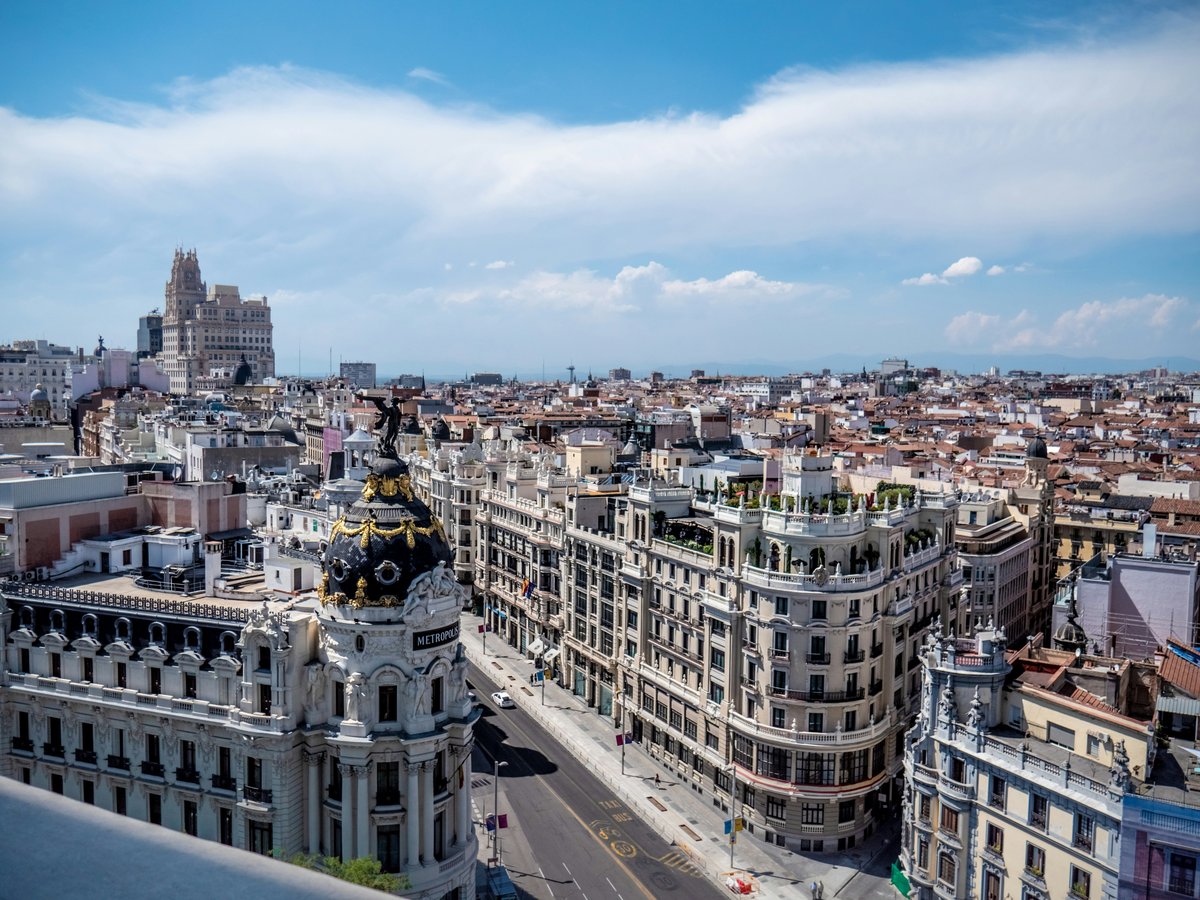
Madrid keeps its museums in a tight walk along the Paseo del Prado and a handful of streets that climb north from Atocha, and the reward for staying on foot is a city where a national picture gallery, a private collector's house, and an Egyptian temple relocated stone by stone are all inside the same afternoon. The Prado, Reina Sofía, and Thyssen-Bornemisza form the Golden Triangle of Art, and the three sit within a few minutes of each other on and around the Paseo. Beyond that spine, the city has quieter rooms: the Royal Palace's staterooms above the Manzanares, a Goya self-portrait inside the San Fernando academy, a naval chart room off Cibeles, a private collection in a Serrano mansion. This list is for the traveller who wants to see Madrid's picture of itself, not tick a canon; the order runs from the unavoidable to the deeply local, so read the whole thing before you plan the day.
-

1 Museo del Prado
Paseo del Prado, 28014 MadridSpain's national picture gallery on the Paseo del Prado
On the Paseo del Prado in the 28014 postal area, the Museo del Prado is Spain's national art museum and the reason most visitors book a Madrid trip in the first place. Skip the temptation to rush all three Paseo museums in one day; the Prado alone is a full afternoon if you want to see it and not just walk through it. Plan the visit against the museum's own calendar at museodelprado.es, and if you need to check anything from the hotel, the switchboard is +34 913 30 28 00. The address is 40.4139 N, 3.6922 W for the taxi driver, but you will not need one: the museum sits on the Paseo, and the door you want is signposted from the street.
-

2 Royal Palace of Madrid
Calle BailénThe official residence of the Spanish Royal Family, open to visitors
At Calle Bailén, the Royal Palace of Madrid still functions as the official residence of the Spanish Royal Family, which is the single fact that changes how you should read it: this is a working state house, not a period reconstruction. Come on a weekday morning, when the ceremonial rooms are open and the tour groups from the Prado have not yet crossed the city. Cross-reference the visit against patrimonionacional.es before you go, because state functions close rooms without much notice; the palace switchboard is +34 914 54 87 00. The building sits at 40.4180 N, 3.7143 W, on the ridge above the Manzanares, and the walk down Bailén is part of the visit.
-

3 Royal Spanish Academy
4 Calle de Felipe IV, Madrid, 28014The official regulator of the Spanish language, in a working scholarly building
Set at 4 Calle de Felipe IV in the 28014, a block behind the Prado, the Royal Spanish Academy is the official regulator for the Spanish language, and it belongs on any museum list that takes Madrid seriously as a capital of ideas rather than a capital of pictures. Don't bother expecting long public galleries; this is a working institution, and the interest is precisely that a language has an address. The building sits at 40.4150 N, 3.6909 W, close enough to the Prado that you can pair the two on foot, and the Academy's own calendar of public sessions and library access lives at rae.es. For readers who care about Spanish, this is the room where the dictionary is decided.
-

4 Museo Nacional Centro de Arte Reina Sofía
Calle de Santa Isabel, 52, MadridSpain's national museum of twentieth-century art, and the home of Guernica
The Reina Sofía sits at Calle de Santa Isabel, 52, five minutes' walk south of the Prado and functionally its twentieth-century counterpart: this is Spain's national museum of art, and the building it occupies makes the visit as much about architecture as about painting. Skip the impulse to see it on the same ticket-hour as the Prado; the collection deserves a fresh pair of legs and a plan. Check museoreinasofia.es for the current hang before you go, because rooms rotate, and the switchboard for anything else is +34 917 74 10 00. The museum lies at 40.4086 N, 3.6940 W, on the far side of Atocha station from the Paseo, and the walk between them is short and worth doing on foot.
-

5 Thyssen-Bornemisza Museum
P.º del Prado, 8The private collection that fills the gaps in Spain's public museums
Across the Paseo from the Prado, at P.º del Prado, 8, the Thyssen-Bornemisza is the museum most casual visitors underrate on the way to the two obvious names. It fills the gaps: schools and centuries the state collections never chased, hung with the coherence a single collector's eye gives a house. Plan around the museum's calendar at museothyssen.org; the temporary shows are often the reason to go, and they turn over. The desk is +34 917 91 13 70 and the building sits at 40.4160 N, 3.6949 W, directly opposite the Prado on the same block of the Paseo. Give it the same three hours you would give a good gallery anywhere else.
-

6 Temple of Debod
Calle Ferraz 1A relocated Egyptian temple standing in a Madrid park
At Calle Ferraz 1, on the western ridge above the Palace gardens, the Temple of Debod is an Egyptian temple in Madrid: a sentence that ought to make anyone stop and reread it. Come at sunset, when the light on the reflecting pools does what postcards claim; that is the visit, and it costs nothing. Avoid the middle of the day, when the interior queue is longer than the small chambers reward. The temple sits at 40.4241 N, 3.7178 W, a ten-minute walk from Plaza de España, and the municipal page at munimadrid.es/templodebod carries the current opening pattern; the office line is +34 913 667 415. Come for the site as much as for the temple.
-
7 Royal Academy of Fine Arts of San Fernando
13 Calle de Alcalá, Madrid, 28014A working art school, museum and gallery on Calle de Alcalá
Ten minutes on foot from Puerta del Sol, at 13 Calle de Alcalá in the 28014, the Royal Academy of Fine Arts of San Fernando is a Spanish art school, museum, and gallery in a single building: a rarer combination than the Paseo museums suggest. It runs quieter than the Prado, with a working academy upstairs and pictures you can stand in front of without a scrum. Check realacademiabellasartessanfernando.com before you go, because parts of the collection rotate around class use, and the switchboard is +34 915 24 08 64. The building sits at 40.4178 N, 3.7007 W, on the walk between Sol and Cibeles.
-
8 Royal Academy of Exact, Physical and Natural Sciences
Plaza de EspañaSpain's national academy of the sciences, off Plaza de España
Off Plaza de España, at 40.4219 N, 3.7128 W, the Royal Academy of Exact, Physical and Natural Sciences is the academy of sciences of Spain, and it belongs on this list for the same reason the language academy does: Madrid puts its national learned bodies at real street addresses in the middle of the city, and you can walk past them on your way to lunch. Skip the assumption that a science academy is closed to the public; the calendar of lectures and open sessions lives at rac.es, and if a talk lines up with your dates it is worth the change of plan. Come with the same curiosity you would bring to a small museum, not the expectation of long galleries.
-
9 Madrid History Museum
Calle de Fuencarral, 78, 28004 MadridThe city's own museum, told in the building the city keeps for it
North of Gran Vía at Calle de Fuencarral, 78 in the 28004, the Madrid History Museum takes Madrid itself as its subject, which sounds circular until you visit and realise how few capitals bother to tell their own story in one room. It works best as the museum for a second visit: the city explained on foot, on a walkable stretch of Fuencarral rather than the Paseo. Check munimadrid.es/museomunicipal for the current hang before you go. The building sits at 40.4258 N, 3.7008 W, twenty minutes on foot from Sol, and the walk up Fuencarral is part of the point.
-

10 Naval Museum of Madrid
Calle Prado 3The Spanish Navy's museum, a short walk from Cibeles
At Calle Prado 3, a short walk from Cibeles, the Naval Museum of Madrid is run by the Navy in a building the Navy keeps, and it is the sort of specialist museum most visitors miss because it is not on the Paseo del Prado spine. Skip that reflex; this is a serious collection, and the walk from the Thyssen is under ten minutes. The chart room and the ship models are worth the visit even without a naval interest: they carry pieces of Spain's imperial story that the picture galleries do not. Check armada.mde.es/museonaval for opening hours before you go. The building sits at 40.4175 N, 3.6928 W, within the Paseo cluster on foot.
-

11 Lázaro Galdiano Museum
Serrano, 122A private collector's mansion, kept as a museum on Serrano
Uphill on Serrano at number 122, the Lázaro Galdiano is housed in the collector's own mansion, and it rewards the visitor willing to walk past the last metro stop most tour itineraries acknowledge. The draw is exactly what makes a fourth blockbuster on the Paseo unappealing: rooms hung the way one man wanted them hung, and the domestic scale that a national museum can never reproduce. Plan the visit against flg.es, because the smaller rooms rotate, and the switchboard for questions is +34 915 61 60 84. The house sits at 40.4369 N, 3.6858 W, on the northern Salamanca stretch of Serrano, and the walk from the Chamartín direction is easier than from the centre.
-
12 National Museum of Natural Sciences
Calle de José Gutiérrez Abascal, 2Spain's national natural history museum, north of the Prado spine
At Calle de José Gutiérrez Abascal, 2, the National Museum of Natural Sciences is Spain's national natural history collection, and it is a fitting close to this list: the city's picture-gallery reputation is so loud that most visitors do not realise it sits a short walk uphill from the Paseo cluster. Rainy Saturdays fill it with families, which is a better recommendation than any brochure. Check mncn.csic.es for the current exhibitions before you go; the building sits at 40.4410 N, 3.6903 W, and the walk from the Prado runs north through the university district. Skip the assumption that natural history is only for kids; the collection is a serious one.
Last verified by automated review (v1.7.2_curated-wave-1737-20260916143418) on . What is automated review?