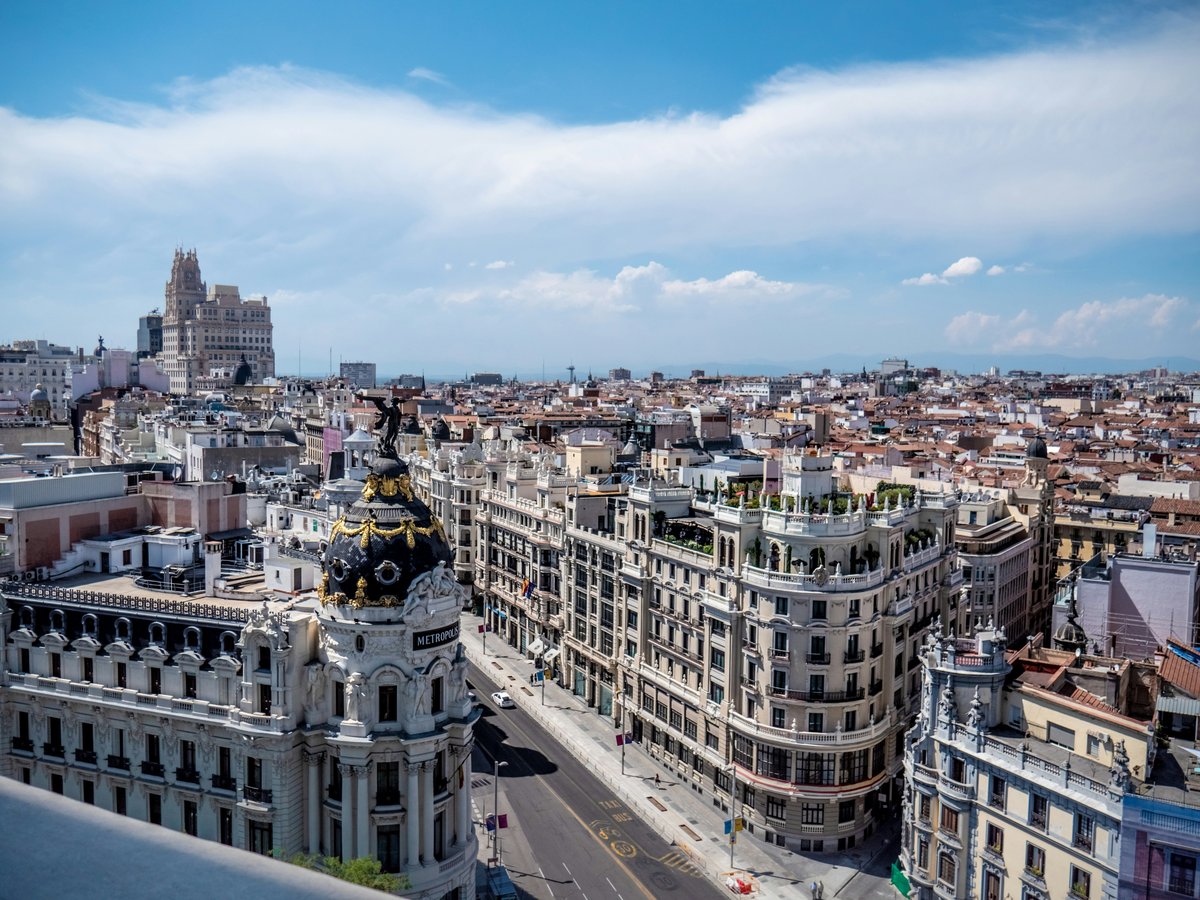
Madrid is built around a central axis that runs roughly north to south, from Chamberí down through the old city core to the river Manzanares. The Puerta del Sol sits at the geographic and emotional center, with Gran Vía cutting east-west like a canyon of early 20th-century facades. Most of the neighborhoods visitors care about cluster within a 3-kilometer radius of Sol. The older quarters, Austrias and La Latina, sit to the southwest. The literary quarter, Barrio de las Letras, slopes southeast. Malasaña and Chueca press north against Gran Vía. Salamanca stretches northeast in a rigid grid. Lavapiés drops south into a denser, louder, more complicated part of the city. The metro connects all of them in under 15 minutes, but walking is how Madrid makes sense. You'll find that neighborhoods bleed into each other with no hard borders, and crossing from one to another might take 5 minutes on foot.
Neighborhoods
-
Sol and Austrias
This is the oldest layer of Madrid, built around the Habsburg royal quarter. The streets are narrow, paved in granite, and bend in ways that predate any grid plan. Plaza Mayor anchors the area with its enclosed rectangular form, 129 meters long, surrounded by rust-red facades with 237 wrought-iron balconies. The pace here is slow in the mornings and dense with foot traffic by midday. You'll hear buskers in the plazas and the scrape of metal chairs on stone terraces.
- Best for
- First-time visitors who want walkable access to the Palacio Real, the Almudena cathedral, and the major plazas without relying on transit
- Key streets
- Calle Mayor runs the full spine from Sol to the Palacio Real. Calle de la Cava Baja in adjacent La Latina is the single best tapas street in Madrid, roughly 400 meters of back-to-back bars. Plaza de la Villa and Plaza de Oriente are quieter squares worth finding.
-
Malasaña
Malasaña grew out of the Movida Madrileña, the cultural explosion after Franco's death in 1975. That countercultural DNA is still visible in the record shops along Calle del Espíritu Santo and the graffiti murals on Calle de la Palma. The architecture is mostly 19th-century residential, 4 to 6 stories, with small iron balconies and peeling paint that nobody seems in a rush to fix. Plaza del Dos de Mayo is the social nucleus. On warm evenings the benches fill by 19:00 and the surrounding bars spill onto the sidewalk. It smells like cheap vermouth and fried croquetas.
- Best for
- Travelers in their 20s and 30s who want nightlife within walking distance, plus vintage shopping and independent coffee roasters
- Key streets
- Calle de Fuencarral forms the eastern border and is the main shopping corridor. Calle del Pez has some of the best casual food in the neighborhood. Calle de la Palma runs parallel and tends toward live music venues and cocktail bars.
-
Chueca
Chueca became Madrid's LGBTQ+ neighborhood in the 1990s and the annual Orgullo parade, which fills the area each late June, reportedly draws over 1.5 million people. The streets are tight and commercial, lined with boutiques, brunch spots, and cocktail bars. Plaza de Chueca is small, maybe 40 meters across, but it functions as a living room for the barrio. The buildings tend toward late 19th-century, cream and terracotta, well maintained. The area sits between Gran Vía and Alonso Martínez, making it central but slightly removed from the heaviest tourist routes.
- Best for
- Travelers who want a walkable, central base with strong restaurant and bar density, and who value an open, progressive atmosphere
- Key streets
- Calle de Hortaleza is the main commercial artery. Calle de Augusto Figueroa has a cluster of independent shoe shops and the Mercado de San Antón, a 3-story market with a rooftop terrace. Calle de Pelayo connects directly to the plaza.
-
Barrio de las Letras
The literary quarter sits between Sol and the Paseo del Prado, named for the writers who lived here in the 16th and 17th centuries. You'll see quotes from Cervantes and Lope de Vega stamped in bronze on the cobblestones of Calle de las Huertas. The buildings are a mix of preserved 17th-century townhouses and 19th-century apartment blocks. During the day it's relatively quiet, with galleries and wine bars operating at a low hum. By Thursday evening it picks up. The whole area slopes gently downhill toward the Prado, so you always have a sense of where east is.
- Best for
- Culture-focused travelers who want the Prado, Reina Sofía, and Thyssen-Bornemisza museums within a 10-minute walk, plus evening restaurants that lean upscale-casual
- Key streets
- Calle de las Huertas is the pedestrianized main street. Plaza de Santa Ana anchors the northwest corner with Teatro Español on its east side. Calle del León and Calle de Lope de Vega run parallel and tend to be quieter.
-
La Latina
La Latina clusters around a steep hillside dropping from the Austrias quarter toward the Manzanares. The streets are narrow and winding, with thick stone walls and small plazas that open up without warning. Sunday mornings belong to El Rastro, the open-air flea market that stretches from Plaza de Cascorro down Calle de la Ribera de Curtidores for about 1 kilometer. The crowd on a good Rastro Sunday might reach 100,000. The rest of the week, the neighborhood is residential and mid-volume, with a food scene concentrated on Cava Baja and Cava Alta.
- Best for
- Food-focused travelers who want to eat and drink seriously, and who enjoy an older, slightly grittier Madrid that hasn't been polished for tourists
- Key streets
- Cava Baja and Cava Alta run parallel and hold perhaps 30 tapas bars between them. Plaza de la Cebada has a market building and connects to the metro. Calle de Toledo runs south from Sol through the heart of the barrio.
-
Salamanca
Salamanca was planned in the 1860s by the Marqués de Salamanca as a grid of wide boulevards and uniform limestone facades. It still feels like that plan. The blocks are rectangular, the streets are broad, and the buildings are 6 to 8 stories of Isabelline-era stonework with ornate balconies. This is where Madrid keeps its money. Calle de Serrano and Calle de Ortega y Gasset hold the flagship luxury stores. The pace is quieter than the center, more composed. You'll notice fewer backpacks and more shopping bags.
- Best for
- Travelers with a higher budget who want clean streets, upscale dining, proximity to the Prado and Retiro, and a neighborhood that feels more residential than touristy
- Key streets
- Calle de Serrano is the main north-south shopping axis, running about 2.5 kilometers. Calle de Jorge Juan has some of the best restaurants in the district. Calle de Claudio Coello runs parallel to Serrano and tends toward antique shops and smaller galleries.
-
Lavapiés
Lavapiés sits in a bowl south of Sol, and the streets drop steeply in every direction from its central Plaza de Lavapiés. This has been Madrid's immigrant neighborhood since the 1980s, and the food reflects that. Indian restaurants line Calle de Lavapiés, Senegalese shops cluster near the Tirso de Molina metro, and Chinese supermarkets sit beside old Spanish ferreterías. The buildings are mostly 18th and 19th century, dense and tall, with narrow light wells between them. It's louder than the center and grittier at the edges. The La Tabacalera cultural center, a former tobacco factory on Calle de Embajadores 53, runs rotating exhibitions and community events.
- Best for
- Budget travelers, solo visitors, and anyone who wants the most diverse food options in Madrid within a 5-block radius
- Key streets
- Calle de Argumosa is the social street, lined with terrace bars that fill on sunny afternoons. Calle de Embajadores runs south and holds the old industrial character. Calle de Lavapiés climbs north to Tirso de Molina metro.
-
Chamberí
Chamberí sits north of Malasaña and feels like the Madrid that existed before tourism reshaped the center. The streets follow a gentle grid, the buildings are early 20th-century with art nouveau details, and the commercial life revolves around Mercado de Vallehermoso and the small shops along Calle de Fuencarral's northern stretch. The noise level drops compared to anything south of Gran Vía. Families push strollers past bakeries that have operated for 40 or 50 years. The Andén 0 ghost metro station, closed since 1966, now operates as a small museum at Chamberí metro stop.
- Best for
- Repeat visitors, families, and anyone who wants a residential base that still puts you 15 minutes by metro from Sol or the Prado
- Key streets
- Calle de Ponzano has become Madrid's most talked-about food street since roughly 2016, with over 30 restaurants and bars in under 1 kilometer. Plaza de Olavide is a leafy circle with terrace seating. Calle de Santa Engracia runs north-south through the core.
-
Retiro and around Parque del Retiro
The park itself covers 125 hectares and was royal land until 1868. The area immediately surrounding it, particularly to the north and west, has a quiet grandeur. Wide sidewalks, mature plane trees, and 19th-century apartment buildings with high ceilings. The Paseo del Prado runs along the park's western edge and holds the Prado, Reina Sofía, and CaixaForum within a 1-kilometer walk. Inside the park, the Palacio de Cristal is a glass and iron structure from 1887 that currently hosts Reina Sofía exhibitions. Mornings in the park are calm. Runners circle the pond by 07:30.
- Best for
- Travelers who want green space, museum access, and a quieter residential atmosphere while still being central
- Key streets
- Paseo del Prado and its continuation Paseo de Recoletos form the cultural spine. Calle de Ibiza on the east side of the park has a local commercial strip. Calle de O'Donnell connects to Goya and the Salamanca grid.
FAQ
What is the best neighborhood to stay in for a first visit to Madrid?
Sol and Austrias or Barrio de las Letras tend to work best for first-timers. Both put you within walking distance of the major plazas, the Palacio Real, and the Prado museum triangle. Barrio de las Letras is slightly quieter at night and closer to the museums. Sol is more central but noisier. Hotel prices in both areas typically range from 90 to 180 euros per night for a mid-range double room, depending on season.
Is Madrid safe to walk around at night?
Madrid is generally considered safe for walking at night, and the city stays active unusually late by European standards. Dinner often starts at 21:30 or 22:00 and bars in Malasaña and Chueca still have full terraces past midnight on weeknights. Standard urban precautions apply in busier tourist zones like Sol and Gran Vía, where pickpocketing has been reported, particularly on metro lines 1 and 3 during rush hours. Lavapiés can feel less comfortable after 01:00 on quieter side streets.
How do I get around between neighborhoods in Madrid?
The Madrid metro has 13 lines and over 300 stations, and a single ride costs 1.50 to 2 euros depending on distance. A 10-ride Metrobús pass currently costs 12.20 euros. That said, most of the central neighborhoods sit within a 30-minute walk of each other. Walking from Malasaña to the Prado takes about 25 minutes through the center. The BiciMAD bike-share system has over 600 stations and a single ride costs around 2 euros for 30 minutes.
When is the best time of year to visit Madrid?
Late September through mid-November and April through mid-June tend to be the most comfortable periods. Summer temperatures in July and August regularly reach 38 to 40 degrees Celsius, and many locals leave the city during August. Winter is drier and sunnier than most northern European capitals, with December and January averaging around 6 to 10 degrees. The San Isidro festival in mid-May fills La Latina and the Pradera de San Isidro park with concerts, food stalls, and traditional chotis dancing for about 10 days.
Which Madrid neighborhood has the best food scene?
La Latina and Chamberí currently compete for that title, though they serve different purposes. Cava Baja in La Latina is the densest concentration of tapas bars, with roughly 25 to 30 spots in 400 meters. Calle de Ponzano in Chamberí has become the more contemporary food street, skewing toward small-plates restaurants and natural wine bars. Lavapiés wins on diversity and value, particularly for Indian, Senegalese, and Chinese food at prices 30 to 50 percent below the city center average.
Last verified by automated review (v1.7.2) on . What is automated review?