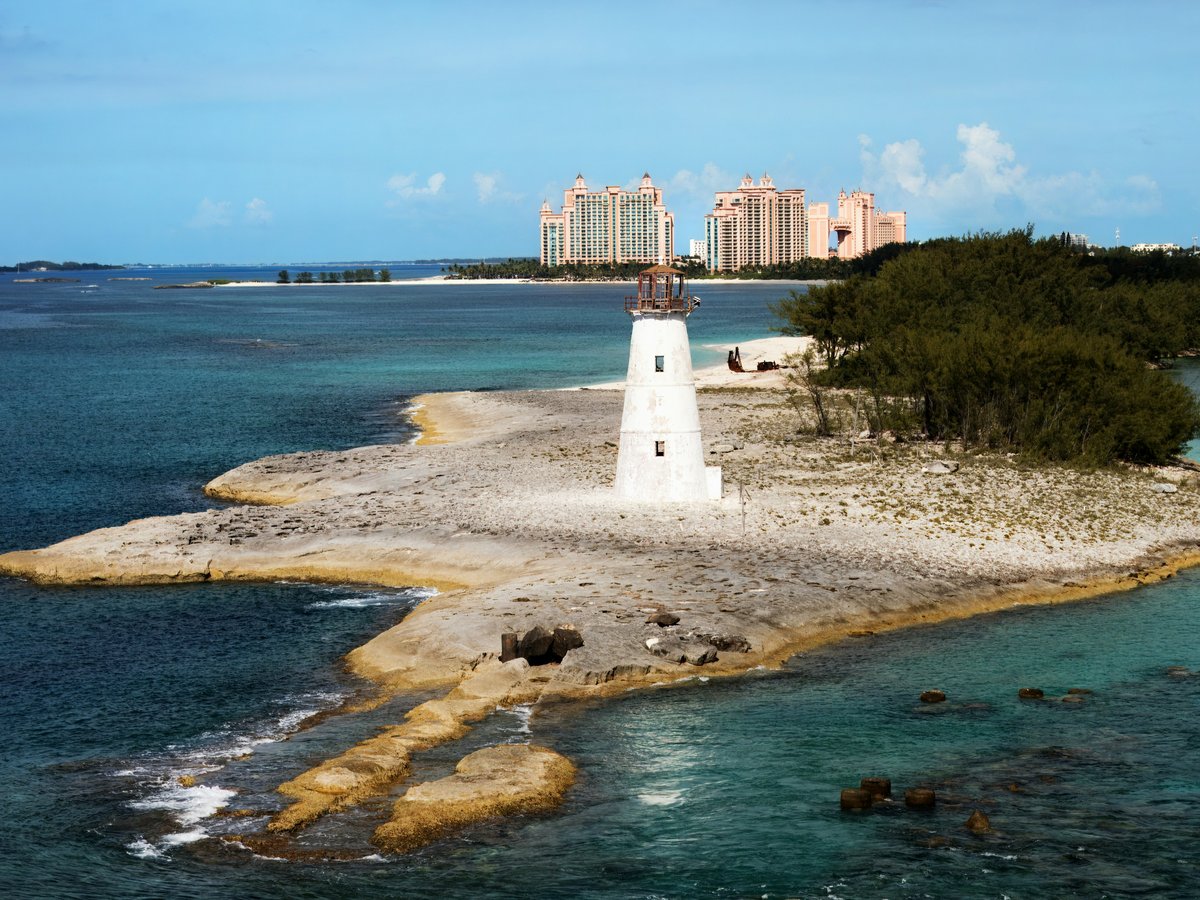
Nassau tends to get written off as a cruise-port shopping stop, but the city's colonial core holds more walkable history per block than most Caribbean capitals. American currency works everywhere on New Providence Island since the Bahamian Dollar is pegged at par with the US Dollar. Beaches along the northern coast carry no entrance fees, and the turquoise shallows near downtown sit a short walk from the main wharf. Churches with centuries of continuous worship open their doors to visitors any day of the week. British-era forts still stand on the hills above Nassau Harbour, free to explore, their limestone walls warm to the touch even in early morning. You might cover the full historic district on foot in a single morning, moving between Rawson Square and Bennet's Hill in about 15 minutes while passing through 3 centuries of architecture.
Free attractions
-
Queen's Staircase
Sixty-five steps carved from solid limestone in the 1790s by enslaved laborers under British colonial rule. The passage runs between high rock walls draped in ferns and tropical creepers, keeping the air noticeably cooler than the streets above. At the top you emerge near Fort Fincastle on Bennet's Hill. Open around the clock with no gate or admission fee.
Fort Fincastle HillHistoric Landmark -
Nassau Public Library and Museum
An octagonal building that served as a colonial jail before its conversion to a public library in 1873. The ground floor holds small exhibits on Bahamian history, including colonial-era maps, Lucayan artifacts, and prints of old Nassau. The thick stone walls and distinctive shape are the main draw, visible as you approach along Shirley Street. Free during regular weekday hours.
Shirley StreetMuseum / Library -
Fort Charlotte
The largest of Nassau's three British-era forts, built between 1788 and 1789 under Lord Dunmore. A waterless moat, underground passages, and cannons along the ramparts make this more interesting than the typical Caribbean ruin. Interior chambers hold exhibits on the fort's military history. Volunteer guides sometimes appear and offer walkthrough tours for tips, but admission itself costs nothing. The hilltop grounds double as a green space with sweeping views west toward Cable Beach.
West Bay StreetHistoric Fort / Museum -
Christ Church Cathedral
Founded in 1670, making it one of the oldest Anglican places of worship in the Caribbean. The current stone structure dates to a later rebuild, but the churchyard holds weathered graves from the 1700s. Dark wood pews, stained glass, and a quiet interior provide a sensory contrast to the noise of George Street outside. Open to visitors during daylight hours.
George StreetHistoric Church -
St. Francis Xavier Cathedral
The first Roman Catholic church in the Bahamas, built in 1886 on West Hill Street. Twin towers frame the entrance, and the interior stained glass casts colored light across the stone floor on sunny mornings. The nave stays cool even during the humid summer months. Worth a 20-minute stop if you are walking between the downtown waterfront and Fort Charlotte.
West Hill StreetHistoric Church -
Fort Fincastle
Built in 1793 and shaped like a paddle-wheel steamer, this compact fort sits on Bennet's Hill, the highest natural point on New Providence Island at roughly 60 meters above sea level. The panoramic view reaches across Nassau Harbour to Paradise Island and beyond. Most visitors arrive via the Queen's Staircase from below. No admission fee.
Bennet's HillHistoric Fort / Viewpoint -
Parliament Square
A cluster of coral-pink neoclassical buildings from the early 1800s housing the Bahamian Senate and House of Assembly. A statue of Queen Victoria stands at the center of the square. The buildings photograph best before 10 AM, when the low sun hits the pink facades without harsh shadow. The square is open and walkable at any hour.
Bay StreetHistoric Government District -
Government House
The official residence of the Governor-General of the Bahamas, sitting on a hill south of downtown. A statue of Christopher Columbus marks the front entrance. The elevated position offers one of the better vantage points over the harbour and the commercial district below. The building itself is closed to casual visitors, but the surrounding grounds and the approach are freely accessible.
Duke StreetHistoric Residence / Viewpoint -
French Cloisters and Versailles Gardens
The stone arches date to a 14th-century French Augustinian monastery. Developer Huntington Hartford purchased and reassembled them on Paradise Island in the 1960s. The surrounding Versailles Gardens are terraced and manicured, with stone pathways, sculpted hedges, and views across Nassau Harbour. Both the cloisters and the gardens are free to walk through at any time.
Paradise IslandGardens / Historic Monument -
St. Andrew's Presbyterian Kirk
A white-painted Presbyterian church on Princes Street, notable for its clean architectural lines compared to the more ornate Anglican and Catholic cathedrals nearby. The interior is plain and bright, with large windows that let in the midday light. The church has served Nassau's Scottish-heritage community for generations and remains open to visitors outside of service hours.
Princes StreetHistoric Church
Free activities
-
Bay Street and Colonial Quarter Walk
A 1 km walk along Bay Street from Prince George Wharf heading west covers the colonial commercial core in about 30 minutes at a slow pace. You pass Rawson Square, a small public garden where local musicians sometimes perform, then the pink facades of Parliament Square and the Pompey Museum at Vendue House. The storefronts date to the 1800s in places, though the interiors are modern retail. The Straw Market sits at the western end of the strip.
DowntownWalking Route -
Junkanoo Beach
The closest free beach to the cruise port, roughly a 10-minute walk west from Prince George Wharf. The strip of white sand is narrower than Cable Beach, but the water is calm and shallow enough for wading. A handful of bars along the edge rent umbrellas and chairs for around $10-15 BSD, though the sand and water themselves cost nothing. The spot gets crowded when multiple ships are in port.
West Bay StreetBeach -
Cable Beach
A longer, wider stretch of sand about 5 km west of downtown, reachable by jitney for $1.25 BSD. To be fair, the public access points sit between large resort properties, so finding them takes a bit of local knowledge. The water here tends to be clearer than at the downtown beach, and the sand runs for roughly 3 km. Morning light turns the shallows a pale green that deepens to blue further out.
Cable BeachBeach -
Arawak Cay and the Fish Fry
A man-made island connected to Nassau by a short causeway, lined with colorful open-air restaurants. Walking through the Fish Fry area costs nothing and offers some of the most photogenic facades in the city, painted in turquoise, yellow, and coral. The smell of cracked conch and deep-fried grouper fills the air from late morning onward. Mind you, if you decide to eat, a plate of conch salad currently runs around $12-15 BSD.
West Bay StreetCultural District -
Nassau Straw Market
The rebuilt Straw Market building on Bay Street is one of the largest in the Bahamas. Vendors sell hand-woven straw bags, sun hats, wood carvings, and souvenir T-shirts across two floors. Browsing costs nothing, and the back-and-forth of price negotiation is part of the atmosphere. The market is busiest between 9 AM and 2 PM on days when cruise ships are docked.
Bay StreetMarket -
Goodman's Bay Park
A public park and beach area about 3 km west of downtown along West Bay Street. Local families gather here on weekends, and the park has picnic tables and enough shade trees to escape the midday sun. This stretch of coast tends to be quieter than both the downtown and Cable Beach options. The park also hosts occasional community events and holiday fireworks.
West Bay StreetPark / Beach
Free events
-
Junkanoo
Boxing Day (December 26) and New Year's Day (January 1)Nassau's largest street festival, where costumed groups compete with goatskin drums, cowbells, and brass instruments. The parade moves along Bay Street from around 2 AM until dawn, and tens of thousands of spectators line both sides of the route. Standing on the sidewalk to watch is free. The sound of cowbells reverberating off the downtown buildings carries for blocks. Months of preparation go into the elaborate costumes, which can weigh over 20 kg.
Bay Street, downtown Nassau -
Transforming Spaces Art Tour
Annually, typically February or MarchAn annual self-guided tour of private galleries, artist studios, and pop-up exhibitions across Nassau and Paradise Island. Most participating venues waive any entrance fee during the event weekend. The tour typically covers 10 to 15 stops, with printed maps handed out at the starting venue. It tends to attract both local collectors and visitors looking to see Bahamian contemporary art outside of a formal gallery setting.
Various venues across Nassau and Paradise Island -
People-to-People Programme
Ongoing by appointment, year-roundA Bahamas Ministry of Tourism initiative that matches visitors with local volunteers for cultural exchanges. Activities have historically included tea gatherings on the grounds of Government House and home-cooked meals with Bahamian families. The programme is free, though advance registration through the Nassau tourism office is required. Availability tends to be better outside of peak cruise-ship hours.
Various locations, including Government House grounds
What charges admission in Nassau
A few of the most-promoted attractions in Nassau require tickets. Ardastra Gardens, Zoo and Conservation Centre, open since 1982, charges around $22 BSD for adults and is known for its marching flamingo show. The National Art Gallery of The Bahamas, founded in 2003 in a restored colonial villa on West Hill Street, charges regular admission of roughly $10 BSD for non-residents. The gallery has hosted periodic community events with free access, but these follow no fixed public schedule at the time of writing. Atlantis Resort on Paradise Island runs day passes starting around $50-70 BSD for its aquarium and water park. Worth noting that Thomas Robinson Stadium, built in 1981, hosts local football and track events where spectator entry tends to be free or under $5 BSD, though major international fixtures carry higher ticket prices.
A zero-budget morning route through Nassau
Start at Prince George Wharf around 8 AM, when the heat is still manageable and the downtown streets are relatively quiet. Walk south along Parliament Street past the pink government buildings. Turn east on Shirley Street to visit the Nassau Public Library, then continue uphill to the Queen's Staircase. Climb the staircase to Fort Fincastle for the harbour view. Descend and head west along East Hill Street to St. Francis Xavier Cathedral. Continue west to Fort Charlotte, where you might spend 30 to 40 minutes exploring the chambers and the moat. By late morning, loop back east along Bay Street through the Straw Market and end at the waterfront. The full route covers roughly 4 km on foot and takes about 3 hours at a relaxed pace, including stops.
FAQ
Is it safe to walk around Nassau's tourist areas on foot?
Nassau carries a solo-traveler safety score of 4.2 out of 10 (see the TTDI Solo-Safety Index), which reflects elevated property crime in certain neighborhoods. That said, the main tourist belt along Bay Street, the waterfront, and the fort areas feels reasonably safe during daylight hours. Stick to well-traveled streets, avoid the Over-the-Hill neighborhoods south of Shirley Street after dark, and keep valuables out of sight. Groups tend to have fewer issues than solo walkers.
Are there any free museums in Nassau?
The Nassau Public Library and Museum on Shirley Street is free during regular hours and doubles as a small history museum in a former colonial jail. Fort Charlotte's interior chambers hold military exhibits at no charge. The Pompey Museum of Slavery and Emancipation at Vendue House on Bay Street charges a nominal fee for adults. For full exhibition-scale art, the National Art Gallery of The Bahamas charges standard admission but has periodically opened its doors for free community programming.
Can you swim at Nassau's beaches without paying anything?
All of Nassau's beaches are public. Junkanoo Beach downtown, Cable Beach to the west, and Goodman's Bay in between all allow free access to sand and water. Some resort-adjacent stretches place chair-and-umbrella setups near the waterline, but the beach itself is always open. Bring your own towel, since rentals tend to cost a few dollars at each location.
Is Nassau a good destination for families on a tight budget?
Nassau scores 6.8 out of 10 on family friendliness (see the TTDI Family-Friendliness Index). The free beaches, fort explorations, and the Queen's Staircase all work well for children. Fort Charlotte's underground tunnels tend to be a particular hit with kids aged 5 and up. The main challenge is food cost, since sit-down restaurant meals on Bay Street or at Arawak Cay typically run $15-25 BSD per person. Buying snacks and water from a grocery store like Super Value on East Bay Street keeps the daily spend lower.
Last verified by automated review (v1.7.2) on . What is automated review?