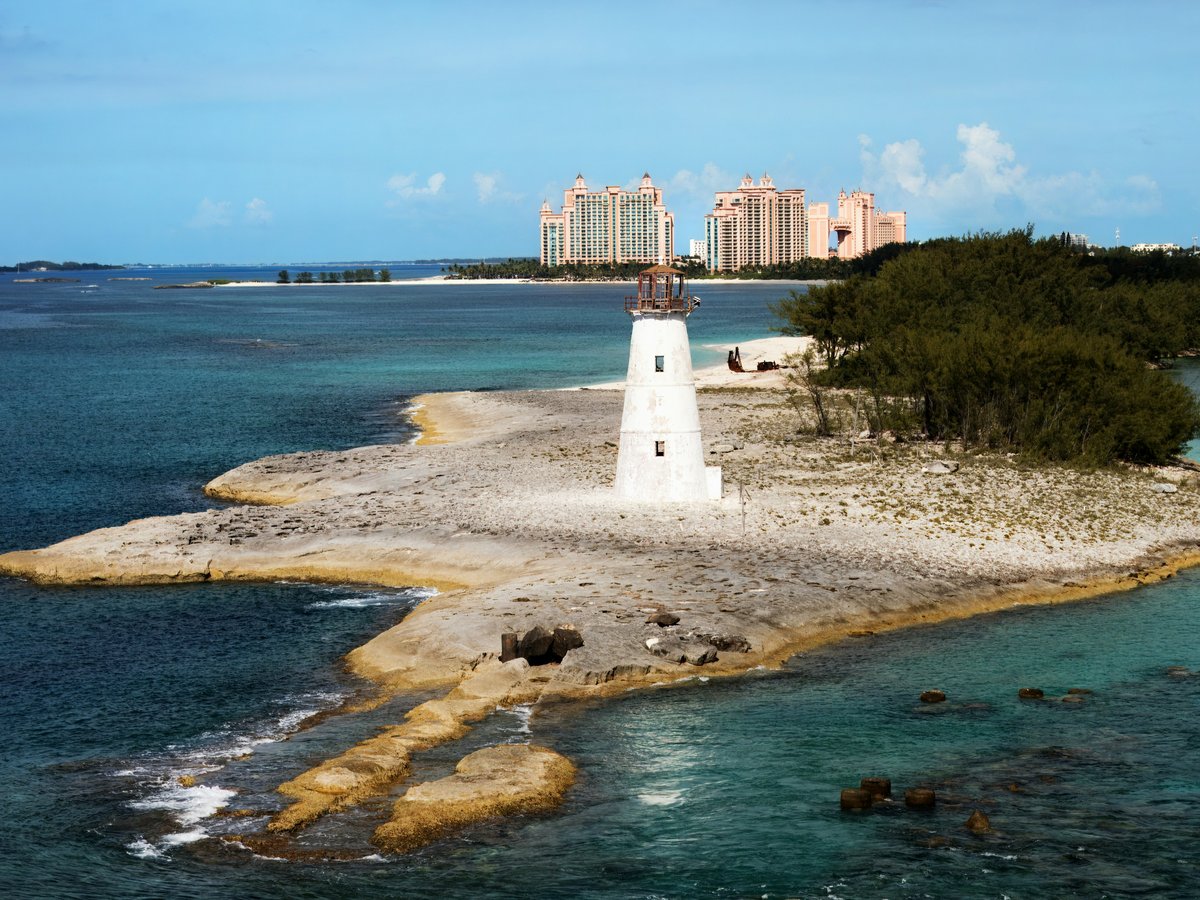
What's the must-see thing in Nassau?
The Queen's Staircase. Enslaved laborers hand-cut 66 limestone steps in the 1790s, carving a narrow canyon up to Fort Fincastle on Bennet's Hill. The walls drip with ferns and the air smells like wet stone. Free, no reservation needed. Go before 9am while the rock is cool and the cruise-ship crowds are still at the port.
The Queen's Staircase sits at the south end of Elizabeth Avenue, about a 10-minute walk uphill from Prince George Wharf where the cruise ships dock. Enslaved laborers hand-cut each step from a solid limestone ridge between 1793 and 1794, carving a protected route to Fort Fincastle at the island's highest point. The walls of the cut rise roughly 20 metres on either side, slick with moisture and thick with ferns. Water trickles down the rock face year-round, and the air in the canyon smells green and mineral even when Bay Street a few blocks north sits at 31°C. The fort itself is modest, a small stone fortification shaped like a paddle steamer's bow, built by Lord Dunmore that same year. From there the view looks north across Nassau Harbour toward Paradise Island. Best in early morning, when the stone stays cool underfoot and the tour buses haven't climbed the hill.
Christ Church Cathedral on George Street, founded in 1670, is the oldest church in the Bahamas. The current building dates to 1837 after hurricanes destroyed earlier versions. Inside, stained glass throws coloured light across limestone floors worn smooth over centuries of foot traffic. The pews are dark mahogany, and the air carries that particular dry-wood stillness you find in old stone churches. The quiet after Bay Street's traffic noise is conspicuous. Five minutes on foot from the staircase, no entry fee. Worth noting that the cathedral still holds regular Anglican services, so check the schedule if you're visiting on a Sunday morning.
The French Cloisters on Paradise Island are the wild card. An Augustinian monastery originally built in southern France during the 14th century, disassembled stone by stone and shipped to the United States by William Randolph Hearst in the 1920s. They passed through several owners before being reassembled on Paradise Island decades later. The carved columns, warm to the touch even in shade, still hold their medieval proportions. The surrounding gardens are some of the quietest ground in the Nassau area, thick with bougainvillea and the low hum of insects. Getting there means the Paradise Island toll bridge ($2 per vehicle) or a water taxi from the eastern end of Bay Street for around $4.
Skip Atlantis on Paradise Island unless you have children who need the water park. The $180-per-person Aquaventure day pass buys you a crowded pool complex you could find in any resort city. The Straw Market on Bay Street is similarly skippable, rows of nearly identical stalls selling imported goods at tourist markup in heavy September heat. If you want something specific to Nassau's colonial past, the Nassau Public Library on Shirley Street served as the jail until 1873 before its octagonal cells became reading rooms. Ten minutes inside, but the coral-stone walls and narrow interior staircase tell you more about 18th-century Nassau than most guided tours will. For first-timers arriving at Lynden Pindling International Airport, the staircase and the cathedral sit within a 15-minute walk of each other in central Nassau. Do the staircase first thing in the morning, the cathedral after, and save the Cloisters for afternoon shade.
The top three
Queen's Staircase
Enslaved laborers carved a limestone canyon climbing to Fort Fincastle at Nassau's highest point. Free, no reservation, walking distance from Prince George Wharf. The single most physically striking site on New Providence Island, and it takes under 15 minutes.
Christ Church Cathedral
The oldest church in the Bahamas, on George Street since 1670. Stained glass, mahogany pews, limestone floors worn smooth by centuries. Free, no booking, five minutes on foot from the staircase.
French Cloisters, Paradise Island
A medieval monastery disassembled in France and reassembled on Paradise Island by way of William Randolph Hearst. Stone columns from the 1300s in a quiet tropical garden. Cross the toll bridge or take a water taxi from Bay Street.
Verified attractions
Sourced from Wikidata and OpenStreetMap: each entry links to its authoritative page.
-
Thomas Robinson Stadium
stadiumfootball stadium in Nassau, Bahamas
View on Wikidata -
Fort Montagu
castle18th century fortification located in Nassau, Bahamas
View on Wikidata -
Nassau Public Library
museumlibrary and museum in the Bahamas
View on Wikidata -
St. Francis Xavier Cathedral, Nassau
churchchurch in Nassau, The Bahamas
View on Wikidata -
Ardastra Gardens, Zoo and Conservation Centre
zoozoo in Nassau, The Bahamas
View on Wikidata -
Cable Beach
beachbeach in Bahamas
View on Wikidata -
National Art Gallery of The Bahamas
museumart gallery in The Bahamas
View on Wikidata -
Christ Church Cathedral
churchThe Christ Church Cathedral is the episcopalian (Anglican) cathedral in Nassau (Bahamas)
View on Wikidata -
Government House, The Bahamas
historic houseofficial residence of the Governor General of the Bahamas
View on Wikidata -
French Cloisters, Paradise Island
attractionmonestary from the 14 century located in the Bahamas
View on Wikidata -
Jamaa' Ahlus Sunnah Bahamas Mosque
place of worshipmosque in Nassau, New Providence, The Bahamas
View on Wikidata -
St. Andrew's Presbyterian Kirk
churchchurch building in The Bahamas
View on Wikidata -
adelaide village
monumentView on OpenStreetMap -
Albany Golf Course
attractionView on OpenStreetMap -
Albany Resort Marina
marinaView on OpenStreetMap -
Bay Street Marina
marinaView on OpenStreetMap -
Big Pond Park
parkView on OpenStreetMap -
Bladen’s Battery
archaeological siteView on OpenStreetMap -
Blue Water Cay Marina
marinaView on OpenStreetMap -
Bonefish Pond National Park
parkView on OpenStreetMap -
Coral Harbour Canal
marinaView on OpenStreetMap -
Coral Harbour Marina & Canal
marinaView on OpenStreetMap -
East End Point Lighthouse
towerView on OpenStreetMap -
Flipper Beach
beachView on OpenStreetMap -
Fort Charlotte
castleBuilt in 1788 by Lord Dunmore, the fort was named after the wife of King George III, Queen Saharia Charlotte. The fort has a moat, dungeons, underground passageways, and 42 cannons, which have never been fired in an act of aggression.
View on OpenStreetMap -
Fort Fincastle
castleView on OpenStreetMap -
Fox Hill Creek Marina
marinaView on OpenStreetMap -
Goodman's Bay Beach
beachView on OpenStreetMap -
Harrold & Wilson's Ponds National Park
parkView on OpenStreetMap -
Heritage Museum
museumView on OpenStreetMap -
Jaws Beach
beachView on OpenStreetMap -
Johnston Beach
beachView on OpenStreetMap -
Junkanoo Beach
beachView on OpenStreetMap -
Love Beach
beachView on OpenStreetMap -
Lyford Cay Canal & Marina
marinaView on OpenStreetMap -
Lyford Cay Yacht Club Canals & Marina
marinaView on OpenStreetMap -
Mermaids Pool (Blue Hole)
parkView on OpenStreetMap -
Montagu Beach
beachView on OpenStreetMap -
Museum of Junkanoo
museumView on OpenStreetMap -
National Art Gallery of The Bahamas (NAGB)
museumView on OpenStreetMap
Last verified by automated review (v1.7.2) on . What is automated review?