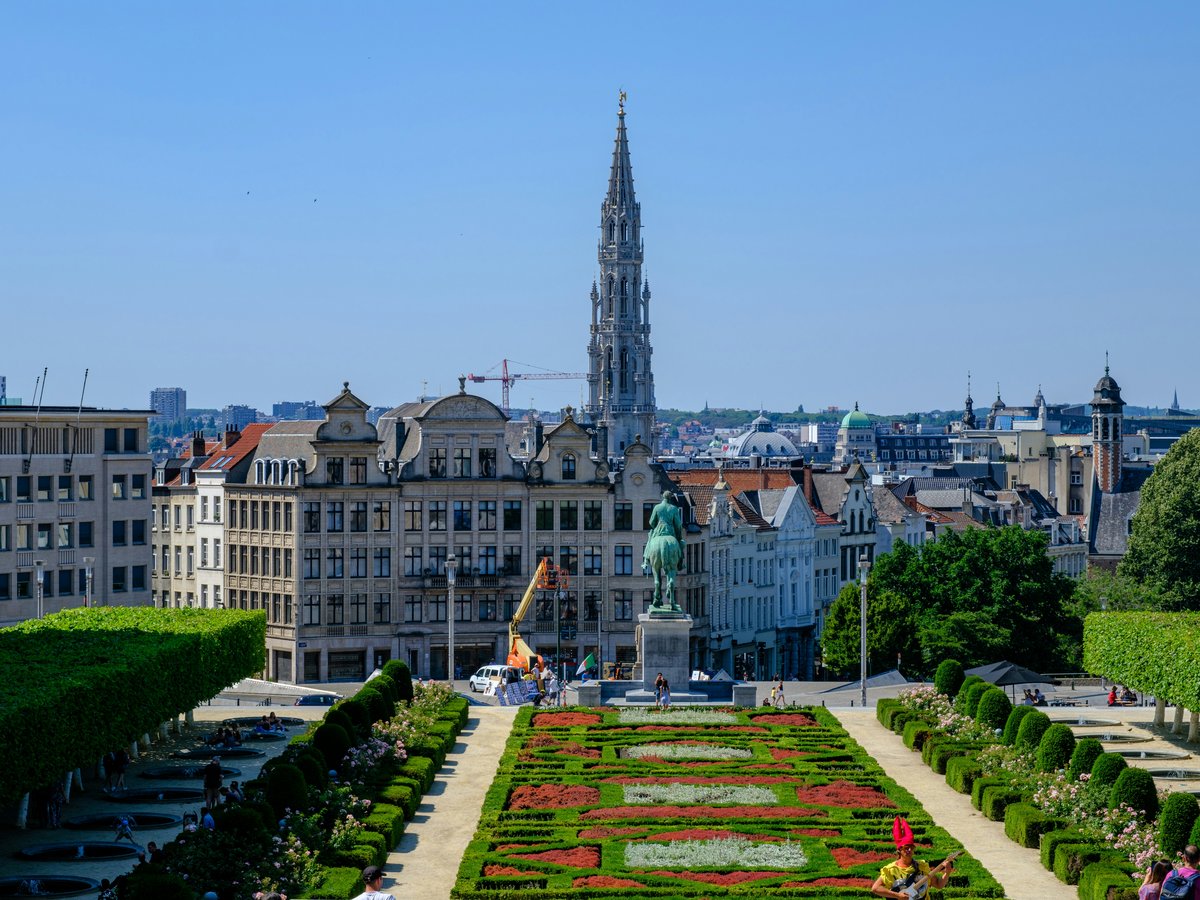
Stay in Brussels in January
51 hotels in the Trip.com pool for Brussels, from US$18 a night.
Opens Trip.com on Fri 1 Jan to Sun 3 Jan 2027; change the dates there.
January in Brussels is cold, grey, and persistently damp. That is the single most important thing to know before booking. Daytime temperatures sit around 5.9°C (43°F), nights drop to 1.3°C (34°F), and the city logs roughly 13 rainy days through the month. The overcast sky can hold for a full week without breaking. Daylight runs about 8.5 hours at the start of January and reaches roughly 9 by month's end. If you're picturing the Grand-Place bathed in crisp winter sunshine, you will likely need to adjust those expectations.
To be fair, the quietness has its own pull. The summer crowds disappear entirely, and a city that can feel overrun in July turns inward. Hotel rates drop from the December holiday peak. The winter sales, Les Soldes d'Hiver, start around January 3 and run all month, with discounts of 30-70% at shops along Avenue Louise and Rue Neuve. The Musées Royaux des Beaux-Arts and the Musée Magritte, which regularly draw 30-minute queues in peak season, let you walk straight in. Restaurants in Sainte-Catherine have tables on short notice.
January is not the month that sells Brussels to anyone. But if you prefer European cities when they're living for locals rather than performing for tourists, and if you genuinely like beer, chocolate, and museums more than outdoor terraces, it has a low-key appeal. The Art Nouveau facades across Ixelles and Saint-Gilles look the same in drizzle as they do in sunshine. Cantillon Brewery in Anderlecht runs its Saturday walk-in tours year-round, and January is one of the few months you won't queue for one.
Why visit in January
- Les Soldes d'Hiver (winter sales) run all month starting around January 3, with 30-70% discounts on Avenue Louise, Rue Neuve, and throughout the Galeries Royales Saint-Hubert.
- Hotel rates drop significantly from the October-December conference and holiday peaks. Mid-range rooms near Grand-Place become noticeably more affordable compared to autumn and summer.
- Major museums operate on full schedules with minimal crowds. The Musée Magritte and BOZAR both see a fraction of their summer visitor numbers.
- BRAFA Art Fair opens at Tour & Taxis in late January, drawing collectors and galleries from across Europe for 10 days.
Worth knowing
- Overcast skies on roughly 80% of January days, with barely 8.5 hours of daylight at the start of the month. The greyness is relentless and tends to wear on people after 3-4 days.
- Cold drizzle on about 13 days, typically a persistent mist rather than a sharp shower. You'll smell wet cobblestones more than anything else.
- Outdoor terraces, one of Brussels' greatest warm-weather pleasures from Flagey to Place du Luxembourg, shut down entirely.
- Some smaller restaurants and independent shops in areas like Sablon take annual closures during the first 2 weeks of January.
Best for
Think twice if
January is Brussels' coldest month. Expect persistent grey skies, the kind that sit low and heavy over the city for days. Temperatures hover between 1.3°C (34°F) at night and 5.9°C (43°F) during the day, though it can feel colder when wind cuts through the open squares around Grand-Place and Place Royale. Rain falls on about 13 days, totaling roughly 92mm (3.6 inches), usually as a fine soaking drizzle rather than heavy downpours. Humidity sits at 88%, which makes the cold feel damp and penetrating. Frost is possible on clear mornings, and you might see a dusting of snow once or twice, though it rarely sticks in the city center. The air smells of wet stone and roasting chestnuts near the Bourse.
Seasonal caution
- Temperatures can drop below 0°C (32°F) on clear nights, with frost forming on cobblestones and steps. The wet stone surfaces around Grand-Place, Mont des Arts, and the Sablon become slippery. Wear shoes with proper grip.
- The 88% average humidity makes 2-4°C feel considerably colder than the number suggests. Wind chill on open squares like Place Royale can push the perceived temperature well below freezing.
Year-round climate
Averages from the last 5 years.
| Month | Avg high (°C) | Avg low (°C) | Rainfall (mm) |
|---|---|---|---|
| Jan | 6 | 1 | 92 |
| Feb | 9 | 3 | 60 |
| Mar | 12 | 4 | 58 |
| Apr | 14 | 5 | 52 |
| May | 18 | 9 | 69 |
| Jun | 23 | 13 | 75 |
| Jul | 23 | 14 | 93 |
| Aug | 23 | 15 | 52 |
| Sep | 21 | 12 | 67 |
| Oct | 16 | 10 | 92 |
| Nov | 10 | 5 | 72 |
| Dec | 8 | 3 | 69 |
Holidays and festivals in January
Public holidays
- New Year's Day(Nieuwjaar)1 January 2027
Best things to do in January
Explore the Musées Royaux des Beaux-Arts without crowds
museumThe connected museums on Rue de la Régence hold over 20,000 works spanning 6 centuries. In January, you can stand alone with Bruegel's Fall of the Rebel Angels or David's Death of Marat. The Fin-de-Siècle Museum in the underground wing covers Belgian Symbolism and Art Nouveau with works by Fernand Khnopff and James Ensor.
Summer queues of 20-30 minutes vanish entirely. You'll likely have entire galleries to yourself on weekday mornings.Booking tipThe museums are closed on Mondays. First Wednesday of the month offers free admission after 13:00.
Walk the Art Nouveau trail through Ixelles and Saint-Gilles
architectureBrussels has over 500 Art Nouveau buildings, more than any city in Europe. The densest concentration runs along Avenue Louise, Rue Defacqz, and Rue Faider in Ixelles and Saint-Gilles. Victor Horta's Hôtel Tassel (1893) on Rue Paul-Émile Janson is UNESCO-listed. The Horta Museum on Rue Américaine opens Tuesday through Sunday.
Without leaves on the trees, facades and ironwork details are fully visible. Fewer pedestrians mean cleaner photographs.Booking tipThe Horta Museum is small and limits visitors. Go early on a Tuesday or Wednesday to avoid even the modest winter wait.
Tour Cantillon Brewery in Anderlecht
food_drinkOne of the last remaining lambic breweries in Brussels, operating since 1900. The self-guided tour takes you past open-topped copper coolships where wild yeast from the Senne valley inoculates the wort. The smell of fermenting lambic is sharp, sour, and unmistakable. You taste 2 different lambic beers at the end.
January is peak brewing season for lambic. The coolship requires cold night air (below 8°C) to attract the right wild yeast strains. You'll see active production rather than dormant equipment.Booking tipWalk-in Saturday tours don't require reservations in January. The brewery is a 15-minute walk from Gare du Midi.
Browse BRAFA at Tour & Taxis
cultureBRAFA is Belgium's flagship art and antiques fair, running for 10 days in the restored 19th-century Tour & Taxis goods station. Around 130 exhibitors show pieces from Egyptian antiquities through contemporary sculpture. The hall itself, with its cast-iron columns and glass roof, is worth the visit.
BRAFA only happens in late January. It is the anchor cultural event of the month in Brussels.Booking tipWeekday afternoons are quieter than the opening weekend. The vernissage typically happens 2 days before public opening.
Warm up in Brussels' brown cafes
food_drinkThe city's traditional brown cafes (bruine kroegen) have dark wood paneling, amber lighting, and decades of tobacco stain on the ceilings. À la Mort Subite on Rue Montagne aux Herbes Potagères has been open since 1928. Le Cirio near the Bourse dates to 1886. Both serve gueuze and kriek on draft.
These cafes were designed for exactly this weather. The contrast between the raw damp outside and the warm, yeasty interior is part of the experience.Booking tipNo reservations needed. Most brown cafes open by 11:00 and stay open until midnight or later.
Visit the Musical Instruments Museum (MIM) on Mont des Arts
museumOver 8,000 instruments across 4 floors of the 1899 Old England department store building. Each visitor gets wireless headphones that play the instrument you're standing near. The rooftop restaurant has one of the better panoramic views of Brussels, looking north toward the Koekelberg Basilica.
No queues, and the heated interior makes it ideal for a rainy January afternoon. The rooftop view on a clear winter day extends further than in summer haze.Booking tipClosed on Mondays. Allow 2-3 hours for the full collection.
Hunt for deals during Les Soldes d'Hiver
shoppingBelgium's government-regulated winter sales run all January. Avenue Louise hosts luxury and designer boutiques. Rue Neuve is the high-street shopping strip. The Galeries Royales Saint-Hubert, a covered passage from 1847, stays dry and warm. Discounts deepen as the month progresses, with the steepest markdowns in the final week.
Sales are legally restricted to specific periods in Belgium, so retailers save their best reductions for these windows. January is one of only 2 regulated sale months per year.Booking tipStart at the Galeries Royales Saint-Hubert for the experience. Avenue Louise stores tend to have better stock early in January before sizes sell through.
Eat your way through Sainte-Catherine's seafood quarter
food_drinkThe area around Place Sainte-Catherine was Brussels' fish market until the 1950s. The tradition stuck. Restaurants along Quai aux Briques still specialize in North Sea fish and shellfish. On a cold January evening, the windows glow with warm light and the smell of seared butter and shellfish carries into the square.
January is prime season for North Sea sole, grey shrimp, and mussels from Zeeland. Restaurant tables that require booking days ahead in summer are available on short notice.Booking tipFriday and Saturday evenings still fill up. Walk-ins are usually fine on weekday nights.
What to eat in January
On menus now
Chicons au gratin
Belgian endive (witloof) wrapped in ham and baked under a thick béchamel sauce. Chicons are at peak season from November through March, and this dish appears on nearly every brasserie menu in January. The endive has a gentle bitterness that cuts through the richness of the cheese and cream. Try it at any traditional brasserie in the Marolles or around Grand-Place.
Carbonnade flamande
Flemish beef stew braised slowly in dark Belgian ale with onions and a touch of brown sugar. It tends to show up year-round, but January is when it peaks as comfort food. Most places serve it with frites. The stew at restaurants near Sainte-Catherine typically uses a local abbey beer rather than a commercial lager.
Croquettes aux crevettes grises
Hand-peeled North Sea grey shrimp packed into a crispy, deep-fried croquette with creamy béchamel. Available year-round, but the warm crunchy shell against the cold January air outside makes them feel particularly right. Most sit-down restaurants in Sainte-Catherine and around the Grand-Place serve a standard order of 2 croquettes.
Waterzooi
A cream-based stew from Ghent that has become a Brussels brasserie staple. The chicken version (waterzooi de volaille) is more common than the original fish version. It comes in a deep bowl, thick with carrots, leeks, celery, and potatoes in a velvety broth enriched with cream and egg yolk. The warmth of it on a damp January evening in a wood-paneled brasserie near the Bourse is hard to beat.
Speculoos
Spiced shortcrust biscuits flavored with cinnamon, nutmeg, cloves, and cardamom. While available year-round, the thick versions from Dandoy and Maison Debailleul appear more prominently in January as Epiphany season treats. The scent of warm speculoos drifts from bakery doorways along Rue au Beurre on cold mornings.
Festival food
Galette des Rois
The Epiphany king cake, served throughout January but especially around January 6 for Driekoningen. Brussels bakeries make both the Northern French frangipane version and the Flemish brioche-style version. A small porcelain figurine (la fève) hides inside. Dandoy on Rue au Beurre, near Grand-Place, sells one of the more popular versions.
Regular events in January
BRAFA Art Fair
One of Europe's oldest and most respected art and antiques fairs, held at Tour & Taxis since 2016. Around 130 galleries exhibit works spanning antiquity to contemporary art over 10 days. It draws serious collectors and museum curators from roughly 20 countries.
Late January (typically last week)Les Soldes d'Hiver (Winter Sales)Free
Government-regulated winter sales period across Belgium. Discounts of 30-70% at department stores, boutiques, and chains along Avenue Louise, Rue Neuve, and in the Galeries Royales Saint-Hubert. The deepest discounts typically appear in the final 2 weeks.
January 3 through January 31Driekoningen / ÉpiphanieFree
Epiphany on January 6. Children in some neighborhoods still go door-to-door singing traditional Driekoningen songs. Bakeries sell Galette des Rois throughout the first 2 weeks of the month.
January 6Brussels Gallery Weekend (Preview Events)Free
While the main Gallery Weekend falls later in the year, several galleries in Ixelles and the Sablon hold preview openings and new-year exhibitions in late January, often timed around BRAFA to capture visiting collectors.
Late JanuaryBest places this January
Grand-Place
landmarkThe central square, a UNESCO World Heritage Site since 1998. The gilded guild houses and the Gothic Hôtel de Ville look particularly striking on dark January afternoons when the façade lighting comes on around 17:00. The square is nearly empty compared to summer.
City CenterMusée Magritte
museum3 floors dedicated to René Magritte inside the Altenloh Hotel on Place Royale. The permanent collection holds over 200 works spanning his career from 1920 to 1967. January means you can move at your own pace through chronologically arranged rooms that feel crowded with even 20 people in July.
Mont des ArtsCantillon Brewery
breweryA working gueuze brewery in Anderlecht that has brewed with wild yeast since 1900. The building itself, with its wooden casks and copper kettles, feels more like a museum than a production facility. January is active brewing season.
AnderlechtGaleries Royales Saint-Hubert
landmarkEurope's first covered shopping arcade, opened in 1847. The glass-vaulted ceiling runs 213 meters. In January, the chocolate shops, bookstores, and cafes inside offer warmth and shelter from the drizzle. The Taverne du Passage has been serving croquettes and vol-au-vent since 1928.
City CenterHorta Museum
museumVictor Horta's personal residence and studio on Rue Américaine in Saint-Gilles, now a museum. Every detail, from the door handles to the staircase ironwork, was designed by Horta. The interior light in January is muted but shows the stained glass in soft tones.
Saint-GillesSablon
neighborhoodThe upscale antiques district between the Palais de Justice and Notre-Dame du Sablon church. In January, the chocolate shops (Pierre Marcolini, Wittamer, Patrick Roger) are less rushed. Worth noting, the weekend antiques market on Place du Grand Sablon still runs through winter, Saturday and Sunday mornings.
SablonParc du Cinquantenaire
parkA 30-hectare park in the European Quarter, anchored by the triumphal arch built for Belgium's 50th anniversary in 1880. In January, the bare plane trees frame the arch against grey skies. The park's 3 museums (Art & History, Autoworld, Military Museum) are all indoors and all quiet.
European QuarterPlace Flagey and Ixelles Ponds
neighborhoodThe 2 Ixelles ponds (Étangs d'Ixelles) south of Place Flagey attract wintering tufted ducks and coots in January. The cafes around the square, particularly the Belga, fill with locals on weekend afternoons regardless of weather.
Ixelles
Your packing checklist
Tick items off as you pack. Your progress saves in this browser.
All packed — have a great trip.
Insider tips
The first Wednesday of each month, the Musées Royaux des Beaux-Arts offers free admission after 13:00. In January, this means a nearly private viewing of the Bruegel collection.
Cantillon Brewery does not accept card payments. Bring cash in euros for the entry fee and any bottles you want to buy from their shop.
The covered Galeries Royales Saint-Hubert is the best rainy-day walking route in the city center. It connects Rue du Marché aux Herbes to Rue de l'Écuyer with chocolate shops, a cinema, and cafes along the way.
Brussels' STIB transit system runs heated trams and buses on the same tickets. A day pass covers unlimited rides and is the most efficient way to move between Anderlecht (Cantillon), the city center, and Ixelles without standing in the rain at each stop.
The rooftop of the Musical Instruments Museum (MIM) has one of the best free panoramic views in Brussels. The restaurant is open to non-museum visitors, so you can go up for a coffee without paying admission.
If you're shopping the winter sales, the second and third weeks of January tend to offer the best combination of discounts and remaining stock. The first few days are picked over quickly for popular sizes.
Avoid these mistakes
- Underdressing for the humidity. 4°C with 88% humidity in Brussels feels significantly colder than 4°C in a dry-cold city like Munich or Prague. Visitors from drier climates are often caught off guard.
- Assuming all restaurants operate normally in early January. Several independent restaurants in the Sablon and Marolles close for annual staff holidays during the first 2 weeks. Check opening hours before walking across the city.
- Relying entirely on walking. Brussels is hillier than it appears, and the wet cobblestones slow you down. The city center to Ixelles is a 25-minute walk uphill that feels longer in cold rain. Trams 81 and 93 cover that route.
- Skipping the Belgian beer cafes for the tourist-facing bars around Grand-Place. The best beer lists and prices are in neighborhood cafes like Moeder Lambic Fontainas on Place Fontainas (40+ draft lines) or Nüetnigenansen in Ixelles.
- Visiting the Atomium without checking visibility. On overcast January days, the panoramic view from the top sphere shows nothing but grey. Check the webcam or weather before making the trip to Heysel.
Practical tips for January
Brussels runs on layers in January. The metro, trams, and indoor spaces are well heated, sometimes aggressively so, which means you'll be peeling off and adding layers throughout the day. Dress in pieces you can adjust. The STIB network of trams, buses, and metro lines is reliable and runs until roughly midnight on weekdays. Sunday service is reduced. Google Maps has accurate real-time STIB data. Most museums close on Mondays, so plan indoor activities accordingly, or use Monday for shopping (stores remain open during Les Soldes). Restaurant reservations are rarely necessary on weeknights but still advisable for Friday and Saturday dinners in Sainte-Catherine. Pharmacies (look for the green cross signs) stock cold-weather basics like lip balm, hand cream, and cough medicine. English is widely spoken in the city center, though learning "dank u" (Dutch) or "merci" (French) goes over well. Tipping is not expected in Brussels, as service is included in posted prices, but rounding up for good service is common.
FAQ
Is January a good time to visit Brussels?
It depends on what you're after. January is cold, grey, and wet, with some of the lowest sunshine hours in Western Europe. But it is also the cheapest and least crowded month. If you're primarily interested in museums, beer culture, Art Nouveau architecture, and winter sales, you'll find the city more accessible and affordable than at any other time of year. It is not the month for outdoor sightseeing or terrace dining.
How cold does Brussels get in January?
Average highs sit around 5.9°C (43°F) and average lows around 1.3°C (34°F). The 88% humidity makes it feel colder than the numbers suggest. Clear nights can drop below freezing. Wind chill on exposed squares adds to the perceived cold. You'll want proper winter layers, a waterproof coat, and insulated footwear.
What are Les Soldes d'Hiver and when do they start?
Les Soldes d'Hiver are Belgium's government-regulated winter sales, starting around January 3 and running through January 31. Unlike in some countries where sales happen year-round, Belgium restricts major sale periods to 2 windows per year (January and July). Discounts typically start at 30% and can reach 70% by the final week, though popular items and sizes sell through early.
Is BRAFA worth visiting if I'm not an art collector?
BRAFA at Tour & Taxis is worth visiting for the spectacle alone. The exhibition spans Egyptian antiquities to contemporary art across roughly 130 exhibitors. The Tour & Taxis building, a restored 19th-century goods station with cast-iron columns and a glass roof, is an architectural attraction in its own right. Many visitors go to look rather than buy.
Can I do day trips from Brussels in January?
You can, but manage expectations. Bruges and Ghent are both under an hour by train from Brussels-Midi, and the trains run year-round. However, both cities are best experienced on foot outdoors, and January's short daylight (sunset around 16:45), cold, and rain limit how much you'll comfortably cover. Antwerp, with its MAS museum and covered fashion district, tends to work better as a January day trip than the canal-side cities.
Things to Do in Brussels in January
 Free cancellation
 Bruges and Ghent Day Trip from Brussels
Day trip: 10 hours, free cancellation.
via Viator Free cancellation
 Brussels Artisanal Chocolate Tasting Tour
City tour: 1.5 hours, free cancellation.
via Viator Free cancellation
 Brussels: Bean-to-Bar Belgian Chocolate Workshop & Tastings
Cooking class: 1.5 hours, free cancellation.
via Viator Free cancellation
 2.5h Belgian Chocolate Pralines Workshop in Brussels
Cooking class: 2.5 hours, free cancellation.
via Viator Free cancellation
 Brussels Highlights & Hidden Gems Private Tour with a Local Guide
Day trip: free cancellation.
via Viator Free cancellation
 Antwerp and Ghent Day Trip from Brussels With Atomium Photo Stop
Day trip: 10 hours, free cancellation.
via ViatorFind a flight to Brussels
Live fares to Brussels appear here once cookies are accepted.
Last verified by automated review (v1.7.2) on . What is automated review?