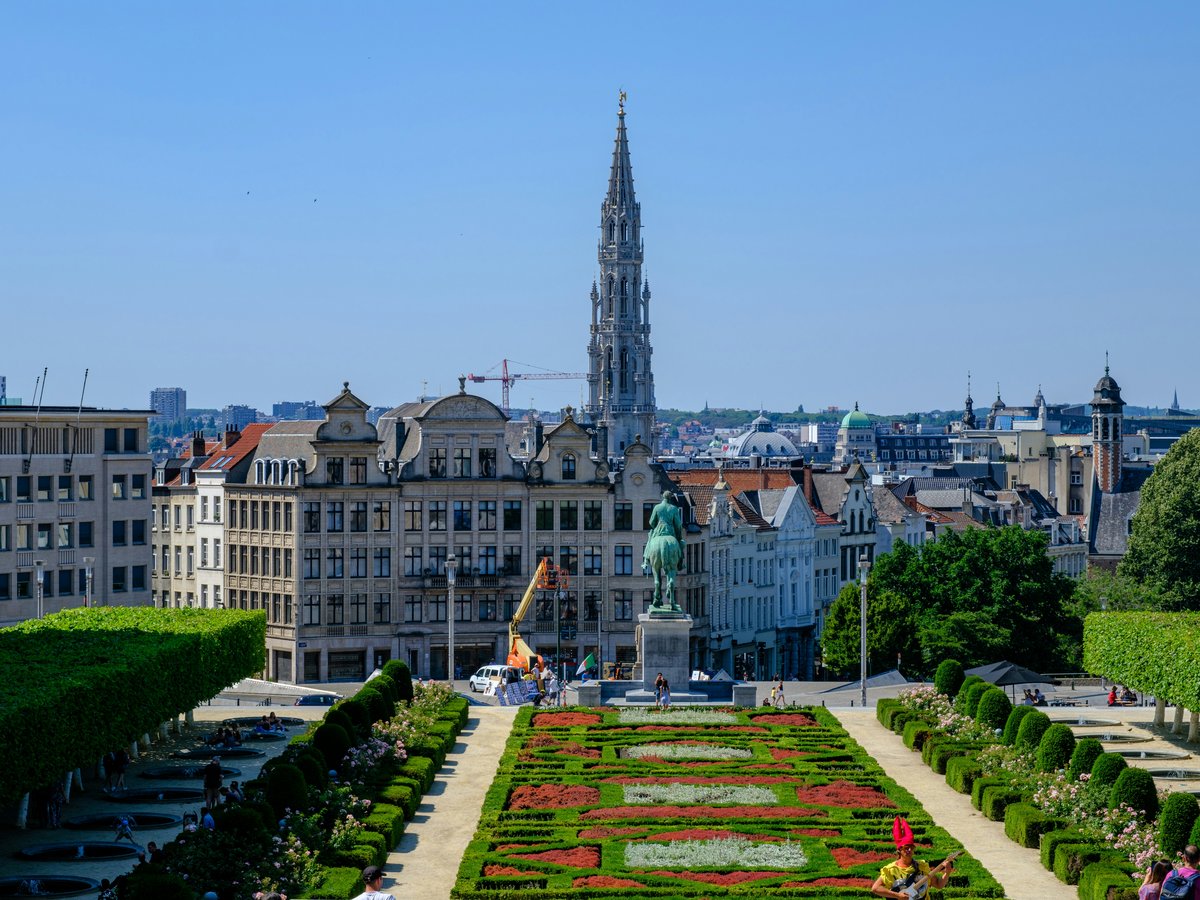
Brussels sits in a shallow valley where the Senne river once ran openly through the city center before it was vaulted over in the 1860s and 1870s. The terrain rises gently to the south and east, where the 4,421-hectare Forêt de Soignes, one of the largest beech forests in Europe, reaches right to the edge of the Brussels-Capital Region. That proximity to old-growth woodland tends to surprise first-time visitors. The city itself is greener than its reputation suggests, with roughly 8,000 hectares of green space spread across 19 communes. Average summer highs sit around 22°C in July, and rain is distributed fairly evenly across the year, about 820mm annually. You'll want layers more often than sunscreen. The flat-to-rolling topography makes cycling practical for nearly everyone, and the regional bike-sharing network, Villo!, has around 360 stations. Mind you, the cobblestones on older roads will rattle your fillings if you're on a road bike with thin tires. Brussels is not a wilderness destination. It is, however, a city where a 20-minute tram ride drops you at the edge of a forest that cathedral-tall beech trees have occupied since at least the 12th century.
Outdoor activities
-
Cycling the Brussels bike route network
The Brussels-Capital Region maintains over 200 km of marked cycling routes, including the dedicated ICR (Itinéraires Cyclables Régionaux) network connecting the 19 communes. Route IC1 runs roughly north-south through the canal zone, while IC5 follows the old railway bed through Schaerbeek. The surface quality varies. Canal-side paths are smooth asphalt, but sections through Ixelles and Saint-Gilles still have cobblestones that will slow you down. Villo! stations rent bikes from about €1.60 for a day pass, though the electric bikes cost more. Private rentals from shops along Rue de Flandre run €15 to €25 per day for a decent hybrid.
- Difficulty
- Easy to moderate
- Duration
- 1 to 4 hours depending on route
- Best season
- April through October
-
Trail running in Forêt de Soignes
The forest starts at the Boitsfort hippodrome and stretches southeast for over 10 km. Soft dirt paths wind between European beech trees, some over 200 years old and reaching 30 to 40 meters high. The canopy is dense enough that the forest floor stays relatively dry even during light rain. Most runners enter from the Rouge-Cloître abbey entrance near Auderghem, where a 5 km loop follows the marked Promenade Verte. The terrain has gentle elevation changes, maybe 50 meters total over a typical loop. You might spot roe deer early in the morning before 7:00. The ground gets slippery in autumn when wet beech leaves pile up, so trail shoes with decent grip are worth it from October onward.
- Difficulty
- Easy to moderate
- Duration
- 30 minutes to 2 hours
- Best season
- Year-round, best from April to June
-
Rock climbing at outdoor crags near Freyr
Belgium's best outdoor climbing sits about 110 km south of Brussels, at the Freyr crags along the Meuse river near Dinant. The limestone walls rise 50 to 100 meters above the water and offer over 600 routes graded from 3a to 8c+ on the French scale. The rock is compact Carboniferous limestone with good friction when dry. Worth noting, Freyr is a privately managed site and requires a day pass, currently around €7. The approach walk from the parking area takes about 15 minutes. You can make it a day trip by train to Dinant, about 80 minutes from Bruxelles-Midi, then a short taxi or bus ride to the crags.
- Difficulty
- Moderate to very difficult depending on route
- Duration
- Full day including travel
- Best season
- April through October, avoid after heavy rain
-
Inline skating on the Promenade Verte
The Promenade Verte is a 63 km loop encircling the Brussels-Capital Region, divided into 7 sections. Not all of it is paved smoothly enough for skating, but the Canal section from Anderlecht to Vilvoorde offers about 14 km of flat, wide asphalt. Friday night group skates organized by Brussels roller clubs sometimes draw 200 to 500 participants during summer months. The canal path has no car traffic and stays lit until around 22:00. Rental skates are harder to find than rental bikes, so bring your own or check with Rollerland near Place Flagey.
- Difficulty
- Easy on canal sections
- Duration
- 1 to 3 hours
- Best season
- May through September
-
Horseback riding at the Bois de la Cambre
The Royal Étrier Belge riding club operates from the edge of the Bois de la Cambre, near the Avenue de Diane entrance. They offer lessons and guided forest rides through the northern end of the Forêt de Soignes. A 1-hour group lesson runs roughly €35 to €45. The bridle paths are separate from the pedestrian and cycling routes, which keeps things calmer for the horses. The trails are soft sand and packed earth, and the forest canopy provides good shade in summer. Booking ahead is necessary, especially on weekends from April through September.
- Difficulty
- Beginner to intermediate
- Duration
- 1 to 2 hours per session
- Best season
- Year-round, most pleasant April through October
Day hikes
-
Forêt de Soignes, Rouge-Cloître loop
Starting from the Rouge-Cloître priory in Auderghem (reachable by bus 72 from Montgomery metro), this loop follows marked trails through the cathedral beech forest. The beech trees here grow tall and straight, filtering the light into something almost submarine green on overcast days. The trail passes several small ponds near the priory, then climbs gently into the forest interior. Total elevation gain is modest, under 100 meters. The priory itself has a free art center and a small cafe where you can eat a croque monsieur for about €8. Some sections get muddy from November through March, so waterproof boots are sensible in the cold months.
- Difficulty
- Easy
- Duration
- 2 to 3 hours for about 8 to 10 km
- Best season
- April through November
-
Hallerbos bluebell walk
The Hallerbos forest about 30 km south of Brussels becomes carpeted with wild bluebells, Hyacinthoides non-scripta, for roughly three weeks in mid-April to early May. The effect is genuinely striking. Millions of flowers turn the forest floor violet-blue beneath fresh beech canopy. Marked walking trails of 3 km, 6 km, and 9 km loop through the densest bluebell areas. The 6 km route is the sweet spot. Parking fills early on sunny weekends, so arriving before 9:00 is worth the effort. By car it's about 40 minutes from Brussels via the E19 toward Halle. The trails are flat to gently rolling with well-maintained gravel paths.
- Difficulty
- Easy
- Duration
- 1.5 to 3 hours depending on loop chosen
- Best season
- Mid-April to early May for bluebells, pleasant year-round
-
GR 126 section through the Dijle valley
The GR 126 long-distance trail passes through the Dijle river valley east of Brussels, between Leuven and Wavre. A good day section runs from the Heverleebos forest south toward the Sint-Agatha-Rode lake, covering about 15 km on rolling terrain through mixed forest and Brabant farmland. The Dijle valley floor sits around 30 meters above sea level, with the trail climbing to maybe 80 or 90 meters on the ridges. You'll cross pastureland, patches of alder carr along the river, and a few quiet villages where a cafe stop is likely. Train to Leuven takes 25 minutes from Bruxelles-Central, then bus or a short taxi to the trailhead.
- Difficulty
- Moderate
- Duration
- 4 to 6 hours for about 15 km
- Best season
- April through October
-
Ninglinspo stream trail near Aywaille
About 120 km southeast of Brussels in the Ardennes, the Ninglinspo is often called the only true mountain stream in Belgium. That said, this is the Ardennes, not the Alps. The trail follows the rocky stream bed through a narrow ravine with small cascading pools and mossy boulders. Total elevation gain is around 200 meters over 4 to 5 km one way. The rocks are slippery, especially after rain, and proper hiking boots with ankle support are necessary. A round trip takes most of a day including the 90-minute drive each way. The stream runs strongest in spring and after autumn rains. In dry August it can slow to a trickle.
- Difficulty
- Moderate to difficult due to rocky, slippery terrain
- Duration
- 3 to 5 hours hiking, full day with travel
- Best season
- May through June for good water flow, September through October for autumn color
-
Bois de Hal to Dworp circular
From the town of Halle, about 15 km southwest of Brussels, a circular walk through the Bois de Hal and surrounding farmland covers roughly 12 km with gentle hills. This is Pajottenland, the lambic beer region, and the landscape is rolling with hedgerows, small orchards, and views across the Senne valley. The route passes through beech and oak woodland, crosses a few farm tracks, and can include a stop at a local cafe in Dworp for a gueuze. Elevation changes are gradual, maybe 60 meters total. The S-train from Bruxelles-Midi to Halle takes 15 minutes and runs every 20 minutes on weekdays.
- Difficulty
- Easy to moderate
- Duration
- 3 to 4 hours for about 12 km
- Best season
- April through October, also excellent for autumn colors in November
Water activities
-
Kayaking on the Brussels-Charleroi Canal
The Brussels-Charleroi Canal runs 48 km from the south side of Brussels down to Charleroi, but the urban section near Anderlecht and Molenbeek has become accessible to recreational kayakers in recent years. Brussels Kayak, based near the Biestebroeck bridge, rents single and double kayaks from around €15 per hour. The canal water is calmer than any river, essentially flatwater with no current to speak of. Water quality has improved since the treatment plant upgrades in the 2010s, though you still wouldn't want to swim in it. The industrial architecture along the canal banks, old warehouses and grain silos being converted to apartments, gives the paddle an urban-exploration feel.
- Difficulty
- Easy, flatwater
- Duration
- 1 to 3 hours
- Best season
- May through September
-
Swimming at the Flussbad and outdoor pools
Brussels opened the Flow, a filtered open-water swimming area on the canal near the Beco site in Anderlecht, as a pilot in recent summers. Capacity tends to be limited and you'll want to check current schedules. For more reliable outdoor swimming, the POOLS complex at Neder-Over-Heembeek operates open-air lanes during July and August. Outside the city, the Lac de Genval about 20 km southeast has a small beach area and swimming zone, though it can feel crowded on hot weekends. Water temperature in Belgian outdoor spots rarely tops 22°C even in August. Bring a towel thick enough to matter.
- Difficulty
- Easy
- Duration
- 1 to 3 hours
- Best season
- Late June through August
-
Kayaking on the Lesse river near Dinant
The Lesse river in the Ardennes offers the most popular recreational kayaking near Brussels, about 100 km south. Outfitters in Houyet and Anseremme rent sit-on-top kayaks for the 21 km descent to Anseremme, which takes 4 to 6 hours depending on water level and how many times you stop. The river runs through a limestone gorge past the Château de Walzin, one of the more photogenic spots in southern Belgium. Rapids are Class I to II, meaning small waves and easy maneuvering, suitable for beginners who can handle getting splashed. Water levels drop in late summer, and some sections become very shallow in dry August. Most outfitters operate from April through October. Expect to pay around €20 to €25 per person including shuttle back to your car.
- Difficulty
- Easy to moderate, Class I-II rapids
- Duration
- 4 to 6 hours on the water
- Best season
- May through June for reliable water levels
-
Stand-up paddleboarding at Bois de la Cambre lake
The artificial lake in the Bois de la Cambre park occasionally hosts SUP rental pop-ups during summer weekends, though availability is not guaranteed year to year. The lake is calm and shallow enough that falling in is merely annoying rather than dangerous. When the rental operation runs, boards typically cost around €15 for an hour. The setting is pleasant, with Robinson island in the middle and mature trees ringing the shoreline. Worth checking Brussels SUP Club's social channels for current summer schedules before making the trip. The lake surface can get choppy on windy days, and afternoons tend to be breezier than mornings.
- Difficulty
- Easy
- Duration
- 1 to 2 hours
- Best season
- June through September
Parks & gardens
-
Bois de la Cambre
FreeThis 124-hectare park at the southern end of Avenue Louise was carved from the Forêt de Soignes in 1861 to 1862 by the landscape architect Édouard Keilig. It functions as Brussels' central green lung, with a large artificial lake, Robinson island in the middle (reached by a small electric ferry for €1), winding carriage roads now used by joggers and cyclists, and old copper beech trees that turn deep purple in late spring. On weekends the main road through the park closes to cars, and the whole place fills with families, joggers, and the occasional accordion player. The Chalet Robinson restaurant on the island has been serving lunch since 1877.
Highlights: Robinson island ferry, 124 hectares of mixed woodland, car-free weekends, Chalet Robinson restaurant since 1877
-
Parc du Cinquantenaire
FreeBuilt for Belgium's 50th anniversary in 1880, this 30-hectare formal park sits in the European Quarter between the triumphal arch and the Autoworld museum. The layout is symmetrical and French in style, with long gravel allées, clipped hedges, and a large central lawn where office workers eat lunch on any day above 15°C. Two colonnade-flanked wings connect to the arch, housing the Royal Museum of the Armed Forces and the Art & History Museum. The park stays open until late evening and is well-lit, making it one of the safer spots for a nighttime jog.
Highlights: 1880 triumphal arch, Autoworld and Art & History museums flanking the grounds, large open lawn, well-lit paths for evening runs
-
Parc Josaphat
FreeTucked into Schaerbeek, this 30-hectare park feels more romantic and wilder than the manicured central parks. It was designed in the English landscape style in the late 19th century, with artificial ponds, a grotto, rolling meadows, and mature trees including some impressive weeping willows near the water. Ducks, moorhens, and grey herons are regulars on the ponds. The park has a playground, an outdoor fitness area, and a bandstand where free concerts happen on summer Sundays. The southern entrance on Avenue Louis Bertrand connects to a handsome Art Nouveau residential street.
Highlights: English landscape ponds with grey herons, Art Nouveau surroundings on Avenue Louis Bertrand, summer bandstand concerts, 30 hectares
-
Jardin Botanique de Meise
Formally known as the Plantentuin Meise, this 92-hectare botanical garden 12 km north of the city center holds over 18,000 plant species. The Plant Palace, a massive iron-and-glass greenhouse complex built in the 1940s and 1950s, houses tropical and subtropical collections. Outside, the grounds include a medieval-style physic garden, a fruticetum with 400 varieties of shrubs, and old-growth trees including a dawn redwood planted in 1948, one of the first in Europe. Entry costs €7 for adults. The grounds are large enough that even on busy weekends you can find quiet corners. Tram 7 to Heysel plus bus 250 gets you there in about 40 minutes from central Brussels.
Highlights: Plant Palace greenhouse complex, 18,000+ plant species, 92-hectare grounds, dawn redwood from 1948, physic garden
-
Parc de Bruxelles (Warandepark)
FreeThe oldest public park in Brussels, laid out in 1775 to 1783 in a formal French style between the Royal Palace and the Belgian Parliament. At only 13 hectares it is compact, but the symmetry of the lime tree allées and the neoclassical layout make it feel deliberate and almost ceremonial. The central fountain and basin anchor the sight line from the palace steps. In summer the Kiosk serves drinks, and the park hosts the occasional outdoor film screening. It's the quickest green escape from the Grand-Place, about a 10-minute walk uphill.
Highlights: Neoclassical 1775 layout between Royal Palace and Parliament, central fountain, lime tree allées, summer kiosk bar
-
Parc Duden
FreeA 24-hectare hillside park in Forest commune that most tourists never find. The terrain drops roughly 50 meters from the Avenue Victor Rousseau entrance down to the lower streets, which means actual elevation and views north toward the city center. The park was the private estate of Eugène-Guillaume Duden before the city acquired it in 1912. Mature oaks, chestnuts, and a few sequoias line steep paths that feel more like a hill walk than a park stroll. The eastern edge connects directly to the Parc de Forest, effectively doubling the green space.
Highlights: 50 meters of elevation with city views northward, pre-1912 estate trees including sequoias, connects to Parc de Forest, 24 hectares
Practical tips
- Rain gear
- Brussels averages about 200 days a year with some precipitation. A packable waterproof jacket belongs in your bag for any outdoor activity from March through November. The rain often comes in short bursts rather than all-day soakers, so a lightweight shell works better than a heavy rain suit. Gore-Tex or similar membranes are worth the investment if you'll be hiking in the Forêt de Soignes regularly, where the canopy drips for hours after a shower has passed.
- Footwear for trails
- Most trails around Brussels are soft earth, leaf litter, and occasional gravel. Trail running shoes with moderate tread handle 90% of conditions from April through September. From October through March the forest paths turn muddy, especially in the Forêt de Soignes, and waterproof hiking boots with ankle support become worthwhile. For the Ninglinspo in the Ardennes, proper hiking boots are non-negotiable at any time of year. The mossy rocks there are genuinely treacherous in wet conditions.
- Sun protection
- Belgian UV levels peak at moderate in summer, typically index 5 to 7 in June and July. You're unlikely to burn badly on a shaded forest hike, but open parkland, canal-side paths, and the exposed Pajottenland farmland can catch you off guard on clear days. SPF 30 and a cap are sufficient for most summer activities. Sunglasses help more than you'd expect when cycling the canal paths, where the water surface reflects glare directly into your eyes.
- Water and hydration
- Tap water in Brussels is safe to drink and tastes fine. Fill a reusable bottle before heading out. The city has free water fountains in several parks, including Parc du Cinquantenaire and Bois de la Cambre, though not all run year-round. For day hikes in the Forêt de Soignes or the Ardennes, carry at least 1 liter per person. There are no water sources on most forest trails. The Rouge-Cloître cafe is a reliable refill point near that trailhead.
- Public transport to trailheads
- Brussels' STIB/MIVB network of metros, trams, and buses reaches most trailheads within the Region. Bus 72 from Montgomery metro runs directly to Rouge-Cloître. For destinations outside the Region like Hallerbos, Leuven, or Dinant, the SNCB/NMBS rail network is reliable and reasonably priced. A weekend return ticket costs a flat €7.20 anywhere in Belgium, which makes day-trip hikes surprisingly affordable. Trains run less frequently on Sundays, so check the SNCB app for return times before you set out.
- Trail markings and navigation
- Belgian long-distance trails (GR routes) use the standard red-and-white blaze system, well maintained by the Grote Routepaden / Sentiers de Grande Randonnée associations. Shorter local loops in the Forêt de Soignes are marked with colored diamonds or dots on trees, but markings can fade or get obscured by fallen branches. Downloading the GPX track from the Sentiers.be website or using the RouteYou app as backup is sensible, especially on the less-traveled loops. Paper maps of the Forêt de Soignes are sold at the Rouge-Cloître visitor center for about €5.
FAQ
Is Brussels a good base for hiking day trips?
It is, mainly because Belgium's flat-fare weekend rail ticket (€7.20 return to anywhere in the country) makes the whole of Wallonia accessible. The Forêt de Soignes is right at the city edge for easy half-day walks, and the Ardennes is about 90 minutes to 2 hours south by train or car. You won't find Alpine terrain, but the beech forests, limestone valleys, and stream gorges offer genuine variety. Most trails are well marked and free to access.
What is the best time of year for outdoor activities around Brussels?
Late April through June tends to be the sweet spot. Temperatures sit between 14°C and 22°C, the bluebells bloom in the Hallerbos around mid-April, and the days are long enough for evening cycling. July and August can reach 30°C during heat waves, which makes forest hikes more appealing than open parkland. September and October bring good autumn color in the Forêt de Soignes. Winter hiking is possible but the trails get muddy and daylight is short, with sunset around 16:30 in December.
Do I need any permits for hiking or kayaking near Brussels?
Hiking trails in Belgian forests and the GR network are free and open to the public without permits. Kayaking on the Lesse or other Wallonian rivers doesn't require a permit for recreational use, though you rent through licensed outfitters who handle any regulatory requirements. The Freyr climbing site charges a day-pass fee of around €7. Some nature reserves, like parts of the Dijle valley, ask visitors to stay on marked paths during bird nesting season from March through June, but there's no formal permit system.
Are the trails around Brussels suitable for beginners?
Most trails within the Forêt de Soignes and the Hallerbos are flat to gently rolling, well-maintained gravel or packed earth, and suitable for anyone who can walk for a couple of hours. The Rouge-Cloître loop and the 3 km Hallerbos route are particularly beginner-friendly. The Ardennes trails like Ninglinspo are a step up in difficulty with rocky footing and steeper terrain. For cycling, the canal paths are flat and paved, making them ideal for casual riders.
Can I swim outdoors in or near Brussels?
Options are limited compared to cities with natural lakes or coastline, but they exist. The Lac de Genval about 20 km southeast has a designated swimming area open in summer. The canal-based Flow swimming project in Anderlecht has operated as a summer pilot in recent years, with filtered water and limited capacity. A few municipal pools open outdoor lanes in July and August. Water temperatures rarely exceed 22°C. The Belgian coast at Ostend is about 115 km northwest, roughly 70 minutes by train from Bruxelles-Midi.
What should I pack for a day hike from Brussels?
A packable rain jacket is essential regardless of the forecast. Brussels weather shifts quickly, and a clear morning can turn into an afternoon shower within 30 minutes. Bring at least 1 liter of water per person, since forest trails have no taps. Trail shoes with decent grip handle most conditions from April to September. Add waterproof boots from October onward. A small daypack, snacks, and the GPX track loaded on your phone cover the rest. Sunscreen matters more than you'd expect on open sections in June and July.
Last verified by automated review (v1.7.2) on . What is automated review?