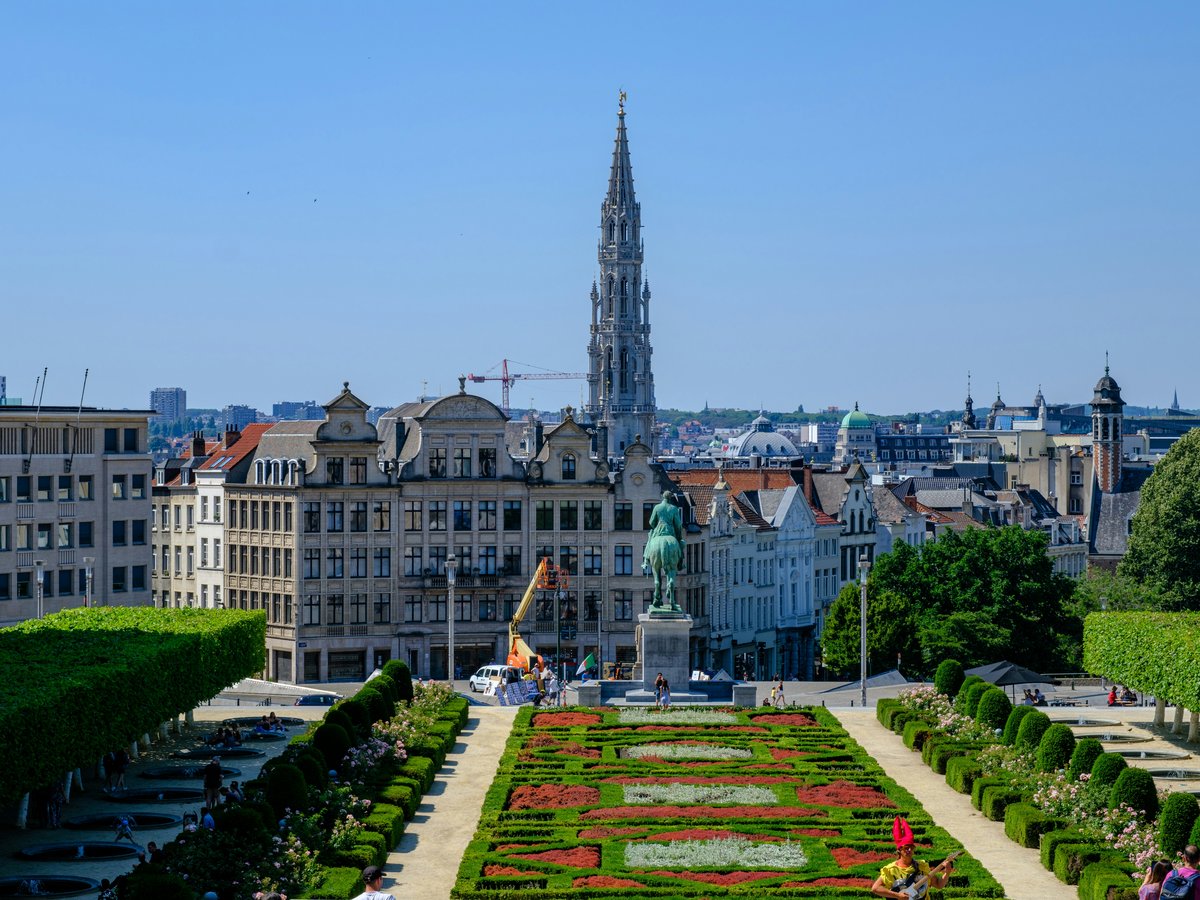
Brussels is not one city. It is 19 communes, each with its own mayor, its own identity, and its own opinion about what constitutes a proper frites sauce. The center sits in a rough pentagon defined by the petit ring, a series of boulevards that trace the old medieval walls. South of that pentagon, communes like Saint-Gilles and Ixelles stack up along the slope toward the Bois de la Cambre. To the east, the European Quarter spreads its glass and steel around Parc du Cinquantenaire. The northwest corner, near the canal, has changed more in the past 10 years than anywhere else in the city. Most visitors stick to the Grand-Place area, which is fine for a weekend, but the neighborhoods 15 minutes by tram from that tourist core tend to be where you'll want to eat, drink, and linger. The bilingual thing is real. Street signs appear in both French and Dutch. Most residents speak French day-to-day, though you'll hear Flemish, Arabic, Portuguese, and increasingly English depending on which commune you're standing in. One more thing. Brussels is compact. Tram 81 from Montgomery to the center takes about 20 minutes. You can walk from the Grand-Place to the Marolles flea market in 12 minutes. Where you stay matters less for logistics than for the mood you want to wake up to.
Neighborhoods
-
Ilot Sacré and Grand-Place
The Grand-Place is a 110-by-68-meter cobblestone rectangle ringed by gilded guild houses from the 1690s, and it still stops people mid-stride. The surrounding Ilot Sacré is a grid of narrow pedestrian streets between Rue du Marché aux Herbes and Rue des Bouchers, packed with tourist-trap restaurants that put plastic lobsters in their windows. It's loud, it's crowded, and the waffles from the stands on Rue de l'Étuve cost €1 to €4 depending on toppings. To be fair, the architecture above eye level is genuinely worth studying. Art Nouveau details hide on upper floors along Galeries Royales Saint-Hubert, a covered shopping arcade from 1847 that predates Milan's Galleria by 20 years.
- Best for
- First-time visitors staying 2 to 3 nights who want walkable access to the major sights, the Manneken Pis, and the Bourse metro hub
- Key streets
- Galeries Royales Saint-Hubert for the 19th-century glass-roofed arcade. Rue des Bouchers for the spectacle, not the food. Rue du Midi runs south toward the Bourse and has better-value lunch spots. Place Sainte-Catherine is a 10-minute walk northwest and feels like a different city.
-
Marolles
The Marolles sits below the Palais de Justice, which looms over the neighborhood from a hill to the west. This was historically the working-class quarter, and the old Brussels dialect, Brusseleer, still surfaces in a few of the older cafes around Place du Jeu de Balle. That square hosts a daily flea market from 06h to 14h where you'll find Art Deco lamps for €15, old Tintin editions, scratched vinyl, and rusted tools laid out on blankets. The buildings are 3 to 4 stories, mostly brick, with faded painted advertisements on some walls. The pace is slower than anywhere else inside the petit ring. On weekday mornings, the smell of roasting coffee drifts from the torréfacteurs on Rue Haute.
- Best for
- Budget travelers, vintage hunters, and anyone who'd rather have a quiet coffee in a neighborhood bar than stand in a museum line
- Key streets
- Place du Jeu de Balle for the flea market. Rue Haute runs the length of the neighborhood and holds the Musée Brueghel at number 132. Rue Blaes has the better antique shops, particularly between numbers 150 and 210, where dealers specialize in mid-century Belgian furniture.
-
Sablon
The Sablon is Brussels' moneyed quarter, split between the Petit Sablon (a small formal garden with 48 bronze statues representing medieval guilds, enclosed by a Gothic Revival fence from 1890) and the Grand Sablon, a sloping square lined with chocolate shops and antique dealers. Pierre Marcolini's flagship at Grand Sablon 39 sells pralines at roughly €85 per kilogram. Wittamer, across the square since 1910, charges similarly. The architecture is mostly 18th-century townhouses in pale stone. It is quiet on weekday mornings, almost eerily so, given how close it sits to the Grand-Place (about 600 meters south). On weekends, an antiques market fills the Grand Sablon from 09h to 18h on Saturdays and 09h to 14h on Sundays.
- Best for
- Couples, chocolate obsessives, and anyone who wants upscale accommodation within walking distance of both the center and the Marolles below
- Key streets
- Grand Sablon for the chocolate shops and weekend antiques. Rue de Rollebeek descends steeply toward the Marolles and has a few small galleries. Rue Lebeau connects to the Palais de Justice and passes the Musée Magritte's less-crowded back entrance on Rue de la Régence.
-
Sainte-Catherine
Sainte-Catherine, northwest of the Grand-Place, sits on what used to be the old port basin, filled in during the 1850s. The Quai au Bois à Brûler and Quai aux Briques trace the old waterline, and the seafood restaurants that line them still pull from that maritime history. Nordzee, a standing-room seafood bar on Place Sainte-Catherine, serves shrimp croquettes for about €14 and raw oysters from €2.50 each. The neighborhood has more restaurant density per block than anywhere else in Brussels, and the quality-to-tourist-trap ratio is better than the center. The architecture is a mix of 19th-century neoclassical facades and some newer glass-front buildings that went up in the 2000s. A new Marriott opened on Quai au Bois à Brûler in 2019, which gives you a sense of the area's trajectory.
- Best for
- Food-focused visitors who want to eat well within walking distance of the center, and anyone who prefers a neighborhood that's busy without being theme-park-crowded
- Key streets
- Place Sainte-Catherine for the fish restaurants and the slightly forlorn 19th-century church in the middle. Rue de Flandre heads northwest toward Molenbeek and has Vietnamese, Turkish, and Portuguese restaurants between numbers 2 and 80. Rue Antoine Dansaert runs parallel one block east and is where Brussels' Belgian fashion designers (Dries Van Noten, Ann Demeulemeester stockists) set up in the 1990s.
-
Saint-Gilles
Saint-Gilles is a commune south of the petit ring that climbs a gentle hill from the Gare du Midi toward the Altitude 100 viewpoint at Avenue Brugmann. The lower part near the station is dense, loud, and heavily North African and Portuguese in character, with bakeries selling pastéis de nata for €1.20 and butchers displaying merguez in the window. Higher up, past the Barrière de Saint-Gilles tram stop, the streets widen and the townhouses grow larger. The Horta Museum, the former home of Art Nouveau architect Victor Horta, sits at Rue Américaine 25 and charges €12 admission. The Parvis de Saint-Gilles, the commune's main square, hosts a market on Thursday and Sunday mornings where North African spices, Belgian cheese, and Portuguese sardines share the same row of stalls.
- Best for
- Architecture enthusiasts, budget-conscious visitors who want a residential feel near the center (tram 81 or 97 reaches the Grand-Place in 10 minutes), and anyone tired of hotels priced for the EU-expense-account crowd
- Key streets
- Rue du Bailli connects Saint-Gilles to Ixelles and has good bakeries and a cheese shop, Tentation, that stocks over 200 varieties. Chaussée de Charleroi is the main commercial drag. Rue de l'Hôtel des Monnaies runs from the Parvis past African grocery shops and Portuguese cafés.
-
Ixelles and Flagey
Ixelles sprawls from the upscale Avenue Louise corridor down to the student quarter around ULB (Université Libre de Bruxelles, about 26,000 students). The Flagey area, centered on Place Flagey and its 1930s Art Deco broadcasting building now converted into a concert hall, is the part most visitors end up in. The Étangs d'Ixelles, two connected ponds just south of Place Flagey, have a walking loop of about 1 km that fills with joggers by 07h. The restaurant scene around Flagey leans affordable and international. Comptoir Rodin on Rue de la Brasserie does a 3-course lunch menu for around €16. The Matongé quarter, between Porte de Namur and Chaussée de Wavre, is the Congolese heart of Brussels, dating to the 1960s. Galerie d'Ixelles, a covered passage at Chaussée de Wavre 28, has hair salons, fabric shops, and a couple of Congolese restaurants where you can get grilled capitaine fish with fufu for about €12.
- Best for
- Younger travelers, anyone who wants a mixed residential-and-restaurant neighborhood that still feels like a real place, and architecture buffs following the Art Nouveau trail (about 15 notable facades line Rue Defacqz and Rue Faider alone)
- Key streets
- Place Flagey for cafes and the Saturday morning market (one of Brussels' best, with over 100 stalls). Chaussée de Wavre through Matongé for Congolese and West African food. Rue Lesbroussart for restaurants between Place Flagey and the cemetery.
-
European Quarter
The European Quarter stretches east from Rue de la Loi to the Parc du Cinquantenaire, a 37-hectare park anchored by a triumphal arch that Léopold II commissioned in 1880 (it wasn't finished until 1905). During weekday lunchtimes, the park fills with EU staffers eating sandwiches on the grass. The architecture around the Commission buildings is mostly 1960s and 1970s glass and concrete, much of it already looking dated. Place du Luxembourg, directly in front of the European Parliament, has become a bar strip where political staffers drink €6 Jupiler pints on Thursday evenings. Mind you, the neighborhood empties dramatically on weekends. Restaurants that are full at 12h30 on Tuesday are closed on Saturday. Hotels here tend to be business-class chains (Thon, Sofitel) that drop their rates 40% to 60% on Friday and Saturday nights.
- Best for
- Anyone with business at the EU institutions, visitors who want discounted weekend hotel rates in a central location, and families heading to the Cinquantenaire museums (Autoworld, the military museum, and the Art and History museum all sit under the arch)
- Key streets
- Rue de la Loi is the main artery but has little charm. Place du Luxembourg for the after-work scene. Rue Archimède has a row of Greek restaurants dating to the 1970s Greek community. Square Ambiorix, 2 blocks north, has the Maison Saint-Cyr at number 11, possibly the narrowest Art Nouveau facade in Europe at 4 meters wide.
-
Schaerbeek
Schaerbeek is a large commune northeast of the center that rarely appears in guidebooks, which is part of why it's interesting. The lower part near Gare du Nord is rough-edged and commercial. The upper part, above the Chaussée de Haecht, has some of the best-preserved Art Nouveau streetscapes in Brussels. Avenue Louis Bertrand, a tree-lined boulevard about 800 meters long, has 20 or more Art Nouveau and Art Deco facades still intact, many with sgraffito panels in blues and golds. The Halles de Schaerbeek, a former covered market from 1865 at Rue Royale Sainte-Marie 22, is now a performance venue that seats about 2,000. Schaerbeek has a large Turkish and Moroccan population, and the bakeries along Chaussée de Haecht sell fresh pide and Turkish börek for €2 to €4.
- Best for
- Architecture enthusiasts willing to go off the usual circuit, budget travelers (Airbnb rates in Schaerbeek run 30% to 40% lower than Ixelles or Saint-Gilles for comparable apartments), and visitors who'd rather see a lived-in neighborhood than a polished one
- Key streets
- Avenue Louis Bertrand for the Art Nouveau concentration. Chaussée de Haecht for Turkish and Moroccan food shops. Rue Royale Sainte-Marie for the Halles and several small galleries that have opened since 2020. Place Colignon has the ornate 1887 town hall and a daily fruit market.
FAQ
Which Brussels neighborhood is best for a first visit of 2 to 3 days?
Sainte-Catherine or the Grand-Place area will keep you walking distance from the center without committing to the tourist-trap restaurants of the Ilot Sacré. Sainte-Catherine has better food options (Nordzee, the fish restaurants on Quai aux Briques) and sits within 10 minutes on foot of both the Grand-Place and the Dansaert fashion strip. Hotels here tend to run €120 to €200 per night, which is slightly less than equivalent rooms in the Sablon.
Is Brussels safe to walk around at night?
Most of the neighborhoods in this guide are fine on foot after dark, particularly the Sablon, Sainte-Catherine, Flagey, and the upper parts of Saint-Gilles and Ixelles. The area around Gare du Nord and Gare du Midi can feel uncomfortable late at night, and the European Quarter gets deserted after offices close. Place de la Bourse and the streets south of it toward Rue du Midi stay lively until midnight or later. Common sense applies. The metro runs until about 00h30 on Friday and Saturday nights.
How do I get from Brussels Airport to the city center?
The Airport Express train runs every 10 minutes from Zaventem to Bruxelles-Central, and the ride takes 17 minutes. A single ticket costs €14.70 as of 2025. The train also stops at Bruxelles-Nord and Bruxelles-Midi. A taxi from the airport to the center costs a fixed €45 (regulated rate). Uber operates in Brussels and a ride from the airport typically runs €30 to €40 depending on time of day. If you're heading to Ixelles or Saint-Gilles, Bruxelles-Midi is the closer station.
What is the best neighborhood in Brussels for food?
Sainte-Catherine has the highest concentration of good restaurants per block, particularly for seafood. Flagey (in Ixelles) is better for affordable international food, including the Congolese restaurants in Matongé along Chaussée de Wavre. Saint-Gilles around the Parvis mixes Portuguese, North African, and Belgian cooking within a 5-minute walk. Worth noting, the Grand-Place area has the worst food-to-price ratio in the city. Locals rarely eat there.
Should I stay inside the petit ring or in one of the outer communes?
The petit ring neighborhoods (Grand-Place, Sainte-Catherine, Sablon, Marolles) keep everything within walking distance but cost more and close earlier. The outer communes (Saint-Gilles, Ixelles, Schaerbeek) have more residential character, better value on accommodation, and livelier local food scenes. Brussels' tram network connects the outer communes to the center in 10 to 20 minutes, so the trade-off is modest. If you want quiet mornings and a neighborhood feel, stay outside the ring. If you want to stumble home from a bar at 01h without figuring out the night bus, stay inside.
Last verified by automated review (v1.7.2) on . What is automated review?