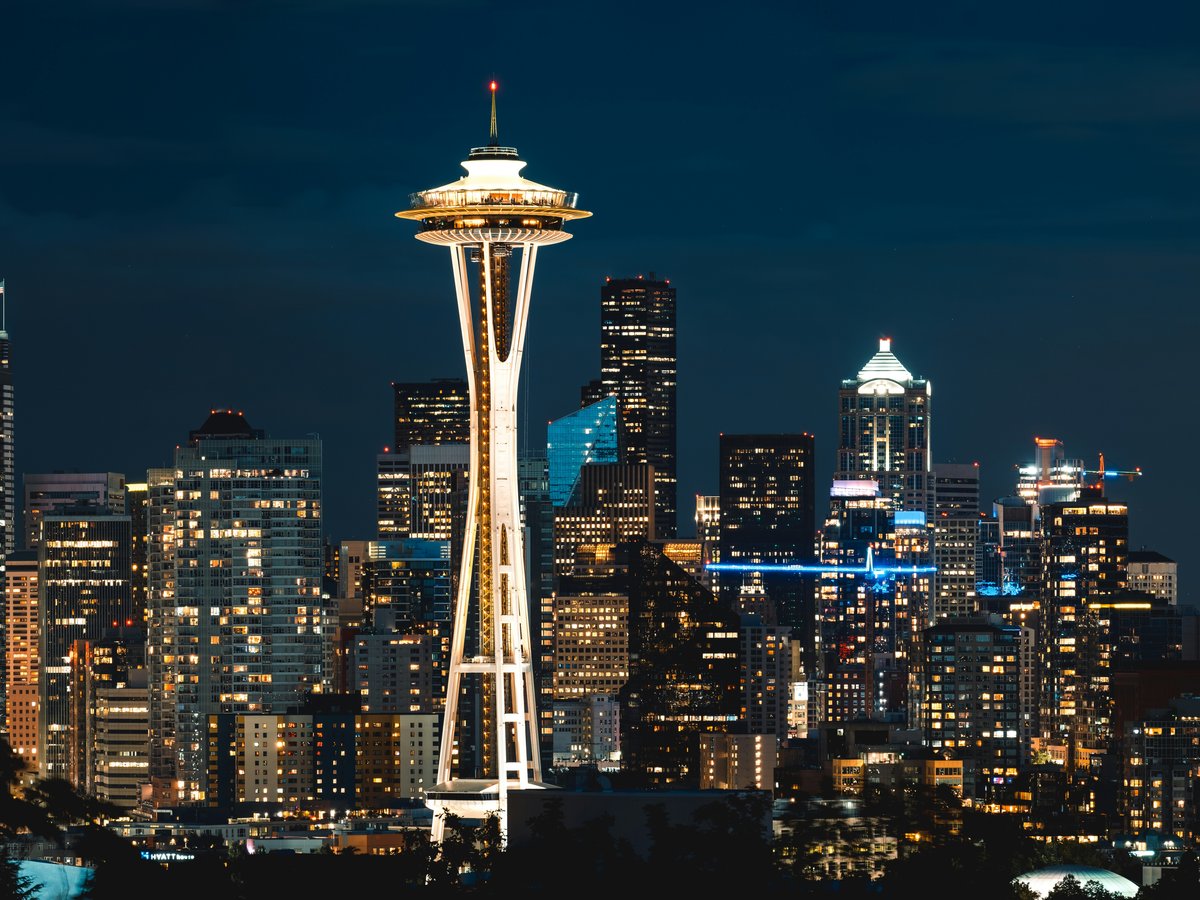
Seattle tends to reward the budget-conscious visitor more than most American cities its size. The geography alone does a lot of the heavy lifting. Puget Sound wraps around the western edge, Lake Union and Lake Washington sit inland, and on clear days Mt. Rainier fills the southern horizon at 14,411 feet. You can walk from the 9-acre Olympic Sculpture Park along the waterfront to Pike Place Market in about 20 minutes, passing public art installations and views of the Olympic Mountains the whole way. The Frye Art Museum on First Hill has been free since it opened in 1952, and the Seattle Public Library's Rem Koolhaas-designed Central Library is one of the more striking buildings in the Pacific Northwest, open to anyone. Parks here feel more like wilderness than city green space. Discovery Park covers 534 acres in Magnolia, and the Hiram M. Chittenden Locks in Ballard let you watch salmon run and boats transit between salt water and fresh water for nothing. Worth noting, too, that Seattle's coffee culture means you'll find third-wave roasters on nearly every block, and the smell of fresh espresso follows you from Capitol Hill to Fremont. The city's First Thursday programs open galleries and select museums at no charge, and summer brings a rotating set of free outdoor concerts that run from late June through September.
Free attractions
-
Frye Art Museum
The Frye has been free every day since Charles and Emma Frye's founding bequest in 1952. The permanent collection leans toward 19th-century European painting, with roughly 230 works on display at any given time, and the rotating contemporary exhibitions on the ground floor tend to be more adventurous than you might expect from a museum this size. The building sits on Terry Avenue in First Hill, a 15-minute walk uphill from downtown. There's a small cafe inside, and the galleries are quiet enough on weekday mornings that you can hear the wood floors creak.
First HillMuseum -
Olympic Sculpture Park
SAM's 9-acre outdoor sculpture park opened in 2007 on a former fuel-storage site between Belltown and the waterfront. It's open from dawn to dusk year-round, and the path zigzags downhill from Western Avenue to the shoreline. Alexander Calder's 'Eagle' stands near the top, and Richard Serra's rust-colored 'Wake' sits closer to the water. On a clear afternoon you'll catch views of the Olympic Mountains across the Sound, and the salt breeze off Elliott Bay is hard to miss even in summer.
BelltownSculpture Park -
Hiram M. Chittenden Locks
Locals call them the Ballard Locks. The U.S. Army Corps of Engineers has operated this passage between Puget Sound and the Lake Washington Ship Canal since 1917. You can stand on the walkways and watch everything from kayaks to commercial fishing boats rise or drop 6 to 26 feet depending on the tide. The real draw might be the fish ladder on the south side, where underwater viewing windows let you watch sockeye and Chinook salmon heading upstream. Peak salmon season runs roughly July through September. The adjacent Carl S. English Jr. Botanical Garden covers about 7 acres and is also free.
BallardLandmark -
Pike Place Market
The Market has been open since August 17, 1907, making it one of the oldest continuously operating public farmers' markets in the United States. Browsing costs nothing. You'll smell fresh Dungeness crab and cut flowers before you even reach the main arcade on Pike Street. The lower levels get interesting. Down past the fish-throwers and the original Starbucks at 1912 Pike Place, narrow stairways lead to floors of small shops and odd corners that most visitors never see. Rachel the Pig, the bronze piggy bank near the main entrance, has collected over $30,000 in loose change for the Market Foundation's social services.
DowntownMarket -
Seattle Public Library, Central Branch
Rem Koolhaas and Joshua Prince-Ramus designed this 11-story glass-and-steel building, which opened on May 23, 2004. The exterior looks like a stack of shifted glass boxes, and inside, the continuous book spiral on floors 6 through 9 holds the nonfiction collection in one unbroken Dewey Decimal sequence. The 10th-floor reading room has floor-to-ceiling windows facing north toward Capitol Hill. It's free to enter and wander even if you don't have a library card. The red-floored 4th-floor meeting space, called the Mixing Chamber, tends to be worth a look for the architecture alone.
DowntownArchitecture -
Kerry Park
This small park on West Highland Drive in Lower Queen Anne might be the most photographed spot in Seattle. The viewpoint is roughly 200 feet above sea level and gives you the Space Needle, the downtown skyline, Elliott Bay, and Mt. Rainier in a single frame, weather permitting. Late afternoon tends to be the best window for light, especially in summer when sunset pushes past 9 PM. The park itself is compact, maybe a quarter-acre, and there's a metal sculpture by Doris Totten Chase called 'Changing Form' at the south end.
Queen AnneViewpoint -
Gas Works Park
The park sits on the north shore of Lake Union, built on the remains of the Seattle Gas Light Company's gasification plant, which operated from 1906 to 1956. The rusted-out boiler house and exhaust towers still stand, fenced off but visible, giving the park an industrial silhouette that looks nothing like a typical city green space. The hilltop sundial, designed by artist Chuck Greening and local astronomy professor Herb Curl, doubles as the best kite-flying spot on Lake Union. On the Fourth of July, this hill fills with thousands of people watching fireworks over the water.
WallingfordPark -
Discovery Park
At 534 acres, Discovery Park is the largest park in Seattle. It occupies a bluff in the Magnolia neighborhood, on the site of the former Fort Lawton military base. The Loop Trail runs about 2.8 miles through forest, meadow, and coastal bluffs. If you take the steep North Beach Trail down to the shore, you'll reach West Point Lighthouse, which has been in operation since 1881. The beach itself is rocky and windswept, with driftwood piled against the tide line. Bald eagles nest in the old-growth trees here, and you can sometimes spot harbor seals in the waters below the bluff.
MagnoliaPark -
Green Lake Park
Green Lake is a 2.8-mile paved loop around a shallow glacial lake in north Seattle. Joggers, cyclists, and dog walkers circle it year-round, and the path gets busy on summer weekends when the temperature climbs past 75°F. The lake itself is warm enough for swimming by mid-July, with a designated swimming area at East Green Lake Beach. Pitch-and-putt golf near the community center currently runs a small fee, but the path and the shoreline are always free.
Green LakePark -
Seattle Art Museum (First Thursdays)
SAM charges a general admission of $34.99 for adults, but on the first Thursday of every month the permanent collection galleries are free. The museum sits on First Avenue between Union and University Streets, and the collection includes strong holdings in Northwest Coast Indigenous art, as well as a rotating schedule of special exhibitions (those may still require a ticket). The 48-foot 'Hammering Man' kinetic sculpture by Jonathan Borofsky stands at the entrance and moves continuously, except on Labor Day, when it gets the day off.
DowntownMuseum (free first Thursday) -
Museum of History & Industry (First Thursday)
MOHAI moved to its current home in the former Naval Reserve Armory on Lake Union's south shore in 2012. General admission is currently $24.95 for adults, but MOHAI participates in the citywide First Thursday free-admission program. The permanent exhibition covers Seattle from the Duwamish people through the Great Fire of 1889, the Klondike Gold Rush, Boeing's early years, and the tech era. The building sits in Lake Union Park, so you can combine a visit with a walk along the waterfront.
South Lake UnionMuseum (free first Thursday)
Free activities
-
Waterfront Walk from Olympic Sculpture Park to Pioneer Square
You can walk the length of Seattle's central waterfront in about 40 minutes. Start at the Olympic Sculpture Park at Broad Street, head south along Alaskan Way past the new Waterfront Park (which opened sections in stages starting in 2024), continue past the Seattle Great Wheel and the ferry terminal at Pier 52, and end in Pioneer Square. The route smells like creosote and salt water, and you'll hear ferry horns as the Bainbridge Island boats come and go. Pioneer Square's brick-and-stone buildings date to the 1890s rebuild after the Great Fire.
Downtown to Pioneer SquareWalking Route -
Fremont Neighborhood and the Fremont Troll
Fremont calls itself the Center of the Universe, and the neighborhood leans into that identity. The Fremont Troll, a concrete sculpture by Steve Badanes, Will Martin, Donna Walter, and Ross Whitehead, crouches under the Aurora Bridge at N. 36th Street clutching an actual Volkswagen Beetle. It went up in 1990. From there you can walk to the Lenin statue on Fremont Place North (a 16-foot bronze originally from Slovakia), past the Fremont Rocket on Evanston Avenue, and down to the Fremont Sunday Market if you're visiting on the right day. The neighborhood has a density of oddball public art you won't find anywhere else in the city.
FremontWalking Route and Public Art -
Capitol Hill Art Walk
Capitol Hill's galleries and small venues participate in a Second Thursday Art Walk, typically running from 5 PM to 8 PM. The walk centers on Pike and Pine Streets between Broadway and 12th Avenue. You'll pass street murals, independent bookstores, and a stretch of bars and restaurants that still feel like the pre-tech neighborhood in places. The art spaces tend to skew younger and more experimental than Pioneer Square's galleries. Check the Capitol Hill Art Walk site for the current month's participating venues, as the list shifts.
Capitol HillArt Walk -
Alki Beach
West Seattle's Alki Beach stretches about 2.5 miles along the shore of Elliott Bay. The paved path runs from Alki Point Lighthouse (built 1913) northeast toward Duwamish Head, and on warm evenings the beach fills with bonfires in the designated fire pits. You get a full-width panorama of the downtown skyline from here, and the sunsets in summer, when the light drops behind the Olympic range across the Sound, tend to be the best in the city. The Statue of Liberty replica near 61st Avenue SW marks the approximate landing spot of the Denny Party in 1851.
West SeattleBeach -
Ballard Avenue Historic District
Ballard Avenue NW between Dock Place and NW Market Street is a 4-block stretch of late-19th-century brick commercial buildings, most of them dating to Ballard's days as an independent city before Seattle annexed it in 1907. You can walk the strip in 20 minutes, passing craft breweries, record shops, and old storefronts that still have their original facades. The street has a quieter feel than Pike Place, and on Sunday mornings the Ballard Farmers Market sets up on the adjacent blocks of Ballard Avenue NW.
BallardWalking Route -
Center for Wooden Boats
The Center for Wooden Boats sits on the south shore of Lake Union, and you can browse the collection of historic small craft for free. On Sundays they offer free public sailboat rides, weather permitting, on a first-come basis starting at 10 AM. The wait can stretch past an hour on sunny days, but the dock area is a pleasant spot regardless, with the smell of varnish and lakewater and the sound of halyards clinking against masts. The center holds roughly 100 vessels, some dating to the early 1900s.
South Lake UnionMuseum and Activity -
University of Washington Campus and The Quad
The UW campus in the University District covers about 700 acres, and the central Quad is lined with Yoshino cherry trees that bloom in mid-to-late March, drawing crowds for about two weeks each spring. Outside cherry season, the Suzzallo Library's reading room, with its 65-foot vaulted ceiling, is open to the public and has the feel of a Gothic cathedral. The Burke Museum of Natural History and Culture sits at the campus's northwest edge. Its general admission is $22 for adults, but it typically offers free first Thursdays as well.
University DistrictWalking Route
Free events
-
First Thursday Art Walk in Pioneer Square
First Thursday of every month, 5 PM to 8 PMPioneer Square's galleries open their doors free of charge on the first Thursday of every month, typically from 5 PM to 8 PM. The neighborhood holds roughly 30 to 40 galleries in its brick-and-sandstone buildings, making it one of the larger gallery-walk circuits on the West Coast. Some venues serve wine, and the sidewalks between Occidental Avenue S and First Avenue S fill with foot traffic even in winter. The walk has been running since the early 1980s.
Pioneer Square -
Fremont Sunday Market
Every Sunday, 10 AM to 4 PM (hours may shift seasonally)The Fremont Sunday Market sets up every week along Evanston Avenue N, between N. 34th and N. 35th Streets. It's a mix of local vendors, antiques, handmade goods, and food stalls. Browsing costs nothing, and the market runs year-round, rain or shine. Attendance tends to fluctuate with the weather, but even in January you'll find 50 or more vendors. It's been a neighborhood fixture since 1990.
Fremont, along Evanston Avenue N -
Out to Lunch Concert Series
Weekdays, late June through early SeptemberThe Downtown Seattle Association organizes free lunchtime concerts in various downtown parks and plazas during the summer, typically running from late June through early September. Performances happen on weekdays, usually between 11:30 AM and 1:30 PM, and cover a range of genres from jazz to folk to R&B. Westlake Park and Occidental Square are common venues. The series has run for over 40 years.
Various downtown parks and plazas -
Ballard Farmers Market
Every Sunday, 9 AM to 2 PM, year-roundThe Ballard Farmers Market operates year-round on Sundays from 9 AM to 2 PM on Ballard Avenue NW. It's free to browse, and the stalls lean heavily toward local produce, flowers, baked goods, and prepared food. In peak season, July through September, you'll find around 70 to 80 vendors. The strawberries and Rainier cherries in early summer tend to pull the biggest crowds. Street musicians set up along the market route.
Ballard Avenue NW, Ballard -
Fremont Solstice Parade
Saturday nearest the summer solstice (usually mid-to-late June)The Fremont Solstice Parade runs on the Saturday closest to the summer solstice, usually in mid-to-late June. The parade is free to watch and features handmade floats, community groups, and the somewhat notorious Solstice Cyclists who ride the route before the parade begins. The route typically follows N. 36th Street through the Fremont commercial district. The event started in 1994 and draws thousands of spectators each year. After the parade, the adjacent Fremont Fair offers free stages with live music through the weekend.
Fremont neighborhood -
Concerts at the Mural Amphitheatre
Various dates, primarily summerSeattle Center's Mural Amphitheatre, an outdoor venue at the base of the Space Needle campus, hosts free concerts and performances periodically through the summer. The schedule varies by year, but events often tie into the larger Seattle Center festival calendar. The amphitheatre was renovated in 2018 and seats around 4,500. The concrete seating heats up in direct sun, so locals tend to bring blankets or cushions. Check the Seattle Center events calendar for specific dates.
Seattle Center, Mural Amphitheatre
Neighborhoods Worth Walking for Free
Seattle's neighborhoods each have a different texture, and covering 3 or 4 of them on foot gives you a better sense of the city than any single attraction could. Capitol Hill, roughly between Broadway and 15th Avenue E, still carries the energy of its punk and grunge years in its record stores and dive bars, though the rents have climbed considerably since the 2010s. The murals along Pike and Pine change seasonally. Fremont leans weird and proud of it, with the Troll, the rocket, and the Lenin statue all within a 10-minute loop. Ballard's old Scandinavian fishing-village identity shows in the historic storefronts on Ballard Avenue NW, and the smell of hops from the neighborhood's 8 or 9 breweries drifts into the sidewalk on warm days. The International District, centered on S. King Street and S. Jackson Street, is Seattle's Chinatown-International District, and Hing Hay Park makes a good starting point. The neighborhood has been under pressure from development and the effects of the pandemic, but the grocery stores, bakeries, and dumpling shops along S. King Street are still there. Pioneer Square's cobblestone streets and Romanesque Revival buildings feel like a different century. You can loop through all of this in a long day if you're comfortable with 8 to 10 miles of walking, or take the Link Light Rail between University Street Station and Pioneer Square Station to shorten it.
Free Viewpoints Beyond Kerry Park
Kerry Park gets the postcard shot, but Seattle has other viewpoints that might be less crowded and, to be fair, sometimes more interesting. The rooftop terrace of the downtown REI flagship store at 222 Yale Avenue N, near South Lake Union, is open during store hours, and you get a close-up view of the downtown skyline. Jose Rizal Park on 12th Avenue S, in Beacon Hill, faces north toward the stadiums, the Port of Seattle cranes, and the full downtown skyline. The vantage is lower and wider than Kerry Park, and the light in the late afternoon can be striking. Ella Bailey Park in Magnolia, at 2601 W. Smith Street, sits high enough to see across the Sound to the Olympic range and is rarely busy. Hamilton Viewpoint Park in West Seattle, above the Duwamish waterway, faces northeast toward downtown and is especially good at dusk. And Dr. Jose Rizal Bridge, the pedestrian bridge connecting Beacon Hill to the International District, gives you a view straight down the I-5 corridor with the skyline rising behind it. None of these cost anything, and none of them typically appear on the tourist-circuit maps.
Seattle's Public Art You Can See for Free
Seattle has had a 1% for Art ordinance since 1973, which means 1% of eligible city capital-improvement funds go toward commissioning public artwork. The result, after 50-plus years, is an unusually dense collection of outdoor art scattered through every neighborhood. The Olympic Sculpture Park is the most concentrated example, but you'll find pieces embedded in infrastructure all over the city. The 'Waiting for the Interurban' sculpture at N. 34th Street and Fremont Avenue N shows six life-sized aluminum figures standing at a bus stop. Locals regularly dress them up in scarves, hats, and seasonal costumes. The 'Hammering Man' outside SAM on First Avenue stands 48 feet tall and swings his arm 4 times per minute. Down at the Colman Dock ferry terminal, the 'Olympic Iliad' mural by Andrew Keating stretches along the terminal's walkway. In SoDo, the industrial district south of the stadiums, you'll find large-scale murals on warehouse walls along 1st Avenue S. And the Jack Straw Cultural Center on the University District's 35th Avenue NE has an outdoor sound-art installation that changes periodically. The density is the point. You'll stumble across pieces without looking for them.
FAQ
Is Pike Place Market free to visit?
Browsing Pike Place Market costs nothing. You can walk through the main arcade, the lower levels, and the craft stalls without paying an entry fee. The Market has been a public market since 1907, and there's no gate or ticket. Food and goods at the vendor stalls cost money, of course, but the experience of walking through, watching the fish-throwers at Pike Place Fish Co., and exploring the lower floors is entirely free.
Which Seattle museums are free on First Thursdays?
Several Seattle museums offer free admission on the first Thursday of each month. The Seattle Art Museum (SAM) on First Avenue opens its permanent collection galleries for free, and the Museum of History & Industry (MOHAI) on Lake Union participates as well. The Frye Art Museum on Terry Avenue is free every day, not only First Thursdays. The Pioneer Square galleries also open for free on First Thursdays as part of the long-running art walk. Check each museum's website for current hours and any exceptions, as special exhibitions at SAM sometimes still require a ticket.
Are the Ballard Locks really free?
The Hiram M. Chittenden Locks, operated by the U.S. Army Corps of Engineers, are free to visit year-round. There is no admission charge to watch the boats transit, walk through the Carl S. English Jr. Botanical Garden, or view the fish ladder. The visitor center inside the grounds is also free. Parking in the adjacent lot has a small fee, but street parking on nearby NW 54th Street is free with a short walk.
What is the best free viewpoint for the Seattle skyline?
Kerry Park on West Highland Drive in Queen Anne is the most well-known, with the Space Needle, downtown skyline, Elliott Bay, and Mt. Rainier all in frame on a clear day. It tends to get busy around sunset. For a wider and often less crowded perspective, Jose Rizal Park on Beacon Hill faces north toward the stadiums and the full downtown profile. Hamilton Viewpoint Park in West Seattle gives you the skyline from across the harbor and is especially good at dusk.
Can you swim at Seattle beaches for free?
Seattle has several free public beaches. Alki Beach in West Seattle has a 2.5-mile sandy shoreline along Elliott Bay, and Green Lake in north Seattle has a designated swimming area at East Green Lake Beach that gets warm enough for comfortable swimming by mid-July, when water temperatures reach the mid-60s°F. Madison Park Beach on Lake Washington and Madrona Park Beach, both on the city's east side, are also free. There are no entrance fees at any Seattle Parks and Recreation beach. Lifeguards are present at select beaches during summer months, typically late June through Labor Day.
How do you get around Seattle for free?
Walking covers a lot of ground in central Seattle. The downtown core, Pike Place Market, the waterfront, Pioneer Square, and Capitol Hill are all within a 30-to-40-minute walk of each other. Beyond walking, the King County Metro bus system is not free (the fare is currently $2.75 per ride), but the Link Light Rail and bus connections are often covered by the ORCA card transfer system, so a single fare can carry you across multiple buses within a 2-hour window. If you're sticking to downtown and the immediate neighborhoods, walking and the occasional bus transfer will get you to nearly every free attraction on this list.
Last verified by automated review (v1.7.2) on . What is automated review?