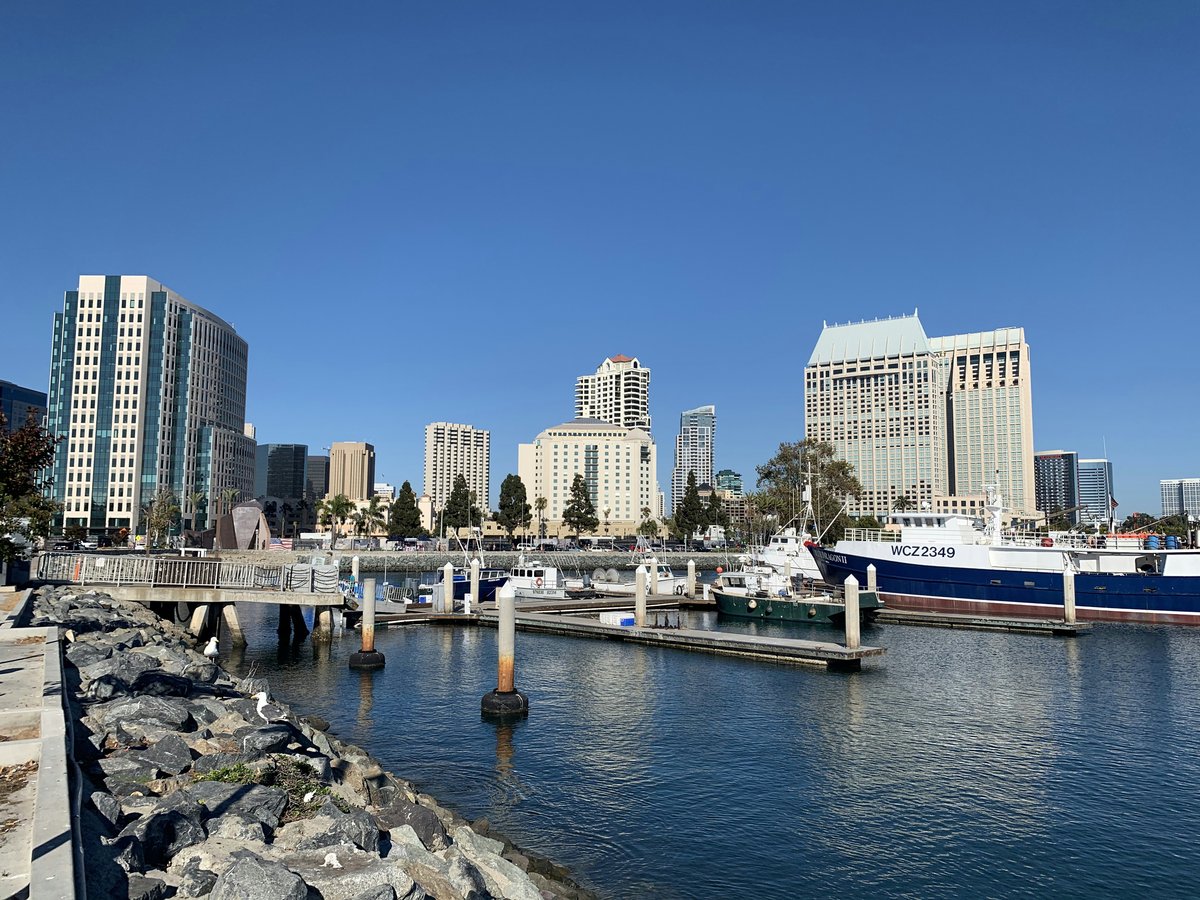
San Diego stretches across roughly 70 miles of Pacific coastline, and its neighborhoods function more like small beach towns than districts of a single city. Locals in Pacific Beach might go weeks without driving to Hillcrest, 8 miles inland on a mesa above Mission Valley. Downtown sits on San Diego Bay, where the Gaslamp Quarter, East Village, and Little Italy fit within a 15-minute walk of each other. Head north along the coast and you'll pass Ocean Beach, Mission Beach, and Pacific Beach in sequence, each separated by 2-3 miles. La Jolla anchors the northern coast near UC San Diego's campus. Inland, Hillcrest and North Park occupy a plateau roughly 4 miles from the waterfront, with Balboa Park, a 1,200-acre green space set aside in 1868, forming the boundary between downtown and those hilltop neighborhoods. Coronado sits on a sandy peninsula across the bay, connected by the 2.1-mile Coronado Bridge or a 15-minute ferry from Broadway Pier. The city rates 9.5/10 for family friendliness (see the TTDI Family-Friendliness Index), which tracks with the mild year-round climate. Mid-August nights currently hold around 21°C with 88% humidity as the marine layer rolls in. You'll hear locals call that fog "June Gloom" when it lingers into summer, though by noon the sun usually wins. Afternoon highs along the coast typically stay between 24-27°C through September.
Neighborhoods
-
Gaslamp Quarter
Sixteen blocks of Victorian-era commercial buildings between 4th Avenue and 6th Avenue, running from Broadway south to Harbor Drive. The buildings date mostly to the 1880s and 1890s, restored after decades of decline that bottomed out in the 1970s. The pace picks up after 7 PM on weekends, when the restaurant patios fill and the noise level on 5th Avenue rises to a steady hum of conversation and bar music. During the day it's quieter than you'd expect, with foot traffic concentrated around Horton Plaza Park. The architecture has a consistency you don't find in most American downtowns. Two-story brick facades, wrought-iron balconies, pressed-tin ceilings inside the older restaurants. Worth noting, the neighborhood is compact enough that you can walk its full length in about 12 minutes.
- Best for
- First-time visitors, couples looking for walkable dining and nightlife, convention-goers staying near the San Diego Convention Center on Harbor Drive
- Key streets
- 5th Avenue between Island Avenue and Market Street is the main restaurant corridor. F Street has a few of the better cocktail bars away from the weekend crowds. J Street near the waterfront tends to be calmer and attracts more locals.
-
Little Italy
India Street is the spine of this neighborhood, running north from Ash Street toward Washington Street. The Italian fishing families who settled here in the 1920s are mostly gone, but the food culture stayed and mutated. You'll smell roasting garlic and wood-fired dough walking past the restaurants on India between Date and Fir Streets. Piazza della Famiglia, a public square completed in 2017, anchors the middle of the district with outdoor tables and string lights. The residential towers going up along Kettner Boulevard over the past decade have added density without killing the sidewalk-cafe feel. Buildings top out around 20 stories, and the neighborhood still belongs to pedestrians. The Saturday morning Mercato farmers market on West Cedar Street draws 8,000-10,000 people between 8 AM and 2 PM.
- Best for
- Food-focused travelers, couples, anyone who wants walkable restaurants without late-night noise. The neighborhood is also convenient for Amtrak arrivals since the Santa Fe Depot sits a 10-minute walk south on Kettner.
- Key streets
- India Street from Ash to Fir for restaurants and cafes. Kettner Boulevard for newer wine bars and breweries. West Cedar Street for the Saturday Mercato, which shuts the road to car traffic.
-
East Village
East Village grew up around Petco Park, the baseball stadium that opened in 2004. The blocks near the stadium have filled in with condo towers, breweries, and coffee roasters, but walk 5 blocks east toward 16th Street and the development thins out fast. You'll find converted warehouse spaces housing tattoo shops and art galleries next to surface parking lots. The pace is slower than the Gaslamp, even on game days. When the Padres play at home, the neighborhood warms up about 2 hours before first pitch. The smell of grilled onions from street vendors on 10th Avenue drifts a block or two. That said, on non-game weekday mornings, several of the newer coffee roasters along Park Boulevard have more baristas than customers before 9 AM.
- Best for
- Baseball fans, craft-beer enthusiasts who want to walk between tasting rooms, and visitors who want a downtown location without the Gaslamp's noise after midnight
- Key streets
- Park Boulevard between Market Street and J Street for restaurants. Market Street from 8th to 13th has a growing cluster of Vietnamese and Korean restaurants. 10th Avenue near the stadium for pre-game food stalls.
-
Hillcrest
Hillcrest sits on the mesa above Mission Valley, bordering the north side of Balboa Park. The neighborhood has been San Diego's primary LGBTQ+ district since the 1970s, and the city rates 9.5/10 for LGBTQ+ friendliness (sourced from TTDI's editorial rubric). Rainbow crosswalks mark the intersection of University Avenue and Normal Street. The commercial strip along University between 1st and 6th has a density of independent businesses that's hard to match elsewhere in the city. Vintage clothing shops, used bookstores, brunch spots with 45-minute weekend waits. The San Diego Zoo, which has occupied its Balboa Park site since 1916, sits about a mile south of the main Hillcrest drag. The architecture on the residential streets is mostly early 20th-century bungalows and low-rise apartments. Walk those side streets and you'll hear screen doors and wind chimes more than traffic.
- Best for
- LGBTQ+ travelers, anyone who prefers independent shops over corporate retail, and visitors planning multiple days exploring the park and zoo complex to the south
- Key streets
- University Avenue between 1st and 6th Avenue for restaurants and retail. Normal Street for the Sunday farmers market and community feel. 5th Avenue heading south toward Balboa Park, where the San Diego Museum of Art has been open since 1926.
-
North Park
North Park is San Diego's craft-beer ground zero. Thirty-plus breweries and tasting rooms cluster along 30th Street and University Avenue, mostly between El Cajon Boulevard and Adams Avenue. The neighborhood was working-class through the 1990s, and the older single-story commercial buildings still line the main streets, now housing breweries, record shops, and taco counters. The residential blocks have California Craftsman bungalows from the 1920s, many with original wooden porches and exposed rafter tails. On warm evenings the smell of hops from the breweries mixes with charcoal smoke from backyard grills. The pace is deliberate. People sit on patios for hours. San Diego's digital-nomad suitability score sits at 6.2/10 (sourced from TTDI's editorial rubric), and North Park is likely where remote workers end up, given the cafe density and the slower rhythm.
- Best for
- Craft-beer fans, younger travelers, freelancers and remote workers who want a residential neighborhood with good cafes and walkable food. Less touristy than anywhere on the coast.
- Key streets
- 30th Street from University Avenue to Adams Avenue is the main corridor. University Avenue heading east toward City Heights for cheaper, more adventurous food. Ray Street for a small gallery cluster near the water tower.
-
Ocean Beach
OB, as locals call it, feels like a California beach town that decided to stop updating around 1978. Newport Avenue runs from the I-8 freeway straight to the ocean and ends at the OB Pier, a 1,971-foot concrete structure built in 1966. The storefronts along Newport lean toward surf shops, secondhand stores, and cash-only taco stands. The salt-air smell is constant this close to the water, and seagulls outnumber tourists most mornings. The pace is genuinely slow. People walk barefoot on Newport Avenue at noon. To be fair, the neighborhood has changed some in recent years. A few wine bars and upscale restaurants have appeared, though they're still outnumbered by the older spots. Point Loma, the hilly peninsula south of OB, is where you'll find the Cabrillo National Monument, a federally protected site since 1913 with views south to the Tijuana border on clear days.
- Best for
- Surfers, budget travelers, anyone who wants a beach town that hasn't been polished for tourism. Dog owners will appreciate Dog Beach at the north end, one of San Diego's few off-leash sand areas.
- Key streets
- Newport Avenue from Sunset Cliffs Boulevard to the pier. Sunset Cliffs Boulevard heading south for coastal cliff walks. Voltaire Street for the neighborhood's quieter, residential side.
-
Pacific Beach
PB is San Diego's post-college beach neighborhood. The median age along the boardwalk appears to be about 27, and on summer weekends the energy skews toward day-drinking and beach volleyball. Garnet Avenue is the main commercial strip, lined with bars, burrito shops, and surf-rental outfits. The noise level at night can be significant, especially between Garnet and Grand on weekend evenings. The boardwalk runs 3.2 miles from the south end of PB through Mission Beach and connects to the Belmont Park roller coaster area. Morning joggers, e-bikes, and roller skaters share the path. SeaWorld, which opened on the shores of Mission Bay in 1964, is about a 5-minute drive from PB's south end. The sand is wide and the water temperature in August currently hovers around 19-20°C.
- Best for
- Solo travelers in their 20s and 30s, groups of friends, and surfers who prioritize beach access over quiet evenings. The city's solo-traveler safety score of 6.8/10 (see the TTDI Solo-Safety Index) reflects the usual urban caution, though PB's well-lit boardwalk and busy restaurant strips tend to feel safe after dark.
- Key streets
- Garnet Avenue for bars and restaurants. Grand Avenue for a slightly calmer commercial strip with more breakfast spots. Ocean Front Walk (the boardwalk) from Law Street south to Mission Beach.
-
La Jolla
La Jolla feels more like a wealthy coastal village than a San Diego neighborhood. Prospect Street, the main drag, is lined with galleries, upscale restaurants, and boutique hotels with summer rooms starting around $350 per night. The sandstone cliffs at La Jolla Cove drop 30-40 feet to tidepools where you can watch harbor seals haul out on the rocks. The smell of kelp is strong here, especially at low tide. Torrey Pines State Natural Reserve, 2 miles north, has 1,500 acres of coastal chaparral and sandstone formations above the ocean. The Salk Institute, designed by Louis Kahn and completed in 1965, sits on the bluffs at 10010 North Torrey Pines Road. Its concrete courtyard, open to the public, frames the Pacific through a narrow channel of travertine and teak. Mind you, La Jolla's parking situation is famously bad. The streets around the Cove fill by 10 AM on weekends.
- Best for
- Couples and families with a higher budget, nature lovers, snorkelers and kayakers. The La Jolla Underwater Park Ecological Reserve covers 6,000 acres of ocean floor accessible from the Cove.
- Key streets
- Prospect Street for galleries and restaurants. Girard Avenue, one block east, for a calmer commercial strip with bookshops and cafes. Coast Boulevard for walking the cliffs above the Cove and watching the seals.
-
Old Town
Old Town San Diego State Historic Park covers 9.5 acres at the base of Presidio Hill, near the site where Father Junipero Serra founded Mission San Diego de Alcalá in 1769. That mission later moved 6 miles up the valley, but Old Town stayed put. The park preserves and reconstructs buildings from the 1820s-1870s, and the surrounding blocks have filled in with Mexican restaurants, souvenir shops, and a few genuinely good taco counters. The smell of corn tortillas on the comal and roasting green chiles drifts through the main plaza most afternoons. The trolley's Green Line stops here, making it one of the more transit-accessible neighborhoods. Old Town can feel like a tourist zone during midday, especially on weekends. That impression lifts around 6 PM when the day-trippers leave and the restaurants fill with locals from the surrounding residential streets above Presidio Hill.
- Best for
- History-focused visitors, families with children, and anyone who wants a transit-convenient base. The trolley connects Old Town to downtown in 12 minutes and to the Mexican border at San Ysidro in about 40.
- Key streets
- San Diego Avenue for the main row of restaurants. Congress Street and Twiggs Street within the state park for historic adobe buildings. Taylor Street for the trolley station and free parking lots.
-
Coronado
Coronado is technically a separate city of about 24,000 people on a sandy peninsula across the bay from downtown San Diego. The Hotel del Coronado, a wooden Victorian resort that opened in 1888, anchors the south end of Orange Avenue and defines the neighborhood's character more than anything else. The beach in front of the hotel is wide, flat, and fine-grained. Coronado's residential streets have a manicured quality. White picket fences, clipped hedges, midcentury ranch homes alongside older Craftsman bungalows. Orange Avenue runs north from the hotel through a compact commercial district of restaurants, ice cream shops, and independent boutiques. Naval Air Station North Island occupies the northern tip of the peninsula, and you'll hear helicopters and patrol aircraft overhead during the day. The ferry from Broadway Pier downtown takes 15 minutes and drops you at the Coronado Ferry Landing, a short walk from Orange Avenue.
- Best for
- Families with children who want a quieter beach than the mainland options, couples marking an occasion, and visitors who want a walkable small-town feel within sight of the San Diego skyline across the bay
- Key streets
- Orange Avenue from the Hotel del Coronado north to 9th Street for restaurants and shopping. First Street along the bay side for views of the downtown skyline. Ocean Boulevard along the beach for morning walks.
FAQ
Where should first-time visitors to San Diego stay?
Little Italy or the Gaslamp Quarter put you within walking distance of downtown restaurants, the waterfront, and the trolley system. Little Italy tends to be quieter at night and sits closer to the train station. The Gaslamp has more late-night energy and is a shorter walk to the Convention Center. Hotel rates in both neighborhoods run $180-300 per night for mid-range rooms in summer. If you want beach access above all else, La Jolla or Pacific Beach serve better, though you'll need a car or rideshare to reach downtown in about 20 minutes from either.
Is San Diego walkable or do I need a car?
The downtown neighborhoods, including the Gaslamp, Little Italy, and East Village, are fully walkable as a cluster. The trolley connects downtown to Old Town, Mission Valley, and the border at San Ysidro. Between downtown and the beach communities, you'll likely need a car or rideshare. Each coastal neighborhood has its own walkable commercial strip, but getting between them by foot isn't practical. Coronado works well on foot once you arrive by ferry. For a broader overview of transit routes and connections, see Wikivoyage's San Diego coverage at https://en.wikivoyage.org/wiki/San_Diego#Get_around.
Which San Diego neighborhood is best for families with kids?
Coronado and La Jolla tend to work best. Coronado's beach is calm, wide, and gentle enough for young swimmers. The small-town scale of Orange Avenue means kids can walk safely between shops and ice cream stops. La Jolla's tidepools at the Cove give children something to explore beyond the sand. For families on a tighter budget, Old Town provides trolley connections to the zoo and downtown museums, and hotel rates run $40-70 less per night than the coastal neighborhoods.
Where are the best tacos in San Diego?
San Diego's taco geography splits into a few zones. Old Town has Baja-style fish tacos at multiple stands near the state park, $3-4 each. North Park's stretch of El Cajon Boulevard has birria and asada options from trucks and walk-up counters. Ocean Beach's Newport Avenue has cash-only taco shops with carne asada plates under $10. For a dedicated taco run, Barrio Logan south of downtown, centered on Logan Avenue, has some of the city's most committed kitchens, though it works better as a destination meal than a place to stay. Wikivoyage's food section at https://en.wikivoyage.org/wiki/San_Diego#Eat maps out additional restaurant districts across the metro.
What areas should I be cautious about at night in San Diego?
San Diego's visitor-facing neighborhoods are generally safe after dark. The Gaslamp and Pacific Beach get rowdy on weekend nights due to bar traffic, but the crowds tend to make the streets feel watched rather than threatening. East Village thins out east of 15th Street and can feel isolated on weekday nights. The area around the Santa Fe Depot and the north end of the Embarcadero has some homelessness. Standard urban awareness applies, and keeping to well-lit commercial streets covers most situations. Wikivoyage's safety section at https://en.wikivoyage.org/wiki/San_Diego#Stay_safe covers additional detail.
Last verified by automated review (v1.7.2) on . What is automated review?