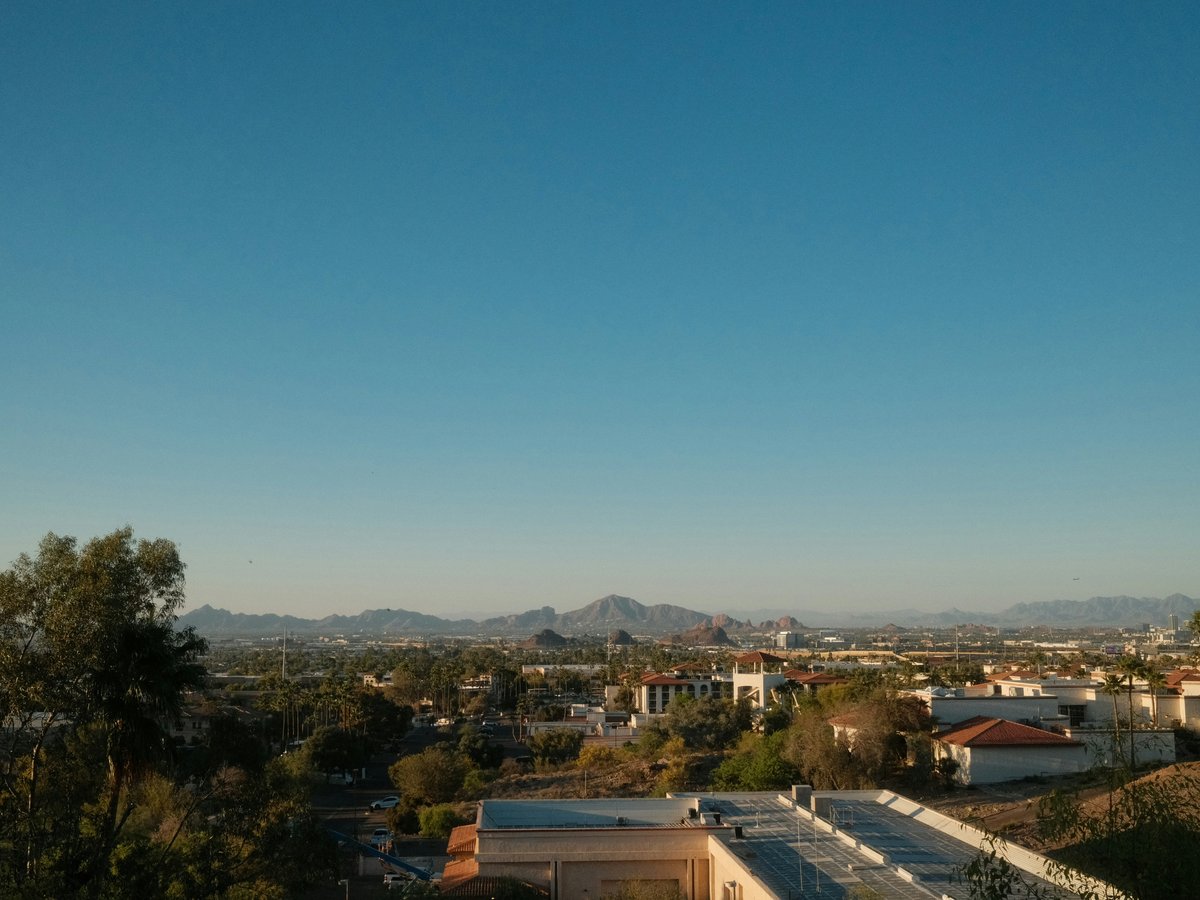
Stay in Phoenix in August
76 hotels in the Trip.com pool for Phoenix, from US$22 a night.
Opens Trip.com on Fri 6 Aug to Sun 8 Aug 2027; change the dates there.
August in Phoenix is dangerously hot. That is the single most important thing to know. Daytime highs average 40.1°C (104°F), and the city regularly hits 43°C (110°F) or higher during peak afternoon hours. The asphalt on Central Avenue can reach 70°C (160°F), hot enough to cause second-degree burns on bare skin. Locals call July and August "hell months" for a reason. Most outdoor recreation effectively shuts down between 10 a.m. and 6 p.m.
That said, August brings one genuinely interesting phenomenon. The North American Monsoon transforms the Sonoran Desert sky most afternoons. Massive thunderheads build over the Superstition Mountains to the east, and by late afternoon you might see walls of dust, called haboobs, rolling across the Valley of the Sun before a sudden downpour drops 15mm in 20 minutes. The smell of creosote bush after desert rain, that sharp, resinous sweetness, is something people remember for years. About 51mm of rain falls across 5 days in a typical August, and the humidity climbs to around 36%, which feels sticky by Phoenix standards even though a visitor from Houston or Bangkok would barely notice.
The trade-off is price. Phoenix in August is one of the cheapest major-city experiences in the United States. Hotel rates across Scottsdale and the greater Valley tend to drop 50-70% compared to peak winter season. Restaurants in the Arcadia neighborhood run summer prix fixe menus at steep discounts. If you can tolerate extreme heat and plan your days around indoor activities and early mornings, the savings are real. But be honest with yourself about whether 40°C heat is something you can handle before booking.
Why visit in August
- Hotel rates across the Valley drop 50-70% from peak season (January through March), making Scottsdale resorts and boutique hotels in the Biltmore area dramatically more affordable than their winter pricing
- The North American Monsoon brings dramatic desert thunderstorms most afternoons, and the post-rain smell of creosote and wet desert soil is a sensory experience unique to the Sonoran Desert
- Phoenix's major museums and indoor attractions, including the Musical Instrument Museum, Phoenix Art Museum, and Heard Museum, are uncrowded, with wait times near zero
- Summer dining deals are widespread. Many restaurants in the Biltmore and Arcadia neighborhoods offer prix fixe summer menus at 40-50% below their winter pricing
Worth knowing
- Average highs of 40.1°C (104°F) make outdoor activity between 10 a.m. and 6 p.m. genuinely dangerous. Maricopa County typically records heat-related deaths every August
- Camelback Mountain and Piestewa Peak, two of Phoenix's signature hikes, are effectively off-limits during midday. The city sometimes closes Camelback trail access when temperatures exceed 41°C (106°F)
- Haboobs (dust storms) can appear with little warning, reducing visibility to near zero and grounding flights at Phoenix Sky Harbor International Airport for hours
- Many seasonal businesses, tour operators, and some restaurants close entirely or reduce hours from June through September
Best for
Think twice if
August in Phoenix is the second-hottest month of the year, trailing July by roughly 1°C. The average high sits at 40.1°C (104°F), and the average low still reaches 28.1°C (83°F), so nights offer limited relief. The North American Monsoon is active, bringing roughly 51mm of rain across about 5 days, typically as intense late-afternoon thunderstorms that last 20-40 minutes. Humidity averages 36%, noticeably higher than the bone-dry 10-15% of April and May. Mornings before 9 a.m. tend to be the most tolerable window, with temperatures around 30-33°C. By 2 p.m. the air shimmers off the pavement. You can feel the radiant heat rising from concrete and asphalt through the soles of your shoes on any sidewalk in Downtown Phoenix.
Seasonal caution
- Extreme heat is the primary hazard. Phoenix averages 40.1°C (104°F) in August, with spikes above 46°C (115°F) possible. Maricopa County issues Excessive Heat Warnings multiple times per month. Heat stroke can be fatal within hours without treatment
- Haboobs (dust storms) can develop rapidly during monsoon season, reducing visibility to near zero. If you are driving on Interstate 10 or Loop 202 when one hits, pull off the road, turn off your lights, and wait. Do not drive into a dust wall
- Monsoon thunderstorms produce dangerous lightning, flash flooding in dry washes, and microbursts with winds exceeding 95 km/h (60 mph). The Indian Bend Wash in Scottsdale and the Salt River bed near Tempe can flood within minutes. Never walk or drive through flooded roadways. Phoenix averages several flash flood warnings each August
- Ground surface temperatures on asphalt, concrete, and dark rock can exceed 70°C (160°F), causing burns on bare feet, hands, or any exposed skin that contacts the surface. Dogs are especially vulnerable to paw burns
Year-round climate
Averages from the last 5 years.
| Month | Avg high (°C) | Avg low (°C) | Rainfall (mm) |
|---|---|---|---|
| Jan | 18 | 5 | 32 |
| Feb | 21 | 8 | 18 |
| Mar | 24 | 10 | 36 |
| Apr | 30 | 15 | 2 |
| May | 35 | 20 | 2 |
| Jun | 41 | 26 | 7 |
| Jul | 42 | 29 | 74 |
| Aug | 40 | 28 | 51 |
| Sep | 38 | 25 | 38 |
| Oct | 32 | 18 | 35 |
| Nov | 25 | 11 | 19 |
| Dec | 20 | 8 | 36 |
Best things to do in August
Early-morning desert hikes at South Mountain Park
hikingSouth Mountain Park and Preserve covers 6,475 hectares on Phoenix's south side, making it one of the largest municipal parks in the United States. The Holbert Trail to Dobbins Lookout runs 3.9 km one way and offers views across the entire Valley at sunrise. The packed-dirt surface radiates less heat than the granite on Camelback, and the trailhead parking lot off Central Avenue opens at 5 a.m.
Starting before 6 a.m. gives you roughly 3 hours of tolerable temperatures, and August monsoon moisture occasionally softens the sky into pink and orange layers at dawn that the dry spring months never produceBooking tipNo booking needed, but arrive by 5:30 a.m. The parking lot at Dobbins Lookout trailhead fills by 6:15 a.m. on weekends even in August
Musical Instrument Museum
museumThe MIM in north Phoenix houses over 8,000 instruments from 200 countries and territories. Each exhibit has wireless headphones that play the instrument as you approach. The Africa and Middle East galleries on the second floor tend to be the least crowded. You can easily spend 3-4 hours here, and the on-site cafe serves decent lunch.
August crowds are minimal compared to the packed winter tourist season, and the air-conditioned galleries are a genuine refuge during the hottest part of the dayMonsoon storm watching from Dobbins Lookout
sightseeingDobbins Lookout sits at 740 meters elevation atop South Mountain, the highest point in the park. On monsoon afternoons, you can watch thunderstorms build over the Superstition Mountains 65 km to the east, with lightning threads visible against the darkening sky. The lookout has a stone ramada for shelter if rain arrives. Bring a camera with a tripod for long-exposure lightning shots.
The North American Monsoon peaks in August, with afternoon storm cells forming 3-4 days per week. The elevation and 360-degree sightlines make this arguably the best urban storm-watching perch in the American SouthwestDesert Botanical Garden evening visits
gardenThe Desert Botanical Garden in Papago Park covers 22 hectares and has one of the world's finest collections of arid-land plants, including over 4,000 species of cacti, agave, and desert wildflowers. The Sonoran Desert Loop Trail takes about 45 minutes. In August, the garden stays open until 8 p.m. on select evenings, and the fading light on saguaro silhouettes is genuinely photogenic.
Evening hours let you explore without the punishing midday sun, and August monsoon rains often trigger overnight blooms on night-blooming cereus and other desert species that are dormant in the dry monthsBooking tipBuy tickets online in advance. The garden occasionally sells out evening sessions even in summer
Scottsdale Museum of Contemporary Art (SMoCA)
museumSMoCA sits on the Scottsdale Civic Center Mall, a grassy 8.5-hectare park designed by architect Bennie Gonzales in the 1960s. The museum rotates 4-5 exhibitions per year across its 5 gallery spaces. The permanent outdoor installation by James Turrell, called "Knight Rise," is a skyspace best experienced at sunset, when the aperture frames the shifting desert light.
Summer programming often includes experimental installations that close before the tourist-heavy winter season. The Turrell skyspace at sunset, when monsoon clouds add texture to the aperture view, is a different experience than in the cloudless springFloat the Salt River at Tonto National Forest
outdoorThe Lower Salt River east of Mesa runs through Tonto National Forest and stays cool enough for tubing even in August, with water temperatures around 18-21°C fed by upstream reservoirs. The Goldfield to Phon D Sutton section runs about 3 km and takes 2-3 hours. The canyon walls provide intermittent shade, and great blue herons and wild horses are common sightings along the banks.
August heat makes the cold river water feel spectacular rather than chilly. Monsoon runoff from upstream can raise water levels, which speeds up the float and adds mild rapids that the dry-season trickle lacksBooking tipSalt River Tubing at the Goldfield launch site typically requires reservations on weekends. Check their operating status, as they close the river during active monsoon flooding
Heard Museum
museumThe Heard Museum in central Phoenix has been dedicated to American Indian art and history since 1929. The permanent "HOME" exhibition spans 10 galleries across 2 floors and traces 2,000 years of Indigenous life in the Southwest. The Barry Goldwater collection of over 400 Hopi katsina dolls on the second floor is particularly strong. The courtyard cafe has mesquite-grilled dishes worth trying.
August is the quietest month for attendance, which means you can spend time with individual pieces without shuffling through tour groups. The museum occasionally runs summer workshops with visiting Indigenous artistsNight swimming at resort pools
leisureSeveral Valley resorts open their pools to non-guests during summer months, typically for a day-pass fee. The water stays warm at 32-35°C, but swimming after 9 p.m. when the air drops to around 35°C and the pool deck cools down is a different experience than the midday oven. The Phoenician in Scottsdale and the Arizona Biltmore both run evening pool programs in summer.
The combination of warm pool water, cooled evening air, and monsoon lightning on the horizon is something you really only get in August. Winter visitors pay peak rates for the same pools during the dayWhat to eat in August
In season: fruit
Prickly pear fruit (tunas)
August is peak harvest for prickly pear cactus fruit across the Sonoran Desert. The magenta-red tunas appear at farmers markets in Downtown Phoenix and at stands along the road in outlying areas. The flavor sits somewhere between watermelon and bubblegum, with crunchy seeds throughout. Several Phoenix restaurants incorporate prickly pear into cocktails, syrups, and sorbets during August.
Melon varieties at local farms
Watermelon and cantaloupe from farms in Maricopa County and the Gila River area hit peak sweetness in August. Roadside stands along Highway 87 toward Payson and the Wednesday Downtown Phoenix Public Market tend to have the freshest picks. The dry heat concentrates sugars in the fruit, and locals will tell you Arizona-grown melons rival anything from the Rio Grande Valley.
What to drink
Summer agua frescas
Agua frescas made from tamarind, hibiscus (jamaica), cucumber-lime, and prickly pear are everywhere in August. Panaderias and taco shops along Van Buren Street and in the Maryvale neighborhood serve them from large glass vitroleros, and the tart, cold sweetness is arguably the best thing about a 40°C afternoon.
In markets
Hatch green chiles
Late August marks the start of Hatch chile season, when New Mexico green chiles arrive in Phoenix by the truckload. Grocery stores like Fry's and local markets throughout the Valley set up roasting drums in parking lots, and the smoky, vegetal smell carries across entire shopping plazas. The chiles end up in everything from breakfast burritos to green chile cheeseburgers at spots across the city.
Regular events in August
First Friday Art WalkFree
Roosevelt Row in Downtown Phoenix hosts an open-gallery art walk on the first Friday of every month. In August, many galleries extend hours past 10 p.m. to take advantage of cooler evening temperatures. The stretch between 3rd Street and 7th Street typically has 20-30 participating venues.
First Friday of AugustPhoenix Mercury WNBA home games
The Phoenix Mercury play home games at the Footprint Center in Downtown Phoenix throughout August. The arena seats 18,000 and the air conditioning alone is worth the visit. The Mercury have been a WNBA franchise since the league's inaugural 1997 season.
Multiple dates throughout AugustCivic Space Park outdoor movie nightsFree
Civic Space Park in Downtown Phoenix, the park with Janet Echelman's suspended net sculpture "Her Secret Is Patience" overhead, hosts free outdoor movie screenings on select August evenings. Screenings start after sunset, around 7:30 p.m., when the concrete has released enough heat to sit on the grass.
Select evenings throughout AugustArizona Diamondbacks home games at Chase Field
Chase Field in Downtown Phoenix has a retractable roof and industrial-grade air conditioning, making August baseball games a comfortable 22°C inside while it is 40°C outside. The D-backs typically have 12-15 home games in August, and upper-deck seats are widely available.
Multiple dates throughout AugustBest places this August
South Mountain Park and Preserve
parkAt 6,475 hectares, one of the largest municipal parks in the US. The drive to Dobbins Lookout takes 15 minutes from the Central Avenue entrance and offers Valley-wide panoramas. Hikers should stick to pre-dawn hours in August.
South PhoenixDesert Botanical Garden
gardenA 22-hectare living museum of desert plants in Papago Park, with over 4,000 species. The evening hours in August let you see night-blooming species and avoid the worst heat. The gift shop carries locally made prickly pear products.
Papago ParkMusical Instrument Museum
museumOver 8,000 instruments from 200 countries, each with a wireless audio guide. The Experience Gallery on the ground floor lets you play a Steinway grand, a gamelan, and dozens of other instruments. Allow 3 hours minimum.
North PhoenixHeard Museum
museumFounded in 1929, this museum holds one of the finest collections of American Indian art in the country. The katsina doll collection and contemporary Native art galleries are highlights. The shaded courtyard offers a cool break.
Central PhoenixPapago Park
parkThe red butte formations of Papago Park sit between Phoenix and Tempe. The Hole-in-the-Rock trail is a short 5-minute climb to a natural window in the sandstone, with views toward Camelback Mountain. Best visited at sunrise in August.
East PhoenixRoosevelt Row Arts District
arts districtThe stretch of Roosevelt Street between 7th Avenue and 16th Street is Phoenix's densest concentration of galleries, murals, and independent shops. The murals change frequently, and the covered patios at spots like Jobot Coffee fill up on cooler evenings.
Downtown PhoenixTaliesin West
historic siteFrank Lloyd Wright's winter home and school, built starting in 1937, sits in the McDowell Mountains in north Scottsdale. The desert masonry walls and canvas-roof structures were designed to channel airflow. Tours run year-round, but August tours tend to have fewer than 10 people compared to 30+ in February.
North ScottsdaleTovrea Castle at Carraro Heights
historic siteThis 1928 cactus-shaped wedding cake of a building sits on a 43-acre hilltop in east Phoenix. The city restored it and opened it for guided tours. The surrounding cactus garden has over 350 saguaros on the property. August tours book up because only 15 people are allowed per session.
East Phoenix
Your packing checklist
Tick items off as you pack. Your progress saves in this browser.
All packed — have a great trip.
Insider tips
The best 3 hours in August Phoenix are between 5:30 a.m. and 8:30 a.m. Locals run, walk dogs, and do outdoor errands in this window. By 9:30 a.m. the heat is already oppressive, and by 11 a.m. the pavement radiates enough to feel through your shoes
Many Valley resorts offer summer day-pass programs that include pool access and sometimes spa credits. These are rarely advertised on the hotel's main booking page. Call the front desk directly and ask about their summer day-pass program
The light rail runs air-conditioned trains every 12 minutes between Mesa, Tempe, and Downtown Phoenix. In August it is a better way to move between museums and restaurants than walking, even for short distances. The 19th Avenue/Dunlap station is closest to the Musical Instrument Museum
Scottsdale restaurants that require reservations 3 weeks out in February often have same-day availability in August. Sommelier-led wine dinners and chef's counter seats that are competitive to book in winter are sometimes available day-of
If a haboob hits while you are driving, the Arizona protocol is to pull completely off the roadway, put your vehicle in park, turn off all lights including hazards, and take your foot off the brake. Lights attract other drivers toward you in zero-visibility conditions
The Tempe Town Lake area along Rio Salado Parkway is one of the few spots where you might feel a breeze in the evening. The lake surface creates a micro-cooling effect, and several restaurants along the north shore have misting systems on their patios
Avoid these mistakes
- Scheduling outdoor activities between 10 a.m. and 5 p.m. Every year visitors end up in Maricopa County emergency rooms with heat-related illness because they treated a 40°C day like a normal warm day. It is not. Plan all outdoor time for before 8 a.m. or after 7 p.m.
- Underestimating hydration needs. At 40°C with 36% humidity, you can lose 1-2 liters of sweat per hour during physical activity. Many visitors drink their usual amount of water and end up dehydrated before they feel thirsty
- Attempting Camelback Mountain or Piestewa Peak at midday. These exposed granite hikes have no shade and the rock surface itself radiates stored heat. The city closes trail access on the hottest days, and search-and-rescue teams respond to multiple hiker distress calls each August
- Leaving anything heat-sensitive in a parked car. Interior temperatures in a parked car in Phoenix reach 70°C within 30 minutes. Electronics, medications, chocolate, crayons, and sunscreen canisters can all be destroyed. Prescriptions containing insulin or similar heat-sensitive compounds require an insulated cooler
- Walking barefoot on any outdoor surface. Pool decks, parking lots, sidewalks, and even grass in full sun can cause second-degree burns in under 10 seconds of contact. This applies to dogs as well. If you cannot hold your hand flat on the pavement for 7 seconds, it is too hot for bare feet
Practical tips for August
Ride-share apps are more reliable than waiting at outdoor bus stops in August heat. Phoenix is a sprawling city, roughly 40 km from the Musical Instrument Museum in the north to South Mountain Park, and walking between attractions is rarely practical even in cooler months. The Valley Metro light rail connects Downtown Phoenix, Tempe, and east Mesa along a 43 km line and runs air-conditioned cars every 12 minutes during peak hours. Most museums and indoor venues open by 10 a.m. and close between 5 and 8 p.m. Plan mornings for any outdoor exploration, midday for museums and galleries, and evenings for dining. Restaurant reservations are easier to get than any other month, but some places close entirely for summer or shift to reduced schedules. Check hours before making the trip, especially in Old Town Scottsdale where several spots close from June through September. Carry water everywhere, even on a 5-minute walk from a parking garage to a restaurant entrance.
FAQ
Is August a good time to visit Phoenix?
Honestly, August is one of the least comfortable months to visit Phoenix. Average highs of 40.1°C (104°F) make outdoor sightseeing between 10 a.m. and 6 p.m. difficult and potentially dangerous. That said, if you are motivated by deep discounts on hotels and dining, or if you specifically want to experience monsoon season in the Sonoran Desert, August has a raw appeal that the sanitized winter tourist season lacks. Plan around indoor activities and early mornings.
How hot does Phoenix get in August?
The average high is 40.1°C (104°F), but individual days above 43°C (110°F) are common, and the record for August sits at 48°C (118°F). The average low is 28.1°C (83°F), which means even nighttime offers limited cooling. Ground surface temperatures on asphalt and concrete regularly exceed 70°C (160°F) in direct afternoon sun.
What is a haboob and should I be worried about one?
A haboob is a massive wall of dust that rolls across the Phoenix metro area during monsoon season. They typically form when a collapsing thunderstorm sends a gust front outward, picking up loose desert soil. Visibility drops to near zero, and they can last 15-45 minutes. If you are driving, pull completely off the road, stop, turn off your lights, and wait. They are dramatic to watch from indoors but dangerous to drive through.
Can I still hike Camelback Mountain in August?
Technically the trails are open on most days, but the city closes access when temperatures exceed 41°C (106°F), which happens regularly in August. Even when open, hiking Camelback in August heat is genuinely risky. The exposed granite holds heat and there is no shade on the summit trail. If you must hike, South Mountain's Holbert Trail before 6 a.m. is a safer alternative with similar desert views.
What is there to do indoors in Phoenix during August?
Phoenix has several world-class indoor attractions. The Musical Instrument Museum in north Phoenix houses over 8,000 instruments and could fill an entire afternoon. The Heard Museum in central Phoenix has one of the best collections of American Indian art in the country. The Phoenix Art Museum, Scottsdale Museum of Contemporary Art, and the Arizona Science Center in Downtown Phoenix are all strong options. Chase Field hosts air-conditioned Diamondbacks baseball games throughout the month.
Are monsoon storms dangerous for visitors?
They can be. August monsoon thunderstorms produce lightning, flash flooding, microbursts with winds over 95 km/h, and occasionally haboobs. The Indian Bend Wash in Scottsdale and dry washes throughout the Valley can flood within minutes of a storm. Never drive or walk through flooded roadways. That said, watching a monsoon storm build from a safe indoor vantage point is one of the more memorable things about August in Phoenix.
Things to Do in Phoenix in August
 Free cancellation
 Small-Group or Private Grand Canyon with Sedona Tour from Phoenix
Day trip: 13 hours, free cancellation.
via Viator Free cancellation
 Grand Canyon with Sedona and Oak Creek Canyon Van Tour
Day trip: 11 hours, free cancellation.
via Viator Free cancellation
 Phoenix area Hot Air Balloon Ride on the Largest Balloon in USA
Outdoor experience: 4 hours, free cancellation.
via Viator Free cancellation
 Arizona Desert Guided E-Bike Adventure
Outdoor experience: free cancellation.
via Viator Free cancellation
 Small Group or Private Sedona and Native American Ruins Day Tour
Day trip: 11 hours, free cancellation.
via Viator Free cancellation
 One-Day Private Grand Canyon National Park/Sedona tour from Phoenix-Scottsdale
Day trip: 13 hours, free cancellation.
via ViatorFind a flight to Phoenix
Live fares to Phoenix appear here once cookies are accepted.
Last verified by automated review (v1.7.2) on . What is automated review?