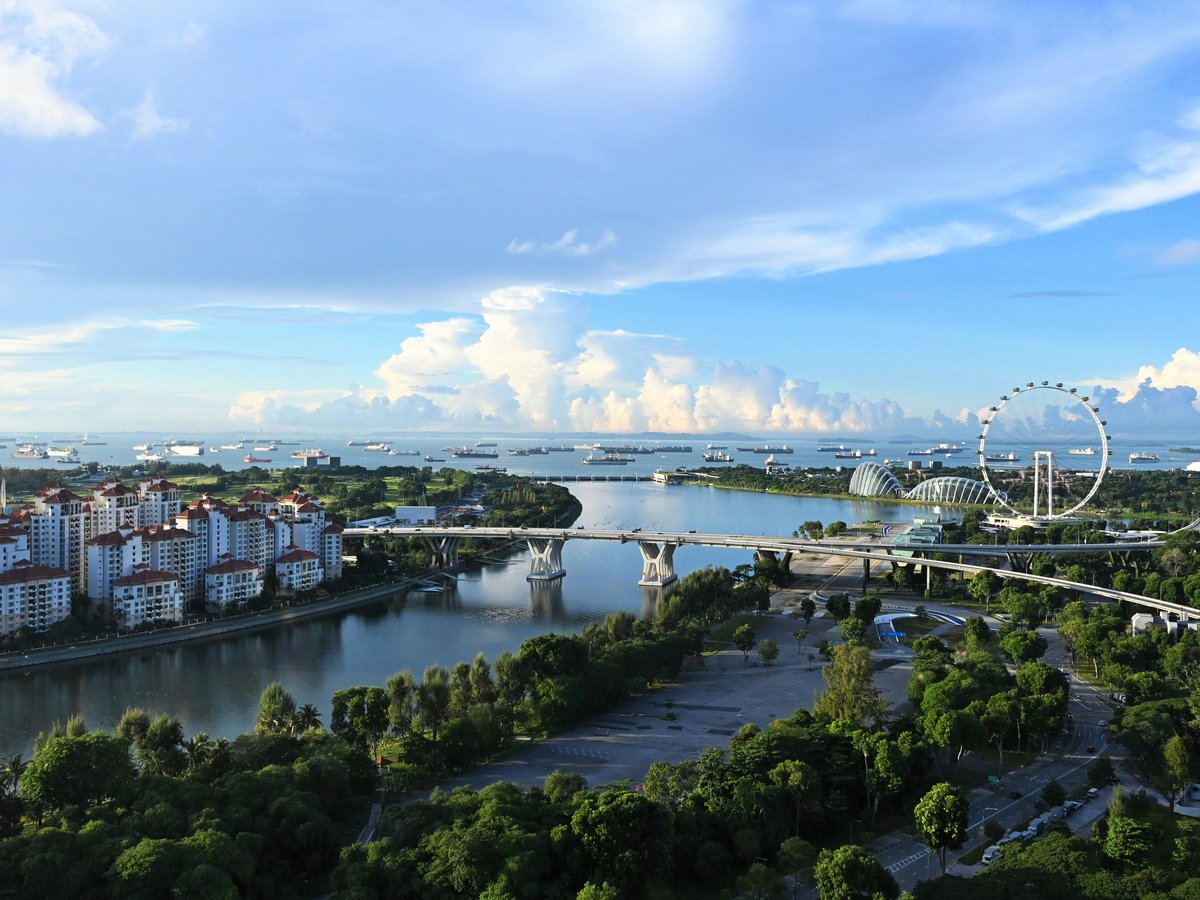
Stay in Singapore in April
125 hotels in the Trip.com pool for Singapore, from US$15 a night.
Opens Trip.com on Fri 2 Apr to Sun 4 Apr 2027; change the dates there.
April in Singapore means one thing above all else: the heat-humidity combination hits its annual peak. Expect daytime temperatures around 31°C (87°F) with humidity sitting at a relentless 87%: the kind that fogs your glasses the moment you step out of an air-conditioned MRT station. This is the inter-monsoon window between the Northeast and Southwest monsoons, and the atmosphere tends to build up pressure all morning before releasing it in dramatic afternoon thunderstorms. Rain falls on roughly 28 of 30 days, though 'rainy day' here rarely means what it does in London or Seattle: these are sharp, theatrical downpours that arrive around 3pm, hammer everything for 20 to 45 minutes, and then clear, leaving the streets steaming.
To be fair, Singapore is possibly the best-engineered city on earth for dealing with its own climate. The MRT is spotless and freezing cold. Shopping malls connect through underground walkways. Hawker centres have overhead cover and ceiling fans that work. You can go entire days barely touching open sky if you plan your route through the network of covered paths locals call sheltered walkways. The infrastructure doesn't cancel out the heat, but it makes April completely manageable if you accept the rhythm: early mornings outside, afternoons inside, evenings back out once the rain clears.
April sits in a relative tourism lull: the Chinese New Year crowds are months gone, the European and American summer holiday surge hasn't started, and school terms are still running across most of Asia. Hotel rates reflect this. You won't have the city to yourself, but you'll notice shorter queues at Gardens by the Bay and actual empty seats on the MRT during off-peak hours. It's not the best month to visit Singapore, but it's far from the worst, and the food, honestly, might be better without the crowds.
Why visit in April
- Fewer tourists than peak months: shorter queues at Gardens by the Bay, actual elbow room at popular hawker centres like Maxwell and Tekka, and hotel availability that doesn't require booking three months out
- Hotel rates tend to drop 15–25% from Chinese New Year and December peaks, making higher-end properties like those around Marina Bay noticeably more accessible
- The dramatic afternoon thunderstorms clear the air and cool temperatures by evening: some of the best sunset light of the year follows these storms, particularly from Marina Barrage looking back toward the skyline
- Singapore's world-class indoor infrastructure means rain barely disrupts a well-planned day: the National Gallery, ArtScience Museum, Cloud Forest at Gardens by the Bay, and Jewel Changi Airport could fill a week on their own
Worth knowing
- Humidity at 87% with temperatures around 31°C (87°F) creates a heat index that can push past 38°C (100°F): genuinely oppressive for visitors from temperate climates, the kind of sticky heat where you shower, step outside, and feel damp again within five minutes
- Rain falls on roughly 28 of 30 days with 287mm total for the month, making reliable outdoor photography planning difficult and forcing constant schedule flexibility
- No major headline festival or event to anchor a trip around: April is one of Singapore's quieter cultural months, unlike September's F1 weekend or the Lunar New Year period
- The UV index regularly hits extreme levels (11+) during midday hours, limiting comfortable outdoor time to early mornings and evenings even on overcast days
Best for
Think twice if
April sits in the inter-monsoon transition between the Northeast and Southwest monsoons, and it shows. Mornings start warm and sticky around 28°C, typically climbing past 30°C by mid-morning with humidity that rarely dips below 85%. By early afternoon, towering cumulonimbus clouds build over the island, and the thunderstorms tend to hit between 2pm and 5pm: sharp, heavy downpours that hammer the streets for 20 to 45 minutes before clearing. Evenings that follow settle around 26–27°C, with air that feels noticeably lighter after the rain has scrubbed it. Lightning is a real feature of April skies here. Singapore sits in one of the world's highest lightning-density zones, and the inter-monsoon storms are the most electrically active of the year. You'll hear thunder most afternoons, sometimes accompanied by wind gusts that send hawker centre napkins flying. The overnight lows around 24°C (75°F) bring modest relief, though the humidity means even nighttime can feel close.
Seasonal caution
- The combined heat index (temperature plus humidity) regularly exceeds 38°C (100°F) during midday hours: heat exhaustion is a real risk if you're walking exposed between 11am and 3pm. Dehydration at 87% humidity is deceptive because sweat doesn't evaporate, so you may not feel thirsty even as you lose fluid. Carry water constantly and drink more than you think you need.
- Singapore experiences some of the world's highest lightning density, and April's inter-monsoon storms are particularly electrically active. Seek solid shelter immediately when you hear thunder: avoid sheltering under trees at MacRitchie Reservoir, the Botanic Gardens, or East Coast Park. The National Environment Agency issues lightning alerts through the myENV app.
Year-round climate
Averages from the last 5 years.
| Month | Avg high (°C) | Avg low (°C) | Rainfall (mm) |
|---|---|---|---|
| Jan | 29 | 23 | 348 |
| Feb | 30 | 23 | 134 |
| Mar | 31 | 24 | 272 |
| Apr | 31 | 24 | 287 |
| May | 31 | 25 | 285 |
| Jun | 30 | 25 | 306 |
| Jul | 30 | 25 | 211 |
| Aug | 30 | 24 | 321 |
| Sep | 30 | 24 | 240 |
| Oct | 31 | 24 | 273 |
| Nov | 30 | 24 | 372 |
| Dec | 30 | 23 | 310 |
Best things to do in April
Hawker centre marathon
foodHit three or four hawker centres in a single day: Maxwell Food Centre for chicken rice in the morning, Tekka Centre for roti prata at lunch, Old Airport Road for carrot cake in the afternoon, and Lau Pa Sat for satay after dark. The shoulder-season crowds mean you'll find seats during peak hours, which is genuinely rare.
Fewer tourists and manageable queues at stalls that normally have 30-minute waits during peak seasonBooking tipNo reservations needed, just show up. Lunch rush at Maxwell still peaks around 12:30pm, so arriving at noon or 1pm helps.
National Gallery Singapore deep dive
cultureTwo former civic buildings (the Supreme Court and City Hall) stitched together into Southeast Asia's largest visual arts museum. The permanent collection covers Singaporean and regional art from the 19th century forward, and the architecture itself rewards slow looking. The atrium connecting the two buildings catches beautiful diffused light.
The afternoon rain makes a compelling case for spending four or five hours inside rather than rushing through in two, and April's lower visitor numbers mean quieter galleriesBooking tipTickets are available at the door. Weekday mornings are the quietest.
Gardens by the Bay evening visit
natureThe Supertree Grove light show runs nightly, and the outdoor gardens are free to walk through. After a late-afternoon storm clears, the air cools enough to make walking the waterfront genuinely pleasant. The Cloud Forest conservatory (a chilled dome with a 35-metre indoor waterfall) is worth the entry fee for the temperature contrast alone.
Post-storm evenings in April often produce dramatic skies behind the Supertrees, and lower tourist volumes mean less jostling for photo anglesBooking tipThe conservatories close earlier than the outdoor gardens: check times before heading out.
Pulau Ubin cycling
outdoorA 10-minute bumboat ride from Changi Point Ferry Terminal drops you on Singapore's last kampong island: unpaved roads, wild boar sightings, abandoned quarries turned turquoise lagoons, and the Chek Jawa wetlands boardwalk. Rent a bicycle at the jetty and spend the morning exploring before the afternoon heat builds.
Start early, before 9am, and you get three solid hours of cycling before the storms roll in: the morning humidity is heavy but the shade cover on the island trails helpsBooking tipBumboats leave when full (about 12 passengers). Weekday mornings may have a short wait. Bring water: there's limited supply on the island.
Tiong Bahru neighbourhood walk
cultureSingapore's oldest public housing estate, now a pocket of independent cafes, bookshops, and pre-war art deco flats with curved balconies and spiral staircases. The wet market on the ground floor of Block 30 is where the neighbourhood still feels genuinely local: old uncles buying fish at 7am, oblivious to the boutique coffee shop upstairs.
April mornings are best for walking the neighbourhood before the heat peaks, and the cafes are less crowded than during school holidaysBooking tipNo bookings needed. The wet market is liveliest before 9am.
Katong and Joo Chiat Peranakan heritage walk
cultureA stretch of pastel shophouses along Koon Seng Road, Peranakan tile work on every facade, and a quiet residential feeling that the Chinatown tourist zone lost years ago. Joo Chiat Road itself has bakeries selling pineapple tarts and kueh, and the restaurants here lean toward Peranakan and Malay home cooking.
The shoulder season means you can photograph the shophouse facades without tour groups blocking the frames, and the neighbourhood bakeries aren't picked clean by mid-morningMarina Barrage sunset picnic
outdoorA dam across the mouth of the Marina Channel with a rooftop green space that offers one of the city's widest skyline panoramas. Locals bring mats and kites on weekend evenings. The view toward Marina Bay Sands and the financial district catches the last light in a way that feels earned after a sticky day.
April's post-thunderstorm skies tend to produce vivid sunset colours as the cloud cover breaks up: some of the best golden-hour light of the yearArtScience Museum visit
cultureThe lotus-shaped building at Marina Bay Sands hosts rotating exhibitions that tend toward the intersection of art, science, and technology. The permanent Future World installation (a collaboration with teamLab) is a dark, immersive room of projected digital art that children and adults both lose time in.
Another strong option for the afternoon storm hours, and April typically has lower foot traffic than school holiday monthsWhat to eat in April
In season: fruit
Durian
Early durian season typically starts around April as the inter-monsoon rains trigger flowering cycles in Malaysian orchards. The first harvests of Mao Shan Wang and D24 varieties tend to trickle into Geylang's durian stalls, though peak supply comes later in June. The smell alone (sweet, sulfurous, unmistakable) will find you before you find the fruit.
Mangosteen
The season for mangosteens tends to overlap with early durian, and April sometimes catches the first arrivals from Thailand and Indonesia. The thick purple rind cracks open to reveal segments of white flesh that taste floral, tart, and faintly sweet: nothing else quite like it.
On menus now
White pepper crab
A year-round hawker staple, but the slightly cooler post-storm evenings in April make the peppery, warming broth hit differently. The white pepper cuts through the residual humidity in a way that chilli crab doesn't quite manage. Long Beach and No Signboard are the well-known spots, though locals tend to have their own favourites.
Ice kacang
Shaved ice mounded with red beans, grass jelly, sweet corn, and a lurid cascade of syrup and condensed milk. Not seasonal in a harvest sense, but April's heat makes it feel essential rather than optional. The best versions have a fine, powdery ice texture that melts on your tongue.
What to drink
Chendol
Pandan-flavoured green rice flour jelly worms swimming in coconut milk and gula melaka syrup over shaved ice. The gula melaka (palm sugar with a deep, caramel-smoke sweetness) is what separates a good chendol from a forgettable one. You'll find solid versions at most hawker centres.
Regular events in April
World Gourmet Summit
A multi-week food festival bringing international chefs to collaborate with Singapore restaurants on special tasting menus and wine-pairing dinners. Participating restaurants across the city offer limited-run dishes you won't find the rest of the year.
Throughout AprilSingapore International Jazz Festival
A weekend of international and regional jazz acts performing at Marina Bay Sands, typically drawing a mix of headliners and emerging artists. The outdoor stage area tends to catch a breeze off the bay.
Late April or early May (dates shift yearly)Earth Day activitiesFree
Various environmental events and clean-up drives across parks and beaches, organized by local green groups. Gardens by the Bay and the Botanic Gardens typically run themed programming for families.
Around April 22Best places this April
Maxwell Food Centre
foodOne of Singapore's most concentrated hawker centres: Tian Tian chicken rice gets the press, but the real depth is in the less famous stalls. Fuzhou oyster cake, popiah, and thunder tea rice all within a two-minute walk of each other.
ChinatownNational Gallery Singapore
museumTwo grand colonial buildings joined into a single museum with the world's largest public collection of Southeast Asian art. The Supreme Court wing alone, with its original courtrooms preserved, is worth the visit.
Civic DistrictJewel Changi Airport
attractionEven if you're not flying, the Rain Vortex (a 40-metre indoor waterfall surrounded by a terraced forest) is one of the stranger architectural experiences in Asia. The light-and-sound show after dark adds another dimension.
ChangiBotanic Gardens
natureA UNESCO World Heritage Site and one of the few tropical gardens in the world that genuinely warrants the title. The National Orchid Garden has the density; the rain tree-lined paths in the older sections have the atmosphere. Early morning is when joggers and tai chi practitioners have it.
TanglinKampong Glam
cultureThe historic Malay-Arab quarter centred on Sultan Mosque. Haji Lane has the street art and independent shops; Arab Street has the textile merchants and perfumeries; Bussorah Street has the cafes. The whole area covers about four blocks and rewards slow wandering.
Kampong GlamCloud Forest at Gardens by the Bay
natureA cooled conservatory kept at around 23°C: basically a different climate zone from the street outside. The 35-metre waterfall greets you at the door, and the elevated walkway through the mist-shrouded mountain gives a bird's-eye view of the tropical montane plants below.
Marina BayChinatown Heritage Centre
museumThree restored shophouses on Pagoda Street recreated to show how early Chinese immigrants lived: cramped cubicle dwellings, opium dens, and the texture of a community building itself from nothing. Considerably more honest than the sanitised Chinatown outside the door.
ChinatownEast Coast Park
outdoorA long strip of beachfront park popular with families, cyclists, and the barbecue crowd on weekends. The seafood restaurants along the East Coast Lagoon serve chilli crab and black pepper crab with the sea breeze. Best visited in the morning or after the afternoon rain clears.
East Coast
Your packing checklist
Tick items off as you pack. Your progress saves in this browser.
All packed — have a great trip.
Insider tips
Download the myENV app from the National Environment Agency: it has a real-time lightning alert map and rain radar that's far more accurate than generic weather apps. Locals use it to time their outdoor activities around the storms, and after a few days you'll start doing the same.
The sheltered walkway network connecting MRT stations to malls and HDB blocks is extensive but poorly signposted. Google Maps won't route you through them. Ask a local or look for the covered overhead bridges: once you learn the connections in your area, you can walk 15 minutes in a downpour without getting wet.
Hawker centres are busiest between 12pm and 1pm. Arriving at 11:30am or after 1:30pm at popular spots like Maxwell or Old Airport Road means dramatically shorter waits. Some of the best stalls close once they sell out, which can be as early as 1pm for popular items like roasted meats.
The MRT's Circle Line connects many of the best neighbourhoods for walking (Tiong Bahru, Botanic Gardens, Holland Village) and the stations themselves are kept so cold you might want that extra layer just for the platform wait.
Grab (the regional ride-hailing app) is generally more useful than taxis for getting around, but during the 3–5pm storm window, surge pricing can spike noticeably. If you're heading somewhere during peak rain, the MRT is almost always faster and a fraction of the cost.
The rooftop bar scene is best experienced after 7pm once the storms have cleared and the humidity drops a few points. The views from spots like Level 33 or 1-Altitude tend to come with cleaner air and better light than during the hazy midday.
Avoid these mistakes
- Underestimating the humidity's effect on hydration: visitors from dry climates often don't realize they're losing significant fluid because sweat can't evaporate. By the time you feel thirsty, you're already behind. Carry water everywhere and drink proactively.
- Planning a full day of outdoor sightseeing without accounting for the afternoon storms. The rain is almost a certainty between 2pm and 5pm in April: schedule indoor activities for that window and you'll have a much better day.
- Wearing jeans or heavy cotton in the equatorial heat. It sounds obvious, but visitors from cooler climates pack what they'd wear at home. Linen, moisture-wicking synthetics, or light shorts are what everyone (tourist and local) wears here.
- Skipping hawker centres in favour of restaurant dining for every meal. The hawker food is genuinely among the best eating in Asia, and the centres themselves are part of Singapore's UNESCO-inscribed culture. Eating exclusively at restaurants means missing the point.
- Staying only in the Marina Bay area and treating Singapore as a compact city-centre destination. The neighbourhoods (Tiong Bahru, Joo Chiat, Kampong Glam, Geylang) are where the texture lives, and they're all within 15 minutes by MRT.
Practical tips for April
April's rhythm in Singapore is predictable enough to plan around: mornings are hot but manageable for outdoor activity, the storms typically arrive between 2pm and 5pm, and evenings cool down enough for comfortable walking. Structure your days with outdoor plans before noon, indoor activities (museums, malls, the conservatories at Gardens by the Bay) during the afternoon storm window, and evening outings after the rain clears. The MRT runs from about 5:30am to midnight and covers most areas you'd want to visit; a stored-value EZ-Link card from any station saves fumbling with single-trip tickets. Hawker centres are cash-heavy, though many stalls now accept PayNow or GrabPay via QR code. Tipping is not customary and not expected anywhere. The tap water is safe to drink. If you're visiting temples or mosques, carry a scarf or cover-up: bare shoulders and short shorts won't pass the dress code at Sultan Mosque or the Sri Mariamman Temple, and the air-conditioning inside is a welcome bonus.
FAQ
Is April a good time to visit Singapore?
It's a fair month, not the best, not the worst. The heat and humidity are at their annual peak, and rain falls nearly every day, but the storms are short and predictable. The trade-off is lower tourist numbers, better hotel rates, and a city that's engineered to function perfectly in wet weather. If you can handle the heat and don't mind planning around afternoon downpours, April has its own appeal.
How hot is Singapore in April?
Daytime highs typically sit around 31°C (87°F), but the real number that matters is the heat index: with 87% humidity, the perceived temperature often pushes past 38°C (100°F) during midday. Mornings start around 28°C, evenings settle to 26–27°C after the rain, and overnight lows hover near 24°C. The humidity is the harder part to manage: the air feels thick and heavy, and sweat doesn't evaporate the way you're used to.
Does it rain every day in Singapore in April?
Very nearly: expect rain on roughly 28 of 30 days. But the pattern is consistent: mornings are usually dry, clouds build through midday, and the storms hit between 2pm and 5pm. They're intense but brief, typically lasting 20 to 45 minutes. After the rain passes, the skies often clear and the air feels noticeably fresher. All-day washouts are rare.
What should I wear in Singapore in April?
Light, breathable fabrics: linen, moisture-wicking synthetics, or light cotton blends. Avoid heavy cotton and denim, which absorb sweat and stay wet. You'll want a light long-sleeved layer for the intensely air-conditioned indoor spaces. Footwear with some grip matters because pavements get slippery after the daily storms. Sandals are fine for most activities, but skip smooth-soled flip-flops.
Are there any major events in Singapore in April?
April is one of Singapore's quieter months culturally. The World Gourmet Summit runs through much of the month, bringing international chef collaborations to restaurants across the city. The Singapore International Jazz Festival sometimes falls in late April. But there's no marquee event at the scale of Chinese New Year, the F1 Grand Prix, or Deepavali: if a headline event is important to your trip, April may not deliver.
Is Singapore expensive in April?
Less so than during peak periods. Hotel rates tend to run 15–25% below what you'd pay during Chinese New Year or the December holiday window, and availability is better at popular properties. Hawker food (arguably the city's greatest asset) costs the same year-round and remains one of the best food bargains in any developed city. Attractions hold steady pricing regardless of season.
Things to Do in Singapore in April
 Free cancellation
 Lion City Bike Tour of Singapore
City tour: 4 hours, free cancellation.
via Viator Free cancellation
 Singapore River Cruise, Night Garden Rhapsody & Spectra by CYT
Day trip: 4 hours, free cancellation.
via Viator Free cancellation
 Singapore Highlights Small Group Bike Tour on Full-Sized Bicycles
City tour: 4 hours, free cancellation.
via Viator Free cancellation
 Singapore Starry Night River Cruise, Spectra & Garden Rhapsody
Day trip: 4.5 hours, free cancellation.
via Viator Free cancellation
 Singapore River Cruise and 2 Must-see Water Light Shows
Day trip: 4 hours, free cancellation.
via Viator Free cancellation
 Private Tour: Nighttime Sightseeing with River Cruise
City tour: 3.5 hours, free cancellation.
via ViatorFind a flight to Singapore
Live fares to Singapore appear here once cookies are accepted.
Last verified by automated review (v1.7.2) on . What is automated review?