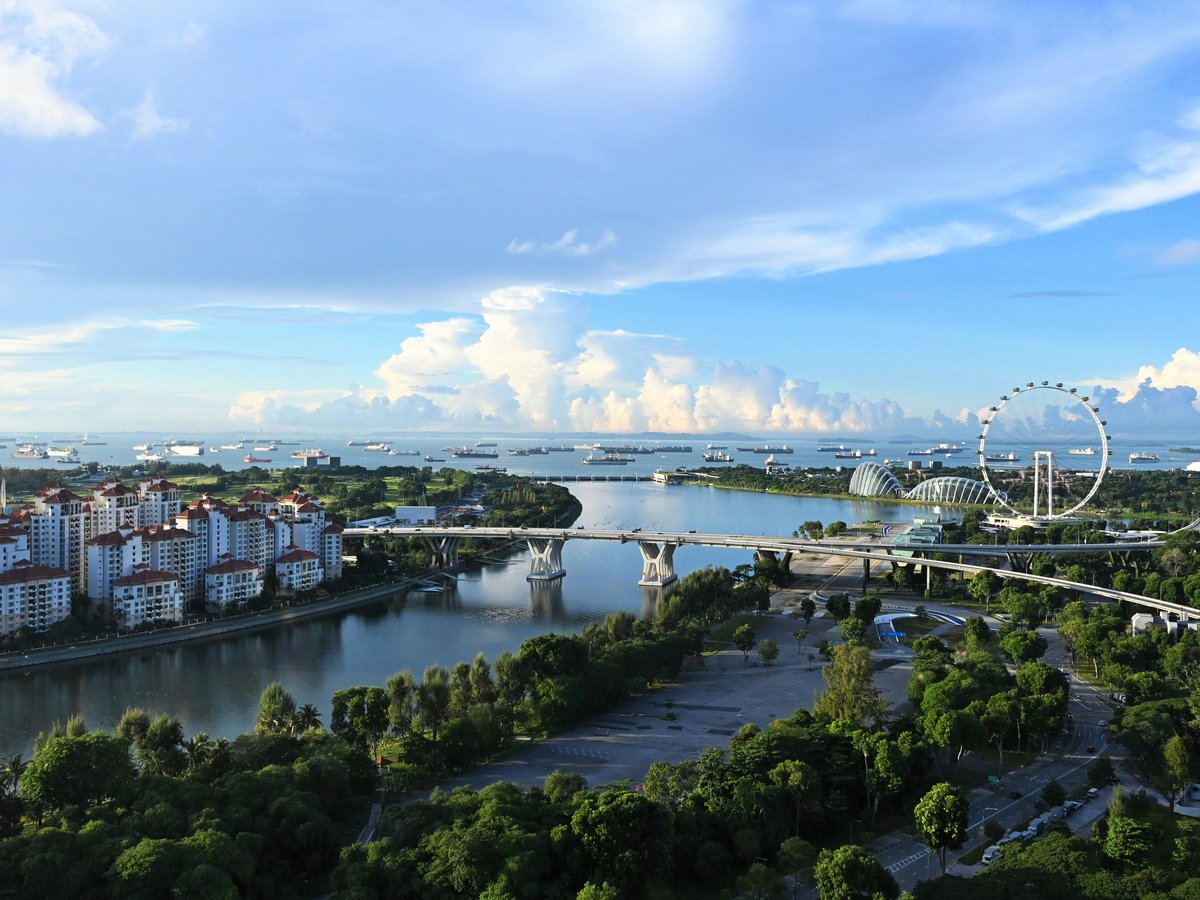
Is Singapore good for digital nomads in 2026?
Singapore scores 6.2/10 for digital-nomad suitability (sourced from TTDI's editorial rubric). Wifi runs at 1 Gbps fiber standard and the MRT comes every 3-5 minutes. The problem is cost. Budget S$4,500 monthly (about $3,500 USD at 1.29 SGD) for a shared room, coworking, and three hawker meals a day. No digital nomad visa exists. Most passports get 30 days, extendable to 89.
Singapore's residential fiber runs at 1 Gbps down and 500 Mbps up on a standard Singtel or StarHub plan. An M1 broadband package at S$49/month delivers tested speeds of 800-950 Mbps. Cafes and coworking spaces sit on dedicated business lines from the same three carriers. Public wifi through Wireless@SG covers MRT stations, libraries, and most hawker centers at 5-20 Mbps, enough for video calls between lunch and your next deep-work block. The National Library on Victoria Street has free wifi, air conditioning cold enough to need a hoodie in July, and no purchase requirement. It fills up by 10 AM on weekdays with students and freelancers staking out power outlets along the 5th floor reading room. Starbucks and Coffee Bean locations tolerate laptop workers for 2-3 hours, but the local kopitiam chains do not. If someone is waiting for your table at Maxwell Food Centre, you close the laptop. That is the local expectation. Singapore's power grid runs above 99.9% uptime, so you will not lose a Zoom call to a blackout.
Coworking in Singapore is priced for corporate tenants, not indie nomads. WeWork at Beach Centre charges S$580/month for a hot desk. The Working Capitol on Keong Saik Road runs S$400/month, with low ceilings, warm wood paneling, and a cafe pulling proper espresso at S$6 a cup. JustCo at Marina One offers S$350/month hot desks, but the open-plan zone fills with insurance sales teams on speakerphone by midday. The Great Room at One George Street is the premium option at S$600/month, quiet and well-designed, with a crowd that skews more toward fund managers than freelancers. The Hive at Lavender comes closest to a nomad-friendly feel at S$330/month, with an outdoor terrace where you can hear the MRT rumble past and a crowd that trends younger and more international. For context, that S$400 average is about $310 USD at the current 1.29 rate. That is 2-3 times what a comparable desk costs in Chiang Mai or Bali.
Tiong Bahru draws the most nomads in Singapore, and the infrastructure supports a full month. The wet market on Seng Poh Road opens at 6 AM, indie cafes line Yong Siak Street, and HDB flats above rent rooms for S$1,000-1,400/month. The Tiong Bahru MRT station is a 5-minute walk. NTUC FairPrice sits below one of the blocks. The drawback is renovation drilling in the older HDB units, which seems to run 6 days a week, and the concrete walls carry every bit of it. Geylang is the budget option. Rooms in shared HDBs go for S$700-900/month, and Lorong 9 through Lorong 29 have some of the best late-night food on the island. Frog porridge and beef hor fun at 1 AM, steam rising off the woks, the smell of charcoal and garlic thick in the humid night air. The red-light reputation applies to even-numbered lorongs, not the odd-numbered ones where most residential stock sits. Bugis and Lavender split the difference at S$900-1,200/month for a room, close to The Hive, with strong hawker options at Albert Centre Market.
The honest monthly budget breaks down to roughly S$4,500 ($3,500 USD). That assumes a shared HDB room at S$1,100, coworking at S$380, three hawker meals a day at S$15 total, MRT transport at S$120, and S$400 for laundry, phone, and weekend expenses. A private studio condo pushes the total past S$6,000 ($4,650 USD). Hawker centers keep the food bill manageable. A plate of chicken rice at Tian Tian in Maxwell Food Centre costs S$6. Laksa at Sungei Road Laksa near Jalan Berseh is S$3.50. You can eat well on S$12-18 a day if every meal comes from a hawker stall, and the food is better than most restaurant options anyway. The temperature holds at 30-33°C year-round with 80-90% humidity. At 7 AM the air reads 26°C but feels like 31°C. Every cafe, coworking space, and MRT car runs at 22-24°C. The constant shift between outdoor heat and indoor cold takes about a week to stop noticing.
Singapore earns 6.2/10 for digital-nomad suitability (sourced from TTDI's editorial rubric), and that number captures a real split. The wifi and transit infrastructure might be the best in Southeast Asia. Monthly costs above $3,500 USD and an 89-day visa ceiling pull it down. Singapore has no digital nomad visa. Most Western passports get 30 days visa-free, extendable once to 89 days at ICA on Kallang Road for S$40. The ONE Pass requires S$30,000/month income proof. Tech.Pass needs S$20,000/month and a tech-sector track record. For a nomad earning $4,000-8,000/month, there is no legal path past 89 days. What keeps people returning is the reliability. The MRT runs every 3-5 minutes. Tap water from PUB meets WHO standards. Streets are clean at 2 AM. Solo-traveler safety hits 9.2/10 (see the TTDI Solo-Safety Index). For a 6-8 week high-productivity sprint between longer stays in Chiang Mai or Bali, Singapore is hard to beat. Past 3 months, the visa and the rent both stop working.
Composite of cafe + coworking download speeds and reliability.
Apartment, coworking membership, food, and transit at a comfortable level.
Coworking spaces
- WeWork Beach Centre (hot desk S$580/mo)
- The Working Capitol, Keong Saik Road (hot desk S$400/mo)
- JustCo Marina One (hot desk S$350/mo)
- The Great Room, One George Street (hot desk S$600/mo)
- The Hive Lavender (hot desk S$330/mo)
- Spaces Guoco Tower
- National Library Victoria Street (free wifi, no membership)
Visa options
Most Western passports receive 30-day visa-free entry, extendable once to 89 days at ICA for S$40. No dedicated digital nomad visa exists. ONE Pass requires S$30,000/month income proof. Tech.Pass targets tech professionals at S$20,000/month minimum. Work Holiday Programme covers ages 18-25 from select countries for 6 months. Realistic ceiling for standard nomads is 89 days.
Last verified by automated review (v1.7.2) on . What is automated review?