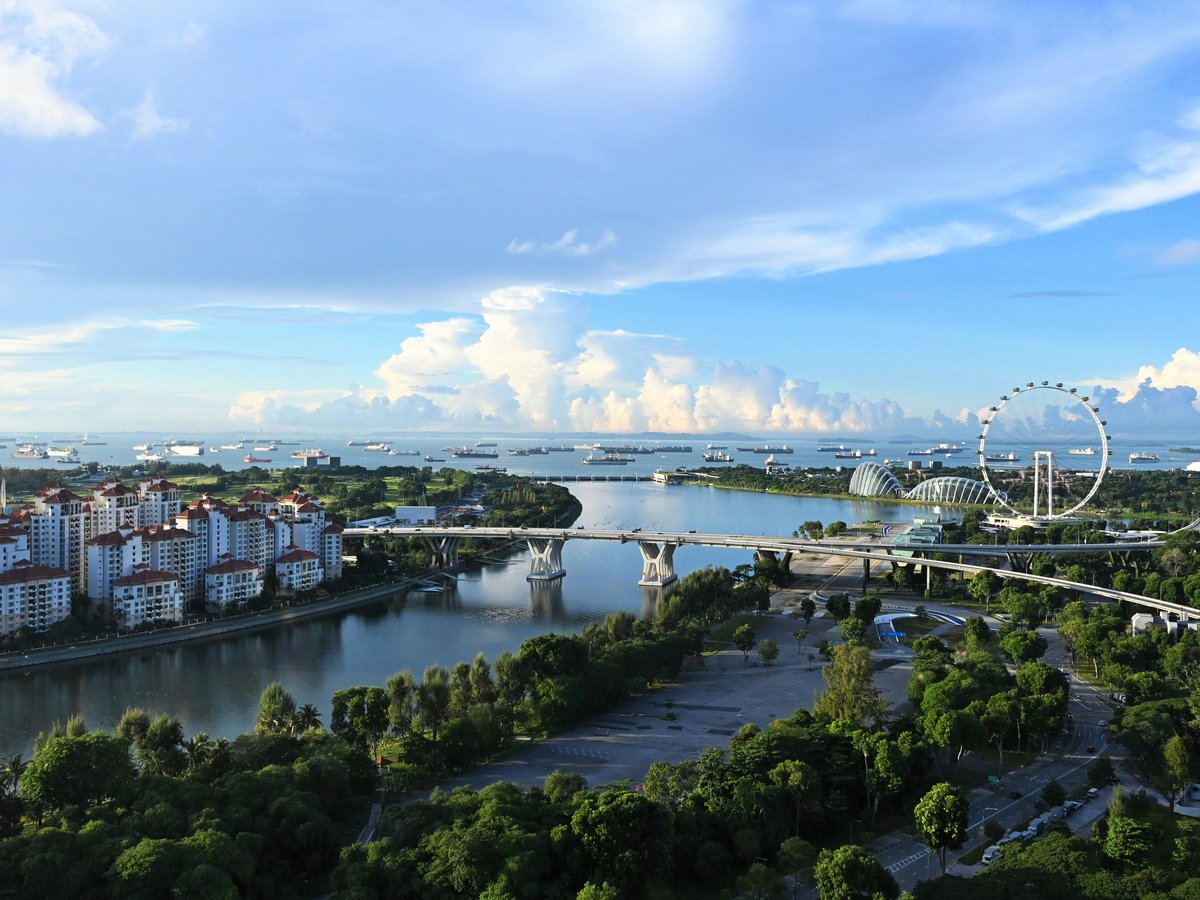
Singapore is small enough that you could technically cross the whole island in under an hour by MRT, which tends to lull first-timers into thinking neighborhoods don't matter much here. They do. The central core (roughly everything south of the Kallang River and east of the Singapore River) packs in most of what visitors care about, but each district within that core has its own rhythm and temperature. The ethnic enclaves (Chinatown, Little India, Kampong Glam) sit surprisingly close together, sometimes just a fifteen-minute walk apart, yet they feel like different cities. South of the river, the colonial district bleeds into the Marina Bay reclaimed land, all glass and geometry. Head west toward Tiong Bahru or east toward Katong and you'll find the residential neighborhoods where Singaporeans live: lower buildings, older trees, hawker centres where nobody is performing for tourists. The MRT connects everything efficiently, but honestly, some of the best transitions between neighborhoods happen on foot, where you notice the architecture shifting block by block. One thing worth knowing: Singapore's planning is deliberate. The ethnic quarters exist because of colonial-era racial zoning, and while those boundaries softened decades ago, the cultural imprint held. You're not stumbling on organic neighborhood character so much as watching a city that decided to preserve it on purpose, which, to be fair, doesn't make it any less real once you're standing in it.
Neighborhoods
-
Chinatown
Chinatown runs hotter and louder than you'd expect from a city this orderly. The streets around Pagoda Street and Trengganu Street are the tourist-facing layer (souvenir shops, calligraphy brushes, that sort of thing) but step one block south toward Keong Saik Road or Ann Siang Hill and the whole mood shifts. These are the streets where restored shophouses now hold cocktail bars with no signage and small wine-natural restaurants where a reservation matters. The architecture is genuinely beautiful: two- and three-storey shophouses with ornate plasterwork and wooden shutters, painted in faded pastels. During the day, the wet market on Smith Street still operates the old way: aunties haggling over fish at 7am. At night, the same stretch becomes the Chinatown Food Street, which locals tend to avoid but visitors seem to enjoy well enough.
- Best for
- Couples and solo travellers who want to eat and drink well without travelling far. Good base for first-timers: central to everything, walkable to the river and Marina Bay.
- Key streets
- Keong Saik Road for bars and restaurants, Ann Siang Hill for the steep walk past small galleries, Smith Street for hawker food, Club Street for weekend brunch spots, Bukit Pasoh Road for quieter shophouse hotels.
-
Little India
Little India hits you with smell first. Jasmine garlands stacked outside Tekka Centre, turmeric and mustard seed from the spice shops on Buffalo Road, incense drifting out of Sri Veeramakaliamman Temple on Serangoon Road. It's the most sensory-dense part of Singapore by a wide margin. The pace here is different too: faster, more chaotic, closer to the energy of actual South Asian cities than anything else on this island. Weekday mornings are quieter, but Sunday afternoons the whole district fills with migrant workers on their day off, gathering in groups, sharing meals, calling home. Serangoon Road is the spine, running north from Tekka, lined with gold shops, sari merchants, and electronics stores that feel like they haven't updated their signage since 1994. The side streets (Dunlop Street, Hindoo Road, Kerbau Road) are where the old residential feel survives, with narrow shophouses and potted plants on every ledge.
- Best for
- Budget travellers and anyone who finds the rest of Singapore too polished. The hostels and small hotels here are the cheapest in the central area, and you're two MRT stops from Bugis and Chinatown.
- Key streets
- Serangoon Road is the main artery, Campbell Lane for the textile and flower market, Dunlop Street for the painted shophouses and Abdul Gafoor Mosque, Race Course Road for the South Indian restaurant row.
-
Kampong Glam
Kampong Glam is the old Malay-Arab quarter, anchored by the gold-domed Sultan Mosque at the end of Bussorah Street. The area has this layered quality: the mosque and the Malay Heritage Centre carry the historical weight, but the streets around them have tilted toward independent shops, textile dealers, perfumeries, and a handful of serious Middle Eastern restaurants. Arab Street itself sells fabrics by the bolt (silk, batik, lace) and the shopkeepers still negotiate if you're buying quantity. Haji Lane, one block over, is the one that shows up on Instagram: a narrow alley of street art, vintage clothing, and small cafes. It can feel a bit curated during peak hours, but early morning it's just you and the cats. The whole district is walkable in thirty minutes, which is part of what makes it work: it's dense enough to reward slow wandering without exhausting you.
- Best for
- Design-minded travellers, couples, anyone interested in Malay and Muslim heritage. The area around North Bridge Road has several mid-range boutique hotels in converted shophouses.
- Key streets
- Bussorah Street for the mosque approach and cafe seating, Arab Street for textiles and perfume, Haji Lane for independent retail, North Bridge Road for the larger restaurants and Zam Zam's murtabak.
-
Marina Bay
Marina Bay is Singapore's engineered showpiece: the skyline you see on every postcard. It's almost entirely reclaimed land, built in the last twenty-odd years, and it shows: everything is wide, new, and architecturally deliberate. Marina Bay Sands dominates the southern edge with its ship-shaped rooftop, the ArtScience Museum sits at its base like a half-opened lotus, and the Helix Bridge connects it all to the Esplanade on the north bank. At night the whole waterfront lights up for the laser show, which honestly feels a bit much after the second viewing but is worth seeing once. During the day, the Gardens by the Bay Supertrees are genuinely impressive up close: the scale doesn't translate in photos. The Shoppes at Marina Bay Sands is where you'll find high-end retail and restaurants, but the waterfront promenade itself is free and open and catches a decent breeze after dark.
- Best for
- Business travellers, architecture enthusiasts, anyone who wants the big-ticket Singapore experience concentrated in one spot. Hotels here are expensive: this is the Ritz-Carlton and Mandarin Oriental zone.
- Key streets
- The Bayfront promenade loops the entire waterfront. Collyer Quay on the north bank for the Fullerton Hotel and One Fullerton dining. Bayfront Avenue for the Sands complex. Marina Gardens Drive for Gardens by the Bay.
-
Tiong Bahru
Tiong Bahru is what happens when a 1930s public housing estate gets slowly colonized by specialty coffee roasters and independent bookshops. The architecture is the draw: art deco walk-up flats with curved balconies and Streamline Moderne details, built by the Singapore Improvement Trust and still lived in by elderly residents who've been there for decades. The ground-floor units along Yong Siak Street and Eng Hoon Street have turned into bakeries, brunch spots, and a very good independent bookstore called BooksActually (now rebranded as Math Paper Press, though locals still use the old name). The wet market on Seng Poh Road is one of the best in Singapore: compact, clean, and the chwee kueh stall on the second floor has had a queue every morning since before the neighborhood got fashionable. The whole area is flat and walkable, canopied by old rain trees, and mercifully quiet compared to Orchard Road twenty minutes north.
- Best for
- Design-conscious travellers, people who want a neighbourhood that feels lived-in rather than built-for-tourists. Limited hotel options: mostly serviced apartments and Airbnb-style stays.
- Key streets
- Yong Siak Street for coffee and bookshops, Eng Hoon Street for the newer restaurants, Seng Poh Road for the wet market, Tiong Bahru Road for the old-school bakeries including Tiong Bahru Galicier, which does a pandan chiffon cake people cross the island for.
-
Katong and Joo Chiat
Katong and Joo Chiat run together along the East Coast, about twenty minutes by bus from the city centre, and this is where Peranakan culture (the descendants of Chinese immigrants who married into Malay communities) left its deepest mark. The shophouses along Koon Seng Road are probably the most photographed residential street in Singapore: rows of pastel facades with intricate tile work and carved pintu pagar (half-doors) that you don't see anywhere else on the island. Joo Chiat Road itself is a long stretch that mixes old and new: traditional Peranakan restaurants next to craft beer bars next to a shop selling nothing but kueh (bite-sized Malay-Peranakan cakes). The neighbourhood has gentrified significantly in the last ten years, but it still has an older, slower energy than anything in the central core. The sea breeze from East Coast Park, a few blocks south, carries through on good evenings.
- Best for
- Foodies, architecture lovers, and anyone willing to trade proximity to the centre for a more residential, less performative Singapore. The beach at East Coast Park is a ten-minute walk. Hotel options are mostly boutique: places like Hotel Indigo.
- Key streets
- Koon Seng Road for the painted Peranakan shophouses, Joo Chiat Road for the full north-south walk past restaurants and shops, East Coast Road for laksa (specifically 328 Katong Laksa, which cuts the noodles short so you eat with a spoon), Ceylon Road for the quieter residential streets.
-
Orchard Road
Orchard Road is Singapore's retail spine: two kilometres of shopping malls stacked one after another from Tanglin in the west to Dhoby Ghaut in the east. If you've been to any major Asian shopping district, you know the template: marble floors, aggressive air-conditioning, luxury brands on the lower levels, food courts in the basement. What makes Orchard distinct is the sheer density: ION Orchard, Ngee Ann City, Paragon, Mandarin Gallery, all within a few hundred metres. The street-level experience between the malls is less interesting: wide pavements, sparse trees, the ambient roar of buses. That said, the side streets tell a different story. Emerald Hill Road, tucked behind the Centrepoint mall, is a row of Peranakan terrace houses with wrought-iron gates that somehow survived the developers. And the far western end near Tanglin has the old Tanglin Mall and Dempsey Hill, which feel nothing like the neon stretch further east.
- Best for
- Shoppers, obviously. Also families: the hotels along Orchard are well-established (Shangri-La, Marriott, Hilton) and close to the Botanic Gardens. If you want maximum convenience and don't mind a sanitised atmosphere, this works.
- Key streets
- Orchard Road itself for the malls, Emerald Hill Road for the heritage terrace houses and small bars, Scotts Road for the intersection with the Grand Hyatt and Far East Plaza (the less polished mall where locals bargain-hunt), Tanglin Road heading toward the Botanic Gardens.
-
Robertson Quay
Robertson Quay sits along the upstream stretch of the Singapore River, past Clarke Quay's nightclub strip and the tourist boats. It's quieter here: the restaurants line the waterfront but the energy is more weeknight-dinner than Saturday-night-out. The buildings are a mix of converted warehouses and newer mid-rise condos, and the clientele skews expat-heavy: French families, Australian couples, European professionals who've settled in for multi-year stints. The dining is genuinely good along this stretch: Super Loco for Mexican, Potato Head for the rooftop, Summerlong for Mediterranean, and most places have river-facing tables where you can sit and watch the bumboats chug past. It's not the most Singaporean of neighbourhoods, if we're being honest, but it's comfortable and walkable and connects to Fort Canning Park via a short climb up the hill.
- Best for
- Expats-in-spirit: travellers who want a relaxed riverside base with good restaurants and easy walks along the river to Clarke Quay or Boat Quay. Several mid-range hotels (Park Hotel, the Warehouse Hotel) sit right on the water.
- Key streets
- Mohamed Sultan Road was the nightlife strip a decade ago and still has a few bars holding on, Merbau Road runs along the quieter end of the quay, Unity Street connects up to River Valley Road where the supermarkets and daily-life amenities are.
-
Bugis and Bras Basah
Bugis is the hinge between the colonial district and the ethnic quarters: the MRT interchange connects the north-south and east-west lines, so everyone passes through. Above ground it splits into two moods. Bugis Junction and Bugis+ are modern malls with the usual chains, but Bugis Street market (the covered outdoor bazaar between Victoria Street and Rochor Road) still has the sweaty, bargain-hunting energy of a proper Southeast Asian street market. Cheap clothes, phone cases, souvenirs, fruit juice stalls. It's loud. Bras Basah, immediately south, is the quieter cultural half: the National Museum, the Peranakan Museum, CHIJMES (a converted convent turned dining-and-events complex), and the old shophouses along Waterloo Street that house a mix of temples, fortune tellers, and vegetarian food stalls. The National Library on Victoria Street is a good air-conditioned refuge with free wifi and a rooftop garden most visitors never find.
- Best for
- Central-location seekers on a mid-range budget. Several good hotels sit between Bugis and City Hall MRT: Andaz, InterContinental, and the budget-friendlier options along Bencoolen Street. You're walking distance to Marina Bay, Little India, and Kampong Glam.
- Key streets
- Victoria Street for the main Bugis corridor, Waterloo Street for temples and vegetarian hawker food, Queen Street for the backpacker zone, Bras Basah Road for the museum strip, Middle Road for the older shophouses.
-
Dempsey Hill
Dempsey Hill is a former British military barracks: low-slung whitewashed buildings set among old-growth trees, connected by winding roads with no pavement. It sits on a ridge between the Botanic Gardens and Holland Road, and because there's no MRT station nearby (Napier station on the Thomson-East Coast Line is the closest, still a walk), it stays quieter than it has any right to be given the quality of its restaurants. The dining here tends toward the higher end: COMO Cuisine, Candlenut (the first Peranakan restaurant to get a Michelin star), Open Farm Community. But it's not stuffy: the setting is too green, too open, too much like eating lunch in a botanical garden for that. The antique dealers and carpet shops that filled the barracks in the early 2000s have mostly given way to restaurants and galleries, but a few remain, and browsing them on a weekday afternoon when the crowds are elsewhere is a specific pleasure.
- Best for
- Couples and food-focused travellers willing to cab or walk. Not a stay-here neighbourhood (there are no hotels) but worth a half-day visit, especially combined with the Botanic Gardens next door.
- Key streets
- Dempsey Road loops through the complex. Block 7 and Block 8 hold most of the restaurants. Loewen Road connects to Holland Road and the approach from the Botanic Gardens side. Minden Road for the quieter galleries.
FAQ
Which Singapore neighbourhood is best for first-time visitors?
Chinatown or the Bugis-Bras Basah area tend to work best for first visits. Both are centrally located, well-connected by MRT, and walkable to most major sights. Chinatown has more character and better food options at the hawker level; Bugis is more of a transport hub with easy access to Little India, Kampong Glam, and Marina Bay. If budget matters, Bugis and Bencoolen Street currently have more mid-range hotel options than Chinatown, where rooms in the shophouse boutique hotels can creep up in price.
Is it worth staying near Orchard Road or is it just shopping malls?
Orchard Road is mostly malls, yes, and the street-level experience between them is not particularly interesting. That said, the hotels along Orchard are some of the best-established in the city (Shangri-La, the Mandarin Orchard, the Hilton) and you're a short walk from the Botanic Gardens, which is worth a morning. The western end near Tanglin has more personality than the ION-Paragon strip. If you're travelling with kids, the pool-and-breakfast routine at an Orchard hotel with the Gardens nearby is a reasonable setup. Just don't expect the neighbourhood itself to surprise you.
How easy is it to get between Singapore neighbourhoods without a car?
Extremely easy. The MRT covers all the central neighbourhoods discussed here, and rides between them rarely take more than fifteen minutes. A single trip costs S$1-2. Grab (the local ride-hail app) fills gaps for places like Dempsey Hill or Katong where you might be a ten-minute walk from the nearest station. Buses are comprehensive but harder to figure out as a visitor. Honestly, though, the distances between central neighbourhoods are short enough that walking is often the best option: Chinatown to Kampong Glam is about 25 minutes on foot and you pass through the colonial district on the way.
Where should I stay if I care most about food?
Katong-Joo Chiat if you want Peranakan and old-school hawker food in a residential setting. Chinatown (specifically the Keong Saik Road area) if you want both hawker centres and modern restaurant dining within a few blocks. Tiong Bahru if you lean toward specialty coffee and brunch alongside a traditional wet market. Little India's Race Course Road has the best South Indian food concentration on the island. The honest answer is that Singapore is small enough that no neighbourhood locks you out of any cuisine, but staying near the food you want to eat at midnight, when you're too tired to take the MRT, is worth optimising for.
Are there quiet neighbourhoods in central Singapore suitable for families?
Robertson Quay and Tiong Bahru are likely your best options for a quieter central base. Robertson Quay has the river promenade, family-friendly restaurants, and a pace that drops noticeably compared to Clarke Quay just downstream. Tiong Bahru is genuinely residential (old trees, flat streets, a proper neighbourhood market) though hotel options are limited to serviced apartments. The Orchard Road end near the Botanic Gardens also works for families: the Shangri-La has a dedicated children's pool area and the Gardens themselves are free and open daily. Avoid Bugis Street and Clarke Quay if noise at night matters to you.
What is the best area for nightlife in Singapore?
Clarke Quay is still the most concentrated nightlife zone: it's the stretch of the river with the neon-lit bars and clubs, and it gets genuinely busy on Friday and Saturday nights. That said, the more interesting drinking tends to happen in Chinatown's Keong Saik Road area (cocktail bars in shophouses, often unmarked), along Ann Siang Hill, or at rooftop spots scattered across the central area. Kampong Glam's Haji Lane has a handful of bars that stay open late with a younger crowd. Singapore's nightlife is expensive compared to the rest of Southeast Asia (expect S$18-25 for a cocktail at most places) and clubs enforce dress codes more strictly than you might expect.
Last verified by automated review (v1.7.2) on . What is automated review?