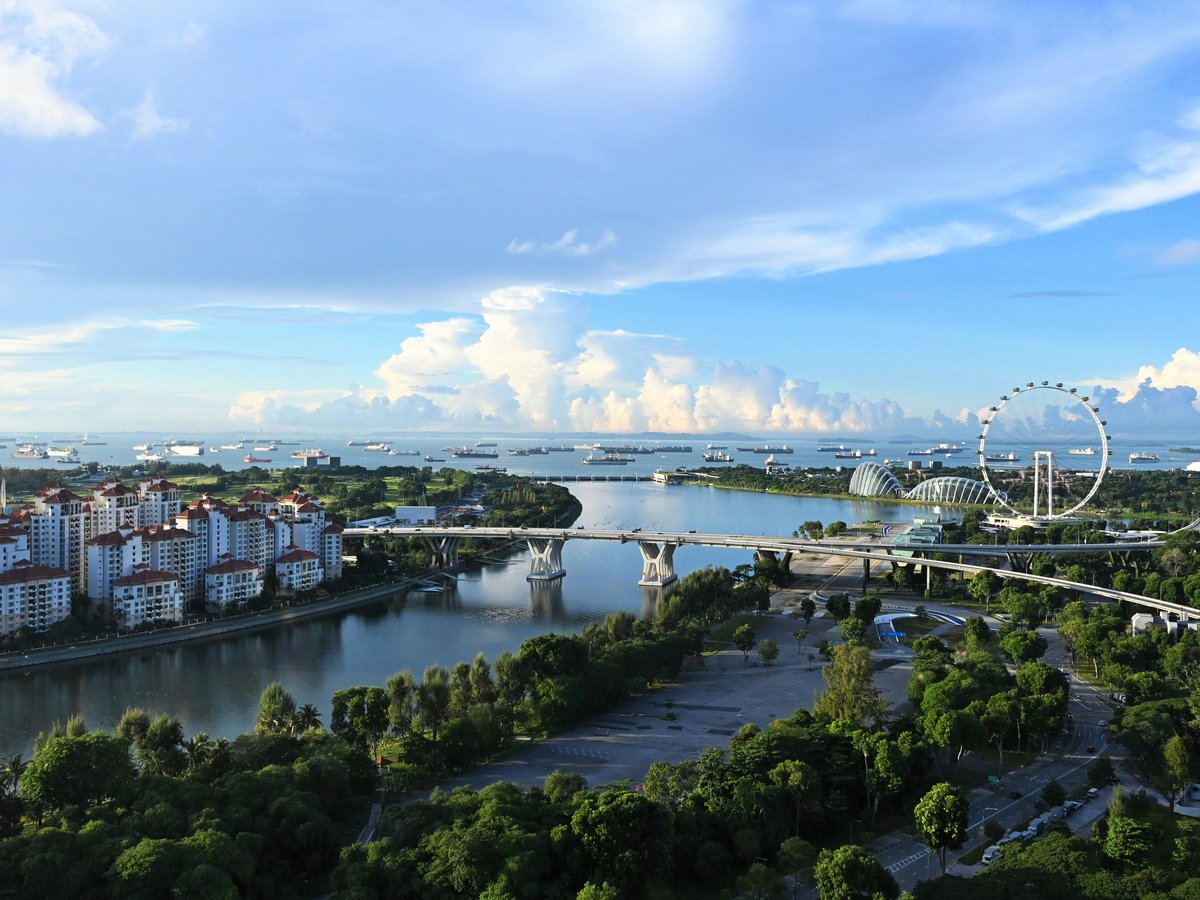
Stay in Singapore in May
125 hotels in the Trip.com pool for Singapore, from US$15 a night.
Opens Trip.com on Fri 7 May to Sun 9 May 2027; change the dates there.
May in Singapore is defined by one thing above all else: the afternoon thunderstorm. Nearly every day (26 out of 31 on average) brings rain, though it tends to follow a predictable rhythm. Mornings start warm and sticky, humidity climbing toward 86%, and by mid-afternoon the sky darkens and drops a short, theatrical downpour. The air smells like wet concrete and frangipani for about an hour, then the clouds break and the city steams dry. Temperatures hover around 30.7°C (87°F) during the day and rarely dip below 24.9°C (77°F) at night, which is to say: it never really cools down.
That said, May sits in a sweet spot for planning. It falls between Singapore's two monsoon seasons, so the rain comes in sharp bursts rather than all-day drizzle. Tourist crowds thin out: Chinese New Year is months gone, and the European summer holidays haven't started. Hotel rates drop to something reasonable by Singapore standards. And if you time it right, you'll catch the first durians of the season appearing at stalls in Geylang, which for a certain kind of traveler is reason enough to book a flight.
Is it the best month to visit? Not quite: February is drier and a touch cooler. But May is honest, workable weather with fewer people jostling for the same table at Maxwell Food Centre. You'll get wet. You'll sweat through your shirt by 10 a.m. But you'll also find a Singapore that feels a little more like itself, without the sheen of peak-season performance.
Why visit in May
- Shoulder season pricing: hotel rates sit 15-25% below December and Chinese New Year peaks, and you can often walk into popular restaurants without booking
- The early durian season begins in late May, with stalls along Geylang Road offering the first Mao Shan Wang of the year at slightly lower prices than the June-July peak
- Afternoon thunderstorms tend to be short and dramatic rather than all-day affairs, leaving cool, freshly washed evenings for exploring hawker centres and waterfront walks
- Gardens and green spaces like the Singapore Botanic Gardens are at their most lush, fed by consistent rainfall: the orchid displays in particular thrive in the humidity
Worth knowing
- 285mm of rainfall across 26 rainy days means you will get caught in a downpour at some point, no matter how carefully you plan: outdoor itineraries need built-in flexibility
- 86% humidity makes the 31°C heat feel significantly worse; the heat index regularly pushes above 38°C (100°F) in direct sun, and walking tours before noon are already uncomfortable
- The occasional haze from agricultural burning in neighboring Indonesia and Malaysia can drift in, though this tends to be worse from June onward: check the PSI readings before planning outdoor days
- Vesak Day closures affect some businesses, and certain hawker stalls in Chinatown take the holiday to rest
Best for
Think twice if
Hot, humid, and wet: the defining trio of a Singapore May. The inter-monsoon transition brings daily afternoon thunderstorms that typically last 30 to 90 minutes. Mornings are warm and overcast, occasionally clearing to harsh tropical sun. The humidity rarely drops below 80% and the overnight temperature barely shifts, so the air feels thick even after midnight. Wind is generally light, offering little relief. That said, the storms break the heat temporarily, and post-rain evenings along the waterfront carry a noticeable freshness.
Seasonal caution
- Heat index regularly exceeds 38°C (100°F) when humidity combines with direct afternoon sun: limit outdoor exertion between 11 a.m. and 3 p.m., carry water constantly, and watch for signs of heat exhaustion
- Sudden lightning storms are common during afternoon downpours; Singapore has one of the highest lightning strike rates in the world: avoid open fields and exposed areas during storms, and the National Environment Agency issues lightning risk alerts
Year-round climate
Averages from the last 5 years.
| Month | Avg high (°C) | Avg low (°C) | Rainfall (mm) |
|---|---|---|---|
| Jan | 29 | 23 | 348 |
| Feb | 30 | 23 | 134 |
| Mar | 31 | 24 | 272 |
| Apr | 31 | 24 | 287 |
| May | 31 | 25 | 285 |
| Jun | 30 | 25 | 306 |
| Jul | 30 | 25 | 211 |
| Aug | 30 | 24 | 321 |
| Sep | 30 | 24 | 240 |
| Oct | 31 | 24 | 273 |
| Nov | 30 | 24 | 372 |
| Dec | 30 | 23 | 310 |
Holidays and festivals in May
Public holidays
- Labour Day(Labour Day)1 May 2027
- Hari Raya Haji(Hari Raya Haji)17 May 2027
- Vesak Day(Vesak Day)20 May 2027
Best things to do in May
Night safari at Singapore Zoo
natureThe world's first nocturnal wildlife park takes on a different character in May's warm, humid evenings. The animals tend to be more active in the thick air, and the tram ride through the park's seven geographical zones feels cooler once the sun drops. Walking the trails after the tram gives you closer encounters: the fishing cats are particularly lively.
Fewer visitors mean shorter queues for the tram and walking trails, and the warm, humid nights mirror the animals' natural habitats more closely than the drier months.Booking tipBook the last tram slot of the evening for the smallest crowds.
Hawker centre crawl
foodSingapore's hawker centres are the real draw, and May's shoulder season means you're not fighting for seats at the popular stalls. Start at Maxwell Food Centre for chicken rice, move to Lau Pa Sat for satay after dark, and end at Old Airport Road for a plate of fried carrot cake. The plastic stools, the clattering of plates, the shouts of order numbers: it's the closest thing to a living food museum.
Peak-season queues at popular stalls can stretch to 45 minutes; in May, you'll wait half that or less, and stallholders have more time to chat.Booking tipGo before 11:30 a.m. or after 1:30 p.m. to avoid the local lunch rush.
Gardens by the Bay after a storm
natureThe Supertree Grove and Cloud Forest look their best right after one of May's afternoon downpours: everything glistens, the air smells green and sharp, and the temperature drops enough to make an outdoor walk genuinely pleasant. The OCBC Skyway between the Supertrees catches the last light of the day when the clouds break.
The post-storm light in May creates photography conditions you simply don't get in the drier months: low golden light hitting wet surfaces, mist rising from the canopy.Booking tipThe Cloud Forest conservatory is heavily air-conditioned: bring a light layer if you've been sweating outside.
Explore Tiong Bahru on foot
cultureSingapore's oldest housing estate has quietly become one of its most interesting neighborhoods. Art deco apartment blocks from the 1930s sit alongside independent bookshops, specialty coffee roasters, and a wet market that's been feeding the neighborhood for decades. The scale is walkable (three or four blocks) and the covered walkways help when the rain hits.
The covered five-foot ways make Tiong Bahru one of the few neighborhoods where a sudden downpour doesn't derail your walk. The wet market is particularly lively on weekend mornings in shoulder season.Marina Bay Sands observation deck at sunset
sightseeingThe view from the top of Marina Bay Sands takes in the entire city skyline, the Strait of Singapore, and on clear days, the islands of Indonesia. In May, the dramatic cloud formations from the daily storm cycle create sunsets that flat-sky months can't match: bands of orange and violet layered through breaking cumulus.
May's storm clouds create the most dramatic sunset conditions of the year. The observation deck is also noticeably less crowded than during December-January peak season.Pulau Ubin cycling
outdoorA bumboat ride from Changi Point takes you to Pulau Ubin, a small island that feels like Singapore from forty years ago: gravel paths, wild boar crossings, abandoned quarries turned turquoise swimming holes. Rent a bike at the jetty and spend a morning exploring the Chek Jawa wetlands before the afternoon heat sets in.
The rain keeps the island lush and green, and the morning window before storms is typically clear enough for a full cycling circuit. Fewer weekend day-trippers than in the drier months.Booking tipTake the earliest bumboat to maximize dry riding time: storms typically hit after 2 p.m.
Little India sensory walk
cultureLittle India assaults every sense simultaneously. The smell of jasmine garlands and fresh curry leaves hits you on Serangoon Road; the technicolor shophouses glow even under overcast skies; the soundtrack is Tamil pop, honking, and the rhythmic thwack of roti prata being stretched. The covered arcades along Buffalo Road keep you mostly dry when the rain comes.
Vesak Day preparations bring extra flower stalls and temple decorations to the neighborhood, adding color and activity that you won't see in other months.National Gallery Singapore
cultureHoused in the former Supreme Court and City Hall buildings, this gallery holds the world's largest public collection of Southeast Asian modern art. The building itself is worth the visit: the rotunda of the old Supreme Court, the restored courtrooms, the way the two colonial buildings connect through a modern glass canopy. You could spend an entire rainy afternoon here without repeating a room.
May's daily storms make this the perfect fallback plan, and the gallery runs fewer school-group tours during shoulder season, so the quieter galleries stay quiet.Booking tipVisit on a weekday afternoon for the emptiest galleries.
What to eat in May
In season: fruit
Durian
The first Mao Shan Wang and D24 durians of the season start appearing at stalls along Geylang Road in late May. Prices tend to be slightly higher than the June-July glut, but the quality of early-season fruit is often superb: the flesh is creamier, less fibrous. The smell hits you from half a block away, and the taste is polarizing: rich, custardy, with an almost fermented sweetness that people either chase or flee from.
Mangosteen
The queen of fruits arrives alongside durian season. The thick purple rind cracks open to reveal white segments that taste like a cross between lychee and peach, with a faint tartness. Available at wet markets in Chinatown and Tekka Centre in Little India at their freshest.
Rambutan
The hairy red fruit starts its season in May, sold in bunches at wet markets across the island. Peel back the spiny skin and the translucent flesh is sweet, faintly floral, and refreshing when chilled. Look for the smaller rongrien variety: sweeter and less clingy on the seed.
On menus now
Chendol
Shaved ice with pandan jelly, red beans, coconut milk, and gula melaka: the thick palm sugar syrup pools at the bottom and you chase it with a spoon. In May's heat, the stall queues at Old Airport Road Food Centre grow longer by the week. The contrast of icy sweetness against the humid air outside is almost medicinal.
Thunder tea rice (Lei Cha)
A Hakka dish of rice topped with finely chopped vegetables, tofu, peanuts, and dried shrimp, served with a thick green tea-and-herb soup poured over it. The earthy, slightly bitter broth cuts through the humidity in a way that feels restorative. You'll find it at hawker centres across the island, though the stalls in Chinatown Complex tend to be the most traditional.
Ice kachang
A towering mound of shaved ice drenched in rose syrup, evaporated milk, and palm sugar, hiding red beans, grass jelly, and sweet corn underneath. It melts fast in May's heat, so you eat it urgently: half the fun is the race. The versions at Ghim Moh Market still use hand-shaved ice, which makes the texture noticeably finer.
Regular events in May
Vesak DayFree
The most significant Buddhist holiday in Singapore, marking the birth, enlightenment, and passing of the Buddha. Temples across the island hold candlelight processions and prayers, with the Buddha Tooth Relic Temple in Chinatown drawing the largest crowds. The atmosphere is contemplative rather than festive: incense smoke, chanting, and lines of devotees carrying lotus-shaped lanterns through the streets.
Full moon day in May (date varies annually)Singapore Art Week fringe eventsFree
While the main Art Week runs in January, May sees a cluster of gallery openings and independent exhibitions in the Gillman Barracks arts precinct and along Haji Lane. The programming tends to be more experimental and less crowded than the flagship events.
Various dates throughout MayHari Raya Aidilfitri celebrationsFree
When Ramadan ends (the date shifts with the lunar calendar), Geylang Serai transforms with a massive bazaar selling traditional Malay food, textiles, and decorations. The light-up along Sims Avenue is elaborate and best seen after dark. Even if the holiday falls in late April some years, the festive energy and bazaar stalls typically carry into early May.
Varies with the Islamic calendarBest places this May
Geylang durian stalls
foodA row of open-air durian vendors stretching along Geylang Road comes alive in late May as the first fruits of the season arrive. The sellers will crack open a fruit for you to inspect before buying, and the best stalls let you sit at plastic tables and eat on the spot. The smell is inescapable within a two-block radius.
GeylangSingapore Botanic Gardens
natureA UNESCO World Heritage Site that peaks in May: the consistent rain feeds the orchid collection in the National Orchid Garden, and the rainforest section along the boardwalk drips with moisture. Early mornings are best, before the heat builds. The gardens have been here since 1859, and the old-growth trees in the primary forest section are some of the last in Singapore.
TanglinChinatown Complex Food Centre
foodThe largest hawker centre in Singapore, with over 200 stalls spread across two floors. The second floor tends to be less crowded and holds some of the more traditional stalls: look for the Hakka thunder tea rice and the roasted meat vendors. The building itself is a brutalist concrete block that somehow becomes atmospheric when packed with lunchtime crowds and steam.
ChinatownBuddha Tooth Relic Temple
cultureA five-story Tang dynasty-style temple that anchors Chinatown's South Bridge Road. The rooftop garden offers unexpected quiet above the street noise, and during Vesak Day the entire building is draped in lights and prayer flags. The museum floors are free and rarely crowded.
ChinatownMacRitchie Reservoir
natureThe oldest reservoir in Singapore, surrounded by mature secondary rainforest and connected by a network of trails. The TreeTop Walk (a 250-meter freestanding suspension bridge through the forest canopy) offers views that make the sweaty hike worthwhile. Go at dawn to avoid the worst of the heat and catch the monkeys before they retreat to shade.
Central CatchmentHaji Lane
cultureA narrow street in the Kampong Glam neighborhood lined with independent boutiques, vintage shops, and cafes tucked into restored shophouses. The street art on the walls changes regularly, and the covered five-foot ways keep you dry during downpours. It gets busy on weekend afternoons but stays relatively quiet on weekday mornings.
Kampong GlamEast Coast Park
outdoorA long stretch of reclaimed-land coastline popular with cyclists, joggers, and families. The seafood restaurants along the beach serve chilli crab and black pepper crab at outdoor tables: the breeze off the strait takes the edge off the humidity in the evenings. Best visited late afternoon after any storms have passed.
East Coast
Your packing checklist
Tick items off as you pack. Your progress saves in this browser.
All packed — have a great trip.
Insider tips
The MRT is the fastest way to get anywhere, but the buses show you the city: the number 36 route from Changi to the Botanic Gardens crosses nearly every neighborhood and costs the same flat fare with an EZ-Link card.
Most hawker centres have a tissue-paper reservation system: a packet of tissues on a table means someone has claimed it. Respect the system, or expect pointed looks.
The afternoon storms follow a loose pattern: the sky darkens around 2 p.m., rain hits hard by 3 p.m., and clears by 4:30 p.m. Plan indoor activities for that window and save outdoor exploration for the cooler post-storm hours.
Durian is banned on the MRT, in hotels, and in most taxis. If you buy it in Geylang, eat it there: the sellers provide tables and wet wipes, and you avoid the transport problem entirely.
Changi Airport is worth visiting even if you're not flying: the Jewel complex has a forty-meter indoor waterfall, a canopy park, and better shopping than most malls. The free shuttle from the MRT station runs every few minutes.
Avoid these mistakes
- Underestimating the heat: visitors from temperate climates often plan full walking days and hit a wall by noon. Schedule morning and evening outdoor activities with a long indoor break in between.
- Skipping the hawker centres for air-conditioned restaurants: the best food in Singapore is genuinely at the hawker centres, and the experience of eating surrounded by steam, shouting, and clattering plates is part of the point.
- Not carrying an umbrella because the morning looked clear: May mornings are often sunny, which lulls visitors into leaving rain gear behind. The afternoon storm will find you regardless.
- Trying to visit Marina Bay Sands, Gardens by the Bay, and Sentosa in one day: they're technically close together but each deserves half a day minimum, and the heat makes rushing between them miserable.
- Booking outdoor activities for mid-afternoon: the 2-4 p.m. storm window cancels boat tours, cycling trips, and walking tours with frustrating regularity. Morning bookings are safer.
Practical tips for May
Carry a refillable water bottle: Singapore's tap water is safe to drink and refill stations are common in malls and MRT stations. Download the MyTransport SG app for real-time bus and MRT tracking, and load a few dollars onto an EZ-Link card at any MRT station for seamless transit. Most hawker centres are cash-only at the individual stalls, so keep small bills handy: some newer centres have adopted NETS or PayNow but coverage is uneven. Air conditioning everywhere means you'll constantly move between extremes of temperature, so dress in layers you can peel off and put back on quickly. The National Environment Agency app shows real-time PSI readings and rain radar, which is genuinely useful for planning each day's outdoor windows around the storm cycle.
FAQ
Is May a good time to visit Singapore?
May is a solid shoulder-season pick. You'll deal with daily afternoon storms and relentless humidity, but the tradeoff is lower hotel rates, thinner crowds at popular attractions, and the start of durian season. It ranks around the middle of the year for visiting, not the driest or coolest month, but far from the worst. If you don't mind sweating and can plan around the 2-4 p.m. storm window, you'll have a good trip.
How often does it rain in Singapore in May?
Expect rain on roughly 26 out of 31 days. That sounds dire, but the pattern is predictable: most rain falls in short, intense afternoon bursts lasting 30 to 90 minutes. Mornings are usually dry enough for outdoor activities, and evenings tend to clear up. The rain is warm and often dramatic rather than the cold, miserable kind, and the city is built to handle it with covered walkways and sheltered hawker centres.
What should I wear in Singapore in May?
Light, loose-fitting clothes in natural fabrics like cotton or linen. Singapore is casual: shorts and sandals are fine almost everywhere except upscale restaurants. Bring a light long-sleeve layer for air-conditioned spaces, which run cold enough to raise goosebumps after you've been sweating outside. Waterproof sandals beat closed shoes for handling sudden downpours, and a compact umbrella should live in your bag permanently.
Is Singapore expensive in May?
Singapore is never cheap, but May offers some relief. Hotel rates drop noticeably compared to the December-February peak and Chinese New Year period. Flights from regional hubs tend to have more competitive pricing. Day-to-day costs (food, transport, attractions) stay consistent year-round, and hawker centre meals remain one of the best food bargains in any world city.
Can you eat durian in May in Singapore?
The first durians of the season start appearing at stalls along Geylang Road in late May. It's early in the season, so selection might be slightly limited compared to the June-July peak, but early-season fruit often has a creamier, more concentrated flavor. Mind you, durian is banned on public transport and in most hotels: buy it and eat it at the stall, where the sellers provide tables, plastic gloves, and wet wipes.
Things to Do in Singapore in May
 Free cancellation
 Lion City Bike Tour of Singapore
City tour: 4 hours, free cancellation.
via Viator Free cancellation
 Singapore River Cruise, Night Garden Rhapsody & Spectra by CYT
Day trip: 4 hours, free cancellation.
via Viator Free cancellation
 Singapore Highlights Small Group Bike Tour on Full-Sized Bicycles
City tour: 4 hours, free cancellation.
via Viator Free cancellation
 Singapore Starry Night River Cruise, Spectra & Garden Rhapsody
Day trip: 4.5 hours, free cancellation.
via Viator Free cancellation
 Singapore River Cruise and 2 Must-see Water Light Shows
Day trip: 4 hours, free cancellation.
via Viator Free cancellation
 Private Tour: Nighttime Sightseeing with River Cruise
City tour: 3.5 hours, free cancellation.
via ViatorFind a flight to Singapore
Live fares to Singapore appear here once cookies are accepted.
Last verified by automated review (v1.7.2) on . What is automated review?