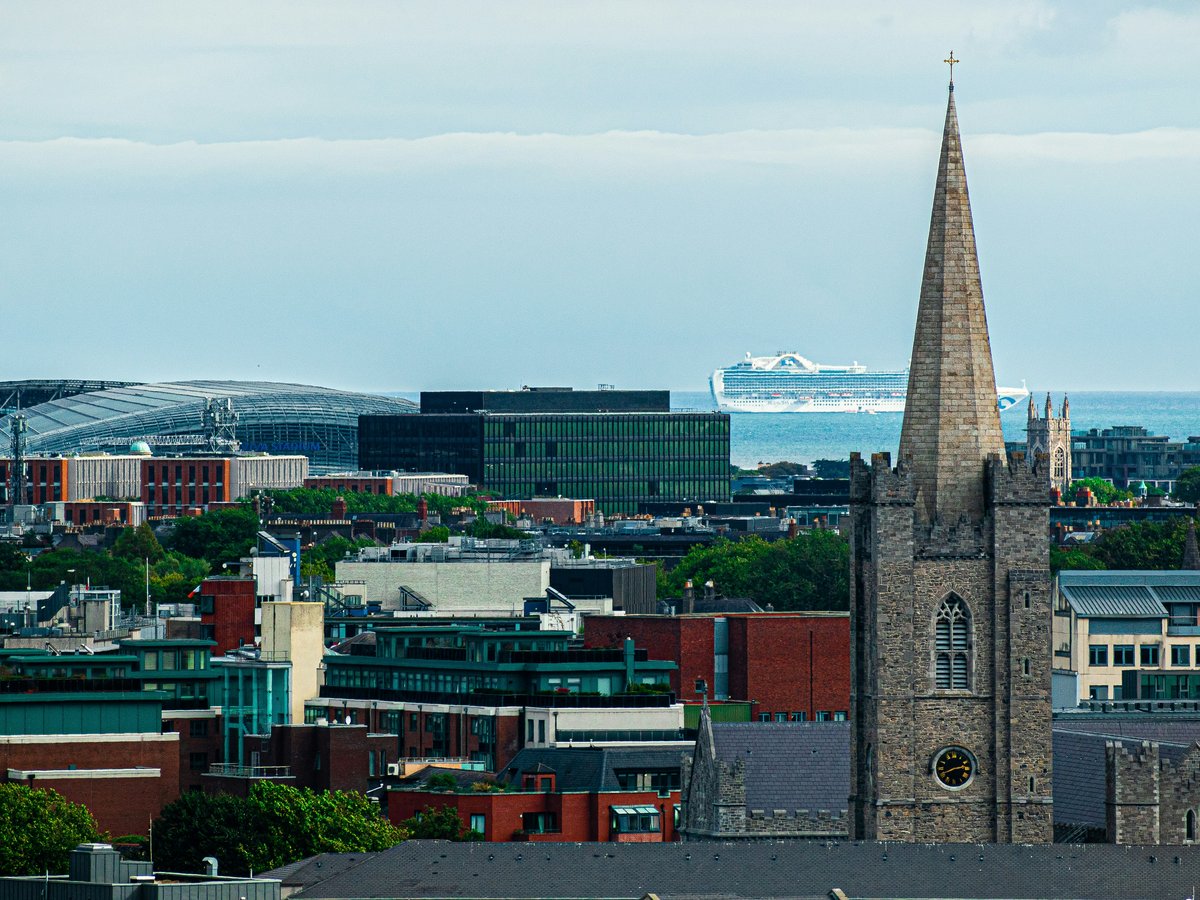
Stay in Dublin in June
100 hotels in the Trip.com pool for Dublin, from US$23 a night.
Opens Trip.com on Fri 4 Jun to Sun 6 Jun 2027; change the dates there.
The defining fact of June in Dublin is the light. Sunset doesn't happen until nearly ten o'clock at night, and even then a sort of silvery twilight lingers past eleven. You get close to seventeen hours of usable daylight, which changes everything about how the city feels: pubs spill onto pavements, canal-side walks stretch well into the evening, and there's a collective reluctance to go indoors that you can almost taste. Temperatures hover around 18°C (64°F) during the day and dip to about 12°C (53°F) at night, which is to say: pleasant, not hot. You'll still want a jacket.
June also marks the real start of Dublin's tourist season, and the city knows it. Hotel rates climb noticeably, Grafton Street gets thick with visitors, and you'll queue for popular spots like the Book of Kells at Trinity College. Bloomsday on June 16th (the annual celebration of James Joyce's Ulysses) draws literary pilgrims from across the world, with readings and re-enactments tracing Leopold Bloom's fictional path through the streets. That said, Dublin never quite reaches the crushing tourist density of a Barcelona or Amsterdam. It stays manageable.
The trade-off is rain. June gets around 71mm across roughly 13 rainy days, which sounds grim until you realise that Dublin rain tends to arrive as passing showers rather than all-day downpours. You might get a grey drizzle at noon and sharp blue sky by two. The locals barely register it. Pack a waterproof layer, accept that you'll use it, and you'll be fine.
Why visit in June
- Nearly 17 hours of daylight: sunset around 9:55pm means long, lingering evenings along the Grand Canal or in beer gardens across Portobello and Stoneybatter
- Mild, comfortable temperatures around 18°C (64°F): warm enough for outdoor dining, cool enough to walk all day without overheating
- Bloomsday on June 16th turns the city into a living literary festival, with free readings, pub crawls, and costumed re-enactments concentrated around Sandycove and the city centre
- Dublin Pride at the end of the month fills the streets with colour and energy: the parade route through the city centre draws tens of thousands
- Parks and gardens hit their peak: rhododendrons blooming in Howth, roses in St. Stephen's Green, wildflowers along the Dodder river walk
Worth knowing
- Hotel prices spike significantly above the annual average: mid-range rooms on weekends in the city centre can be hard to find without booking well in advance
- Rain is still a constant companion: 13 days of the month will likely see some precipitation, and you can't count on any single day being completely dry
- Popular attractions like Kilmainham Gaol and the Guinness Storehouse sell out days in advance: spontaneous visits rarely work in June
- The combination of tourist crowds and Dublin's narrow medieval streets around Temple Bar can feel genuinely congested on weekend afternoons
Best for
Think twice if
June is arguably Dublin's most pleasant month, though 'pleasant' by Irish standards still means carrying a rain jacket. Daytime highs sit around 18°C (64°F) with lows near 11.7°C (53°F) at night. The air carries a coolness that can surprise visitors expecting European summer heat: mornings along the Liffey often have a freshness that feels more like early autumn elsewhere. Humidity averages 76%, which sounds high but rarely feels oppressive at these temperatures. Rain falls on roughly 13 days, totalling about 71mm for the month, but most showers pass within twenty or thirty minutes. The real story is the light: sunrise before five, sunset close to ten, and a glow in the northern sky until nearly eleven.
Year-round climate
Averages from the last 5 years.
| Month | Avg high (°C) | Avg low (°C) | Rainfall (mm) |
|---|---|---|---|
| Jan | 8 | 4 | 71 |
| Feb | 10 | 5 | 69 |
| Mar | 11 | 5 | 78 |
| Apr | 12 | 6 | 82 |
| May | 15 | 9 | 67 |
| Jun | 18 | 12 | 71 |
| Jul | 20 | 13 | 92 |
| Aug | 20 | 13 | 72 |
| Sep | 17 | 12 | 107 |
| Oct | 15 | 10 | 120 |
| Nov | 11 | 7 | 82 |
| Dec | 10 | 6 | 89 |
Holidays and festivals in June
Public holidays
- June Holiday(Lá Saoire i mí an Mheithimh)7 June 2027
Headline events
Bloomsday
June 16 (fringe events June 14-18)
The annual celebration of James Joyce's Ulysses, held on the date the novel is set: June 16, 1904. The city leans into it fully: costumed readings at the James Joyce Centre on North Great George's Street, re-enactments at Davy Byrne's pub on Duke Street (where Bloom eats his gorgonzola sandwich in the novel), a ceremonial breakfast at the Martello Tower in Sandycove where the book opens, and guided walks tracing Leopold Bloom's route through the city. The atmosphere tends to be more participatory pub crawl than stuffy literary lecture, which is a good part of its charm.
Best things to do in June
Howth Cliff Walk
outdoorThe loop trail around Howth Head takes roughly two to three hours and gives you sea cliffs, wildflower meadows, and views across Dublin Bay to Bray Head and the Wicklow Mountains. The path is well-maintained but uneven in places: proper walking shoes, not sandals. You'll smell the gorse before you see it: coconut-sweet and bright yellow, it peaks in late May and early June.
The extended daylight means you can start the walk at six in the evening and finish comfortably before dark. Wildflowers and gorse are at their peak, and the coastal breeze keeps the temperature comfortable.Booking tipNo booking needed. Take the DART to Howth station: trains run every ten to twenty minutes from the city centre.
Swimming at the Forty Foot
outdoorThe Forty Foot in Sandycove is Dublin's most famous sea swimming spot: a rocky inlet below the Martello Tower where Joyce set the opening of Ulysses. The water in June sits around 12-14°C, which is bracing but survivable. You'll see regulars in at seven in the morning, year-round. The shock of the cold water fades after about ninety seconds, replaced by something close to euphoria.
Water temperatures reach their most approachable point of the year, and the long evenings mean you can swim after work with daylight to spare. The Bloomsday connection makes a June swim here feel particularly fitting.Booking tipNo booking. Bring a towel and something warm to change into: the wind off the Irish Sea can be sharp even in June.
Kilmainham Gaol tour
culturalThe guided tour of Kilmainham Gaol walks you through the prison where leaders of the 1916 Easter Rising were executed. The stone corridors are cold even in summer: you can feel the damp in the walls. The tour guides tend to be excellent, and the stonebreakers' yard where the executions took place is genuinely sobering. It's one of those places that earns its reputation.
June's long days and mild weather make the walk from the city centre to Kilmainham pleasant. Book early: this is Dublin's most-visited heritage site and June slots fill fast.Booking tipBook online at least a week ahead. Morning slots tend to have smaller groups.
Trinity College and the Book of Kells
culturalThe Long Room at Trinity College is one of those spaces that stops you in your tracks: a barrel-vaulted library stretching nearly 65 metres, lined with 200,000 of the oldest books in the collection. The Book of Kells exhibition downstairs shows the illuminated manuscript itself. The craftsmanship is staggering when you see it close up: intricate knotwork in colours that are still vivid after twelve centuries.
The college grounds are at their greenest, and the combination of Bloomsday literary energy and long daylight hours makes June the month when Trinity feels most alive. Fellow's Square fills with students and visitors lounging on the grass.Booking tipTimed-entry tickets are essential. Book online several days ahead: walk-up queues in June can stretch well past an hour.
Kayaking on the Liffey
outdoorGuided kayak trips run from the docklands upstream through the city centre, passing under Ha'penny Bridge and the Custom House. Seeing Dublin from the water gives you a perspective you can't get any other way: the scale of the quay walls, the Georgian architecture rising above the river, the surprising quiet once you're off the streets. The water is calm and the routes are beginner-friendly.
The long, bright evenings make sunset kayak trips possible: paddling under Ha'penny Bridge as the light goes golden around nine o'clock is something you'll remember. Water conditions are typically calm through June.Booking tipSeveral operators run trips from Grand Canal Dock and Spencer Dock. Book a few days ahead for weekend sunset slots.
Day trip to Glendalough
outdoorAbout an hour and a half south of Dublin by car or bus, Glendalough is a monastic settlement in a glacial valley in the Wicklow Mountains. The round tower, the lake, the oak forests: it feels like a different country from Dublin. The upper lake trail takes about two hours and the silence up there, broken only by birdsong and wind in the trees, is the antidote to a few days in the city.
June's long daylight and mild temperatures make the valley walks genuinely comfortable. The oak woodland is fully leafed out, ferns are chest-high along the trails, and the light filtering through the canopy has a green tint that feels almost tropical.Booking tipSt. Kevin's Bus runs daily from Dawson Street. If driving, arrive before ten to get parking near the visitor centre.
Pub session crawl in the Liberties
culturalThe Liberties neighbourhood (Dublin's oldest) has traditional pubs where you can still catch unannounced trad sessions: fiddle, bodhrán, flute, maybe an accordion. The Brazen Head claims to be Ireland's oldest pub, though half the pubs in Dublin seem to make that claim. The Fallon's on The Coombe is less touristed and the sessions tend to be more spontaneous. The sound of a fiddle drifting out of a pub doorway on a warm June evening is about as Dublin as it gets.
Warmer evenings mean pub doors stay open and the music drifts onto the street. Sessions run later in June because nobody wants to go home while there's still light in the sky.Booking tipNo booking needed. Sessions typically start after nine. Ask the barman what nights have music: it varies.
Dalkey and Killiney Hill walk
outdoorTake the DART south to Dalkey, explore the village, then walk up Killiney Hill for what is arguably the best view in the Dublin area: the bay curving south toward Bray Head, the Sugarloaf mountain behind it, and on a clear day, the Wicklow Mountains stretching into the distance. The climb takes about twenty minutes and the view at the top earns the effort.
Clear June evenings give you visibility that winter rarely offers. The light at golden hour (roughly eight to nine-thirty) makes the bay look almost Mediterranean. Almost.Booking tipNo booking. The DART from Pearse or Tara Street stations takes about twenty-five minutes to Dalkey.
What to eat in June
In season: fruit
Irish strawberries
June is when Wexford strawberries hit their peak: small, deeply red, and far sweeter than the imported supermarket variety you'll find the rest of the year. You'll see them at farmers' markets and sold from roadside stalls outside the city. The flavour difference is stark: fragrant, almost jammy, with a sweetness that doesn't need sugar.
On menus now
Dublin Bay prawns (langoustines)
The catch peaks through early summer. These aren't shrimp: they're proper langoustines pulled from the Irish Sea, served simply with butter and lemon at seafood spots around Howth harbour. The sweetness of fresh-landed langoustine is hard to describe if you've only ever had frozen.
In markets
New season potatoes
The first Irish new potatoes of the year arrive in June, and the difference from a stored winter potato is noticeable: waxy, thin-skinned, with an earthy sweetness that needs nothing more than butter and a scatter of salt. Queens and British Queens tend to be the varieties you'll find at markets around this time. They fall apart differently, almost creamy. Worth seeking out at the Temple Bar Food Market on Saturdays.
Samphire
This salty, crunchy sea vegetable starts appearing on restaurant menus and at coastal markets in June. It grows wild along the Irish coast and has a briny snap that pairs well with the season's seafood. You might find it blanched alongside those Howth langoustines, or pickled as a garnish. The taste is somewhere between asparagus and the sea itself.
Regular events in June
Dublin Pride FestivalFree
A week-long celebration culminating in one of Ireland's largest parades through the city centre. Live music stages, community events, and parties across the city, with the main parade route running from Merrion Square through Dame Street. The atmosphere is joyful and inclusive: the whole city seems to turn out.
Last week of JuneTaste of Dublin
A long-running food festival held in the Iveagh Gardens, where Dublin restaurants set up tasting stations and chefs run demonstrations. It's a chance to sample dishes from places you might not otherwise try, all in the setting of one of Dublin's prettiest hidden parks. The gardens alone are worth the visit: walled, quiet, tucked behind the National Concert Hall.
Mid-June (typically Thursday to Sunday)Dalkey Book Festival
A literary festival in the seaside village of Dalkey, about thirty minutes south of the city centre by DART. Authors, journalists, and public figures give talks in venues around the village: pubs, churches, the castle grounds. The setting is half the appeal: Dalkey feels like a small town that happens to be on Dublin's doorstep.
Mid-JuneForbidden Fruit Festival
A music and arts festival that typically takes place in the grounds of the Royal Hospital Kilmainham over the June bank holiday weekend. The lineup leans toward electronic and alternative acts, and the 17th-century courtyard makes for an unusual backdrop. It draws a younger, local crowd more than tourists.
Early June (bank holiday weekend)Best places this June
St. Stephen's Green
parkThe rose garden hits its peak in June: beds of hybrid teas and floribundas in full colour, with the Victorian bandstand as a backdrop. Lunchtime on a sunny day, the park fills with office workers sprawled on the grass. The duck pond, the formal beds, the mature trees: it's a genuine oasis in the middle of the city's busiest shopping district.
City CentreHowth Harbour and village
coastalA fishing village on a peninsula north of the city, reachable in about thirty minutes on the DART. The harbour still has working fishing boats, and the seafood restaurants along the west pier serve whatever came in that morning. The smell of salt and diesel at the harbour, the sound of halyards clanking against masts: it's a different Dublin out here.
HowthPhoenix Park
parkOne of the largest enclosed urban parks in Europe. The herds of fallow deer have been here since the 1660s, and they're surprisingly unbothered by people. In June the meadow areas are thick with wildflowers and the chestnut trees along the main avenue are in full leaf. It's big enough to feel genuinely rural once you're away from the main gates.
Phoenix ParkMerrion Square
historicGeorgian Dublin at its most photogenic: colourful doorways with ornate fanlights, wrought-iron railings, the park in the centre where artists hang paintings on the railings at weekends. Oscar Wilde's house is on the corner, and there's a reclining statue of him on the granite boulder across the street that manages to capture his wit somehow.
Georgian QuarterGlasnevin Cemetery and Museum
historicThe resting place of Michael Collins, Éamon de Valera, and many of the figures who shaped modern Ireland. The guided tours are surprisingly engaging: the guides connect the headstones to the broader sweep of Irish history in a way that brings the place alive. Daniel O'Connell's round tower dominates the skyline. It's quieter than the big tourist sites and arguably more moving.
GlasnevinThe National Gallery of Ireland
museumFree entry and a collection that punches well above what most visitors expect. The Caravaggio (The Taking of Christ) is the headline piece, but the Irish rooms are what make this gallery distinctive: Jack B. Yeats's paintings of the west of Ireland capture something about the landscape that photographs miss. The Millennium Wing hosts rotating exhibitions that are usually worth the detour.
Merrion SquareSandycove and the James Joyce Tower
literaryThe Martello Tower where Joyce briefly lived in 1904 and where Ulysses opens. It's a small museum now, and the views from the roof across Dublin Bay are worth the climb. Below it, the Forty Foot swimming spot draws brave souls year-round. On Bloomsday, this is ground zero for the celebrations: costumed readings, ceremonial breakfasts, general literary revelry.
SandycoveIveagh Gardens
parkDublin's best-kept-secret park, tucked behind the National Concert Hall. Walled and hidden from the street, it has a cascade waterfall, a rosarium, and a rustic grotto. Most tourists walk right past the entrance without noticing it. In June, the roses are in full bloom and the enclosed space traps the warmth: it can feel several degrees warmer than the street outside.
Harcourt Street
Your packing checklist
Tick items off as you pack. Your progress saves in this browser.
All packed — have a great trip.
Insider tips
The DART coastal train is one of Dublin's underrated experiences: the stretch between Pearse Station and Bray runs right along the coastline, and on a clear June evening the views across Dublin Bay are genuinely spectacular. Sit on the left side heading south.
Bloomsday is best experienced if you've read at least the first chapter of Ulysses. You don't need to have finished it (hardly anyone has) but knowing who Buck Mulligan is and why the Martello Tower matters transforms the day from quirky street theatre into something you connect with.
Skip Temple Bar for evening drinks. The pubs there charge tourist prices and the atmosphere tends toward stag parties. Walk ten minutes to Stoneybatter or Phibsborough for pubs where locals go: places like The Cobblestone for trad music or L. Mulligan Grocer for craft beer.
The Iveagh Gardens are genuinely hidden: most Dubliners don't know about them, let alone tourists. The entrance is on Clonmel Street, behind the National Concert Hall. In June the walled garden traps warmth and the roses are at their peak. It's the quietest green space in the city centre.
If you're visiting Howth, walk past the harbour restaurants on the main strip and continue to the west pier. The seafood is the same quality, the views are better, and you're more likely to get a table without waiting. The fish and chips from any of the harbour spots are reliably good.
Dublin Bus and Luas fares are cheaper with a Leap Card than paying cash. Pick one up at any newsagent near the airport arrivals. It works on buses, trams, and the DART, and the daily cap means you stop paying after a few trips.
Avoid these mistakes
- Underestimating how quickly weather changes: you can leave the hotel in sunshine and get caught in a downpour thirty minutes later. Always carry a rain layer, even on cloudless mornings. The locals have a saying: four seasons in one day.
- Not booking Kilmainham Gaol in advance: it's the single most common disappointment tourists report in June. Tickets sell out days ahead online, and there's no walk-up availability once they're gone. Check the website the moment you confirm your Dublin dates.
- Spending too much time in Temple Bar: it has its charm for an afternoon wander, but the pub prices are inflated and the evening atmosphere skews toward tourist-oriented entertainment. You'll get a more authentic experience in the Liberties, Stoneybatter, or along Camden Street.
- Assuming you need a car: Dublin's city centre is compact and walkable, the DART covers the coastline, and parking is both expensive and scarce. A car is useful for day trips to Glendalough or the Boyne Valley, but within the city it's more burden than benefit.
- Packing for Mediterranean summer: first-time visitors from southern Europe or the US sometimes arrive with shorts and t-shirts expecting warm weather. Dublin's 18°C feels cool when there's a breeze off the Irish Sea, and evenings drop to 12°C. Layers and long trousers are more practical than summer clothes.
Practical tips for June
Book accommodation and key attractions as early as possible: June is Dublin's busiest month alongside July, and availability tightens quickly for popular spots like Kilmainham Gaol and the Book of Kells. Transport from the airport is straightforward: the 747 Airlink bus runs to the city centre every fifteen minutes during the day, and the journey takes about thirty to forty minutes depending on traffic. For getting around the city, a Leap Card is the most cost-effective option across buses, trams, and the DART train. Dublin is compact enough that most central sights are within walking distance of each other: you can walk from Trinity College to the Guinness Storehouse in about twenty-five minutes. Restaurants that are popular for weekend brunch or dinner should be booked a few days ahead; weekday dining is usually fine without a reservation. The DART train is your best friend for day trips to Howth, Dalkey, and Bray: frequent, cheap, and scenic. If you're planning to visit Glendalough, book the bus or arrange a car the day before. June daylight is generous enough that you can comfortably fit in two major activities per day with a long, relaxed evening afterwards.
FAQ
Is June a good time to visit Dublin?
June is widely considered one of Dublin's two best months for visitors, alongside September. You get close to seventeen hours of daylight, mild temperatures around 18°C, and the city's events calendar is at its fullest with Bloomsday and Dublin Pride. The trade-off is higher prices and bigger crowds, particularly around weekends. Rain is still a factor (roughly 13 days will see some precipitation) but showers tend to be brief rather than sustained.
How much does it rain in Dublin in June?
Dublin typically gets around 71mm of rain spread across about 13 days in June. That sounds like a lot, but most of it falls as short showers rather than all-day downpours. You might get twenty minutes of drizzle followed by clear skies. The key is carrying a waterproof layer and not letting the forecast discourage you: a 'rainy day' in Dublin often means one or two brief showers with sunshine between them.
What should I wear in Dublin in June?
Layers are the answer. Daytime temperatures reach about 18°C but mornings and evenings can feel cool, especially near the coast. A t-shirt with a long-sleeve layer and a packable waterproof jacket covers most situations. Comfortable walking shoes with decent grip are important: cobblestones get slippery when wet. You'll likely add and remove layers several times a day as conditions shift.
Is Dublin expensive to visit in June?
Dublin is one of Europe's pricier capitals year-round, and June pushes accommodation costs higher still: rates tend to run well above the annual average, especially on weekends. Flights from European cities also rise in price. That said, many of Dublin's best experiences are free or low-cost: walking the coastal trails, exploring the National Gallery, wandering Georgian squares, catching a trad session in a Liberties pub. The daily spending increase compared to shoulder season is driven almost entirely by accommodation.
Can I swim in the sea in Dublin in June?
You can, and plenty of people do: the Forty Foot in Sandycove and Seapoint are the most popular spots. Water temperatures in June sit around 12-14°C, which is cold but manageable once you're in. The local swimming community treats it as a year-round activity, and June is when the water feels most approachable. No wetsuit required for a quick dip, though many swimmers wear one for longer sessions.
What is Bloomsday and is it worth experiencing?
Bloomsday on June 16th celebrates James Joyce's novel Ulysses, which is set entirely on that date in 1904. The city marks it with costumed readings, guided walks tracing the novel's route, pub re-enactments, and a ceremonial breakfast at the Martello Tower in Sandycove. You don't need to have read the book to enjoy the atmosphere: it's part literary festival, part pub crawl, part street performance. That said, having read even the first chapter or two makes the references click in a way that deepens the experience considerably.
Things to Do in Dublin in June
 Free cancellation
 Dublin to Cliffs of Moher, including Wild Atlantic Way and Galway
Day trip: 13 hours, free cancellation.
via Viator Free cancellation
 Dublin to Cliffs of Moher, Burren, Wild Atlantic Way, Galway Tour
Outdoor experience: 12.5 hours, free cancellation.
via Viator Free cancellation
 Kilkenny, Wicklow and Glendalough Sheepdog Trials from Dublin
Day trip: 10 hours, free cancellation.
via Viator Free cancellation
 Dublin to Glendalough, Wicklow and Kilkenny Full Day Guided Tour
Day trip: 9.2 hours, free cancellation.
via Viator Free cancellation
 Dublin to Dunluce Castle, Giant's Causeway, Dark Hedge, Belfast
Outdoor experience: 12.5 hours, free cancellation.
via Viator Free cancellation
 Dublin Book of Kells, Castle and Molly Malone Statue Guided Tour
City tour: 2.5 hours, free cancellation.
via ViatorFind a flight to Dublin
Live fares to Dublin appear here once cookies are accepted.
Last verified by automated review (v1.7.2) on . What is automated review?