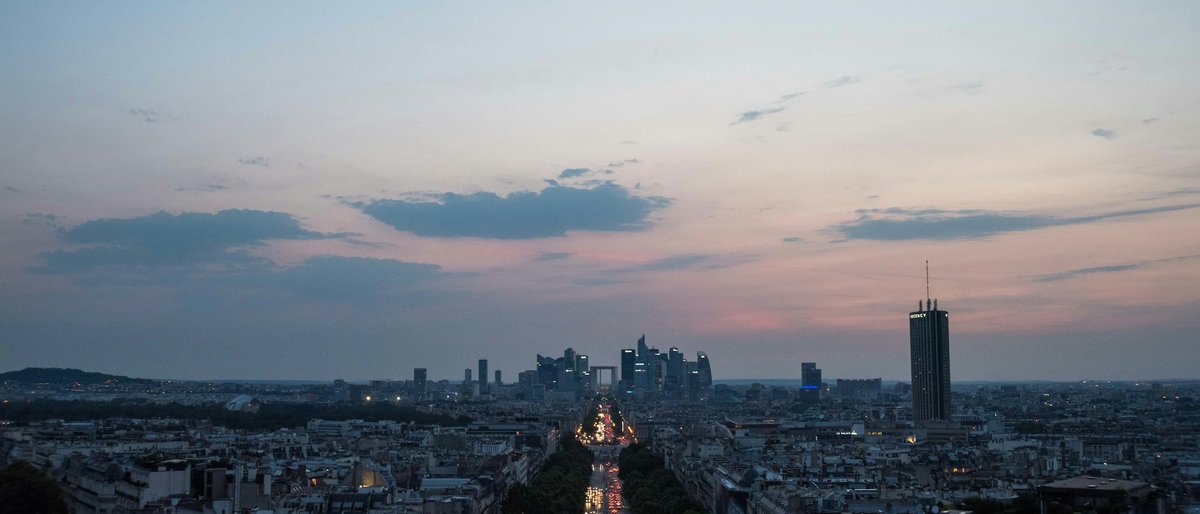
Stay in Paris in July
158 hotels in the Trip.com pool for Paris, from US$21 a night.
Opens Trip.com on Fri 2 Jul to Sun 4 Jul 2027; change the dates there.
July in Paris belongs to one date. The Fête Nationale on July 14 brings Europe's largest military parade down the Champs-Élysées at 10:00, fills the Champ de Mars with hundreds of thousands of spectators by nightfall, and closes with a 35-minute fireworks display launched from the Eiffel Tower. That single day sets the tone for the whole month. Daytime highs settle around 25°C (77°F), the sun doesn't set until 21:45, and the limestone facades still radiate the day's warmth well after dark.
The trade-off is real, though. July is peak tourist season, and the Louvre's Pyramid courtyard, the terrace tables along Boulevard Saint-Germain, and the queue outside the Musée d'Orsay all show it. Hotel rates tend to run 40-60% above the annual average. Mind you, many Parisians leave for les grandes vacances starting mid-month, which quietly empties residential neighborhoods like Belleville and the Batignolles. Walk 10 minutes from any major monument and you might find a calmer city than you'd expect.
July is not the single best month to visit Paris. That distinction likely goes to June or late September, when the weather is nearly as warm, the crowds noticeably thinner, and the golden-hour light sits softer over the zinc rooftops. But July is solidly good. Those long evenings, the smell of grilled merguez wafting from the bals des pompiers, and the crack of fireworks echoing off the Seine make the premium worth paying if you plan around the crowds.
Why visit in July
- Daylight stretches past 21:45, giving you 16+ hours of usable light for sightseeing, outdoor dining, and evening walks along the Seine
- Bastille Day on July 14 delivers the Champs-Élysées military parade, free bals des pompiers at fire stations across the city, and a fireworks display over the Eiffel Tower that ranks among Europe's largest
- Paris Plages transforms sections of the Seine's Right Bank and the Bassin de la Villette into free urban beaches with sand, lounge chairs, and swimming from mid-July onward
- Many Parisians leave the city from mid-July, thinning crowds in residential neighborhoods like Le Marais, Oberkampf, and the Batignolles while tourist corridors absorb the volume
Worth knowing
- Hotel rates typically reach their annual peak, running 40-60% above the yearly average, with rooms near the 1st and 7th arrondissements sometimes doubling their February prices
- The Louvre, Versailles, and the Eiffel Tower hit their highest annual visitor counts. Morning queues at the Musée d'Orsay can stretch 45 minutes without a timed ticket
- Heat waves (canicule) strike roughly 1 in 3 Julys and can push temperatures above 35°C (95°F) for several consecutive days. Paris recorded 42.6°C in July 2019, and most older apartment buildings lack air conditioning
- Some neighborhood restaurants and small shops begin their congés annuels (annual holiday closure) in the last week of July, limiting options outside tourist zones
Best for
Think twice if
July typically delivers Paris's warmest temperatures alongside its longest days. Average highs reach 25°C (77°F) and lows settle around 15.3°C (60°F) after dark. The city sees roughly 86mm of rain spread across about 11 days, usually as afternoon showers that pass within 20-30 minutes. Humidity holds around 66%, noticeable on still days but rarely oppressive compared to tropical cities. The occasional canicule (heat wave) can push daytime temperatures well above 30°C for stretches of 3-5 days, though the average July remains comfortable in light layers.
Seasonal caution
- Heat waves have become more frequent in recent years. Paris recorded 42.6°C (108.7°F) in July 2019. When the national weather service issues an orange or red canicule alert, the city opens cooling centers (salles rafraîchies) in public buildings. Most older Haussmann-era apartments and many mid-range hotels lack air conditioning. If traveling during a forecast canicule, confirm your accommodation has AC before booking.
Year-round climate
Averages from the last 5 years.
| Month | Avg high (°C) | Avg low (°C) | Rainfall (mm) |
|---|---|---|---|
| Jan | 7 | 2 | 84 |
| Feb | 10 | 3 | 47 |
| Mar | 13 | 4 | 63 |
| Apr | 16 | 6 | 55 |
| May | 19 | 10 | 72 |
| Jun | 24 | 14 | 82 |
| Jul | 25 | 15 | 86 |
| Aug | 25 | 15 | 71 |
| Sep | 22 | 13 | 82 |
| Oct | 18 | 10 | 85 |
| Nov | 11 | 6 | 66 |
| Dec | 9 | 4 | 69 |
Holidays and festivals in July
Public holidays
- Bastille Day(Fête nationale)14 July 2027
Headline events
Bastille Day (Fête Nationale)
July 14 (parade at 10:00, fireworks around 23:00). Bals des pompiers on evenings of July 13 and 14
France's national day marks the anniversary of the storming of the Bastille in 1789. The morning military parade on the Champs-Élysées is the largest in Europe, with jets trailing red, white, and blue smoke above the Arc de Triomphe. Free bals des pompiers (firemen's balls) open at fire stations across Paris on the nights of July 13 and 14, with music and dancing until the small hours. The evening fireworks display from the Eiffel Tower draws crowds to the Champ de Mars, Trocadéro, and bridges along the Seine. The smell of gunpowder and merguez hangs over the river well past midnight.
Tour de France Final Stage
Typically the last Sunday of July (exact date varies by year)
The final stage of the Tour de France traditionally finishes with multiple laps on the Champs-Élysées, turning one of the world's most recognizable avenues into a professional cycling course for an afternoon. The peloton arrives in the late afternoon, and the sprint finish between the Arc de Triomphe and Place de la Concorde is one of the great spectacles in professional cycling. Free to watch from the roadside.
Best things to do in July
Bastille Day military parade on the Champs-Élysées
culturalThe défilé militaire du 14 Juillet begins at 10:00 with a flyover by the Patrouille de France, whose jets trail red, white, and blue smoke above the Arc de Triomphe. Ground forces march from the Arc to Place de la Concorde over about 2 hours. The sound of military bands echoing between the chestnut trees lining the avenue is surprisingly moving, regardless of how you feel about parades.
Occurs only on July 14, France's national dayBooking tipFree to watch. Arrive by 08:00 for a spot along the barricades between the Rond-Point des Champs-Élysées and Place de la Concorde. Métro stations near the parade route close by 07:00.
Bastille Day fireworks at the Eiffel Tower
culturalA 35-minute pyrotechnic display launched from and around the Eiffel Tower, synchronized to orchestral music broadcast on Radio France. The tower itself becomes part of the show, with light sequences running along the iron lattice between bursts. The concussive thud of the large shells arrives a second after the flash, and the reflections in the Seine double the spectacle.
July 14 only. The display starts around 23:00 when the sky is dark enough.Booking tipThe Champ de Mars fills by 20:00 and access is controlled at capacity. The Pont de Bir-Hakeim, about 500 meters south, offers a comparable angle with less crowding if you arrive by 20:30. Bring a picnic.
Paris Plages at the Bassin de la Villette and along the Seine
outdoorThe city installs temporary sand beaches, palm trees, lounge chairs, and water-misting stations along sections of the Right Bank near the Hôtel de Ville and at the Bassin de la Villette in the 19th arrondissement. The Villette site includes a supervised open-water swimming area in the canal basin, one of the few legal swimming spots in central Paris. The sand under your feet and the sound of splashing water in the middle of a city of 2.1 million people is genuinely surreal.
Opens mid-July and runs through mid-August. The first weeks tend to be less crowded than August.Booking tipFree entry. The Villette swimming area requires a swimsuit (no board shorts) and enforces capacity limits. Weekday mornings are calmest.
Cinéma en Plein Air at Parc de la Villette
culturalFree outdoor film screenings on a large inflatable screen on the Grande Prairie lawn at Parc de la Villette. The program typically follows a theme each year and mixes French classics with international films, subtitled. Screenings start at nightfall, around 22:00 in July. Several hundred people on blankets in the warm grass, sharing wine and cheese with the screen glowing above them, is a distinctly Parisian summer experience.
The festival typically launches in the second or third week of July and continues through August.Booking tipFree, no ticket needed. Bring a blanket and a picnic. The lawn opens around 19:00 and good spots fill by 20:30 on weekends.
Tour de France final stage on the Champs-Élysées
sportThe peloton completes 8 laps of a circuit on the Champs-Élysées on the race's final day. The sprint finish between the Arc de Triomphe and Place de la Concorde, with the tight whir of carbon wheels and the roar of the crowd, is one of professional cycling's most photogenic moments. The atmosphere is festive even if you don't follow the race.
The Tour traditionally ends on the last Sunday of July in Paris.Booking tipFree roadside viewing. The best spots along the Champs-Élysées fill 3-4 hours before the peloton arrives, typically in the late afternoon. Bring water and sun protection.
Evening picnics along Canal Saint-Martin
outdoorThe tree-lined banks of the Canal Saint-Martin in the 10th arrondissement fill with locals on warm July evenings. The iron footbridges, the working locks, and the dappled light filtering through the plane trees make this one of the most photogenic picnic settings in the city. Wine shops and fromageries on nearby Rue de Marseille and Rue Yves Toudic sell everything you need.
The 21:45 sunset and 15°C evening temperatures create perfect conditions. By late September, evenings are too cool and dark for this.Booking tipNo booking. Grab supplies before 20:00, as smaller shops close early. Weeknight evenings are mellower than weekends.
Soldes d'été shopping in Le Marais and Saint-Germain-des-Prés
shoppingFrance's government-regulated summer sales run through July, with discounts of 30-70% at boutiques, department stores, and fashion houses. Le Marais along Rue des Francs-Bourgeois and Saint-Germain-des-Prés near Rue de Rennes offer the densest concentration of participating shops. Second and third markdowns deepen as the month progresses, so patience pays.
The soldes d'été start in late June and run about 4 weeks. By mid-July, second-round markdowns of 50-70% appear on remaining inventory.Booking tipNo booking needed. Weekday mornings avoid the worst of the crowds. Le Bon Marché and Galeries Lafayette run their own parallel promotions.
Golden-hour Seine cruise
sightseeingSunset at 21:45 in July means golden-hour light bathes the city's stone facades in warm amber tones from roughly 20:30 onward. A river cruise departing around 20:00 from Pont de l'Alma passes the Île de la Cité, Notre-Dame's restoration, and the Louvre under this light. The stone seems to glow from inside, and the reflections in the water double every arch and balustrade.
The late sunset puts golden hour at a practical evening departure time. In winter, golden hour falls at 16:00.Booking tipBook dinner cruises at least a week ahead for July weekend departures. Standard 1-hour sightseeing cruises from Bateaux Mouches or Vedettes de Paris are walk-up friendly on weekdays.
What to eat in July
In season: fruit
Cerises de Montmorency
Tart Montmorency cherries from the Val-d'Oise north of Paris reach their peak in early July. Market stalls at Marché d'Aligre and Marché Bastille pile them high. The flavor is sharper than sweet cherry varieties, with a brightness that works in clafoutis or eaten straight from the bag.
Abricots du Roussillon
Apricots from the Roussillon region in southern France arrive at Paris markets in July at their most fragrant. The Bergeron variety tends to be the most common, with firm flesh that softens to a honeyed sweetness when fully ripe. The scent alone fills a market aisle.
Pêches blanches
White peaches from the Rhône Valley and Drôme arrive at Paris markets through July, with a floral sweetness and perfume that fills nearby stalls. The texture at peak ripeness is soft enough that the juice runs down your hand. Look for them at any open-air market, though the selection at Marché d'Aligre tends to be especially good.
On menus now
Ratatouille
The Provençal vegetable stew reaches its best form in July when all its components, eggplant, zucchini, tomatoes, and bell peppers, hit peak season simultaneously. Bistro versions range from rustic chunky stews to the layered tian-style presentations. The flavor difference between a January ratatouille and a July one is night and day.
What to drink
Rosé de Provence
Pale, dry Provençal rosé dominates Paris terraces from mid-June through August. The city's consumption of rosé roughly doubles in summer months compared to winter. A glass at a cafe terrace typically runs 5-8 euros. Côtes de Provence bottles at a caviste start around 10 euros and are perfect for canal-side picnics.
In markets
Tomates anciennes
Heirloom tomato varieties like Coeur de Boeuf, Noire de Crimée, and Green Zebra come into full season at Paris markets in July. Bistros serve them as simple salads with fleur de sel, olive oil, and fresh basil. The color range alone, deep purple through streaked green to orange, makes them worth seeking out at the covered markets.
Regular events in July
Paris Jazz Festival
Weekend afternoon jazz performances in the natural amphitheater at Parc Floral de Paris in the Bois de Vincennes. The setting among tropical greenhouses and flower beds adds a layer of atmosphere that indoor venues cannot match. The program mixes French jazz artists with international acts. Park admission is a few euros, and the concerts are included.
Saturdays and Sundays through June and July, concerts from 15:00Festival Paris l'ÉtéFree
A city-supported performing arts festival with free outdoor performances in dance, theater, circus, and music at venues across Paris, including the Jardin des Tuileries and the courtyard of the Palais Royal. The program changes yearly but consistently favors site-specific work that uses the architecture of its host venues.
Mid-July through early AugustBest places this July
Jardin du Luxembourg
parkThe 23-hectare Luxembourg Gardens in the 6th arrondissement are at their greenest in July. Chestnut trees form a dense canopy over the metal chairs arranged around the Grand Bassin. Pétanque players claim the gravel areas by late afternoon. The Medici Fountain on the east side stays cool under its bower of plane trees, and the temperature there drops noticeably on hot days. Worth noting that the chairs are free and nobody rushes you.
Saint-Germain-des-PrésParc des Buttes-Chaumont
parkThis hilly 25-hectare park in the 19th arrondissement draws far fewer tourists than the Luxembourg or Tuileries. The Temple de la Sibylle perched on the central rocky island offers some of the best elevated views of Sacré-Coeur and Montmartre. Evening picnics on the steep, terraced lawns are a fixture of local life through July's long twilight. The grass smells like warm hay by late afternoon.
Buttes-ChaumontCanal Saint-Martin
waterwayThe 4.5-kilometer canal in the 10th arrondissement is lined with plane trees and crossed by iron footbridges. In July, the tree-shaded banks become an extended picnic zone from about 18:00 onward. Wine shops and fromageries on surrounding streets supply the essentials. The locks at Écluse du Temple still operate, and watching narrowboats navigate them is a quiet pleasure.
10th arrondissementBerges de Seine
promenadeThe pedestrianized Left Bank quays between the Musée d'Orsay and the Pont de l'Alma are car-free year-round, but temporary bars, food stands, and lounge seating that appear in July add a new dimension. The stretch near the Pont Alexandre III fills with runners, strollers, and readers through the long evening light. The stone retaining walls hold warmth until well after 22:00.
7th arrondissementÎle Saint-Louis
neighborhoodThe smaller of the two Seine islands stays quieter than its neighbor the Île de la Cité even in peak season. The Quai d'Orléans on the south side faces the Left Bank and catches afternoon light. Berthillon's ice cream queue is a July fixture on Rue Saint-Louis en l'Île, but the island's limestone-walled interior streets remain shaded and several degrees cooler than exposed boulevards nearby.
4th arrondissementPalais de Tokyo
museumThe contemporary art museum in the 16th arrondissement stays open until midnight, making it one of the few cultural venues you can visit after a full day outdoors. The terrace overlooking the Eiffel Tower is accessible to anyone, even without a museum ticket. The view at 22:00 with the tower lit against a deep blue sky is worth the walk from Trocadéro.
TrocadéroMarché d'Aligre
marketThis daily market on Place d'Aligre in the 12th arrondissement runs a covered hall (Marché Beauvau) alongside an open-air section. July brings peak stone fruit, heirloom tomatoes, and the first French melons from Cavaillon. The market operates Tuesday through Sunday and is notably cheaper than equivalent markets in the 6th or 7th arrondissements. The North African spice vendors in the covered section fill the hall with cumin and ras el hanout.
Bastille
Your packing checklist
Tick items off as you pack. Your progress saves in this browser.
All packed — have a great trip.
Insider tips
The bals des pompiers on the evenings of July 13 and 14 are free dance parties at fire stations across Paris. The casernes in the 3rd and 4th arrondissements near Le Marais draw the biggest crowds and tend to have the best DJs. Arrive by 21:00 and expect dancing until 04:00.
Vélib' bike-share stations near major tourist sites empty out by mid-morning in July. Pick up a bike from a residential-area station 2-3 blocks away instead. The 30-minute free windows on a day pass are generous enough for most cross-city rides if you dock and redock at stations along your route.
Many neighborhood restaurants start their congés annuels (annual vacation closure) in the last week of July. Check Google Maps or the restaurant's Instagram for closure notices if you're visiting after July 20, especially in the 11th and 20th arrondissements where independently owned spots dominate.
For the Bastille Day fireworks, the Champ de Mars fills by 20:00 and police control access once it hits capacity. The Pont de Bir-Hakeim, about 500 meters south, offers a comparable angle on the Eiffel Tower with noticeably less crowding if you arrive by 20:30.
The fontaines pétillantes (sparkling water fountains) scattered around Paris dispense free chilled sparkling water. In July heat, knowing the nearest one saves real money. The Jardin de Reuilly in the 12th arrondissement has one, and the Paris.fr website maps them all.
Avoid these mistakes
- Scheduling outdoor sightseeing between 12:00 and 15:00 without checking the UV index. The reflected light off Paris's pale limestone amplifies sun exposure, and the UV index in July typically reaches 7-8. Heatstroke cases at Versailles and the Tuileries peak this month. Start early or shift outdoor time to after 17:00.
- Not booking Eiffel Tower summit tickets at least 60 days in advance. Walk-up queues in July regularly exceed 2 hours, and summit access slots sell out weeks ahead. Second-floor tickets are easier to secure but still need advance booking.
- Assuming every restaurant will be open through the whole month. The French congés annuels tradition means many independent restaurants and small shops close for 2-3 weeks starting in mid-to-late July. This hits local spots hardest, not the tourist-area chains. Always check before walking 20 minutes across town for a specific meal.
- Packing only summer clothes and no rain layer. July in Paris averages 86mm of rain over 11 days. The showers pass quickly but a single downpour can soak you thoroughly if you're caught on the Pont des Arts or crossing the Tuileries without cover.
Practical tips for July
Book Eiffel Tower and Versailles tickets at least 60 days ahead, since July is peak demand and walk-up queues can reach 2-3 hours. The Paris Museum Pass (2, 4, or 6 days) covers the Louvre, Musée d'Orsay, and roughly 50 other sites with priority-access lanes at most. The Métro runs its normal schedule, and the fully automated Lines 1 and 14 have the shortest headways between trains. Tipping at restaurants is not expected beyond rounding up, since a 15% service charge is included in all listed prices by law. Pharmacies (marked by the green neon cross) carry high-SPF sunscreen, after-sun gel, and electrolyte sachets. Tap water is safe and free at any restaurant when you ask for une carafe d'eau. Many smaller shops close on Sunday, except in tourist zones like Le Marais and the Champs-Élysées. If a canicule heat alert is active, the city opens cooling rooms (salles rafraîchies) in public buildings throughout each arrondissement.
FAQ
Is July a good time to visit Paris?
July is a good but not ideal month. The weather is warm, with average highs of 25°C (77°F), and 16+ hours of daylight give you more outdoor time than any other season. Bastille Day on July 14 is a genuine once-a-year highlight. The trade-off is that July is peak tourist season, with the highest hotel rates and longest queues at major attractions. June and September typically offer similar weather with noticeably fewer crowds and 30-40% lower hotel rates.
What is the weather like in Paris in July?
July is one of Paris's two warmest months, with average highs of 25°C (77°F) and lows around 15.3°C (60°F). Expect about 86mm of rain over 11 days, usually as short afternoon showers rather than all-day downpours. Humidity sits at 66%. Heat waves can push temperatures above 35°C (95°F) for several consecutive days, though the average July stays comfortable. Pack for a 10-degree swing between afternoon and late evening.
Is Paris crowded in July?
Yes. July and August are peak tourist months. The Louvre, Eiffel Tower, Musée d'Orsay, and Versailles reach their highest annual visitor counts, and queue times at attractions without pre-booked tickets can exceed 2 hours. That said, residential neighborhoods thin out as many Parisians leave for les grandes vacances from mid-July onward. Areas like Belleville, the Batignolles, and the upper Marais feel quieter than you might expect.
What should I wear in Paris in July?
Light layers in cotton or linen for daytime temperatures in the mid-20s°C. Evenings drop to around 15°C, so bring a thin jacket or cardigan. Parisians dress more neatly than most tourist cities even in summer, though formality has relaxed over the years. Comfortable walking shoes matter more than style, since the city involves 15,000-20,000 steps per day on cobblestones, uneven sidewalks, and Métro stairs.
Do I need to book attractions in advance for July?
Yes, for major sites. Eiffel Tower summit tickets should be booked at least 60 days ahead. The Louvre and Musée d'Orsay sell timed-entry tickets that let you skip the general queue. Versailles tickets are available same-day but the morning walk-up queue can exceed 90 minutes without a pre-booked slot. Smaller museums like the Musée de l'Orangerie and the Musée Rodin are easier to access without advance booking, though a timed ticket still saves 15-20 minutes.
Things to Do in Paris in July
 Free cancellation
 Normandy D-Day Sites & Cemetery Day Trip from Paris with Lunch
Day trip: 14 hours, free cancellation.
via Viator Free cancellation
 Bateaux Parisiens Seine River Gourmet Dinner & Sightseeing Cruise
Cruise: 2.5 hours, free cancellation.
via Viator Free cancellation
 Bateaux Mouches® Dinner Cruise on the Seine River in Paris
Cruise: 3 hours, free cancellation.
via Viator Free cancellation
 Loire Valley Castles Day Trip from Paris with Complementary Wine
Day trip: 13 hours, free cancellation.
via Viator Free cancellation
 Paris Half-Day: 30+ Sights, Eiffel Tower, Montmartre & Notre-Dame
City tour: free cancellation.
via Viator Free cancellation
 Normandy D-Day Small-Group Day Trip with Omaha Beach, Cemetery & Cider Tasting
Day trip: free cancellation.
via ViatorFind a flight to Paris
Live fares to Paris appear here once cookies are accepted.
Last verified by automated review (v1.7.2) on . What is automated review?