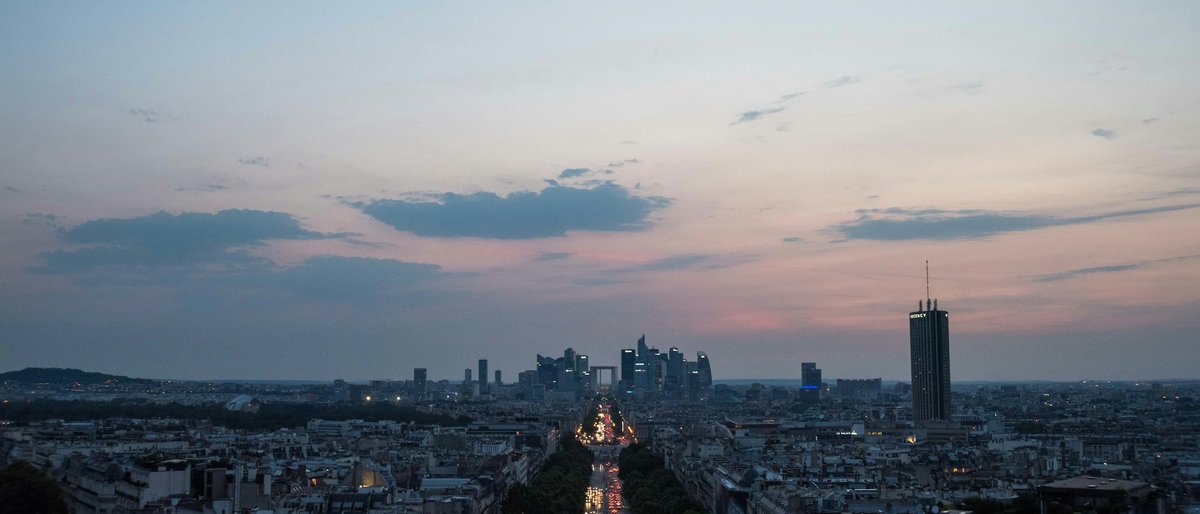
Paris sits in a broad, shallow basin carved by the Seine, and the geography tends to surprise people who only picture cobblestones and café terraces. The city itself is remarkably flat: you'll barely notice 30 meters of elevation change walking from the river up to Montmartre, but the Île-de-France region surrounding it rolls into proper forested hills, sandstone gorges, and river valleys within an hour's train ride. The climate is maritime-continental, which in practice means mild but fickle. Summers hover around 25°C with occasional heat spikes into the mid-30s, and winters are grey and damp rather than cold. Spring and early autumn are the sweet spots for outdoor activity: comfortable temperatures, longer daylight, and the parks at their best. What catches most visitors off guard is how much green space Paris contains: over 400 parks and gardens, plus the two massive bois on the city's flanks. And then there's Fontainebleau, arguably the best bouldering destination in Europe, sitting less than an hour south by train. You don't come to Paris thinking 'outdoor adventure,' but the options are solid once you know where to look.
Outdoor activities
-
Bouldering at Fontainebleau
Fontainebleau forest contains thousands of sandstone boulders scattered across sandy ground, with established circuits marked by colored arrows according to difficulty. The rock has a distinctive gritty texture that eats shoe rubber but offers superb friction when dry. You'll share the forest with trail runners, horse riders, and families picnicking: it never feels like a climbing gym transplanted outdoors. The circuits range from beginner-friendly yellow and orange routes to brutal red and black problems that attract climbers from across Europe. Bas Cuvier, Franchard Isatis, and Rocher Canon are among the most popular sectors, each with a different character. The sand underfoot means crash pads aren't strictly necessary on easier problems, though most people bring them.
- Difficulty
- Beginner to expert depending on circuit color
- Duration
- Full day recommended: you'll lose track of time
- Best season
- Autumn and spring, when friction is best and temperatures are moderate. Summer can be too humid; winter works on dry, cold days.
-
Cycling the Seine à Vélo
The Seine à Vélo route follows the river from Paris toward the Normandy coast, but even the first 40-50 km stretch out through the western suburbs and into the Yvelines countryside makes a solid day ride. The path is largely flat and follows dedicated cycling lanes and quiet towpaths. You'll pass through Bougival, where the Impressionists painted, and Conflans-Sainte-Honorine, a barge town where the Seine meets the Oise. The surface alternates between paved bike lane and packed gravel. Vélib' bikes work for pottering along the Seine within Paris itself, but for anything beyond the Périphérique you'll want a proper road or gravel bike: rental shops near Bastille and the Marais can sort you out.
- Difficulty
- Easy to moderate, mostly flat
- Duration
- 3-6 hours for a 40-60 km out-and-back
- Best season
- April through October. Midsummer can be hot on exposed stretches.
-
Trail Running in Bois de Vincennes
The eastern lung of Paris covers roughly 995 hectares, and the trail network through it is dense enough that you can string together a 15-20 km loop without repeating yourself. The terrain is mostly flat with soft dirt paths winding through oak and chestnut woodland, around Lac Daumesnil and Lac des Minimes. The footing gets muddy after rain (properly boggy in places during winter) so trail shoes with some grip are worth it. Early morning on weekdays the bois is quiet enough that you might hear woodpeckers. Weekends bring crowds near the lake but the deeper paths stay relatively empty.
- Difficulty
- Easy: flat with soft surfaces
- Duration
- 1-2 hours for a good 10-20 km session
- Best season
- Year-round, though spring mornings are good. Avoid midday in July and August.
-
Road Cycling in Vallée de Chevreuse
The Haute Vallée de Chevreuse regional natural park sits about 30 km southwest of Paris and offers rolling terrain through farming villages and forest. You can reach the start by RER B to Saint-Rémy-lès-Chevreuse and ride from there. The roads are quiet, well-surfaced, and wind through the Yvette valley with enough short climbs to keep things interesting without being punishing. A popular loop takes in Dampierre-en-Yvelines, Cernay-la-Ville, and the Cascades de Cernay. Local cycling clubs use these roads heavily on weekends, which means drivers are generally accustomed to sharing.
- Difficulty
- Moderate: rolling hills with some punchy climbs
- Duration
- 3-5 hours for a 60-80 km loop
- Best season
- March through November. The autumn colors through the valley are worth timing a ride around.
-
Rock Climbing at Rocher de la Dame Jouanne
If Fontainebleau's bouldering doesn't scratch the itch and you want something taller, Dame Jouanne in the Forêt des Trois Pignons offers some of the tallest standalone boulders in the forest: the main rock is about 15 meters high with established routes. The area is part of the broader Fontainebleau system but has a different feel: more remote, fewer people, and the three-hills landscape gives a sense of space you don't get at the more popular sectors. Access is a short walk from the D16 road. This is a spot where a crash pad and a spotter are non-negotiable on anything above the easy circuits.
- Difficulty
- Moderate to advanced: the height factor is real
- Duration
- Half to full day
- Best season
- October through April for best conditions. Avoid after heavy rain: the sandstone weakens when saturated.
Day hikes
-
GR 1 Loop through Fontainebleau Forest
The GR 1 long-distance trail passes through Fontainebleau forest, and you can pick up a section from Fontainebleau or Bois-le-Roi station for a satisfying day hike. A popular loop from Fontainebleau-Avon station takes in the Gorges d'Apremont: a landscape of tumbled sandstone boulders, heather, and birch that looks more like it belongs in the Scottish Highlands than 60 km from Paris. The sandy trails wind through boulder fields and pine forest, with occasional viewpoints over the canopy. Footing can be tricky on the loose sand and rock. Bring more water than you think you need: there's no reliable source on the trail and the sand reflects heat in summer. The Transilien R train from Gare de Lyon gets you there in about 40 minutes.
- Difficulty
- Easy to moderate: sandy and uneven terrain but minimal elevation gain
- Duration
- 4-6 hours for a 12-18 km loop
- Best season
- Spring and autumn. Summer is doable but hot and dry; the sand amplifies the heat.
-
Forêt de Rambouillet Circuit from Saint-Léger-en-Yvelines
Rambouillet forest is less famous than Fontainebleau but arguably more pleasant for a quiet walk. The forest is heavily wooded with oak, beech, and pine, and the trail network is well-marked with local PR (Promenade et Randonnée) routes. A circuit from Saint-Léger-en-Yvelines passes through Étang de la Porte Baudet and several other forest ponds, which are atmospheric on a misty morning. You might spot deer: the forest has a significant population. The Transilien N line from Gare Montparnasse to Rambouillet takes about 35 minutes, and local buses or a short taxi gets you to trailheads. The terrain is gently rolling and the paths are well-maintained.
- Difficulty
- Easy: well-maintained forest paths with gentle terrain
- Duration
- 3-5 hours for a 10-15 km loop
- Best season
- Year-round. Autumn is spectacular for color; spring for wildflowers and birdsong.
-
Gorges de Franchard Loop, Fontainebleau
A shorter, more focused hike than the full GR 1 section, the Franchard gorges trail starts from the Franchard car park (reachable by bike from Fontainebleau town if you don't have a car) and loops through a dramatic landscape of sandstone chaos: huge boulders piled on each other, narrow passages, and sandy clearings. The circuit is marked and well-trodden. Some sections involve light scrambling over rock, nothing exposed but you'll want your hands free. The hermitage ruins partway around add a historical layer. This is the kind of hike where you stop every few minutes because the rock formations keep changing character.
- Difficulty
- Easy to moderate: some scrambling sections, sandy footing
- Duration
- 2-3 hours for the main 7-8 km loop
- Best season
- March through November. The gorges hold moisture, so they can be slippery in winter.
-
Vallée de la Bièvre from Igny to Jouy-en-Josas
The Bièvre is a small river that once flowed through Paris: it's now covered within the city, but upstream in the southern suburbs it still runs through a green valley. A walking route from Igny (RER C) follows the river south through meadows and light woodland to Jouy-en-Josas (RER C), where you can catch a train back. The trail is flat and follows the riverbank closely, passing old wash-houses and small weirs. It's more of a gentle ramble than a proper hike, but the valley feels surprisingly rural for being this close to Paris. The Musée de la Toile de Jouy at the end is worth a look if it's open.
- Difficulty
- Easy: flat riverside path, suitable for families
- Duration
- 2-3 hours for roughly 8 km one-way
- Best season
- Spring through early autumn. The path can flood in winter after heavy rain.
-
Forêt de Montmorency from Montmorency or Domont
North of Paris, the Montmorency forest is the closest significant woodland to the city center: accessible by Transilien H from Gare du Nord. The forest sits on a ridge and the trails have more elevation variation than you'd expect, with some decent viewpoints toward Paris on clear days. Chestnut trees dominate, and in autumn the forest floor is thick with fallen chestnuts and golden leaves. The main circuits are 8-14 km and well-marked. The town of Montmorency itself has some historical charm: Rousseau lived here, and there's a small museum. Less polished than Fontainebleau, which is part of the appeal.
- Difficulty
- Easy to moderate: some hilly sections on the ridge trails
- Duration
- 3-4 hours for a 10-14 km circuit
- Best season
- Autumn for the chestnut forest color. Spring is also good. Can be muddy in winter.
Water activities
-
Kayaking on the Marne
The Marne river east of Paris flows through a gentler, more bucolic landscape than the Seine, and several outfitters near Joinville-le-Pont and Nogent-sur-Marne rent kayaks and canoes for half-day or full-day paddles. The current is mild and the river winds past guinguettes (riverside dance halls that still operate in summer), wooded islands, and old rowing clubs. The stretch between Joinville and Champigny-sur-Marne is pleasant: wide enough to feel spacious, narrow enough that you're close to the banks. Water quality has improved significantly in recent years. You'll share the river with rowers, a few motorboats, and the occasional swan family.
- Difficulty
- Easy: calm water, suitable for beginners
- Duration
- 2-4 hours for a half-day paddle
- Best season
- May through September. The guinguettes along the banks are open in summer, which adds to the atmosphere.
-
Swimming at Bassin de la Villette
The Bassin de la Villette in the 19th arrondissement opened designated swimming areas in 2017, making it one of the few places you can legally swim outdoors in central Paris. The swimming zone operates in summer (typically July and August) with lifeguards, water quality monitoring, and three pools of different depths including a children's area. The water is filtered canal water: clean but not exactly the Mediterranean. The surrounding quays fill up with sunbathers, and the bars and restaurants along the canal are right there. It gets crowded on hot days, but the atmosphere is festive rather than stressful.
- Difficulty
- Easy: supervised swimming area
- Duration
- As long as you like during opening hours
- Best season
- July and August only, when the swimming zones are staffed and open.
-
Rowing and Sculling on the Seine
Paris has a long rowing tradition, and several clubs along the Seine accept temporary members or offer introductory sessions. The Société Nautique de la Basse Seine in Courbevoie and clubs near the Île de la Jatte are good starting points. The Seine's current is manageable for experienced rowers, though motorboat wake can be choppy. If competitive rowing isn't your thing, the rowboat rentals at Lac Inférieur in the Bois de Boulogne and Lac Daumesnil in the Bois de Vincennes are more casual: wooden boats, no experience needed, and a peaceful hour on the water with ducks and overhanging willows.
- Difficulty
- Varies: casual lake rowing is easy; Seine sculling requires experience
- Duration
- 1-2 hours
- Best season
- April through October. The lake rentals typically operate from spring through early autumn.
-
Canoeing the Loing River near Moret-sur-Loing
About an hour south of Paris by Transilien R, Moret-sur-Loing is a small medieval town where the Loing river offers calm, scenic paddling. Local outfitters rent canoes and kayaks for downstream trips that pass under stone bridges, along willow-lined banks, and through landscapes that Sisley and other Impressionists painted. The river is shallow and slow: you'll drag bottom in a few spots during dry summers, but otherwise the paddling is straightforward. The town itself is worth wandering afterward: fortified gates, a church with stained glass, and a few restaurants along the river where you can eat outside and watch the water.
- Difficulty
- Easy: slow, shallow river suitable for all levels
- Duration
- 2-4 hours for a typical downstream section
- Best season
- May through September. Water levels drop in late summer but remain paddleable.
Parks & gardens
-
Jardin du Luxembourg
FreeThe Luco, as Parisians sometimes call it, occupies 23 hectares on the Left Bank and manages to feel both formal and lived-in. The French garden section is all geometric gravel paths and clipped hedges radiating from the central octagonal basin, where kids still push model sailboats with sticks. The English garden on the south side is looser, with sloping lawns and mature chestnut trees that throw heavy shade in summer. The Medici Fountain, tucked into a shaded corner with a long reflecting pool, is one of the coolest spots in the city on a hot day: temperature-wise and otherwise. The orchard section grows heritage apple and pear varieties, a leftover from the park's Napoleonic era.
Highlights: Medici Fountain, model sailboats on the basin, heritage orchard, free outdoor chairs that everyone drags into the sun
-
Parc des Buttes-Chaumont
FreeBuilt on a former gypsum quarry in the 19th arrondissement, Buttes-Chaumont has a wild, hilly character that feels nothing like the manicured gardens elsewhere in Paris. The park wraps around a central rocky island topped by the Temple de la Sibylle, connected by a suspension bridge that sways just enough to make you think about it. The slopes are steep: you'll feel your calves on the paths winding up from the lake. The grotto with its artificial stalactites and waterfall is over-the-top in the best possible way. Local families, joggers, and picnickers colonize the lawns on warm evenings. The Rosa Bonheur guinguette inside the park does drinks and dancing on summer nights.
Highlights: Temple de la Sibylle on the island, suspension bridge, the grotto waterfall, Rosa Bonheur bar, steep terrain for a city park
-
Bois de Boulogne
FreeParis's western forest covers over 800 hectares and contains enough variety that you could spend a full day and still miss sections. The Bagatelle garden within it is worth the small entry fee for its rose collection: over a thousand varieties in bloom from late May through September. The two lakes, Lac Supérieur and Lac Inférieur, have rowboat rentals that feel charmingly old-fashioned. Longchamp racecourse sits at the southern end, and the Fondation Louis Vuitton building by Frank Gehry rises from the trees like a glass sailing ship. The northern section around the Jardin d'Acclimatation is family territory; the deeper southern paths through old-growth trees are quieter and wilder.
Highlights: Bagatelle rose garden, rowboats on the lakes, mix of formal gardens and genuine woodland, Fondation Louis Vuitton
-
Jardin des Tuileries
FreeStretched between the Louvre and Place de la Concorde, the Tuileries is Paris's most central park and carries the energy of the city through it. The gravel paths can feel crowded around the main axis, but the side alleys under the chestnut rows are quieter, with those green metal chairs that you can drag wherever you like. The two round ponds at either end attract a mix of tourists and office workers at lunch. In summer, a small fairground sets up along the Rue de Rivoli side with a Ferris wheel that gives a surprisingly good view down the Champs-Élysées. The Musée de l'Orangerie sits at the western corner: Monet's water lilies are inside, which feels appropriate given the garden context.
Highlights: Green metal chairs, chestnut-lined alleys, round ponds, Orangerie museum, summer fairground
-
Coulée Verte René-Dumont (Promenade Plantée)
FreeAn elevated linear park built on a disused railway viaduct in the 12th arrondissement, and yes, this is the one that inspired New York's High Line, not the other way around. The walkway runs about 4.5 km from Bastille toward the Bois de Vincennes, starting on top of the Viaduc des Arts (the arches below house artisan workshops) and eventually descending to ground level through a tree-lined cutting. The elevated section gives you an unusual rooftop-level perspective on the neighborhood: you're looking into apartment windows and over courtyard gardens. The planting is lush: wisteria, roses, bamboo, and ornamental grasses depending on the section.
Highlights: Elevated walkway above the 12th, Viaduc des Arts artisan shops below, wisteria tunnels in spring, the original High Line
-
Parc Montsouris
FreeA 15-hectare English-style park in the 14th arrondissement that rarely appears on tourist itineraries, which is part of its appeal. The large lake in the center attracts herons and cormorants: somewhat startling birdwatching for the middle of a city. The lawns slope gently and the mature trees include some old cedars and sequoias. The RER B station Cité Universitaire is right at the southern edge, making it easy to reach. The surrounding streets have a calm, almost suburban feel. On warm afternoons the park fills with students from the nearby Cité Internationale Universitaire, giving it a relaxed, young energy.
Highlights: Heron-watching at the lake, mature cedars and sequoias, calm atmosphere away from tourist circuits, sloping lawns
Practical tips
- Footwear
- For Fontainebleau and the regional forests, trail shoes with decent grip are worth bringing: the sandy terrain is deceptive, and rock sections get slippery when damp. For Paris parks and paved towpaths, any comfortable walking shoe works fine. The sandy trails around Fontainebleau will fill low-cut shoes with grit, so mid-height trail runners or light boots are ideal.
- Sun protection
- Paris summers can spike above 35°C, and shade is inconsistent on open trails. Carry sunscreen, a hat, and at least 1.5 liters of water per person for any hike over two hours. The sandstone areas around Fontainebleau amplify heat: it can feel 5-10 degrees warmer in the boulder fields than in the shade of the forest. Water fountains in Paris parks (the green Wallace fountains) provide free drinking water, but trail sources outside the city are unreliable.
- Transport to trails
- Almost every worthwhile outdoor destination near Paris is reachable by public transport: Transilien trains from the main stations (Gare de Lyon for Fontainebleau, Montparnasse for Rambouillet and Chevreuse, Gare du Nord for Montmorency). A Navigo Toutes Zones pass covers most of these journeys. Check train schedules carefully on weekends and holidays, as frequency drops. Some trailheads require a short walk or bus connection from the station: apps like Citymapper handle the Île-de-France network well.
- Hydration
- The green Wallace fountains scattered throughout Paris dispense potable water and are useful for refilling bottles during city walks or runs. Outside the city, carry everything you need: the forests around Fontainebleau and Rambouillet have no reliable water sources on trail. In summer, freeze a bottle overnight and carry it as backup. Pharmacies everywhere sell electrolyte sachets (look for Hydratis or similar) which help on hot days.
- Best times to go
- The outdoor sweet spot for Paris is mid-April through mid-June and September through mid-October. July and August work but bring heat and crowds. The forests are at their best in October when the deciduous canopy turns. Winter hiking is possible (the forests stay accessible) but expect mud, short daylight, and temperatures around 2-8°C. Spring wildflowers in Chevreuse valley and Rambouillet forest peak in April and May.
- Bouldering gear
- At minimum, bring climbing shoes and a crash pad. Pads can be rented in Fontainebleau town if you're traveling light. A guidebook or the app 27 Crags helps navigate the circuit system: the painted arrows on rocks are clear once you understand the color grading but confusing at first. Brush loose sand off holds before pulling on them. The sandstone is soft when wet, so avoid climbing after rain to protect both the rock and yourself.
FAQ
Can you swim in the Seine river in Paris?
As of recent years, designated swimming areas have opened at Bassin de la Villette (a canal basin, technically) during summer months with lifeguard supervision and water quality testing. The Seine itself has historically been off-limits for swimming due to water quality, though Paris has invested heavily in cleanup: the 2024 Olympics included Seine swimming events. For reliable, supervised outdoor swimming, the Bassin de la Villette in July and August is currently your best bet within the city.
How do I get to Fontainebleau forest from Paris without a car?
Take the Transilien R line from Gare de Lyon to Fontainebleau-Avon station: the journey takes about 40 minutes. From the station, local bus line 1 runs to the town center, or you can walk about 20 minutes to reach the forest edge. For specific bouldering sectors like Bas Cuvier, the walk from the station is around 30 minutes. On weekends the train runs less frequently, so check schedules on the SNCF app or Citymapper before heading out.
Are Paris parks safe for running early in the morning?
Generally yes, with common sense. The Bois de Boulogne and Bois de Vincennes are both popular with runners and have active running clubs using them from dawn. Stick to main paths if you're running before sunrise, in the Bois de Boulogne which has a complicated reputation after dark, though the running community uses it heavily and early morning is fine. Parks like Luxembourg, Montsouris, and Buttes-Chaumont open at fixed hours (typically 7:30 or 8:00 AM, earlier in summer) so check seasonal schedules.
What difficulty level are the hiking trails near Paris?
Most trails within an hour of Paris are easy to moderate. The terrain is generally flat to gently rolling, with the main challenges being sandy or uneven footing (Fontainebleau), mud after rain (everywhere in winter), and distance rather than elevation. The Gorges d'Apremont and Franchard in Fontainebleau involve some light scrambling over sandstone, but nothing exposed or technical. Families with children over about 6 can handle most of the marked circuits comfortably. If you want genuine difficulty, the longer GR trail sections through Fontainebleau can be extended to 25+ km.
Do I need any permits for outdoor activities around Paris?
For hiking, cycling, and casual kayaking on public waterways, no permits are required. The forests are publicly accessible: Fontainebleau, Rambouillet, and Montmorency are all managed by the ONF (Office National des Forêts) and open to walkers and climbers. Bouldering at Fontainebleau is free and requires no permit. For swimming, stick to designated supervised areas. If you want to fish, you'll need a fishing permit (carte de pêche) which can be purchased online through the local fishing federation.
Is it worth renting a bike in Paris for outdoor exploration?
Vélib' (the city bike-share) works well for riding along the Seine quays and through parks within Paris: the electric-assist bikes handle the few hills easily. For anything beyond the city limits, like the Chevreuse valley or the Seine à Vélo route, you'll want a proper road or gravel bike from a rental shop. Several shops near Bastille and in the Marais rent quality bikes by the day. Bring your own helmet: Vélib' doesn't provide them, and rental shops usually include them. The cycling infrastructure within Paris has expanded dramatically in recent years, with protected lanes on most major routes.
Outdoor experiences in Paris
 Free cancellation
 Eiffel Tower Guided Tour by Stairs Optional Top floor by Elevator
Outdoor experience: 1.5 hours, free cancellation.
via Viator Free cancellation
 Versailles Full-Day Electric Bike Tour : Market, Picnic & Palace
Outdoor experience: 8 hours, free cancellation.
via Viator Free cancellation
 Paris: Small Group Highlights E-Bike Guided Tour
Outdoor experience: 2.5 hours, free cancellation.
via Viator Free cancellation
 Segway tour Paris
Outdoor experience: 2.5 hours, free cancellation.
via Viator Free cancellation
 Paris: Experience Segway Top Highlights Small Group 2 Hours
Outdoor experience: 1.5 hours, free cancellation.
via Viator Free cancellation
 Paris: Private Vintage Sidecar Tour with Pick-Up at your Hotel
Outdoor experience: 1.5 hours, free cancellation.
via Viator Free cancellation
 Paris - Segway Tour 120 min
Outdoor experience: 2 hours, free cancellation.
via Viator Free cancellation
 Eiffel Tower Tour by Stairs with Optional Summit by Lift
Outdoor experience: 2 hours, free cancellation.
via Viator Free cancellation
 Private ride in a Citroën 2CV in Paris - 2h
Outdoor experience: 2 hours, free cancellation.
via ViatorLast verified by automated review (v1.7.1) on . What is automated review?